Category Archives: Travel

The C. Crane CC Skywave SSB: first production run review

[IMPORTANT UPDATE (October 21, 2018): Please note that C. Crane have addressed issues that I found in the first production run of the CC Skywave SSB. Click here to read the update and click here to read my full review of the CC Skywave SSB.]

Just last month, the little radio that I found most exciting this year hit the market: the C. Crane CC Skywave SSB.

Why the appeal for me?  Frankly, since I do most of my portable radio listening while traveling, and since I typically travel out of one bag, having a compact radio with performance and features is an absolute must in my world.  Up to this point, the original CC Skywave is the radio I often choose when traveling, as it packs so many useful features: AM, FM, Shortwave, AIR band, Weather Radio, and like any good travel radio, clock, alarm, and sleep functions, lacking only SSB mode.  So it goes without saying that I was excited to see its newest edition.

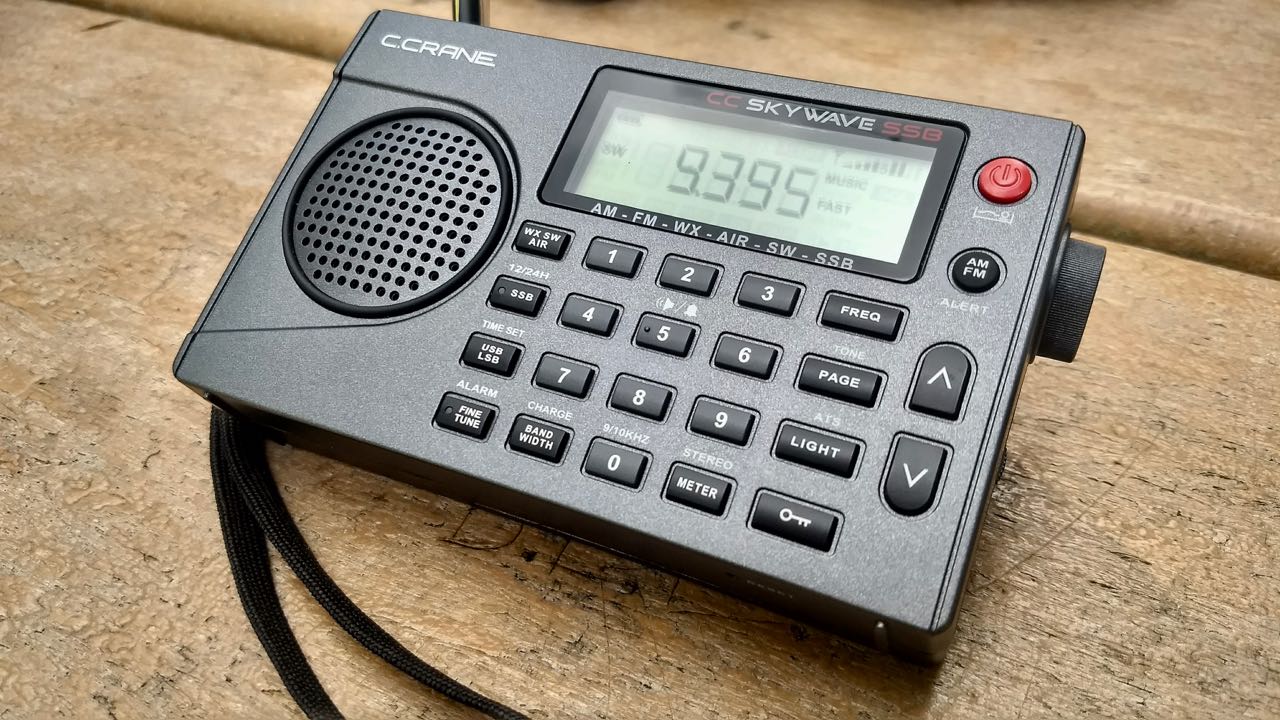
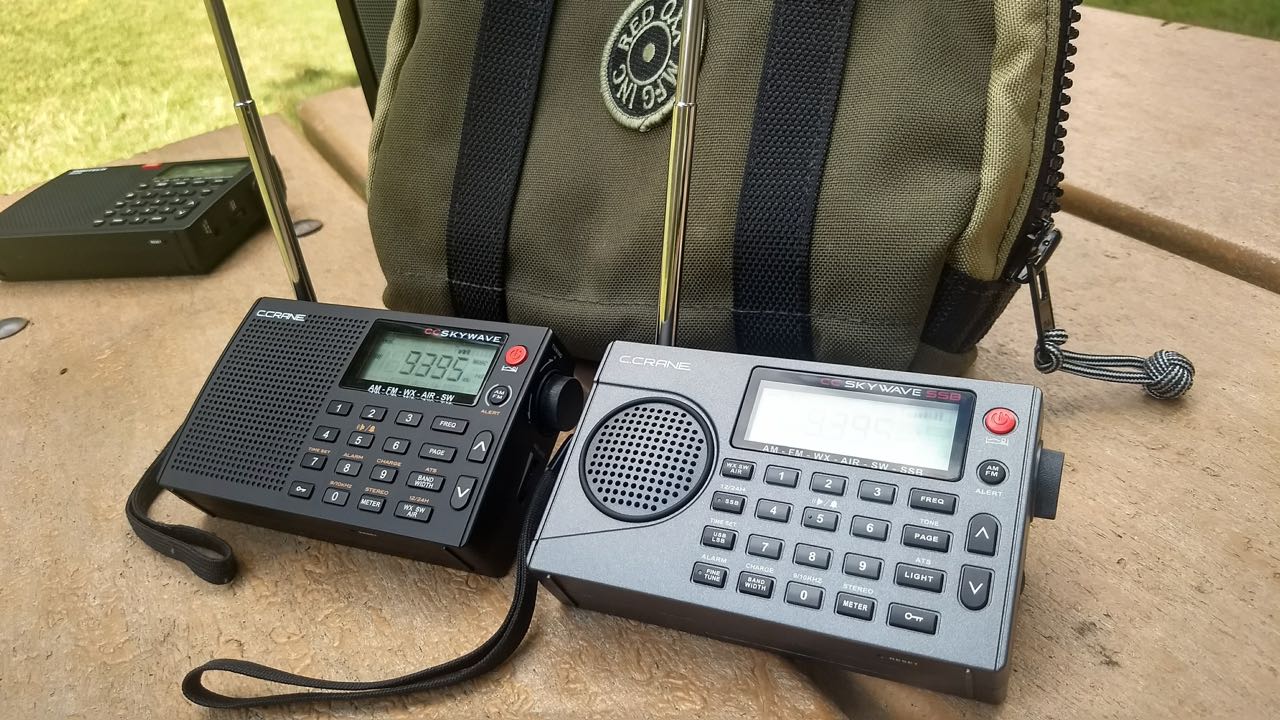
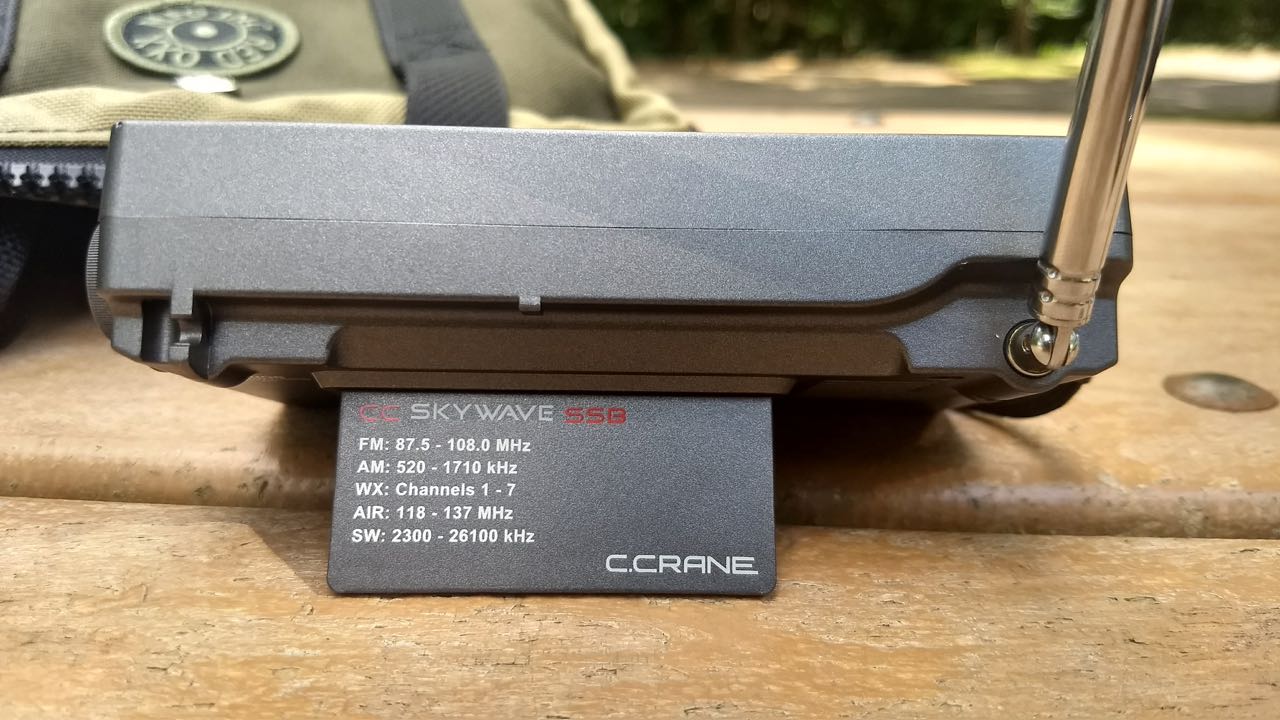
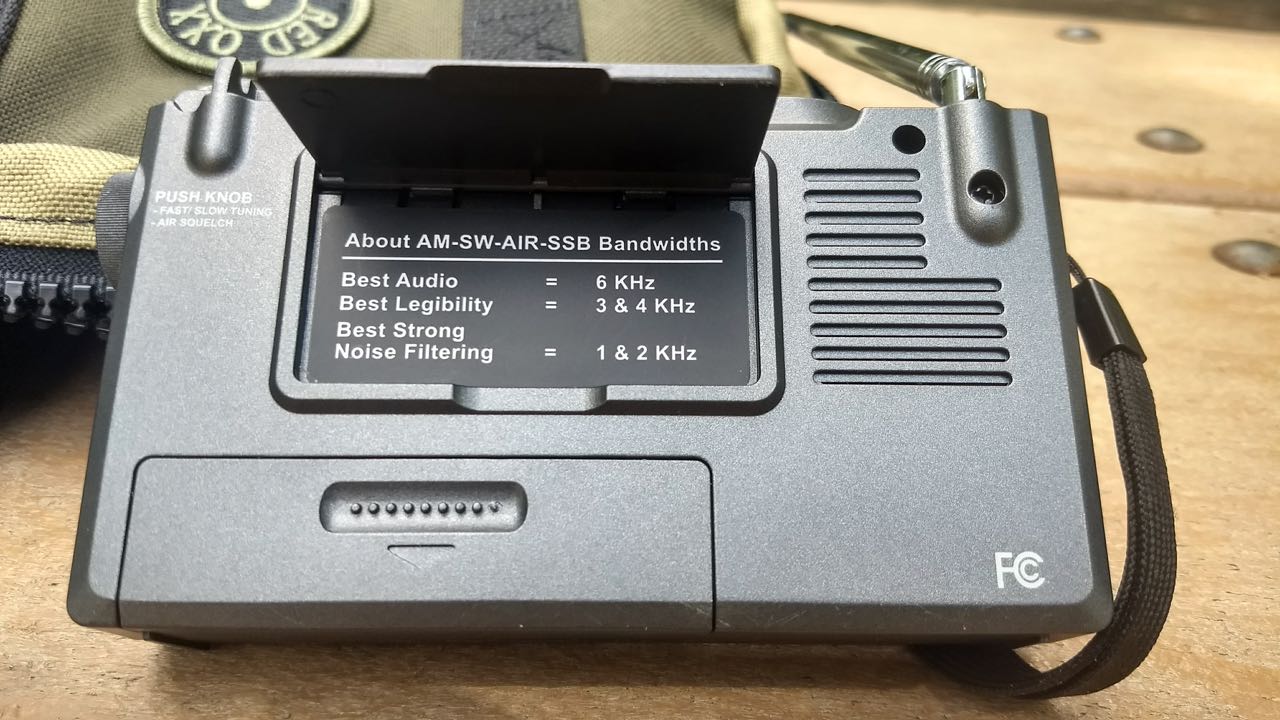
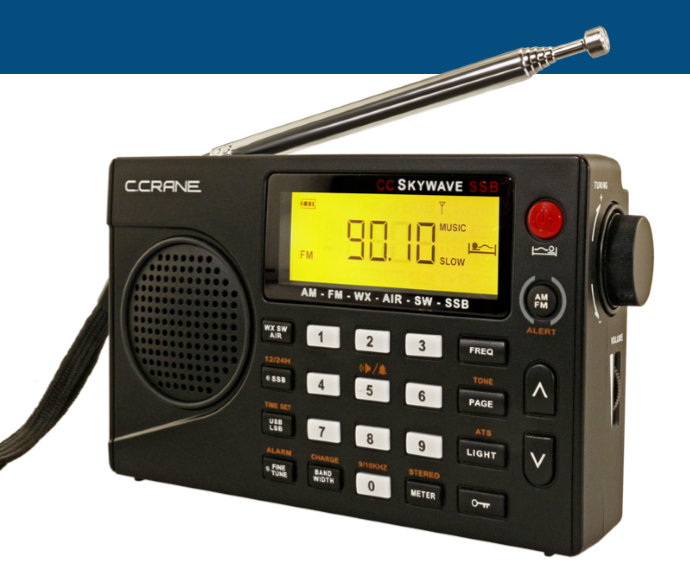
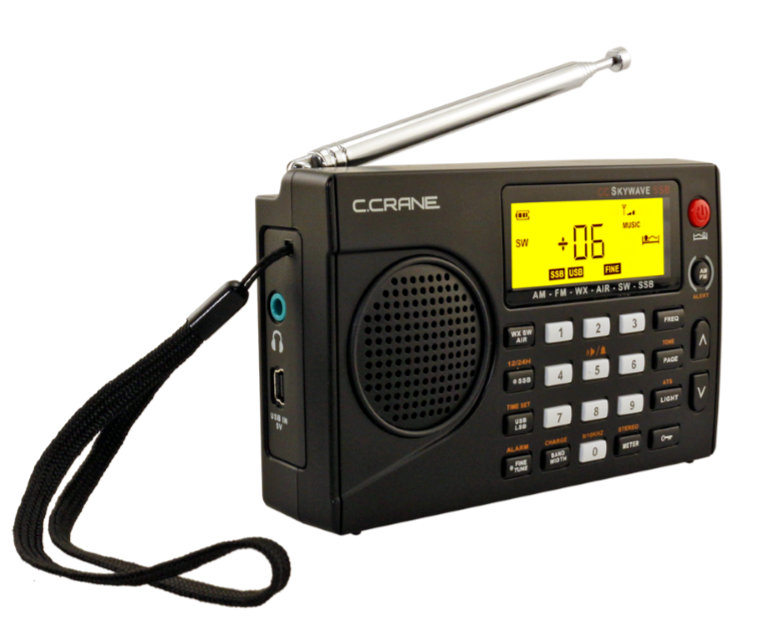
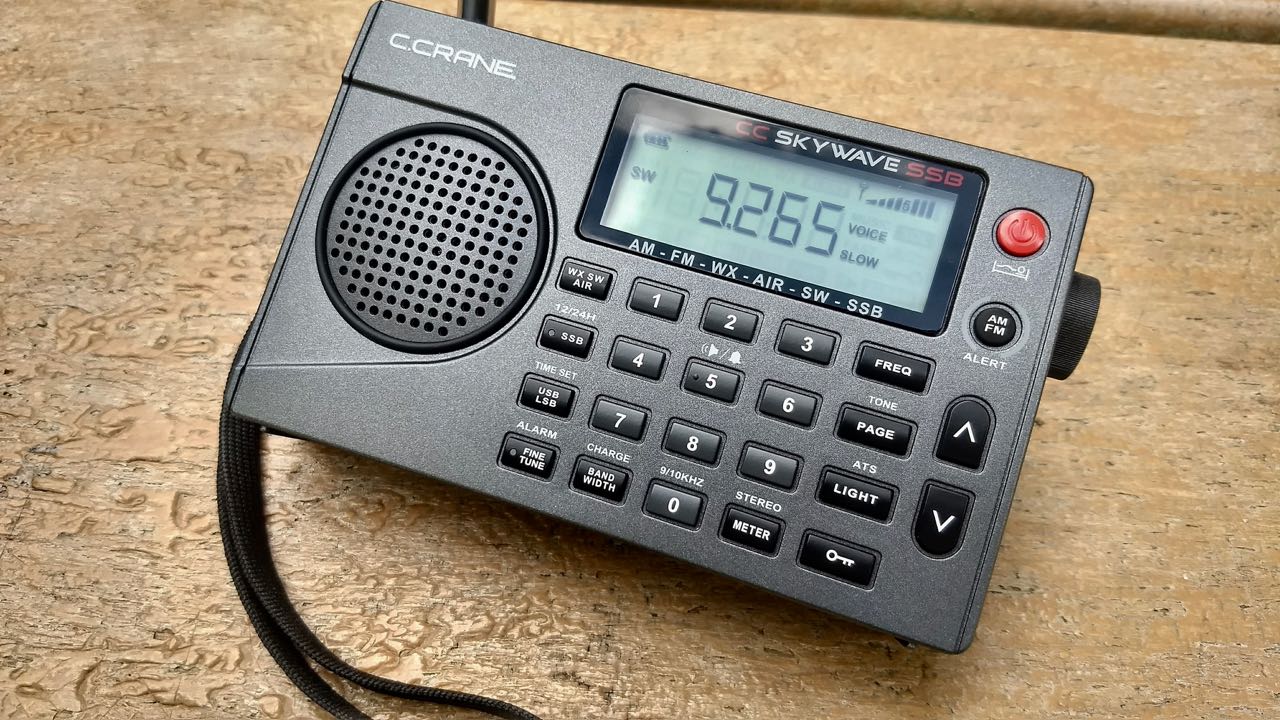
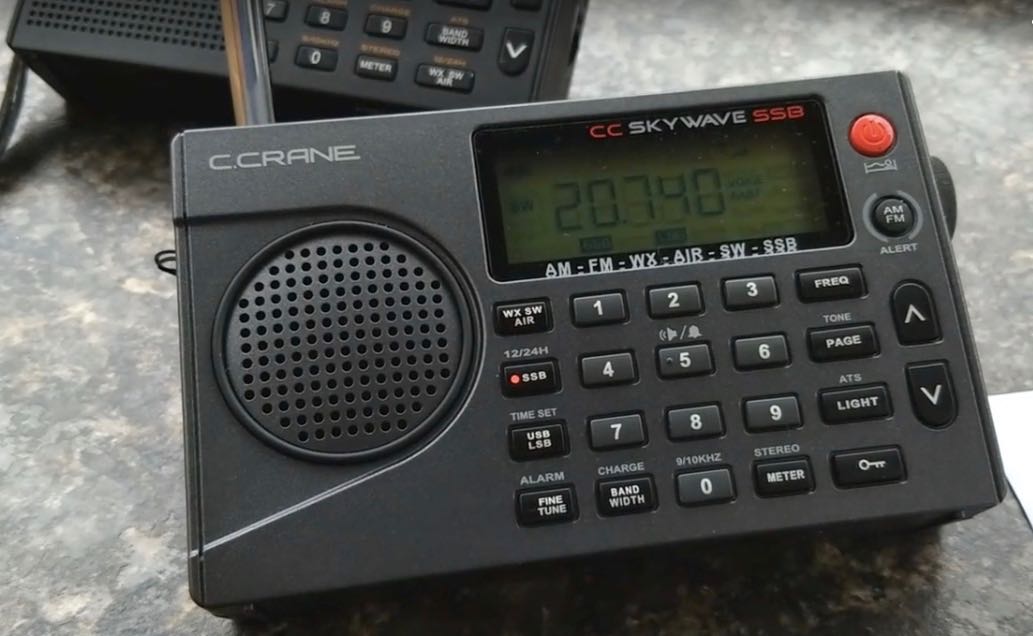
The CC Skywave SSB

What follows is an account of my experience evaluating CC Skywave SSB production units, and a brief summary of their performance.

My hope is that this summary review will help readers with purchase decisions. Note that this is merely preliminary to an extensive, unabridged review that will appear in a future issue of The Spectrum Monitor magazine, then in the SWLing Post the following month.

Pre-production Skywave SSB
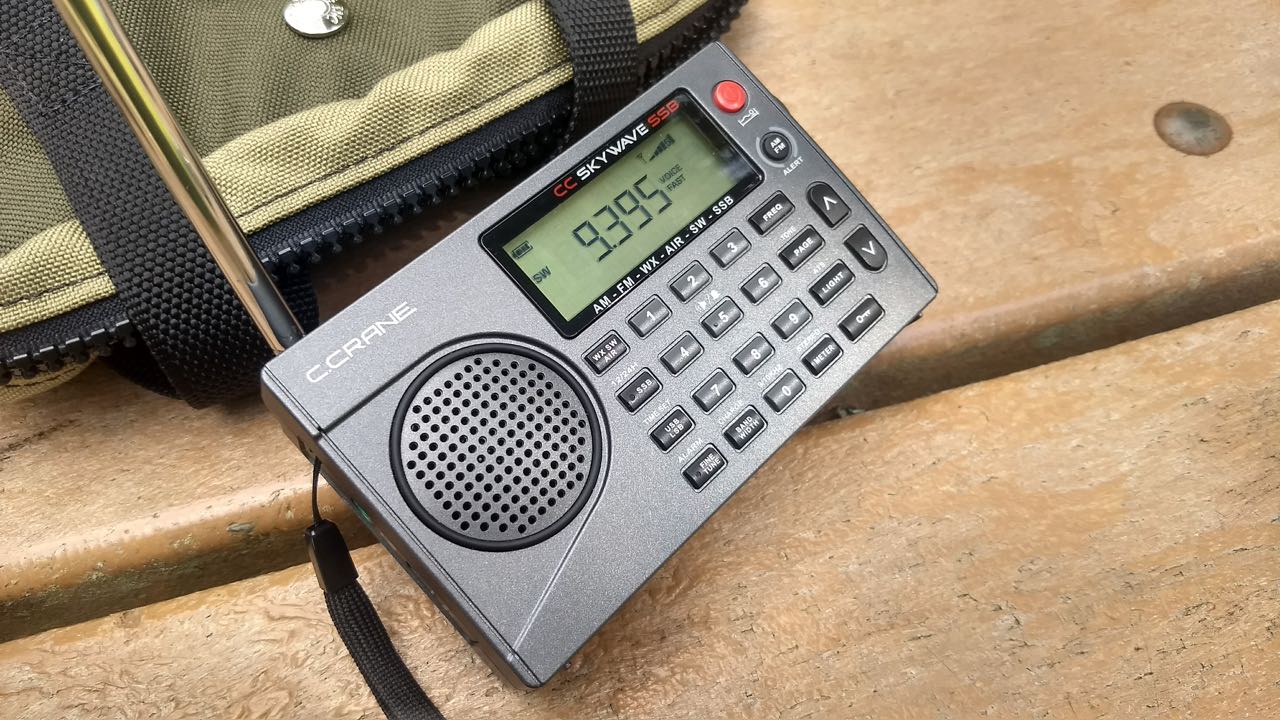
As many readers know, I was sent a pre-production model of the Skywave SSB for evaluation this summer.

As I mentioned in my sneak peek and reiterated to a number of inquisitive readers: I never base a product review or comment upon pre-production radios. I don’t comment about the performance of the pre-production model for an obvious reason: pre-production radios are quite simply not the versions that ship to customers upon the product release.

Now that the production model has been in the wild for a few weeks, I feel more at liberty to talk about my experience with the pre-production Skywave SSB.

In short: I have been very pleased, indeed, with the pre-production model’s performance. In terms of features, it is a nice incremental upgrade from the original Skywave. In terms of performance, it’s also tweaked in the right direction. As an early adopter of the original Skywave, I’ve been truly enthusiastic about this evaluation pre-production model.

All the notes I took while evaluating the pre-production Skywave SSB were made for C. Crane so they could hopefully implement any changes or address concerns prior to starting the first production run. But the truth is, I found the pre-production model in my possession to be quite solid, so my suggestions were minor.

Putting my pre-production model aside, I ordered an actual production unit on C. Crane’s website just like everyone else.

C. Crane kindly dispatched my unit as soon as they received the first production batch from the factory so I could get to work on the full review.

Quirks with the first production units
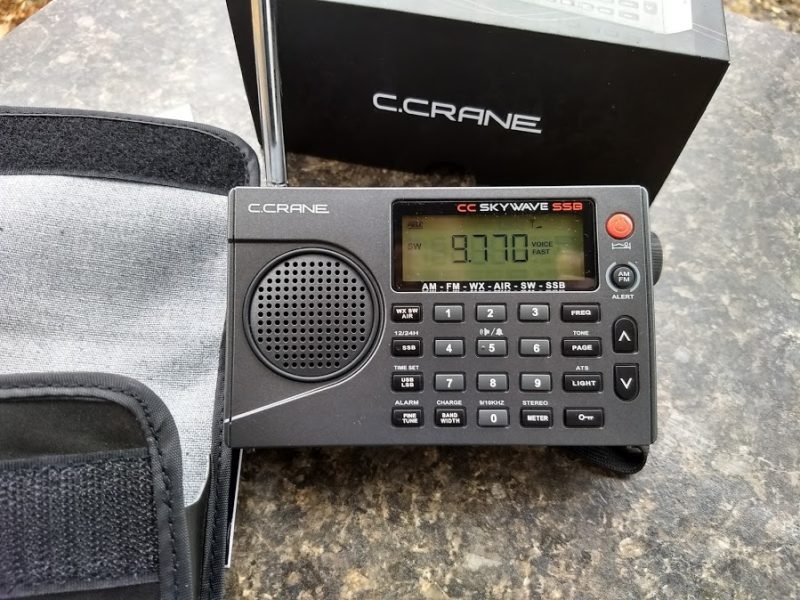
I was eager to get started on the review of the Skywave SSB, so as soon as I received it, I did what I always do: compared it with other radios.

I make my comparisons, by the way,  at least fifty yards from my house to separate the radios from any inadvertent sources of local noise.

Production Radio #1

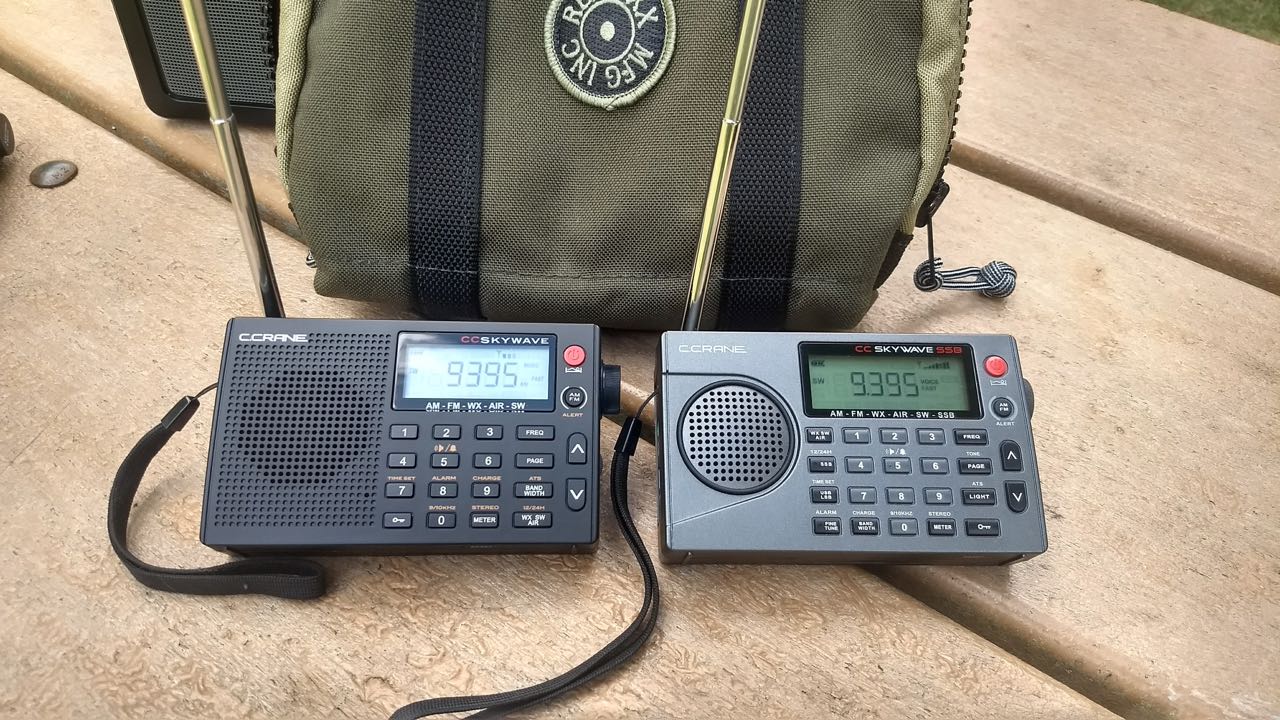
My first comparison was with the Digitech AR-1780 and the original CC Skywave. I quickly noted that the Skywave SSB was very slightly less sensitive than the other radios. I had tested the pre-production unit enough to know that the Skywave SSB’s performance should at least be on par with the original Skywave.

Upon careful listening, I discovered the production unit had a very faint, internally-generated whine on some of the shortwave bands; when tuned to marginal signals, this whine manifested itself as variable background noise. Between signals it was audible as a faint background whine, hardly noticeable. With that said, the whine was most notable while tuning––since the Skywave SSB mutes between frequency changes, the whine was most conspicuous during audio recovery.

The pre-production unit had no trace of an internally-generated whine. Audio was very clean in comparison.

Here’s a sample of the first production radio being tuned down from 10,000 kHz in 5 kHz tuning steps:

Here’s a sample from the pre-production unit:

Hear the whine in the first sample? Yes, so do I.

I contacted C. Crane promptly, and to their credit, they immediately dispatched another unit from inventory, via UPS Next Day,  along with a return label to send my faulty unit back to their engineering team.

Production Radio #2

The second unit arrived while I was on Thanksgiving vacation, but was sent to me directly at my hotel.  The day I received the replacement Skywave SSB, I put it on the air. The first listening session with it, alone, revealed that this unit did not have the internally-generated whine, however, this unit had issues with sensitivity. All of my comparison receivers were outperforming this Skywave SSB on the shortwave broadcast bands. When I compared it with the pre-production Skywave SSB unit and the first production unit, the second production unit was about four to five S-units less sensitive. Odd.

I sent both production radios back to C. Crane with detailed notes and sample recordings. Their engineering team confirmed my findings and started looking into the variations in QC and double-checking their inventory to make sure none shipped with these problems.

Production Radio #3

A few days later, I was sent a third production unit. After putting it on the air, I immediately noticed the same faint noise characteristics of my first full production unit, which is to say, the notorious whine.

Once again, I contacted C. Crane.  This time, I requested that no less than three radios be sent to me, and they kindly expedite the request.

Production Radios #4, #5, and #6
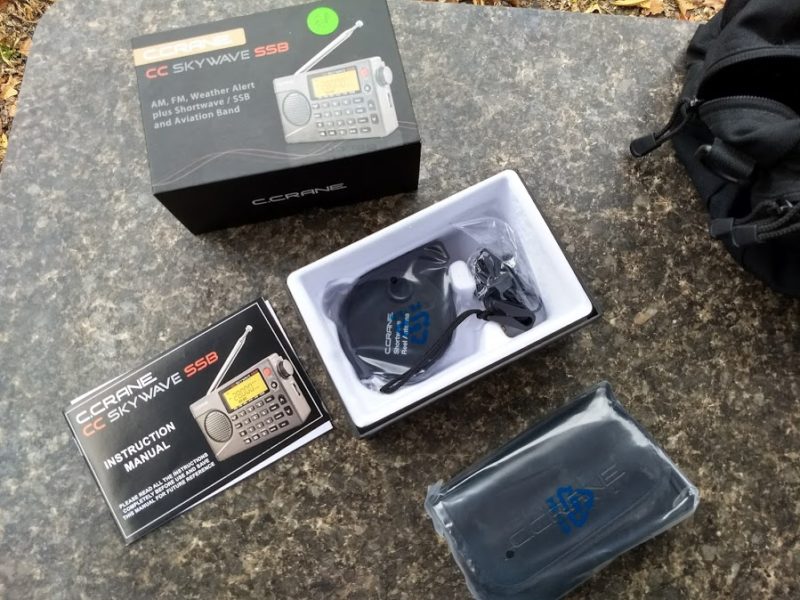
Yesterday, I tested all three radios. What follows is a quick assessment of those radios:

Performance

In a nutshell, the three production units I tested yesterday performed better than my second and third production radios on all bands. Strictly in terms of sensitivity, these were on par with the pre-production unit.  Very good.

But with that said, even the last three production units I received had internally-generated noises that I couldn’t help but notice. Disappointing.

At this point, I must assume these noises are prevalent throughout the first production run since all but one of the six CC Skywave SSB production units I tested have it. Meanwhile, the only one that didn’t have the noise had serious sensitivity issues.

Noises

Yesterday, I spent two full hours searching for birdies (internally generated noises) and other anomalies on the three CC Skywave SSB production units I received Monday. Each radio’s noise location varied slightly (within 20-40 kHz). The following locations are roughly the average of frequencies:

Birdies

Birdies are a fairly common occurrence among sensitive receivers, and the CC Skywave SSB has about an average number. The birdies I noted are outside the space where I do my broadcast listening:

  • 2,305 kHz
  • 9,220 kHz
  • 11,520 kHz

Background audio whine/tone

All of the production units (save Radio #2) have a very slight audio whine present––either via the internal speaker or headphones––on certain portions of the spectrum.

In my first full production unit, I believe this whine may have slightly affected the unit’s overall sensitivity. On the last three production units, it didn’t seem to have as much of an impact on overall sensitivity.

The whine is still there, however, and occasionally when tuned to a weak signal within one of these zones, other faint sweeping noises could be detected in the background.

Sometimes it’s even more noticeable when the broadcaster is weak and is located within one of the whine zones. Here’s an example of 10 MHz WWV time station comparing the original Skywave with the Skywave SSB. Note that yesterday we had terrible propagation due to a geo storm, so WWV was very weak indeed.

Listen for the sweeping tones:

Here are the frequency ranges where I noted the background whine:

  • 7,830 – 8335 kHz
  • 8,610 – 8,690 kHz (note: very faint)
  • 9,770 – 10,415 kHz
  • 11,585 – 11810 kHz

Another oddity is a noise I found prevalent on CHU Canada’s 7,850 kHz frequency. I’m guessing it may be due to the combination of a DSP birdie on top of a relatively strong broadcaster.

Here’s a video comparing the original Skywave with one of the production models:

I noted no birdies or noises on the mediumwave band. The FM, AIR band, and Weather frequencies perform beautifully.

Summary:  The bad news––and the good

At the moment, it appears the first production run of the CC Skywave SSB has some challenging QC issues. Therefore, unfortunately, I can only recommend it at present if you’re willing to check your unit very carefully for any of the internally-generated noises I noted above.

If, however, you’ve already purchased a Skywave SSB and have noticed the noises, then please contact C. Crane. I’ve been a C. Crane customer for many years and I’m confident they will take care of your issue.
This being said, the truth is, I sympathize with C. Crane. It must be challenging to get things right and truly consistent on the first production run of a radio––especially on a tiny compact radio like the Skywave SSB.  It must be especially hard to keep noises out of the audio chain when so much is crammed into such a tiny package.

I fully suspect these issues will be sorted out in the second production run which, of course, I will test and review.

But the good news, and it’s sincerely good news, is this:  if C. Crane can produce a CC Skywave SSB as good as the pre-production unit, they’ll truly have a winner.  So let’s keep our fingers crossed that C. Crane can do it again…and again.
A review of the Red Oxx “Lil Roy”: an excellent radio kit bag

Yesterday, I posted some photos of the yet-to-be-released CC Skywave SSB and a number of readers had the same reaction as Frank (K4FMH):

“Who makes and sells your canvas bag? Inquiring minds want to know!”

Frank was referring to the bag in the background on many of the radio shots–and he wasn’t alone in his inquiry. I received a few email messages and inquiries on Facebook about this bag.

Be warned: I’m an avid bag and pack geek. If you find the topic boring, you should run away now!

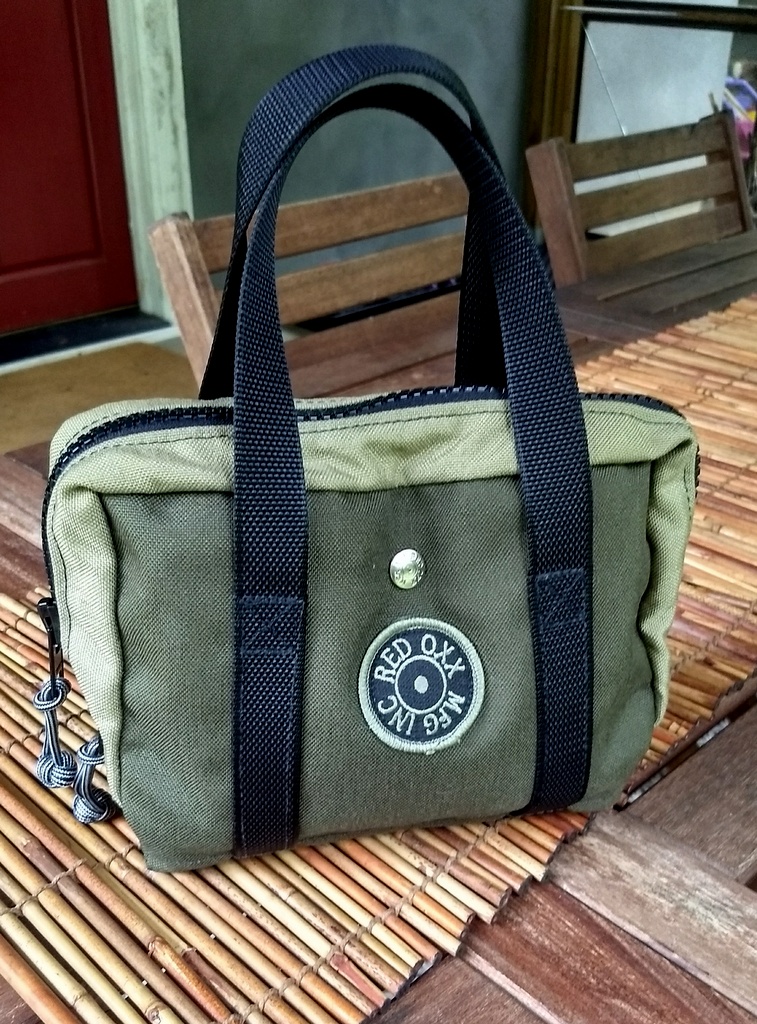
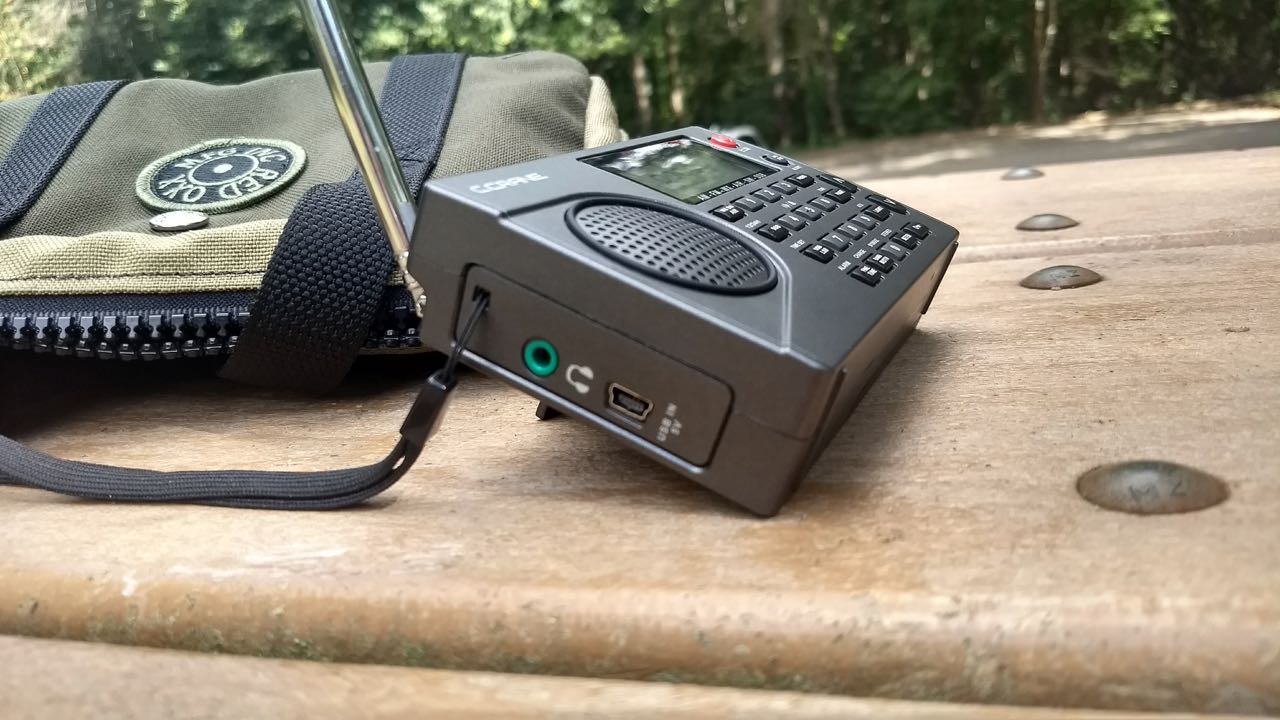
The Red Oxx “Lil Roy”

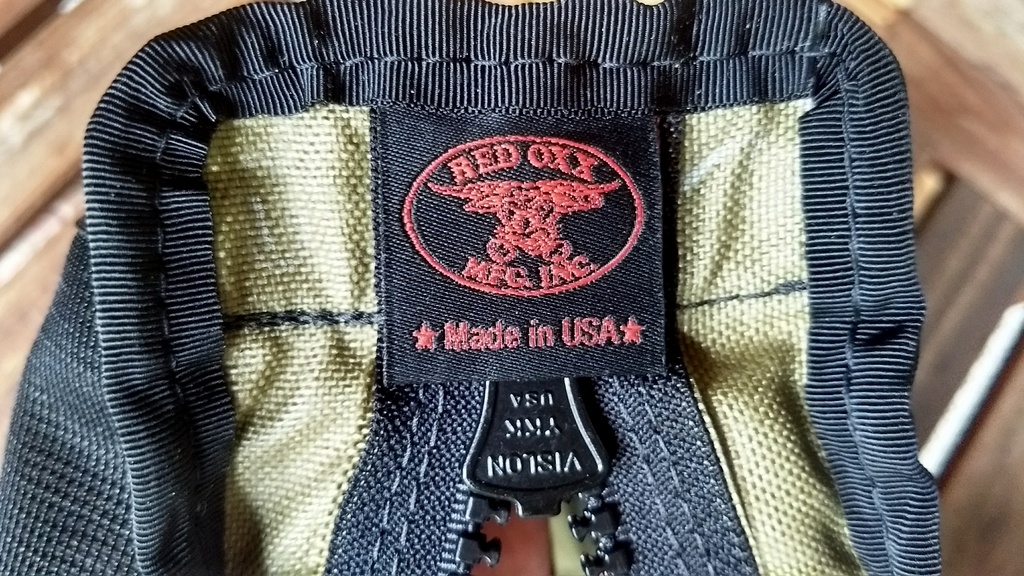
The Lil Roy might look like a typical canvas bag.  But the Lil Roy isn’t made by the typical pack manufacturer–it’s made by Red Oxx Manufacturing in Billings, Montana, USA. Red Oxx gear isn’t just designed in Montana, it’s made in Montana. The two leaders,  Jim Markel and President Perry Jones, are military veterans and bring mil-spec quality to all of their products.

I love the design of Red Oxx bags–they’re not tactical, but they’re not really low-profile or urban either. Markel describes the design as:

“Tactical strength without looking like you’re going to war.”

I was first introduced to Red Oxx gear in 2012 when I traveled to a meeting in Denver with my good friend Ed Harris (who is an SWLing Post reader).

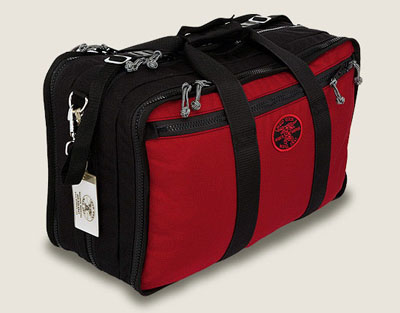
Even though Ed and I had traveled together in Belize and had known each other for quite a while, I never realized he was a one-bag traveler like me. Once the topic came up, we proceeded to talk about our main travel bags. Ed showed me his Air Boss by Red Oxx.

The Red Oxx Air Boss.

I instantly fell in love with the overall quality and the bold Red Oxx design.

All Red Oxx bags are manufactured to the company’s high standards, including the Lil Roy

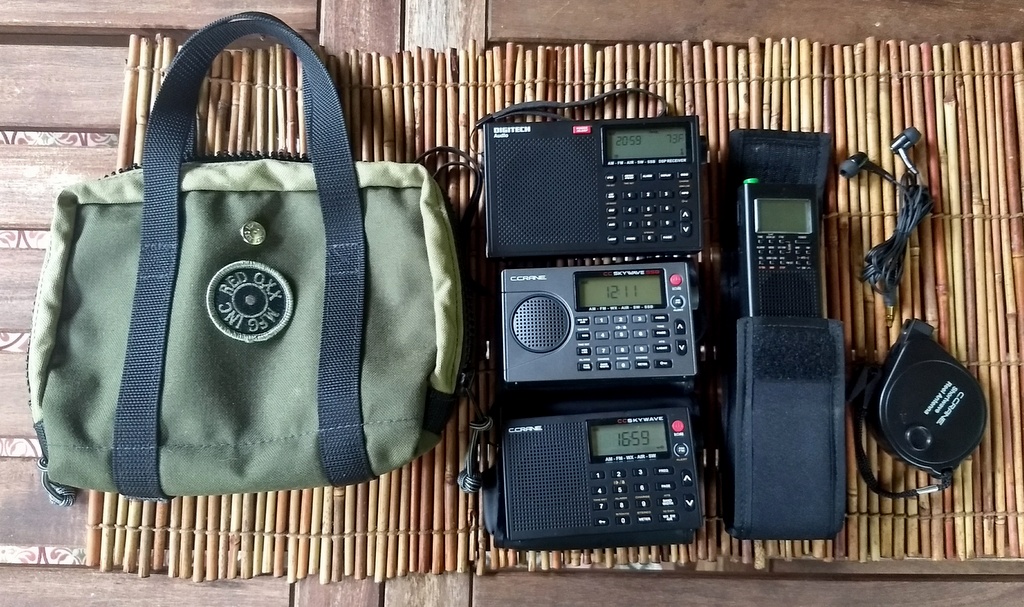
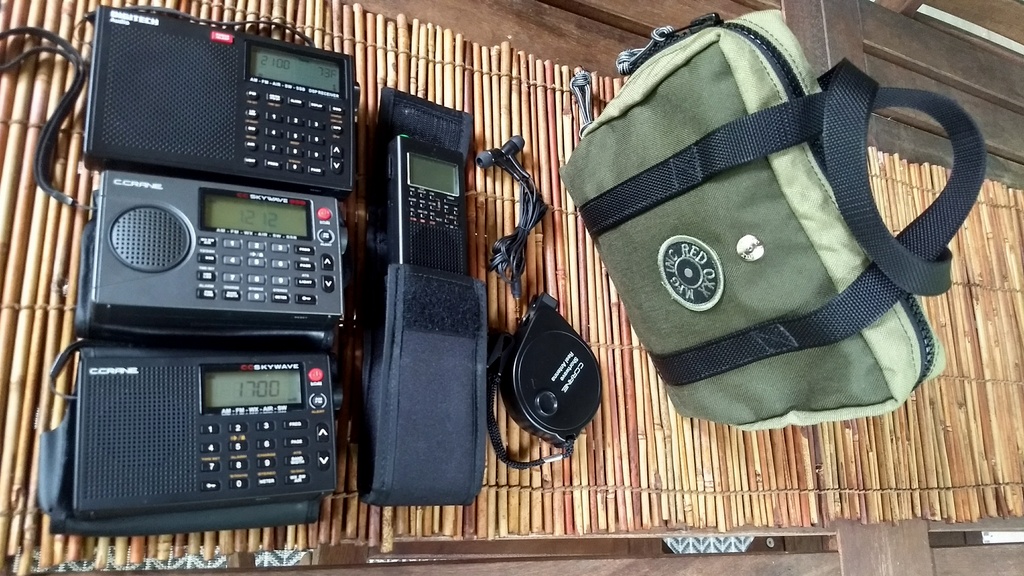
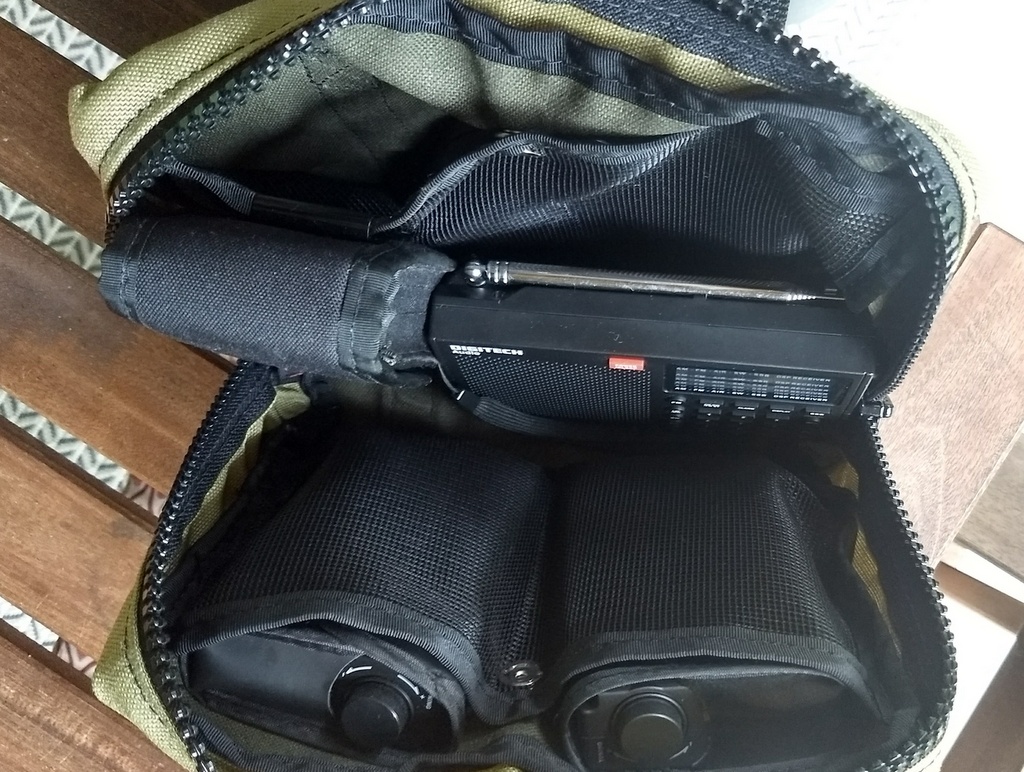
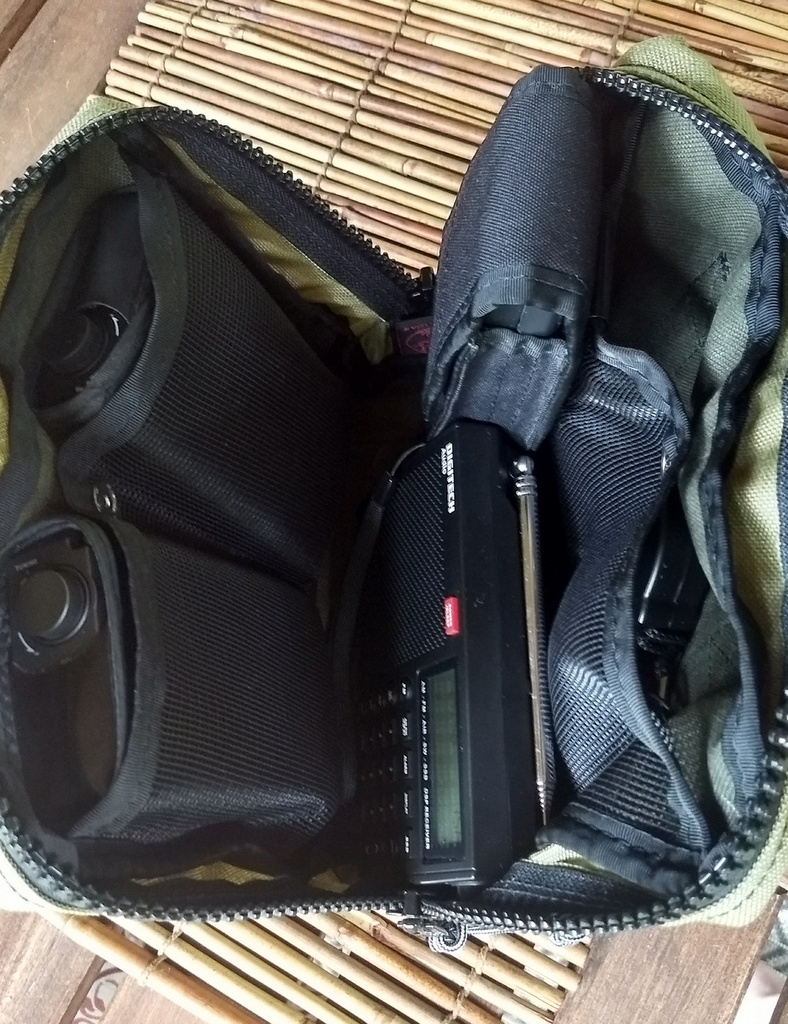
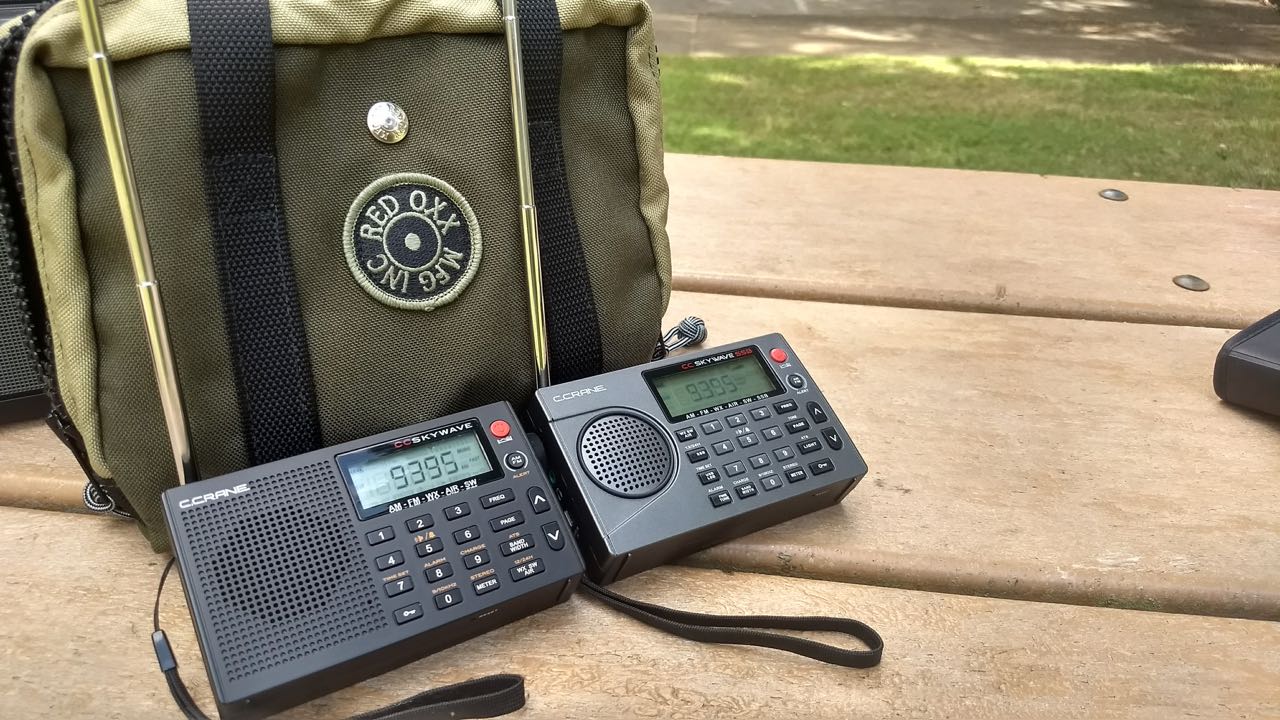
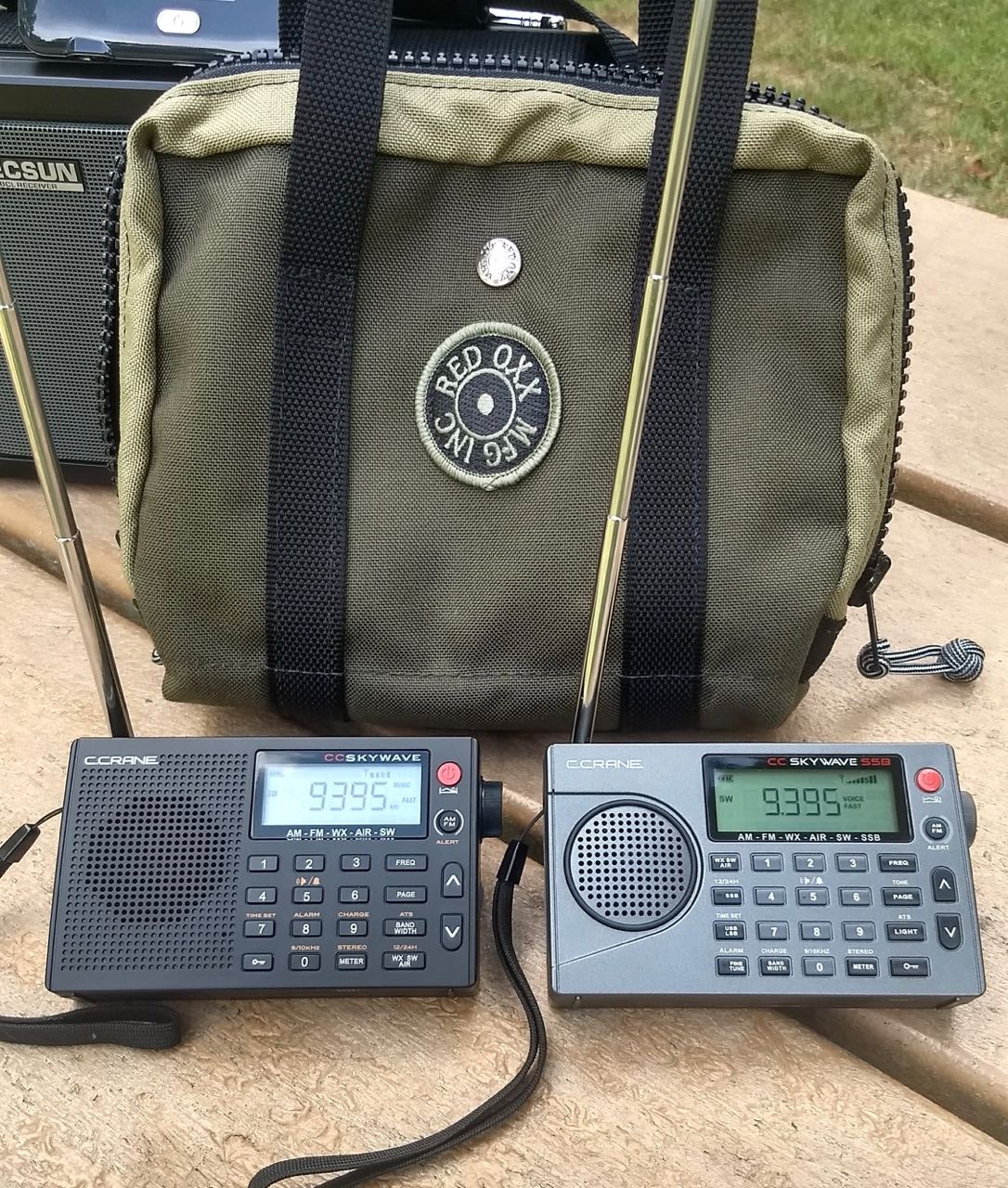
Four portable radios, an antenna reel and earphones all easily fit into the Lil Roy with room to spare.

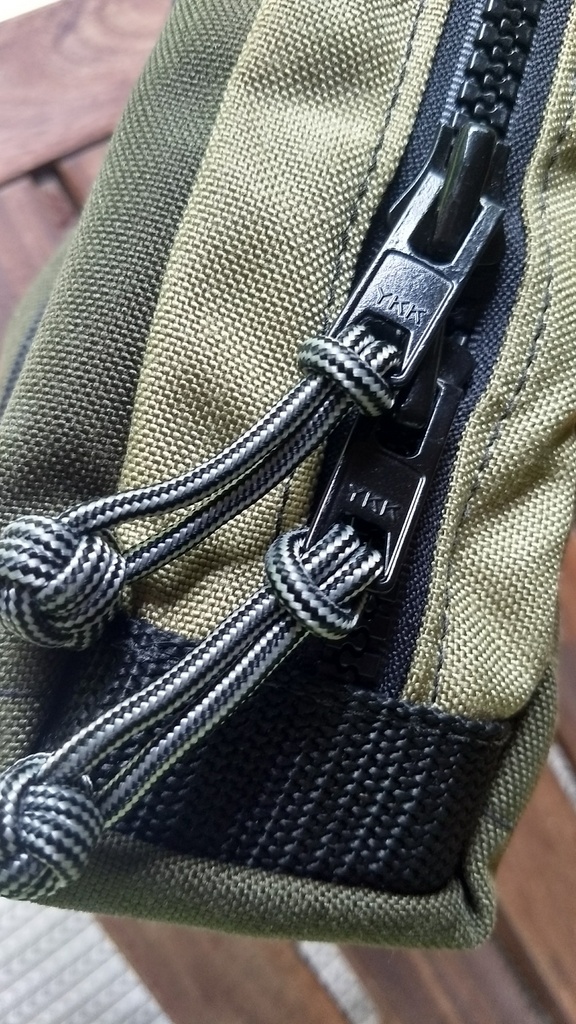
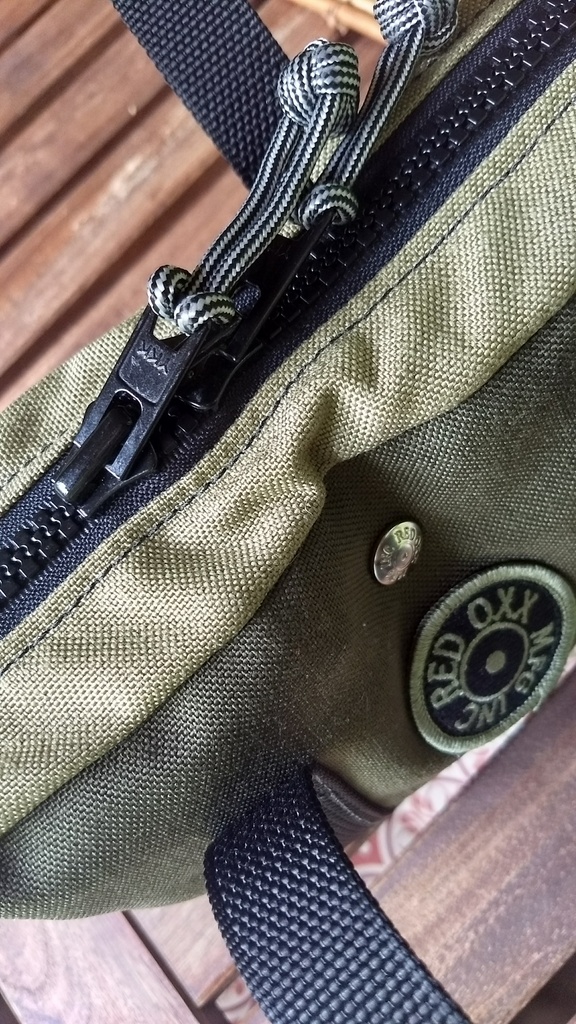
Though it looks like a canvas bag, the Lil Roy is made of 1000 weight CORDURA nylon. Red Oxx uses super strong UV resistant threads in the stitching and into every seam. Each stress point is box stitched.

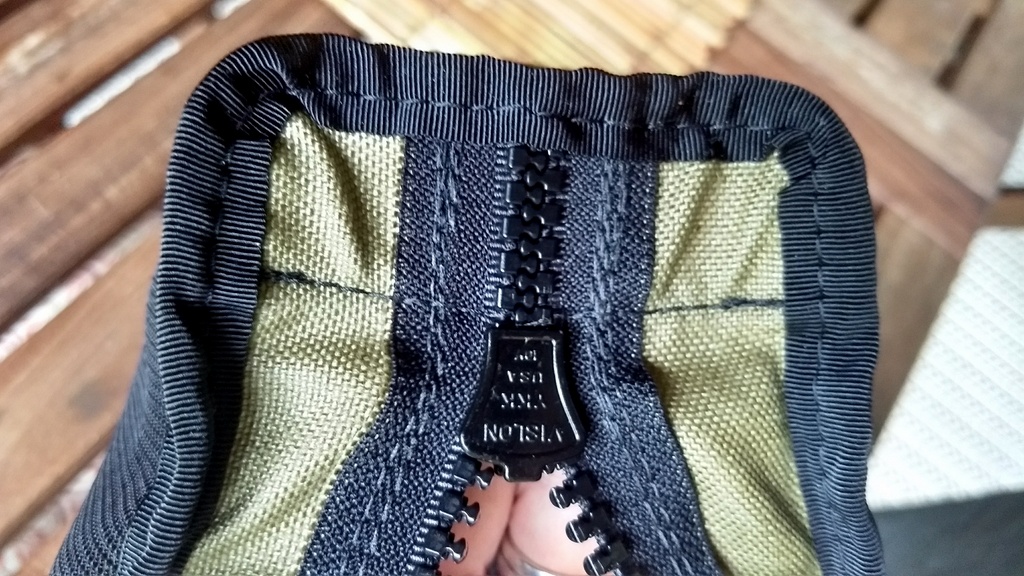
Red Oxx uses large, pricey #10 YKK VISLON zippers on all of their bags. They slide beautifully and if you don’t zip up the bag completely, the zippers won’t slide back open–they essentially lock into place. They’re even field-repairable.

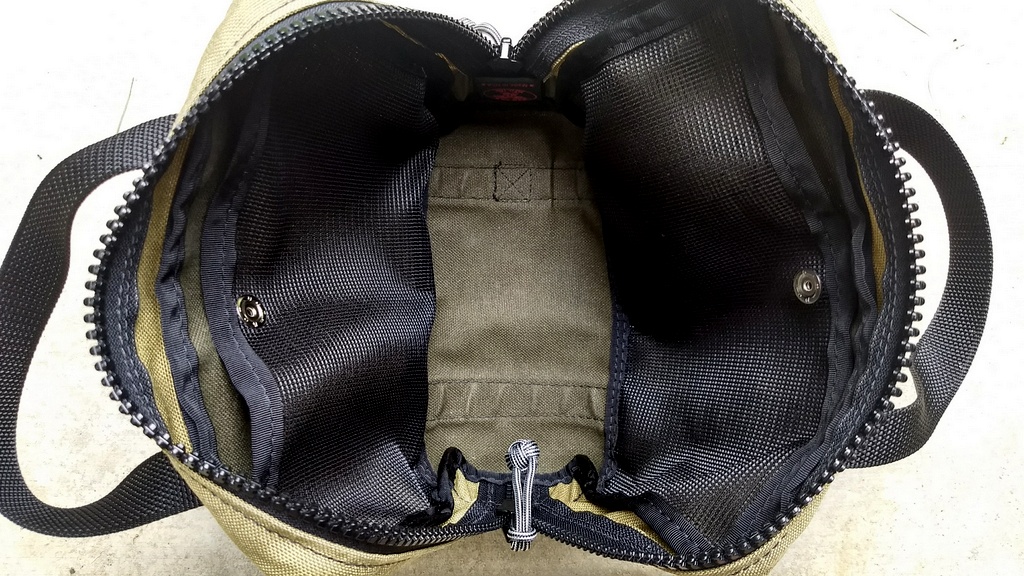
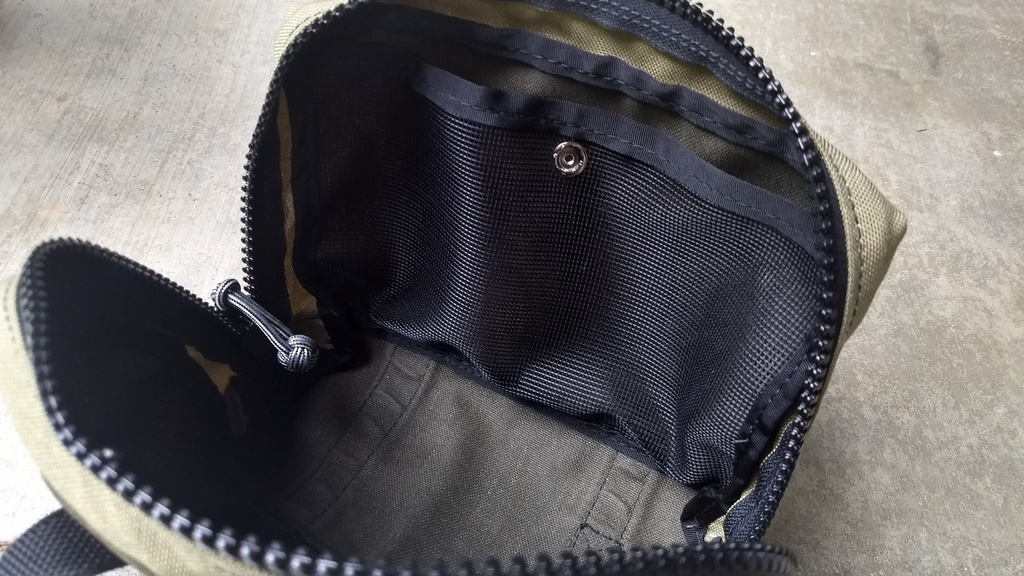
Inside the Lil Roy you’ll find two “stiff mesh” pockets on each inside wall with Red Oxx Mil-Spec snaps to keep things contained.

FYI: If you ever want to check the quality of a bag or pack, flip it inside out and look for frays, bad stitching and incomplete seams. Cheap bags are loaded with them–you won’t find one thread out of place on a Red Oxx bag.

While the Lil Roy is a small bag, I’ve found that it holds a lot of stuff. This month, I’ve had no less than four radios to beta test and review. I found that the Lil Roy can hold all of my portables and accessories, making it easy to grab the whole lot and take them to the field for testing.

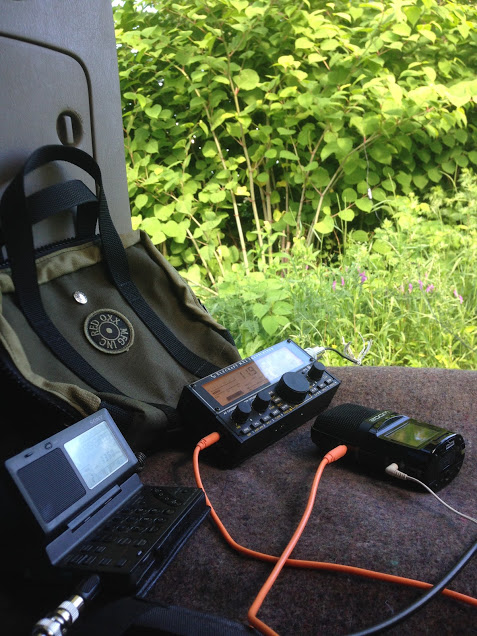
While in Canada this summer, I had to do all of my radio listening and testing in the field. I was able to pack my portable radio and my recording gear into the Lil Roy with room to spare.

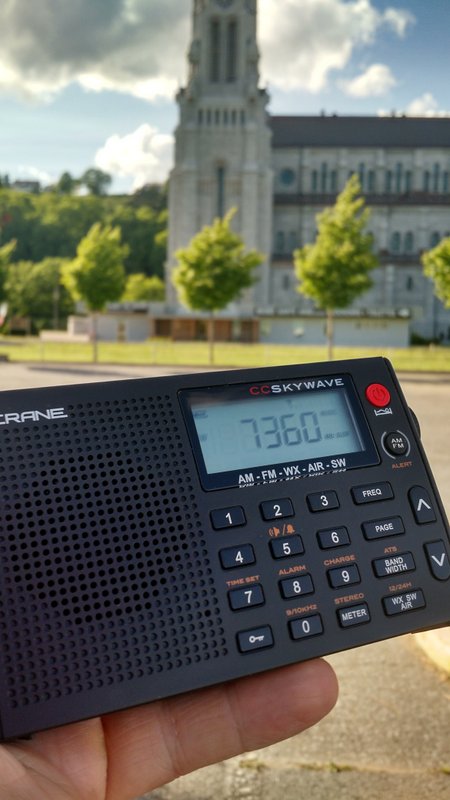
Listening to the 2017 BBC Antarctic Midwinter Broadcast from the back of my vehicle in Saint-Anne-de-Beaupré, Québec, Canada.

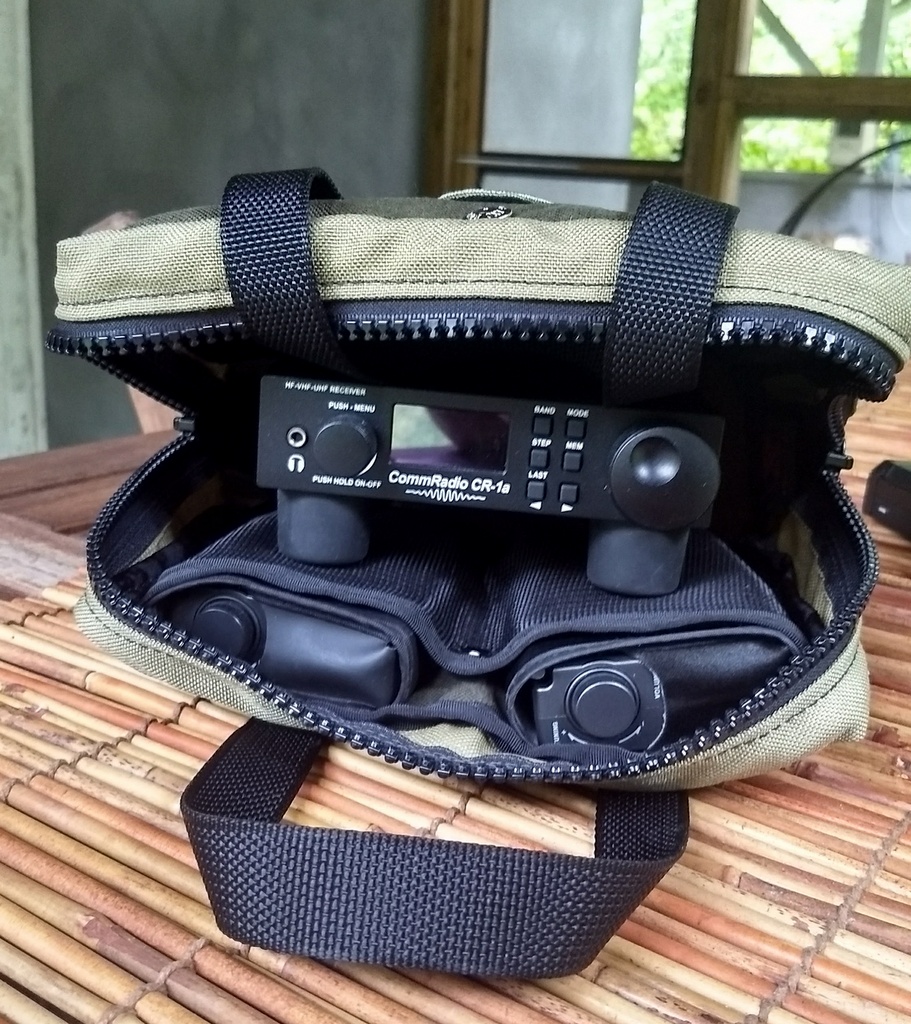
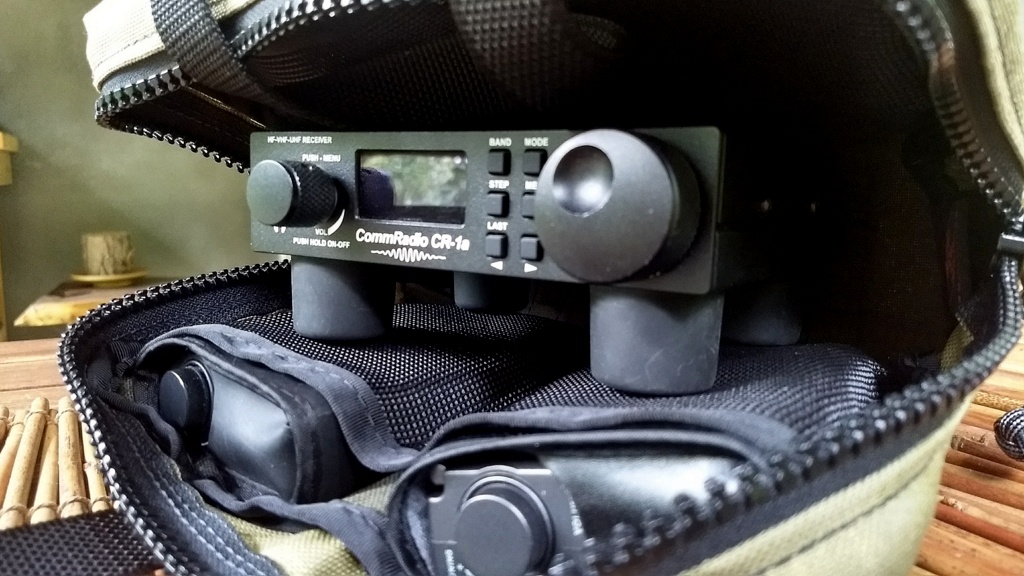
I’ve also packed my CommRadio CR-1a, NASA PA-30 antenna and all assorted cables for a little weekend travel and radio fun. The Lil Roy easily accommodated everything. In the photo below, I simply placed the CR-1a inside (on top of the CC Skywave and CC Skywave SSB) to show how much room there is to spare:

So are there any negatives? Perhaps one: the Lil Roy was never designed to carry radio equipment, so there’s no padding inside.

Indeed, I believe Red Oxx initially designed Lil Roy for someone who wanted a bag to hold their car chains. Of course, most customers use the Lil Roy as an electronics organizer–something to hold tablets, Kindles, cables, etc. Some even use it as a packing cube.

Since there’s no padding in the bag, I’m selective about what I put inside and how I pack it. Most of my portables have soft cases that protect them anyway. When I put something like the CommRadio CR-1a inside, I enclose the radio in a soft padded sack. Even though the sack makes the CR-1a bulkier, the Lil Roy can still easily accommodate it.

In general, Red Oxx gear is considered pricey by most standards. After all, you’re purchasing products wholly designed and made in the United States, so US wages are baked into that price. On top of that, Red Oxx backs all of their stuff with what they call a “No Bull” no question’s asked Lifetime Warranty. Because of this warranty, Red Oxx gear holds its value amazingly well. The warranty still holds even if you purchase the bag used.

I also believe when you’re purchasing from Red Oxx, you’re supporting a good local company that does one thing and does it very well.

The Lil Roy retails for $50 US. I think it’s a fantastic value for a simple, rugged bag that can be used in a variety of applications. The longer I’ve had it, the more uses I’ve found.

I’m considering purchasing the Red Oxx Mini Boss or possibly Skytrain in the next few months to replace my Timbuk2 Small Wingman.

Told you…I’m a pack geek! Don’t say I didn’t warn you! 🙂

Click here to check out the Lil Roy at Red Oxx Manufacturing.

Post readers: Red Oxx is one of three quality pack manufacturers I support–Tom Bihn and Spec Ops Brand are two others. Do you have any favorites?  Please comment!

The C. Crane Skywave SSB: A sneak peek!

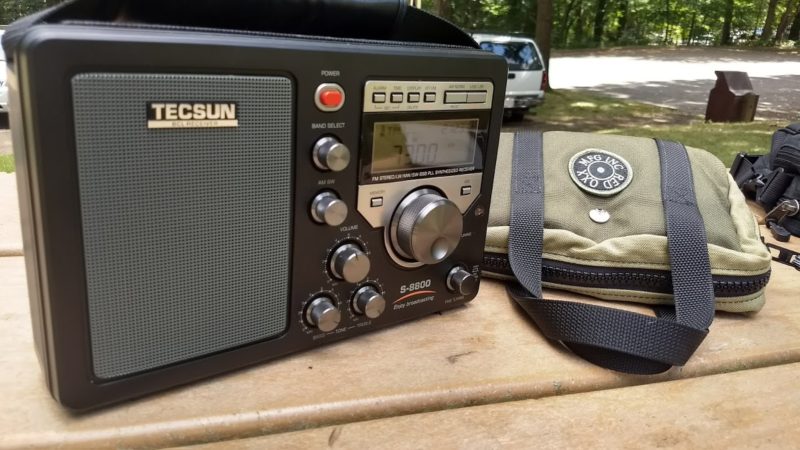
Tuesday afternoon, I took a number of portable radios to the field: the Tecsun S-8800, Tecsun PL-880, Digitech AR-1780, C. Crane CC Skywave and the new C. Crane CC Skywave SSB.

Last week, I received a pilot run (pre-production) CC Skywave SSB from C. Crane to test and provide feedback. My unit, of course, is still subject to cosmetic changes and engineering tweaks.

Since this is not a final iteration of the product, I won’t comment or review performance other than to say that if you like the original CC Skywave, you should love the new CC Skywave SSB.

C. Crane has kindly given me permission to post a few preview photos.

CC Skywave SSB Photos

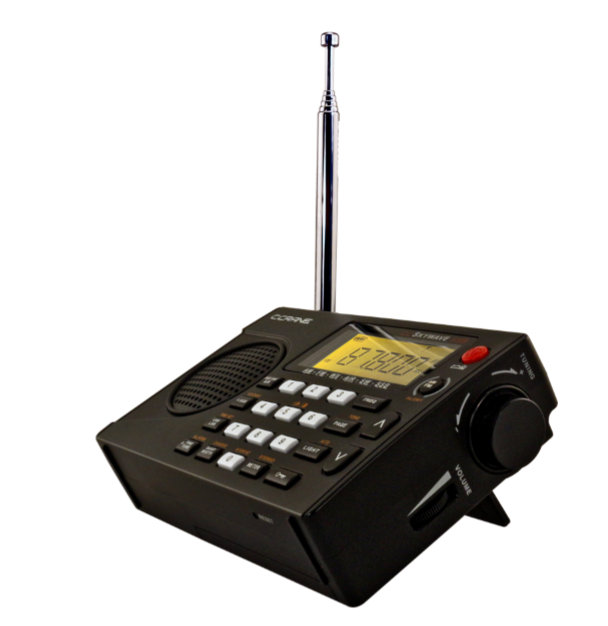
First thing you’ll notice is that the CC Skywave SSB is essentially identical to its predecessor in size and shape.

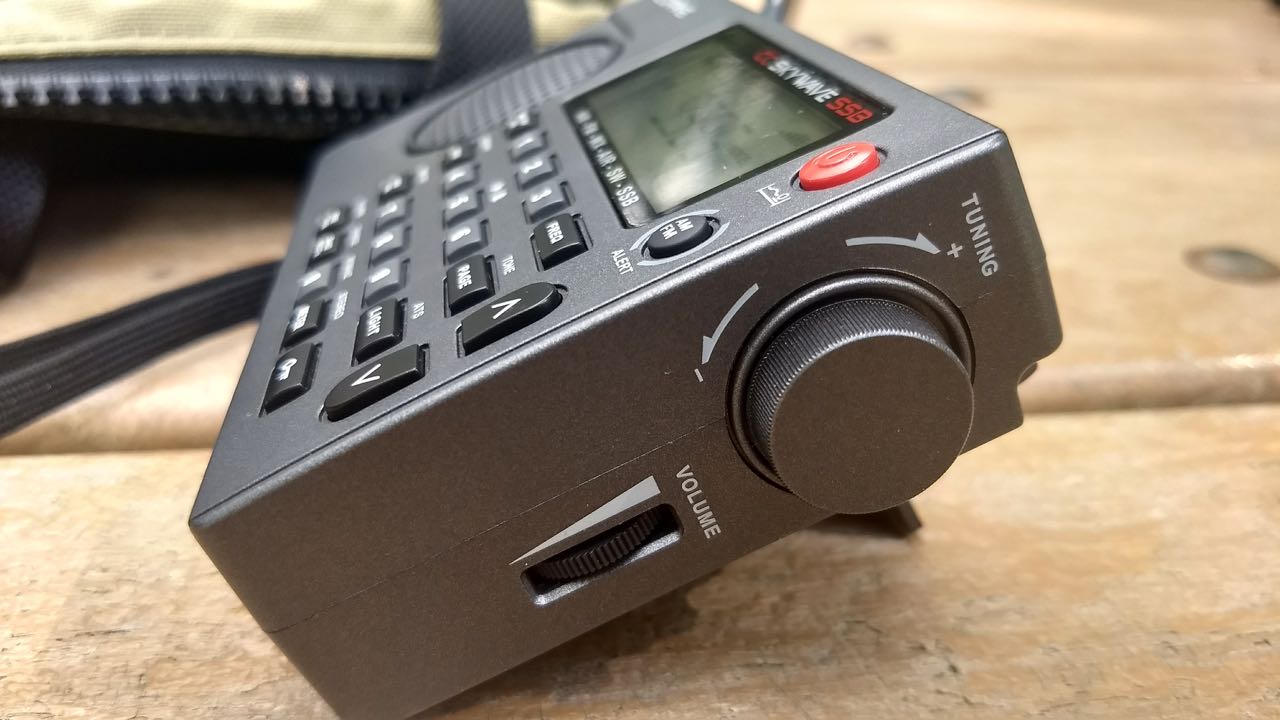
Indeed, the CC Skywave SSB fits the original Skywave’s carry case perfectly. If you’ve purchased a custom protective case–like this one— for the original Skywave, it’ll fit the CC Skywave SSB like a glove.   As you can see above, the front panel design has changed, though. The CC Skywave SSB accommodates four additional function buttons and sports a re-designed speaker grill (similar to the CC Pocket Radio).  Nice touch! C. Crane thought to use that little piece of real estate behind the backstand.

As many of you know, I’m a one-bag-traveler-kind-of-guy who never leaves home without a shortwave radio. On one bag travels, of course, I only carry one full-featured portable. Space is too precious to carry two.

Listening to the 2016 BBC Midwinter Broadcast to Antarctica while traveling in Canada with the CC Skywave.

The original CC Skywave has pretty much been my go-to travel radio since it was released. I’ve taken it everywhere.

I’ve also taken the amazing Sony ICF-SW100 and the full-featured Grundig G6 (which even includes the AIR band) on trips when I wanted access to single sideband mode–something the original CC Skywave lacked. (Note that both of these radios are now discontinued.)

But when traveling in North America or by air, I really appreciate the Skywave’s excellent NOAA weather radio and access to aviation frequencies on the AIR band. Very handy features for the traveler who likes to stay informed.

By adding single sideband mode to an already capable ultra-compact travel radio, C. Crane has created a welcome radio traveling companion indeed.

Video: Peter’s review of the Digitech AR-1780

Many thanks to SWLing Post contributor, Rob Wagner (VK3BVW), who comments:

There’s a quick and dirty video review of the AR-1780 by Peter VK3YE, which highlights a few interesting quirks (if that’s the right word!) with this receiver. Some birdies, specs that don’t appear accurate, and a query over one of the bandwidth settings. Well worth a look!:

Click here to view on YouTube.

Thank you for sharing this video review, Robert!

Peter (VK3YE) has done an excellent job indeed summing up the AR-1780–his notes and comments mirror my own. I would have never caught that oddity with the 1.2 to 1 kHz bandwidth reversal.

Check out Peter’s website by clicking here and his YouTube channel by clicking here.

[UPDATE: Click here to read our full review of the Digitech AR-1780.]

The CC Skywave SSB: Is C.Crane developing a Holy Grail travel radio?

Earlier today, intrepid SWLing Post contributor, Cap Tux, spotted an interesting link on Google when he searched for “C.Crane Skywave SSB”:

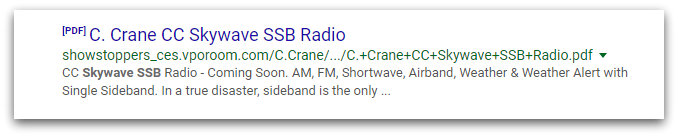
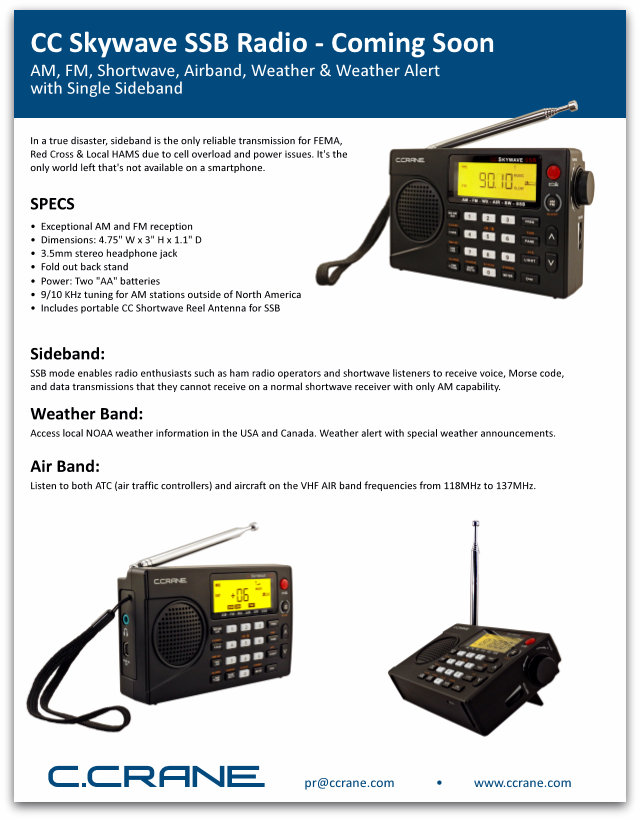
Turns out, it’s a product sheet for a new C.Crane radio: the CC Skywave SSB. Ther is no mention of this radio on C.Crane’s website yet. Here’s a screenshot:

Yes, C.Crane has obviously listened to our feedback and has developed a version of the Skywave with SSB mode–! Based on the product sheet, the CC Skywave SSB has all of the features of the original Skywave as well. That’s a plus because I love the NOAA weather radio functionality and the aviation band, especially when traveling.

If the Skywave SSB performs well, and the price point is decent, I think it might become one of the most popular shortwave portables currently on the market.

Why?

Well, for one, I’m a huge fan of the original CC Skywave (check out my review from 2014). It’s compact, feature-rich and has brilliant performance for a very compact travel radio. It’s a brilliant piece of kit for us one-bag travellers. The only glaring omission with the original Skywave was SSB mode, but at the time I believe DSP chips simply couldn’t implement this functionality.

Similarity to the Digitech AR-1780?

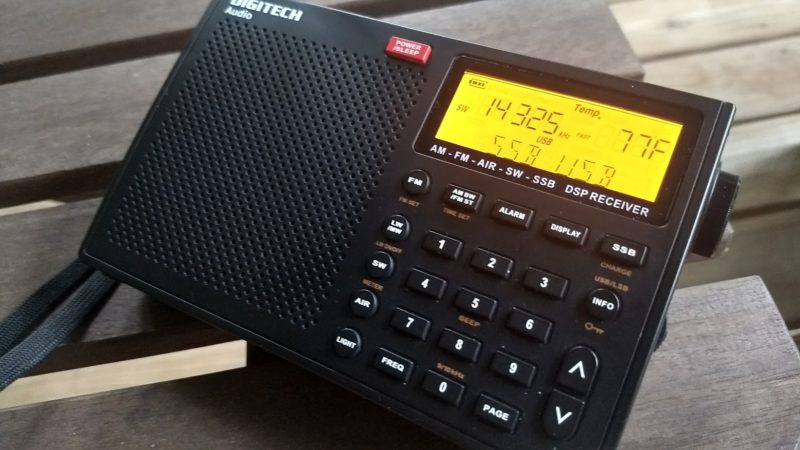
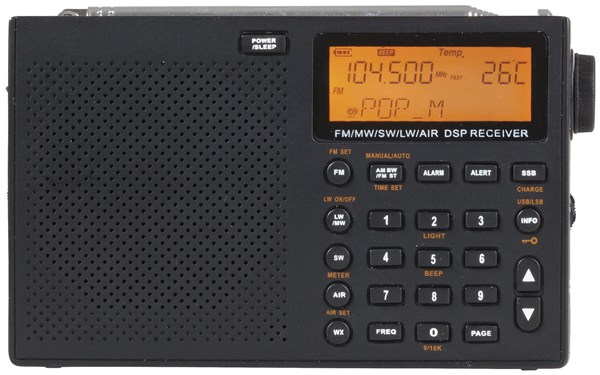
The Digitech AR-1780

In terms of size, the side-mounted encoder and some key placement, the CC Skywave SSB resembles the Digitech AR-1780 I ordered yesterday. The overall chassis design and display, however, are quite different.

I wouldn’t be surprised if both the AR-1780 and the Skywave SSB are built on the same DSP chip.

Will they have similar performance? I doubt it.

If you recall, when the original CC Skywave was first announced, we radio geeks noticed a striking resemblance to the Digitech AR-1733. Fortunately, the Skywave was far superior in terms of performance. I made the following note in my Skywave review:

“But I was concerned a few months ago when I noted the similarity between the CC Skywave and the poorly-reviewed Digitech AR1733, sold in Australia/New Zealand by Jaycar.

Fortunately, it’s clear that C. Crane noticed the shortcomings of the AR1733 and has modified the Skywave’s design and firmware accordingly, which may account for the delayed roll-out of the CC Skywave. Obviously, the Skywave’s ACG circuit has been tweaked to cope with medium wave and shortwave listening, since a poor ACG circuit is one of the shortcomings of the AR1733. But, if so, wow…what a tweak.”

I know the crew at C.Crane and I can confirm that they do their own product development. Their team consists of proper radio enthusiasts and ham radio operators who work directly the engineers. This is why C.Crane never releases products with serious receiver flaws like other manufacturers have in the past.

A CC Skywave SSB review?


You bet!

As soon as I can get my hands on the CC Skywave SSB, I’ll share updates here on the SWLing Post. Just follow the tag: CC Skywave SSB.

You might have noticed that my expectations are pretty high for the CC Skywave SSB, so I hope I’m not disappointed when I do the review.

In the past decade, there have been very few full-featured, ultra-compact travel radios with SSB introduced to the market. There is, of course, the CountyComm GP5-SSB, but it lacks a direct entry keypad, aviation coverage and NOAA weather radio. There is also the discontinued Grundig G6, but it too lacks NOAA weather radio and SSB operation was pretty basic (let’s not forget the G6 was also a “sticky radio”).

The CC Skywave SSB could be a Holy Grail travel radio, if it lives up to expectations.

At this point, of course, I have no idea when this little radio will hit the market. We can assume, though, that C.Crane will do their best to ship it prior to the 2017 Christmas shopping season.

Stay tuned! And thanks for the tip, Cap!

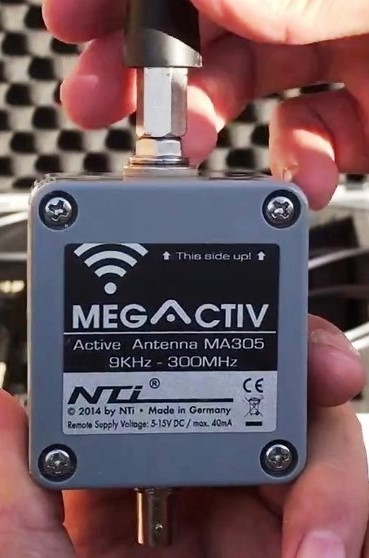
Brilliant hard-core DX with the USB-powered Bonito MegActive MA305 antenna


Hi there, you might remember my post from last month focussing on the Bonito MegActive MA305 E-field antenna, kindly supplied to me for testing, by Bonito themselves. That post was essentially a report on my experiences travelling to Crete with the MA305, navigating through security at London Gatwick and Heraklion airports (mostly with relative ease), but more importantly, how well it worked with the equally excellent Eton Satellit portable receiver. Whilst in Crete I managed to copy a number of personal firsts, including CRI on 7295 kHz, via their relay in Bamako, Mali, The Voice of Beibu Radio on 5050 kHz, Nanning, XSL ‘Slot Machine’ on 6251 kHz USB, Ichihara, Japan, S32 ‘The Squeaky Wheel’ on 3828 kHz and NHK World Radio Japan, 11910 kHz. I also copied RTM Wai/Limbang FM on 11665 kHz from Kajang, Myanmar Radio on 5985 kHz and AIR Bhopal on 4810 kHz, amongst others – all of which I would certainly consider to be difficult catches in Europe.

 The USB-powered MegActive MA305 is perfect for DXing on the move…

Despite excellent all-round results from the ultra-portable USB powered MA305, there was one signal I copied, which more than any other, demonstrated the DXing credentials of this antenna; Radio Tarma from Peru on 4775 kHz. With a TX power of 1 kW, this is a very difficult station to hear in Western Europe, even with a longwire. To catch this station in Crete, with a 22 cm antenna was incredible and it was at that point during my trip that I realised E-field antennas really can work superbly well for hard-core DXers on the move.

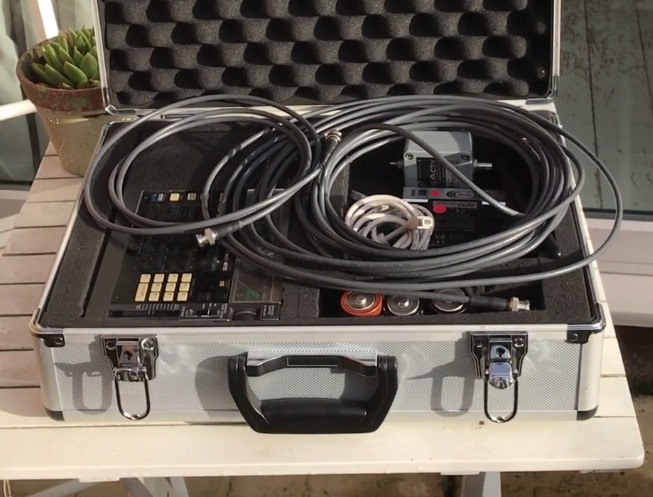
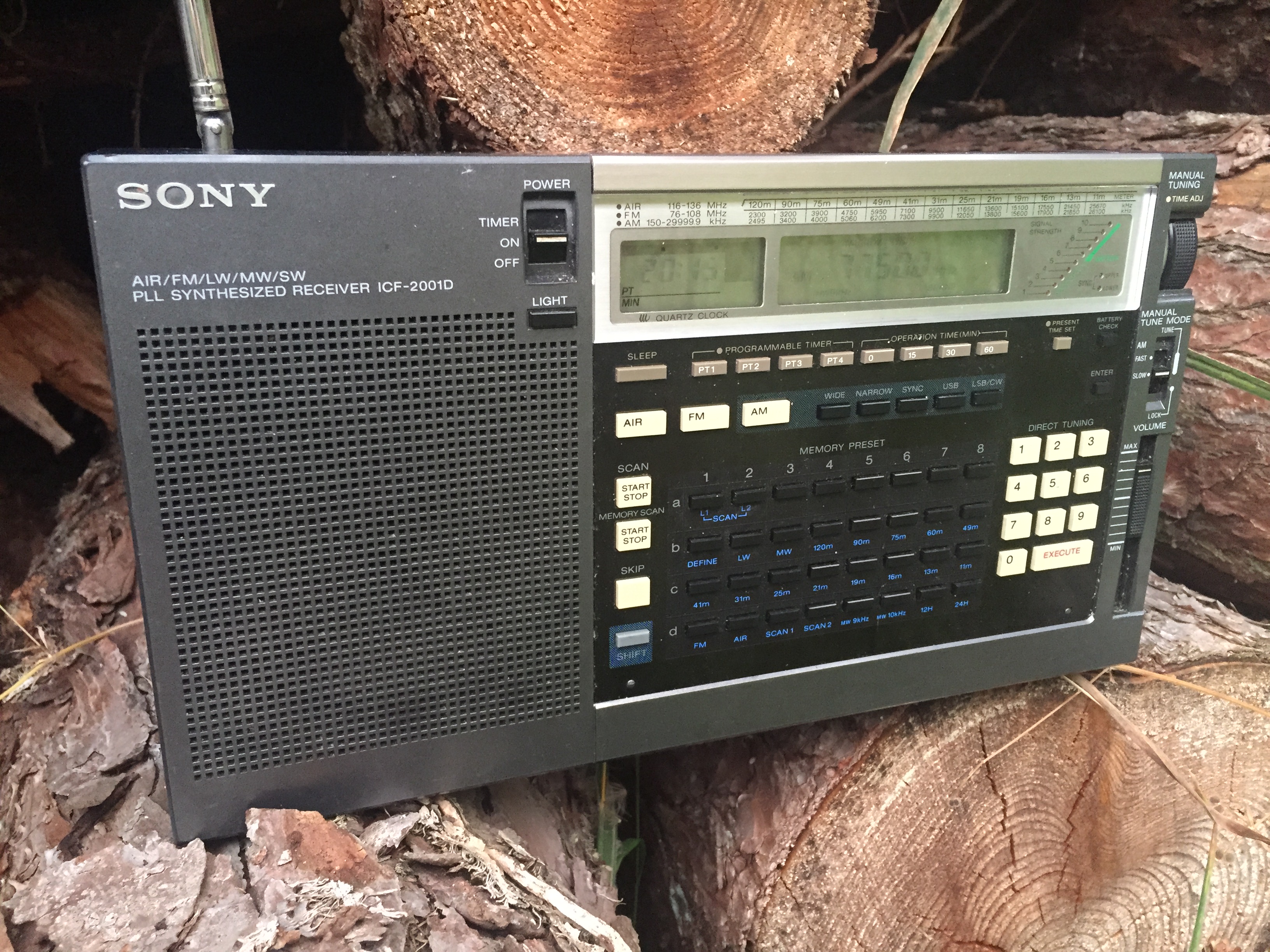
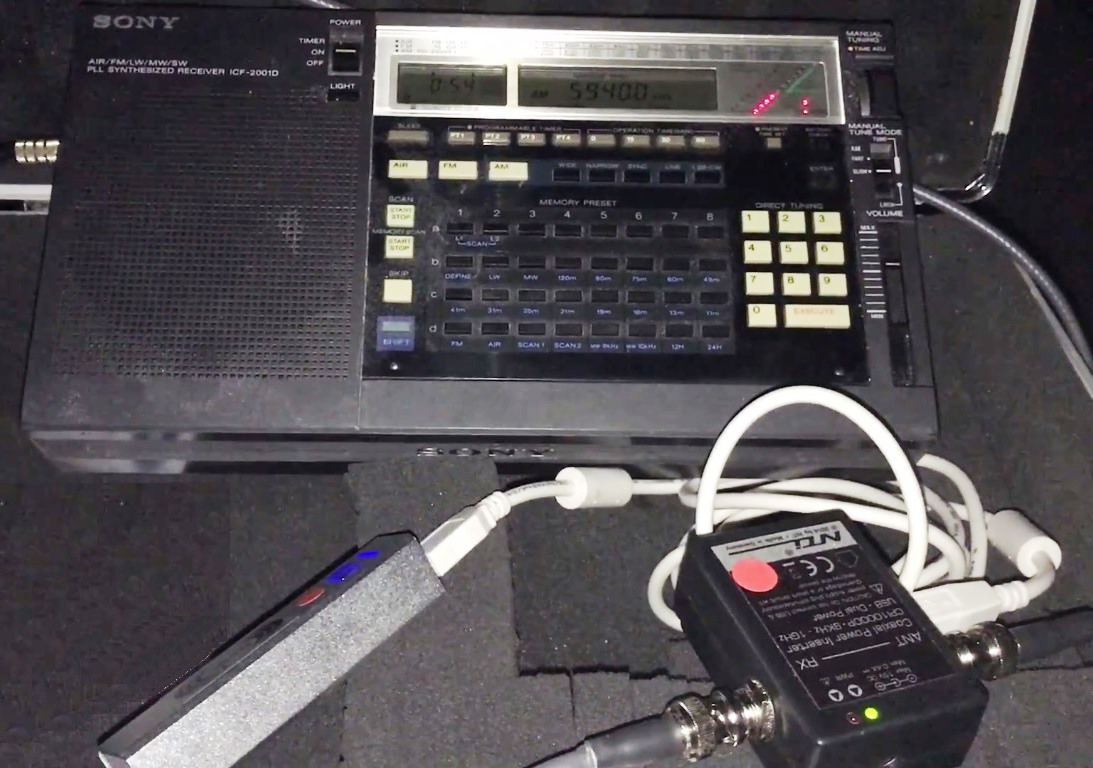
Upon my return to Oxford, I immediately started thinking about a DXpedition to the local woods I use for what I consider serious DXing. For obvious reasons, E-field antennas require an electrically quiet environment to ensure maximum SNR performance. In noisy environments, these types of antennas amplify the signal of interest and the background ‘electro-smog’, thus increasing signal levels but critically, not signal-to-noise. Fortunately, the Oxfordshire wood I have been using for a couple of years is only a 10 minute drive from my QTH as I sort of live in the countryside anyway and the QRM levels there are just about zero. Now, given that this was essentially an experiment to determine the best possible performance from the MA305, I decided to use my best portable radio. It was quite tempting to pack up the Elad FDM DUO which running on a home-brew battery pack has proven itself to be my best (pseudo) portable radio. However, this is supposed to be a real-world test and in this type of scenario, DXpeditions with the Bonito antenna are much more likely to be undertaken with a portable radio. For these reasons I decided to conduct the test with the venerable Sony ICF-2001D. Having proven to be a superb receiver over many, many dxpeditions (check out the evidence on my YouTube Channel Oxford Shortwave Log) and still regarded by DXers as one of the best ever portable radios – possibly the best – it was the obvious choice.

 My portable DXing kit comprising the Bonito MegActive MA305 antenna and the Sony ICF-2001D…a bit of a legend in DXing circles…

I ventured out in early June around 23:00 hrs BST (22:00 hrs UTC), parked the car on the edge of the wood and proceeded to set up my cheap camera tripod, slightly modified to accept a 2 metre-long stainless steel tube, into which a slightly thinner 1 metre tube was mounted, topped off with my partially disassembled ‘Selfie Stick’ – which made it back from Crete lol. The antenna was set up in less than 5 minutes and approximately 4 metres above the ground – much quicker and easier than de-spooling 100 metres of wire! With fresh batteries in the Sony and the MA305 powered up using the USB power brick supplied by Bonito, I was ready to start listening. Almost immediately I heard and recorded a personal first; Lao National Radio, Laos, signing on 6130 kHz, with an excellent signal. Hearing them in the UK was only made possible by the annual two week shut down of the PBS Xizang transmitter in Lhasa, Tibet, but hey, I’ll take it. A brilliant start to my listening session.

Over the next two hours I was amazed at what could be heard using this 22 cm amplified antenna. Bearing in mind I have spent many hours at the woods previously, listening via various 100 metre longwires and a 200 metre Beverage, my expectations were, I thought, realistic in that the MA305 coupled to the Sony would catch some very good DX. However, I did believe there might be an absence of at least some of the more exotic low power stations on the Tropical Band – afterall the MA305 is a very short antenna. Clearly I was wrong, because what transpired during the session surpassed anything I thought possible with this set-up. A list of reception videos follows below and further below, a selection of embedded videos. Some of the entries on this list simply stunned me at the time. Rádio Educação Rural for starters is such an incredibly difficult signal to hear in Europe, even with a very large antenna. Thus, to hear them on an ultra-compact set-up felt very special. Radio Mali is another station that is very difficult to catch with any modulation, except on a large antenna and yet there they were – at the first time of trying. Similarly, Rádio Nacional de Angola and Alcaravan Radio are exotics that at best deliver very weak audio – and most of the time no audio. Furthermore, the signals from Emisoras Pio XIIMyanmar Radio and Rádio Clube do Pará were verging on what I would call superb…I’d never heard anything like it previously except via 100 (or more) metres of wire.

 The ICF-2001D and MegActive MA305              Rádio Educação Rural transmitter site in Tefé, Brazil

So what’s next? Well it would certainly be an interesting experiment to compare the performance of the MegActive antenna with the Wellbrook ALA1530 active loop in a similar environment. I have used the Wellbrook on DXpeditions several times, with often excellent results, however, it’s not designed to be portable and if SNR performance could be demonstrated as similar between these two products, given a very favourable price delta, the Bonito antenna would add up to be a very compelling purchase decision. More on that to come. In the meantime, thank you very much for reading/watching/listening and I wish you all excellent DX.

Please click on the links below for the reception videos on the Oxford Shortwave Log YouTube channel.


Selected embedded reception videos from the list above:

Clint Gouveia is the author of this post and a regular contributor to the SWLing Post. Clint actively publishes videos of his shortwave radio excursions on his YouTube channel: Oxford Shortwave Log. Clint is based in Oxfordshire, England.

Gary DeBock’s April 2017 Kona, Hawaii Ultralight DXpedition

Many thanks to SWLing Post contributor, Gary DeBock, who shares the following notes and recordings from an Ultralight DXpedition in Kona, Hawaii:


April 2017 Kona, Hawaii Ultralight DXpedition

The first long-range test of a “Frequent Flyer” FSL Antenna

By Gary DeBock, Puyallup, WA, USA April 2017

Introduction

Ever since the U.K.’s Graham Maynard published his innovative article about the “Ferrite Sleeve” antenna in early 2011 an enthusiastic group of DXers and tinkerers has continually refined and upgraded the design, with most of them going in the pursuit of maximum possible gain. Monster FSL models were designed with weights of up to 38 pounds (17 kg), and considering the size, weight and subversive appearance of the typical model, the general assumption was that this new type of antenna was highly unsuitable for air travel, since it would send airport security personnel into a serious panic.
This situation continued for a full 6 years, during which the FSL antenna became a star performer in the related new niche of ocean cliff transoceanic DXing. But was there another possible application for the antenna’s compact performance advantage? What if a very lightweight, high-performing model could be designed which would not only provide a huge boost in DXing gain, but fit inside a hand-carry suitcase, and routinely pass airport security screening inspections around the world? This was a tough design challenge, but well worth the effort if successful!

Since the new antenna would need the maximum possible performance for its small, lightweight size, the use of the Russian surplus 100mm x 20mm x 3mm ferrite bars was mandatory. Every possible effort would be used to make the antenna as compact and lightweight as possible, although the choice of the highest-sensitivity 1162/46 Litz wire was critical for best performance. The PVC frame would be shrunk down to the smallest practical size. Finally, in a major experimental effort here over the winter season, the first of the new 5 inch (127mm) “Frequent Flyer” FSL’s became a reality. The finished antenna had a very non-subversive appearance, and could fit inside a custom-sized plastic tote within a hand-carry suitcase. Most importantly, it could still deliver a serious amount of inductive coupling gain– roughly similar to that provided by a 4 foot (1.22m) air core box loop, but with the advantage of somewhat lower noise reception.

Because the Russian surplus 100mm x 20mm x 3mm ferrite bars are extremely scarce (without any current supply source) only five of these original “Frequent Flyer” models would be made, although alternative models using the commonly available 140mm x 8mm ferrite rods were also designed. These antennas would be somewhat heavier and larger, but these “Baby FSL” ferrite rod models could be easily assembled from parts available on eBay, fit inside the hand-carry suitcases, and still deliver a lot of DXing performance (while routinely passing airport security screening). Finally, an economic model using the commonly available 62mm x 12mm x 4mm Russian surplus ferrite bars was also designed. This lightweight FSL can be constructed for around $65 US, and can still provide a serious DXing gain boost to a stock Ultralight radio. For want of better terms, these three classes of “Frequent Flyer” FSL antennas are called the “first class,” the “business class” and “coach class” models, with FSL sensitivity scores (ferrite length x coil diameter) of 585, 490 and 300 respectively.

From April 9-12 a Mini-DXpedition was conducted on a 6th floor oceanfront room at the Royal Kona Resort Motel in Kona, Hawaii. This was the first of many long-range DXing trips based upon the performance boost provided by the compact new antenna– which was specifically designed to easily pass through airport TSA security checkpoints. A 5 inch (127mm) “Frequent Flyer” FSL antenna was packed inside a matched-size plastic tote within a hand-carry suitcase, and breezed through TSA security screening in both the Seattle and Kona airports (without even a single question ever being asked). This was one of the “first class” Frequent Flyer models described previously, and was used to boost DX station gain on a 7.5″ loopstick C.Crane “Skywave” Ultralight radio. This combination was effective enough to track down many exotic Pacific Island stations (540, 621, 1440, etc.) at S9 levels during transmitter-site sunset skip propagation into Kona, as well as Asian TP-DX of varying strength around local sunrise.

This Kona trip was primarily designed as an anniversary celebration with my wife, so before we took off I had (somewhat reluctantly) agreed that DXing would have a secondary priority to sightseeing over the four days. Because of this there were many frequencies that could not be investigated in Kona, but I knew very well which Pacific island stations were tough challenges in both North America and Japan, and I was determined to go after them with a vengeance. 540, 621 and 1440 would all receive serious attention in Kona– not because they were great challenges in Hawaii, but because most DXers in both North America and Japan needed all possible information about them if they were to have any chance of reception at all. Besides this I was eager to try my long-range luck chasing exotic Asians around local sunrise with the innovative FSL antenna, but I knew that east-west propagation was almost totally dependent upon solar activity– and as it turned out both the A and K indexes shot up after our arrival.

Overall the Kona MW propagation to the Pacific islands was exceptional around local midnight (as expected), but the sunrise propagation was somewhat challenging for long range Asians. Perhaps the biggest success of this entire trip was the interest and excitement that the “Frequent Flyer” FSL antenna series (the major experimental project here this past winter) has inspired among DXers who routinely travel to foreign countries and other faraway venues. As I write this Craig Barnes of Wheat Ridge, Colorado is conducting his own 5 inch “Frequent Flyer” FSL- based DXpedition to Hawaii. Good luck, Craig!

Recordings

[Note: a selection of audio files have been embedded in the post below, but all audio is available to download and stream via the links provided.]

531  6DL?   Dalwallinu, Australia   Presumably the one with the same-sounding announcer and program as the one on 630-4QN at the time (at 1547 on 4-9; see MP3 for 630-4QN), but it didn’t seem to be exactly parallel (maybe a time zone delay?)
https://app.box.com/s/7bg1hruxrufccuys5axc4yzumexr3q36

540  2AP   Apia, Western Samoa   This station features a lot of Samoan music (with both male and female announcers), and dominates the frequency in Kona at night as long as it transmits. Unfortunately it doesn’t follow the listed PAL sign off time of 1000, but runs past this time routinely, which made it tough to track down an exact sign off time during my limited sessions. My guess is that it signs off sometime between 1030 and 1100. The following MP3 is of S9+ level Samoan Christian worship music at 0931 on 4-9. This overwhelming signal was one of the most awesome recorded during the entire DXpedition:

https://app.box.com/s/8ejvx8s7udh5ibtqymtxs5ew65mquqcl

Energetic Samoan music at 0956 on 4-12. This is typical of the station’s music format

https://app.box.com/s/tbo84s7gb2jci6gfxkawo7rsqpmpkyp3

More typical Samoan choral music at 0835 on 4-11 — a staple of programming in the station’s format

https://app.box.com/s/z8ecbvx14fyqx0tpjtw2ahy2r7omhst4

Relaxing Samoan choral music at 1013 on 4-12

https://app.box.com/s/v50700yxviojl4qkkdgh9omdx1hf0yrl

The usual male announcer in Samoan at 1028 on 4-12

https://app.box.com/s/03xy87zls2aqqz52oiz8pbobi9f433rt

The usual female announcer in Samoan at 0856 on 4-11

https://app.box.com/s/6rkd8ckcd1005fyc5itupxowaf6jqhex

558   Radio Fiji One   Suva, Fiji   Somewhat of an underperformer considering its South Pacific location and (nominal) 10 kW power level. My guess is that the station has some transmitter and/ or antenna issues. Here is some fair level male speech with island music at 1001 on 4-9, which was the strongest signal it managed during the entire trip

https://app.box.com/s/ly0u5y34rg85e1aotimyjjj1bksunsd3

558   UnID-TP    Once again, this weak signal sounded a lot like the 630-4QN program at the time (1548 on 4-11), so my guess is that 6WA in Wagin, Australia is the most likely possibility

https://app.box.com/s/10plmz0gumpjk7ymwi6ay44oqzo67ong

603   HLSA   Namyang, S. Korea   One of the common Asians which ran the gauntlet of dicey solar activity. It was fairly good at 1521 on 4-12, but was MIA during a couple of days

https://app.box.com/s/9s3g67w2j5ge9ggsj31kwuwnqmfdiyh9

621   3RN   Melbourne, Australia   This LR network station would start to fade in just when Radio Tuvalu was about to sign off (around 1000), although it never provided any serious competition for the exotic station. This MP3 was made just after Tuvalu’s sign off at 1006 on 4-9

https://app.box.com/s/x0k4bnu3jmytorhzjphz5a6nqyet4h5r

621  Radio Tuvalu   Funafuti, Tuvalu   A very tough station to track down on the mainland, but certainly a “piece of cake” in Kona. Routinely has sign off at 1003 UTC, preceded by island choral music and the national anthem (sung by the same choral group). Around 0950 a female announcer begins the routine by giving a monolog news broadcast about 5 minutes long, typically followed by an island music song right before the fixed 5-minute sign off routine. The latter two features are included in the following 8 minute recording (at near S9 strength) made at 0955 on April 10

https://app.box.com/s/3z2ql91i5afhhi6kmjsnvos4p9q2j56y

The usual female announcer with her 5 minute news broadcast at near S9 strength at 0955 prior to the sign off routine on April 11. The lady giving the correct pronunciation for “Tuvalu” is at the 11 second point

https://app.box.com/s/knpjrxdb40p7hfe9xx7djlwyz3fzf8j3

Around five minutes of typical Island choral music at good-level strength at 0921 on 4-9

https://app.box.com/s/0vouj030pvoxy96o7xtvg45zq0uxed1n

Here is a different recording of the female-announced news broadcast just prior to the sign off routine at 0956 on 4-9 (at very good strength)

https://app.box.com/s/u0rg1xlye0le5jth12x8wccw6nc5sv99

630   4QN   Townsville, Australia   This 50 kW station was far and away the strongest Australian signal heard throughout the trip. Unfortunately it wasn’t in the same time zone as fellow LR network stations on 531 and 558 in Western Australia, making parallel checks seem dubious. Here is a typical signal at 1543 on 4-9

https://app.box.com/s/j82og05m8v4umqacm78e41cs1xht21to

657   Pyongyang BS   Pyongyang, N. Korea   This bizarre station was far and away the strongest Asian heard during the trip– almost like it was a South Pacific semi-local. When solar activity cooled off it could blast in with serious power, such as at 1555 on 4-9

https://app.box.com/s/9exi01zvab4y2fjemxbqhz6ma1q3gv8o

For those who really don’t mind wacky-sounding music (this is your final warning), the 3 minute long version of this signal is posted at

https://app.box.com/s/m69fuqcxrjul7y06wu5f5ge63bap3cka

693   UnID-TP   This mystery signal showed up at 1604 on 4-9, after NHK2 (JOAB) sign off. Obviously there is male speech and some kind of backup music at various times, but I’m totally unfamiliar with stations on this frequency (except for JOAB). Any hints or suggestions? This station only showed up on 4-9; rising solar activity brought in only 690-Honolulu splatter on the other three days

https://app.box.com/s/8yabwqs7llyac52tsfv4taannfuggedq

774   JOUB   Akita, Japan   Solar activity limited the usual potent signals from this NHK big gun, but it did manage fair strength at 1505 on 4-11

https://app.box.com/s/uigxcvv382u7ryq1k1xqcsvw7uuj5bd9

972   HLCA   Dangjin, S. Korea   Another Asian big gun taking somewhat of a hit from unfavorable solar activity at 1517 on 4-12

https://app.box.com/s/uigxcvv382u7ryq1k1xqcsvw7uuj5bd9

1017   A3Z   Nuku’alofa, Tonga   Island music at very good strength at 0944 on 4-9; this station was strong every evening at this same time

https://app.box.com/s/6cq35g3lio356v4hserwpehi5o3cofcc

Live play-by-play of a sports competition at 1015 on 4-12, with a “goal” at the 10 second point in the recording

https://app.box.com/s/umg0rj0as6h97wmwqsrqni57scs1woee

The usual male announcer in the Tongan language at very good strength at 0835 on 4-11

https://app.box.com/s/4ngp7fhuru3l6rmvgxnkqftu9nzmu3sn

The same Tongan male announcer at good level at 0953 on 4-11, obviously on “island time,” with very long pauses in his speech pattern

https://app.box.com/s/4y59xljxk0d24kvtbab8yjvnc5q1gc71

1035   Newstalk ZB   Wellington, NZ   Received late in sunrise enhancement at 1611 on 4-12, this was a rather modest signal from the Kiwi big gun, which never seemed to get anywhere close to its Oregon cliff strength during the entire trip

https://app.box.com/s/1lwotewd38bn4z26l786ihjv5eyuklzf

1098   V7AB   Radio Marshalls   Majuro, Marshall Islands   One of the regular Pacific island stations received in Kona, and one of the best bets for Mainland reception. The frequency has very little QRM, although Newstalk ZB could be weakly received in between the island music songs after around 0900.

Strong island music at 0955 on 4-9 (its best performance during the trip)

https://app.box.com/s/cmqbngvvtnfvkm201jqlpcbws4te5wk5

More energetic island music at 0958 on 4-9

https://app.box.com/s/nvljx11f8tvrnrb2hyelci4fsxjwff93

Typical island music on the same night at 0948 (4-9)

https://app.box.com/s/znb2botiiuzq7201xponc35c7o06blov

1098   Newstalk ZB   Christchurch, NZ   Heard only once in between island songs on V7AB (at 0957 on 4-9); and never really strong enough to compete for the frequency with Radio Marshalls

https://app.box.com/s/x1i5e35rxkzgx6wxrnome06r9g2122j5

1440   Radio Kiribati   Bairiki, Kiribati   Because of its domestic frequency this obscure station is another of the toughest Pacific island stations (and countries) to receive on the Mainland, but some very helpful identity clues were discovered in Kona (where the station is a breeze to hear). The station routinely signs off at 0936 UTC each evening, with a very loud 1000 Hz audio tone right before it cuts power. The sign off routine includes station ID’s in both the local language and English around 0932 prior to the choral music national anthem, although because of her heavy accent the fact that the female announcer is talking in English might well go unnoticed. The full sign off routine is included in the following MP3, preceded by an Island music number (during which a 1440 Spanish pest attempts a run on the frequency, only to be immediately drowned out)

https://app.box.com/s/s9sgwesnmi3ljjf1fkuhlsb08st7ty5y

The station uses a distinctive 4-bong time signal on the half hour, as in this recording made at 0929 UTC (at the 35 second point).

https://app.box.com/s/ks6n49yjreqdykdu2am76jl7qqj9mvyu 

The American country music format can be heard prior to the 4-bong time signal.

Prior to the sign off routine this station also uses its female announcer to give a final news update (like 621-Tuvalu). This recording is of such a news update at 0925 on 4-11, with several mentions made of the American president

https://app.box.com/s/a1zx6jelrvhguyzjfy6b5dgwlfjfceij

This station plays a lot of American country music (of all formats). Here is typical programming at 0912 on 4-11

https://app.box.com/s/fdtbl3tk01yz7u2y5lb7xyaaauc33km8

1566   HLAZ   Jeju, S. Korea   Fairly regular with its Chinese Christian service around 1530 each morning in Kona, but never at very great strength (possibly due to unfavorable solar activity). Here at 1609 on 4-9 it is the music station playing the Chinese version of “I Would Rather Have Jesus,” in a mix with the (presumed) Mainland Chinese Yanbian Jammer

https://app.box.com/s/m66yi638bm6r1vrigiewo9680yuydvk6

1566   Yanbian, China   (Presumed location, Jammer)  Because of Chinese inflection this is the apparent co-channel of HLAZ in the same recording at 1609 on 4-9; it was also received at 1600 on 4-10 with Chinese 5+1 time pips (thanks to Chris Kadlec for his assessment)

https://app.box.com/s/m66yi638bm6r1vrigiewo9680yuydvk6

1593   CNR1   Changzhou, China   Good strength at 1525 on 4-12, with co-channel NHK2 quite a bit weaker underneath

https://app.box.com/s/3shbri3d8hfpaej6kvzyklkz6kl1oq4j

1593   NHK2   Matsue/ Niigata, Japan   In a mix with CNR1 at about an equal level around 1520 on 4-12

https://app.box.com/s/my9bdqgobvo4iuvgd3hhrkh9yap28xgr

The “Business Class” Frequent Flyer FSL antenna


Many thanks, Gary, for sharing your Kona DXpedition report and audio with us! It sounds like you had a great vacation and some excellent DX to boot!