Shortwave listening and everything radio including reviews, broadcasting, ham radio, field operation, DXing, maker kits, travel, emergency gear, events, and more
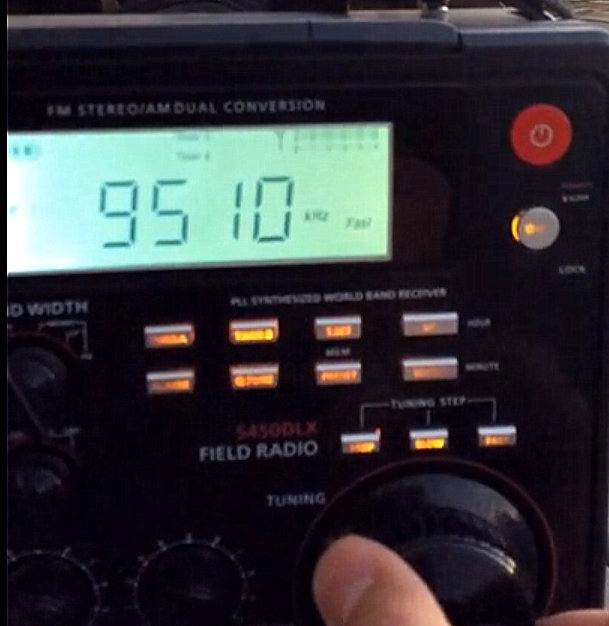
While the audio sounds identical to that of UVB-76’s on 4,625 kHz. I strongly suspect this is simply a pirate radio station relay–especially since it’s broadcasting just below the 40 meter ham radio band. Either way, it’s a great catch! Thanks for sharing, Andrea!
In August, foreign ministers from 10 nations blasted China for building artificial islands in the disputed South China Sea. As media around the world covered the diplomatic clash, a radio station that serves the most powerful city in America had a distinctive take on the news.
Located outside Washington, D.C., WCRW radio made no mention of China’s provocative island project. Instead, an analyst explained that tensions in the region were due to unnamed “external forces” trying “to insert themselves into this part of the world using false claims.”
Behind WCRW’s coverage is a fact that’s never broadcast: The Chinese government controls much of what airs on the station, which can be heard on Capitol Hill and at the White House.
[…]A typical hour on most stations begins with a short newscast that can toggle between China news and stories about violent crimes in the United States. Besides the overtly political coverage, topics range from global currency fluctuations and Chinese trade missions to celebrity wardrobe analysis and modern parenting challenges.
[G&E president and CEO James Su] declined to describe how he makes money when most of the U.S. stations air virtually no commercials. He also declined to say how he got the money to finance his radio leases and acquisitions.
His stations, Su said, offer the American public an alternative viewpoint on Chinese culture and politics. He has “no way to control” what CRI broadcasts on the stations, he said, nor is he part of any plan to spread Chinese propaganda.
“We are only telling the unfiltered real news to our audience,” he said.
On Oct. 29, WCRW carried a program called “The Hourly News.” Among the top stories: Senior Chinese and U.S. naval commanders planned to speak by video after a U.S. Navy ship passed close by China’s new artificial islands in the South China Sea.
Washington and its allies see the island-building program as a ploy to grab control of strategic sea lanes, and the Navy sail-by was meant to counter China’s territorial claims.
WCRW omitted that side of the story.
The admirals are holding the talks, the announcer said, “amid the tension the U.S. created this week.”
Many thanks to Chris Smolinski, from the HF Underground, who has crunched some numbers from North American pirate radio loggings on Halloween. The number of pirates (and his charts with times and frequencies) are most impressive and informative.
Chris posted the following on the HF Underground and has kindly allowed me to share them here as well. Chris notes:
Here are two charts showing who-was-on-when-and-where this Halloween.
Many thanks to SWLing Post contributor and noted DXer, Guy Atkins, for the following guest post:
Wellbrook 1530LNPro vs ALA1530S+ Imperium Loop Antennas
-Guy Atkins
This past weekend I found some interesting results from medium wave DXing with both models of Wellbrook Imperium loop antennas at the “fabled” Rockworks cliffs near Manzanita, Oregon USA. This location has become popular the last few years with Oregon, Washington, and British Columbia DXers due to the signal enhancement at this narrow strip of land approx. 450 feet above the Pacific ocean. The main benefit seems to be splatter reduction of “pest” stations due to the signal blockage of the rock walls blasted into the cliffs for the coastal highway 101. However, a boost of signals around local sunrise is also beneficial, and is a common occurrence near salt water beaches.
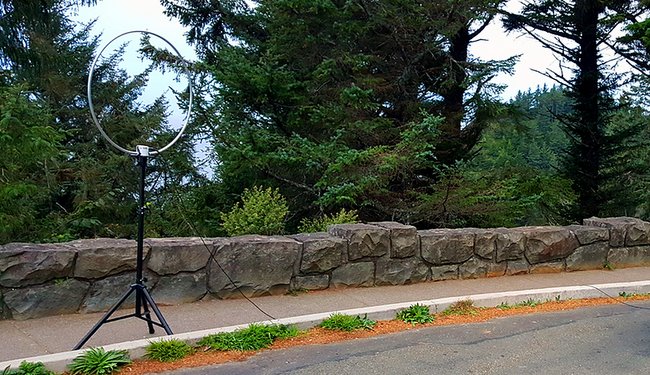
Because of the limited space along this scenic coastal highway, all antennas used for DXing need to be both compact and temporary. Wellbrook loops supported on pro-audio speaker stands are a great way to go, and can easily be set up in the pre-dawn darkness.
Comparison
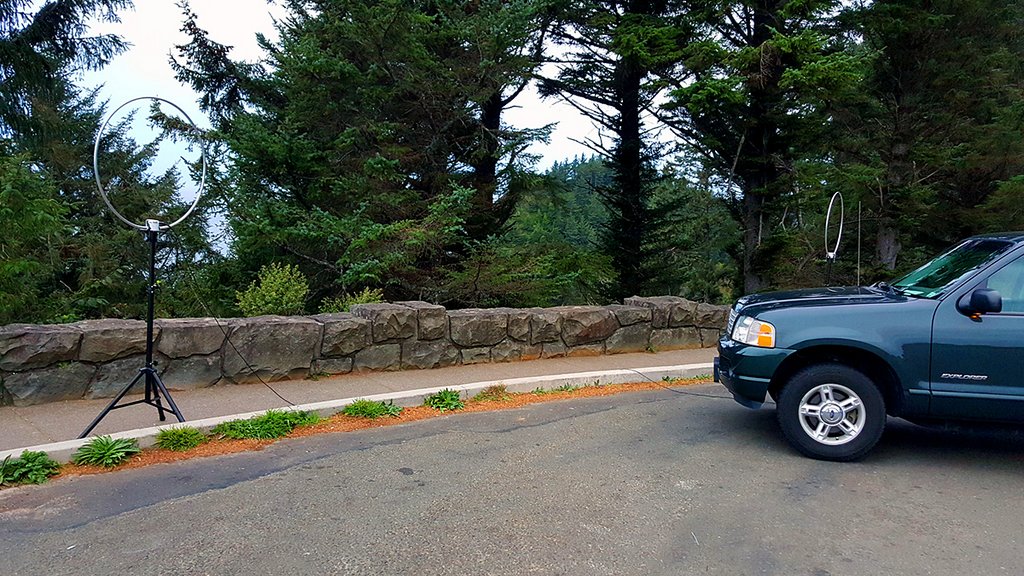
Both Wellbrook loop antennas mounted on “pro-audio” tripod stands right at the cliff edge at Rockworks Cliffs. (Photo: Guy Atkins)
This is a comparison file of weak signal reception with the two models of Wellbrook Communications “Imperium” series loop antennas: the ALA1530LN “Pro” Imperium and the ALA1530S+ Imperium.
Both models of compact, 1-meter dia. active loops are excellent for reception from longwave & medium wave upwards. However, the ALA1530LN “Pro” excels at LW & MW with its low overall noise level and 9dB higher gain, engineered by Wellbrook for improved signal-to-noise ratio (S/N) of up to 10 dB. S/N on the HF bands is reportedly better also.
My laptop running HDSDR software in my SUV; the receiver is an Elad FDM-S2. (Photo: Guy Atkins)
On the weekend of October 24th, 2015 I was DXing at the “Rockworks” cliffs on the Oregon coast near Manzanita, OR. Both of these Imperium series antennas were in use and I was recording the medium wave band with an Elad FDM-S2 SDR receiver. Both antennas were fed with identical 25 ft. lengths of RG-58 coaxial cable.
The demonstration in this video begins with 10 seconds using the ALA1530LN Pro Imperium loop, alternating with 10 seconds with the ALA1530S+ Imperium loop.
The first signal tuned is aviation voice beacon “SQM” from Level Island, Alaska on 529 kHz (400 watts). The signal is weak, but audible as it rises above the noise floor. The reception improvement with the ALA1530LN Pro is evident.
Half way through the recording the frequency is switched to 1710 kHz, where an unidentified station (possibly a MW pirate) is audible playing the 1967 Zombies tune “Time of the Season”. Again, the clip starts with 10 seconds with the ALA1530LN Pro alternating with 10 seconds of the ALA1530S+ Imperium.
Each antenna is a worthy, compact loop for DXing, but for chasing the weakest signals with the best readability I think the ALA1530LN Pro shows its advantages.
Many thanks, Guy, for sharing your loop research!
What I love about your portable SDR set-up, is that you can go to the cliff side, set up your antennas and equipment, record the spectrum on your SDR, then go back home to analyze and listen to what you captured. It takes some of the pressure off while you’re on-site.
This year at the Dayton Hamvention, I purchased the Pixel Technologies RF PRO-1B mag loop antenna. I used it (for the first time) at the PARI DXpedition. We were all impressed with its performance. I would love to compare it with the ALA1530LN Pro at some point in the future.
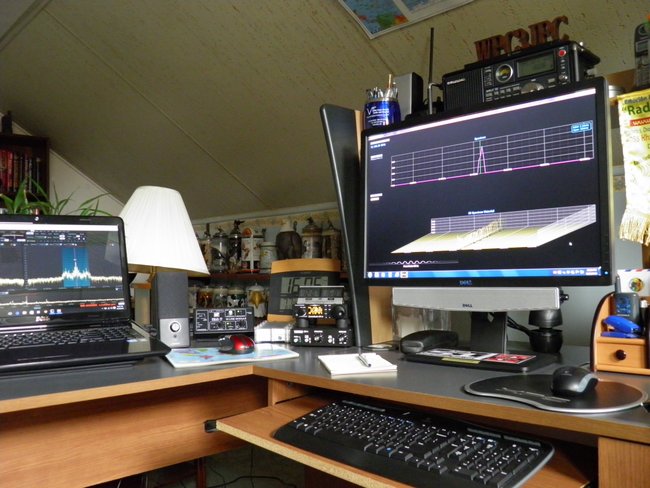
In exchange for sharing a photo of your favorite listening post or your radio shack with the SWLing Post community, you’ll be entered for a chance to win a Grundig G2 portable radio/recorder and player! The choice will be made by random selection, so everyone has an equal chance of winning.
Yesterday, Tony (K3DY), shared a video (via Twitter) demonstrating his new home brew loop antenna and amplifier.
This is actually a great demonstration of how even a relatively simple, inexpensive loop antenna can improve reception in locations with heavy radio interference. Tony includes the following notes with his video:
“Testing a new receiving loop antenna that I built today. It uses a pre amplifier based on deferential setup of two 2N5109 transistors. Loop is made out of coaxial cable, only the shield is connected to the circuit.
Quick demo on 31 meters, lots of stations at sunset time. No time for further testing but I observed a pronounced directivity below 7 MHz. 75 meters is so quiet that it makes me forget I live in a townhouse. As a comparison, my noise level on 75 meters is at S8 on an end fed [antenna].
I will use this loop primarily for SWLing purposes but I may use it as a separate receiving antenna with my amateur radio equipment.
A lot of fun, loops are fascinating and efficient!
Indeed, Tony! And perhaps the icing on the cake is that loop antennas are so portable, low-profile and easy to deploy. They’re ideal for those living in restricted areas and with picky home owners’ associations.
Inspired by my buddy Vlado (N3CZ), I’ve actually been collecting the pieces to build my own mag loop antenna this winter. I doubt the parts for my loop will exceed ten dollars as I plan to use the shield of some heavy coax for the primary loop and a little PVC for support (much like Tony’s loop).
Tony’s video is inspiring me to go a step further and also build a simple amplifier. Any suggestions or schematics for doing so are most welcome!