“Father Knows Best” episode features shortwave radio

Many thanks to SWLing Post contributor, Dave Zantow (N9EWO), who notes the following episode of “Father Knows Best” (link below) features shortwave radio. Dave also points out that the website streaming this episode can be somewhat slow to load, but is very watchable.

Click here to view on Shout Factory TV.

Thanks for the tip, Dave!

Waffle House Tee: “Proudly Serving Ham Radio Operators”

Many thanks to SWLing Post contributor, Robert Yowell, who writes:

Thomas – while I was in Dayton last month (after Hamvention), I stopped in a Waffle House and noticed all the workers were wearing the same T-Shirt which had emblazoned on the back “Proudly Serving Ham Radio Operators”!

I asked if the shirts were for sale and was told I needed to contact the regional office in Huber Heights which handles all Dayton area Waffle Houses. It turns out that for the past decade or so, every year in June the Waffle Houses in the Dayton area would have their employees wear shirts to honor Hamvention.

I was told the designs and colors are different every year, but this is what this year’s shirt looks like. They sold it to me do $18 including shipping!

Thank you, Robert. The connection between the Waffle House and Ham Radio has been a mystery to me and you’ve solved it! Each year at Hamvention, like you, I see Waffle House shirts floating around everywhere. Thanks for sharing!

RTÉ longwave service temporarily suspended

(Source: Southgate ARC)

RTÉ on 252 Khz is now off air for a possible 10 weeks or so and in the UK we can hear signals from Algeria Chaine 3 even now in the middle of the day.

Earlier this year the chair of Ireland’s Oireachtas Communications Hildegarde Naughton TD (Galway West and South Mayo) announced that a major antenna upgrade will ensure the transmission of RTÉ on long-wave will continue for at least the next two years.: “The maintenance of long wave radio for the Irish diaspora is a significant concern to the Committee.”

She announced that service will have to be “temporarily suspended” for approximately ten weeks, but RTÉ has said it will endeavour to complete the works as quickly as possible.

“I welcome the efforts being made to continue this service, which serves as an invaluable link between the diaspora and home,” she added.

See http://www.theirishworld.com/reprieve-for-rte-longwave/

Can someone ID this Singer Eaton magnetic loop antenna found on eBay?

Many thanks to SWLing Post contributor, Dan Robinson, who shares a link to this 31″ Singer Eaton loop antenna found on eBay.

The seller knows nothing about this antenna, but did provide some detailed photos of the connector and product information sticker:

This loop obviously came from US government inventory based on the sticker. It looks to be quite robust and sports one of the balanced antenna connectors found on rigs like the Hammarlund SP-600. I’m guessing this loop might be fixed-frequency as I see no tuning section with a variable capacitor.

Can any SWLing Post readers shed a little light on this loop?  Have you ever used one? Please comment! 

IEEE Spectrum: “Is Ham Radio a Hobby, a Utility…or Both?”

Many thanks to a number of SWLing Post readers who have shared a link to the following article that follows the debate and discussion over an FCC proposal–RM-11831 (PDF)–to “Reduce Interference and Add Transparency to Digital Data Communications.”

The IEEE article, written by Julianne Pepitone, covers both sides of the debate:

Is Ham Radio a Hobby, a Utility…or Both? A Battle Over Spectrum Heats Up

Some think automated radio emails are mucking up the spectrum reserved for amateur radio, while others say these new offerings provide a useful service

Like many amateur radio fans his age, Ron Kolarik, 71, still recalls the “pure magic” of his first ham experience nearly 60 years ago. Lately, though, encrypted messages have begun to infiltrate the amateur bands in ways that he says are antithetical to the spirit of this beloved hobby.

So Kolarik filed a petition, RM-11831 [PDF], to the U.S. Federal Communications Commission (FCC) proposing a rule change to “Reduce Interference and Add Transparency to Digital Data Communications.” And as the proposal makes its way through the FCC’s process, it has stirred up heated debate that goes straight to the heart of what ham radio is, and ought to be.

The core questions: Should amateur radio—and its precious spectrum—be protected purely as a hobby, or is it a utility that delivers data traffic? Or is it both? And who gets to decide?

Since Kolarik filed his petition in late 2018, this debate has engulfed the ham world. Fierce defenders of both sides have filed passionate letters and comments to the FCC arguing their cases.

On one side is Kolarik in Nebraska. In his view, it’s all rather simple: “Transparency is a core part of ham radio,” he says. “And yet, you can find tons of traffic from automatic[ally controlled digital] stations that are extremely difficult to identify, if you can identify them at all, and they cause interference.”

The automatically controlled digital stations (ACDS) Kolarik refers to can serve to power services like Winlink, a “global radio email” system.

Overseen and operated by licensed volunteers around the globe, Winlink is funded and guided by the Amateur Radio Safety Foundation, Inc. (ARSFI). The service uses amateur and government radio frequencies around the globe to send email messages by radio. Users initiate the transmission through an Internet connection, or go Internet-free and use smart-network radio relays.

On Winlink’s website, the service says it provides its licensed users the ability to send email with attachments, plus messages about their positions, and weather and information bulletins. Representatives of the service say it also allows users to participate in emergency and disaster relief communications.

But Kolarik’s petition argues two points: First, because such messages “are not readily and freely able to be decoded,” the FCC should require all digital codes to use protocols that “can be monitored in entirety by third parties with freely available, open-source software.” Secondly, he wants the rule change to reduce the interference that he says services like Winlink can create between amateur-to-amateur stations—by relegating the often-unattended automatic stations to operate solely on narrower sub-bands.

Loring Kutchins, the president of ARSFI, says he believes Kolarik’s petition is “well intentioned in its basis. But the fundamental conflict is between people who believe amateur radio is about hobby, not about utility. But nowhere do the FCC rules use the word ‘hobby.’”[…]

Click here to continue reading the full article on the IEEE Spectrum website.

“Night of Nights” CW Event Returns Tonight!

Many thanks to SWLing Post contributor, Brian Smith (W9IND), who shares the following announcement:

“Night of Nights” CW Event Returns Friday (U.S. Time) 

“It was 20 years ago today,” say members of the Maritime Radio Historical Society, but they’re not covering a famous Beatles song.

They’ll certainly be on key, however, when they fire up two maritime CW stations, KPH and KFS, and their amateur radio club station, K6KPH, for the 20th annual “Night of Nights” at 8:01 p.m. Eastern Time on Friday, July 12/0001 UTC Saturday, July 13. (Alas, several previously participating stations will be absent again this year, including ship-to-shore stalwart WLO of Mobile, Alabama, and a quartet of Coast Guard stations.)

This weekend’s event marks the date in 1999 when commercial Morse code operations ceased in the United States. One year later, the preservation-minded MRHS staged its first “Night of Nights,” treating shortwave radio enthusiasts to the dits and dahs of historic maritime station KPH and other callsigns that were once presumed dead on shortwave CW frequencies.

This year, the society has put out a special appeal to anyone (licensed or not) with CW proficiency to help operate K6KPH. While KPH and KFS transmit “code wheels” (repeating messages), personal messages, and tributes to long-gone maritime stations and operators, K6KPH will make CW contacts with other amateur stations on 3550, 7050, 14050 and 21050 kHz.

Whether reporting for CW duty or not, the public is welcome to observe today’s event and tour the facility, located at 17400 Sir Francis Drake Boulevard in the Point Reyes National Seashore. Doors open at 3 p.m. local (Pacific) time.

And if you’re not within driving distance, you can tune in the Morse signals on the following medium wave and shortwave frequencies:

KPH:  426, 500, 4742.0, 6477.5, 8642.0, 12808.5, 17016.8, 22477.5 kHz

KFS:  12695.5 kHz

Reception reports go to P.O. Box 392, Point Reyes Station, CA 94956. Please include an SASE if you’d like a QSL.

The following links provide additional information:

Maritime Radio Historical Society: 

http://www.radiomarine.org

http://campaign.r20.constantcontact.com/render?m=1109843077277&ca=156b371f-da9f-4fed-8819-4bb55bd7bd44

http://campaign.r20.constantcontact.com/render?m=1109843077277&ca=b54f353c-4692-4564-b79a-0059721f9206

National Park Service: https://www.nps.gov/pore/planyourvisit/events_nightofnights.htm

Okay, Brian…that “being on key” bit? Clever! 🙂

Looking forward to some sweet CW music on the Night of Nights! Thank you for sharing!

Using amplified loop antennas with portable radios?

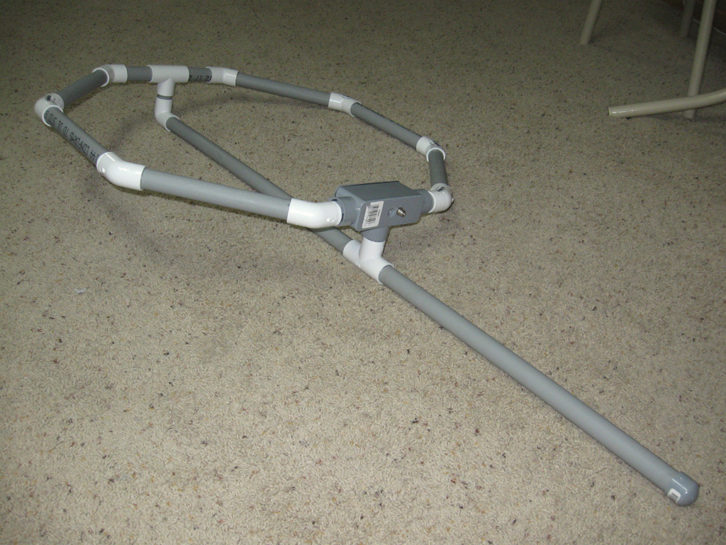
SWLing Post contributor, Klaus Boecker, sports a homebrew magnetic loop antenna on his balcony in Germany.

Many thanks to SWLing Post contributor, Marty, who writes:

I have a question about loop antennas; specifically which type is “better,” passive magnetic loops or active electric loops?

I know, “It depends.”–?

I live in a ground-floor apartment, with a small porch, lots of RFI and restrictions against visible antennas. Also there are no trees within 75 ft of my porch, which faces on a parking lot. My radio is a Tecsun PL-660, which works okay inside with my 10-ft bare wire antenna hidden on the porch.

With a loop antenna, I’d like to mount the antenna on the porch at night and have a remote tuner/control inside because it’s very hot n humid here in Louisiana even after dark.

No doubt there are a number of magnetic loop antennas that could serve you well in your situation, Marty.

To answer your first question, though, you should search for a wideband amplified loop antenna since you’re only concerned with receiving.

Passive loops are great antennas on the shortwave bands–and easy to build–but they best serve ham radio operators who wish to transmit. Passive loops typically have a very narrow bandwidth that requires the operator to constantly tune the antenna when they tune the radio a few kHz. Most amplified wideband loops need no separate tuning mechanism.

Last year, I posted an article about choosing the right loop antenna for situations like yours where one has limited installation options.

Click here to read : Shortwave antenna options for apartments, flats and condos

Portables and amplified loops?

I do hesitate to encourage you to invest in an amplified loop antenna when your only receiver is a Tecsun PL-660. Some portables don’t handle amplified antennas well–they can easily overload and I imagine you can even damage the front end of the receiver.

I’m well aware, however, that there are a number of readers here who do couple their portable radio to an amplified loop. I have connected a number of portables to large wire antennas and found they could easily handle the extra gain, so I imagine an amplified loop would perform as well; the Sony ICF-SW7600GR, Tecsun S-8800, and Sangean ATS-909X come to mind.

But the PL-660 is a hot little receiver even with the built-in telescopic antenna–I’m not sure if amplification would help or hinder.

Please share your experience

This is where I hope the amazing SWLing Post community can pitch in and help us out here!

Does anyone here regularly connect their PL-660 to an amplified loop antenna? If so, what model of antenna are you using? Are there other portables out there that you regularly connect to amplified loops? Please share your notes, thoughts and experience in the comments section.

Thank you in advance!


Do you enjoy the SWLing Post?

Please consider supporting us via Patreon or our Coffee Fund!

Your support makes articles like this one possible. Thank you!