Tag Archives: Shortwave Radio

Vote: Support the production of a car shortwave radio

c300 photo in operation

SWLing Post contributor, Fred Studenberg, recently contacted me about an ingenious car (mobile) shortwave radio he’s designed. Though originally designed for his own personal use, Fred’s now considering initiating a production run of the radio for the commercial market. To do so, however, he needs funding to help pay for parts, and this is where we can help:  by voting for his shortwave car radio design in this contest–! Fred writes with details about his radio:

I wanted a high performance shortwave receiver in my car without the clutter of a separate unit under the dash.  It had to be easy to tune stations and not require any modifications to my car’s built-in radio and audio system.   I looked everywhere, and there was nothing that even came close to meeting my requirements.

Being a retired RF communications engineer, I set about designing a high performance digital radio.  It installs remotely in the trunk or hatchback area and broadcasts tuned shortwave audio to your car FM radio.  No modifications at all to the car radio or FM system are required.  It is powered right off your car’s power plug.

new bst photo

Operation is simple: tune your car FM radio to 88.1 or 88.3 and use a small handheld wireless key fob controller to scan through the 100 preset channels.  You have access to full shortwave band coverage in 5 KHz tuning steps with excellent sensitivity and selectivity.  There is even a digital noise blanker to eliminate spark plug ignition interference.   You can also manually scan to find new stations to add to preset memory, quick tune to WWV for time checks, and even switch the audio bandwidth for voice or music.

If your FM radio has RDS display you can see the tuned shortwave frequency as well as a digital “S” meter.  If your car radio does not have RDS, it still works.  Just press the scan button on the wireless controller until you hear something interesting or go into manual mode and scan the various shortwave bands listening for something of interest.

This started as a project just for my use, but after I showed it to a few people, I was encouraged to make it commercially available.   I’ve entered it in a design contest that will provide $10,000 worth of parts to help launch a production run.

You can see full information on the radio at www.carshortwaveradio.com and there is a link right at the top to take one to the voting site, or go directly to the voting site at Your IoT and look for the car shortwave radio entry.

If readers are interested in seeing this in production, indicate your interest by voting.  You have to vote by logging in with your Facebook account, which presumes you have a FB account–if not, they are easy to set up, and you can use a pseudonym and leave out all the personal info they ask [for] at signup.

I voted for Fred’s design earlier today. It does require using your Facebook login to vote, but the contest site can only read the public profile you choose to provide, and–if you allow it–your email address.

If you have a Facebook account, please consider helping Fred out by voting for his shortwave car radio design!

Click here to vote!

An eBay caution: some sellers are out for a buck–or hundreds

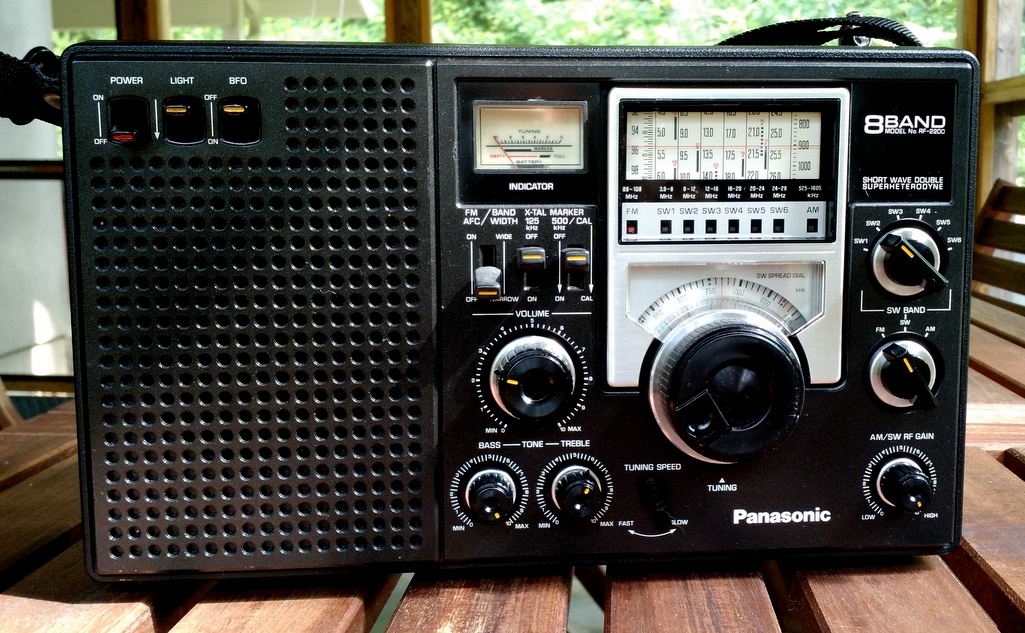
RF2200
SWLing Post contributor, Dan Robinson, has recently noticed exorbitant prices demanded by certain sellers on eBay. Dan writes:

As readers of SWLing Post know, Ebay prices–at least asking prices–can often go completely off the scale.

While it’s true that prices can be as high as the market will bear, some recent examples are cases in point. The RF-2200 by Panasonic was an amazing radio for its time, competing with the SONY 5900W and some other models back in the early days of sophisticated portables. The 2200 was known, and is still respected, for its directional AM loop antenna, and is a prized part of the stables of many SWL’s today.

But let’s face it…only a 2200 found new-in-the-box, or in [like]-new condition, should fetch anything over $250-300. Other examples recently include a DX-302 for which the owner was seeking something like $1200. Price inflation has also been seen with SONY ICF-6800Ws. The [difference] with these sets is that they truly are in new or 10.0 condition, worth several hundred dollars.

New SONY ICF-2010s–[and] there are still some circulating that are new-in-the-box or in [like]-new condition–can and do bring prices north of $400, sometimes more. So do new-in-box SONY ICF-SW100s if they are complete with all accessories, in the box–but beware, they should be the newer modified versions and not the old version (you can tell this by looking at the hinge on the SONY, which should have a notch to indicate the revised version of the radio).

Another classic portable that deserves somewhat higher pricing is the Panasonic RF-B65. In [new-in-the-box] condition, these can go for more than $300.

So, [unless] you’re seeing astronomically high prices for RF-2200s, stop and think about it. These are old portables, and you should not be paying exorbitant prices–UNLESS you [encounter] a time capsule with a radio in the box that was never used. Even so, buyers need to ask multiple questions of sellers to protect yourself.

I agree completely, Dan. If you want to purchase an item at a fair market price or even a bargain, you must do your research before simply using the “Buy It Now” option on eBay. There are plenty of sellers who charge fair prices still; leave the stratospheric-priced items on the eBay shelf.

Tecsun-PL-365-Ebay-Crazy-Price

A case in point (above): never mind the grammar error in the above listing, the $125 “Buy It Now” price for the Tecsun PL-365 is frankly excessive. The PL-365 is identical to the CountComm GP5/SSB–a radio I recently reviewed–and is available new from Universal Radio for $79.95 plus shipping. And since there are currently no other listings for the PL-365 on eBay (I’m not sure why) this price might appear reasonable to a new buyer.

This same seller initially offered the Tecsun PL-365 for a much higher price–in excess of $180, I believe. While this seller has excellent ratings, and no doubt would stand behind the product, the markup is simply too high for me to endorse (hence, no eBay link here).

In the past, I’ve also noted a semi-rare vintage radio–a “boat anchor” variety with a market price of perhaps $1,500–up for auction with a first bid amount in excess of $20,000 US! Yet I felt confident of the $1500 market price because I checked and cross-referenced it in Fred Osterman’s Shortwave Receivers Past & Present, which provides fair market values.

So, while I continue to support eBay, which remains one of the most secure platforms from which to buy unique and vintage goods on the open market, I want to encourage readers to heed Dan’s warning: research all pricing before making radio purchases on eBay…and keep the holes out of your pockets. Note that I will never directly link to unreasonable eBay listings.

SWLing Post DXpedition at PARI is all systems go!

DSC_0884Some of you may recall a post I published last year regarding a shortwave and medium wave DXpedition at the Pisgah Astronomical Research Institute (PARI), a 200-acre radio astronomy observatory and former NASA tracking station located deep in the mountains of western North Carolina.

Since this is the first event of its kind, we’ve been working closely with PARI staff to put the DXpedition together.  And come together, it has.

I’m pleased to announce that we’ve now received the official go-ahead: we’re clear to launch the (first-ever!) 2015 SWLing Post DXpedition, which will take place Friday, October 9, through Sunday, October 11.  Come join us!

PARI will soon post the official registration form on their website; of course, I’ll post an update when this form is ready.

Meanwhile, those of you who may be interested in attending, keep reading…and do join our dedicated email discussion group (more info below).

A few DXpedition details…

DSC_0916

As I mentioned last year, PARI has agreed to handle all of the event’s arrangements, and will even provide a limited number of basic shared dormitory rooms to the first registrants who request them. An event fee will pay for facilities and PARI staff (see below); modest profits, should there be any, will benefit PARI’s worthy science education mission.

We are fortunate to be sharing the beautiful PARI campus with with a larger party of amateur astronomers, aka, a “star party,” taking place the same weekend; the DXpedition will benefit from this in terms of expanded facilities access. An additional benefit is that we can share our passion for radio with members of the star party, while learning a little about astronomy from their members.  And for those of us who enjoy both, all the better.

Costs

The costs associated with the event are as follows:

Registration fee: $100

Lodging: On campus, the fee is $50 per night, per person, in a shared dormitory room; or $20 per night, per tent or travel trailer (no hook ups, though electricity is available). Want to come along, but not interested in roughing it? You’ll find numerous comfortable hotels and inns within a 30-40 minute drive of PARI’s mountain campus.

Meals: Catered meals will be provided for a modest charge to be determined (PARI is working with local food services to arrange our meals currently). Of course, you can always bring your own food and prepare it on-site, as well.  The campus has a lunchroom with a microwave.

The PARI campus and accommodation

DSC_0934

PARI was formerly a NASA tracking station, and following that, a Department of Defense monitoring facility.  Because of the remote nature of the campus, basic on-site dormitories were built; scientists use these throughout the year as they conduct their research, and the shared rooms are available upon request.

Typical PARI dorm room (click to enlarge)

Typical PARI dorm room (click to enlarge)

The dormitories are conveniently located in the heart of the 200-acre campus, and sleep about four to each room.  These are simple facilities, and no private rooms are offered. Bathrooms (with showers) are shared, and separate buildings house men and women; thus the dormitories may not be the best option if you plan to bring a spouse, a large family, or young children.

Of course, if you enjoy camping and/or star-gazing, you can pitch a tent (just $20/night), or park your travel trailer on campus (also just $20/night). Note that this is not a travel park, thus hook-ups for travel trailers are not supplied, although power is available.

For those who prefer not to camp or stay in a shared room, the nearby mountain town of Brevard, NC (approximately 35 minutes from PARI by car) is a charming small town offering numerous hotels, bed-and-breakfasts, and other comfortable private accommodations. PARI often recommends the Hampton Inn in Brevard, NC. Hotels.com and AirBnB offer alternatives.

Receivers, antennas, and other radio equipment

DSC_0904DXpedition participants should bring their own receivers, antennas, and accessories. If you wish to bring an SDR or tabletop receiver, there are quite a few places on campus where you’ll have access to power. At least one main listening post will be set up under cover, as well, for our participants.

Feel free to bring any type of receiver you like. A few potential participants have noted that they plan to bring a portable receiver only, and that’s absolutely fine–this is your DXpedition, your chance to sit back and listen to your radio without distraction, so any radio you choose to bring is the right one.

Of course, a few SDRs, tabletops, and portable receivers will be available for participants to try out, so if you can’t bring your own receiver, please let me know in advance; I’ll try to reserve a time slot for you to use one of the available rigs.

SWLing Post DXpedition email group

DSC_0838

We have created an email discussion group for the DXpedition. If you are seriously considering joining the DXpedition, click here to become a member of the group as this is the place where we’ll organize and make further plans.

Since this is the first time the SWLing Post and PARI have sponsored a DXpedition, we’re certainly trail-blazing here. My sincere hope is that this event will lead to future DXpeditions…not to mention, real friendships among our readers and fellow SWLers.

Looking forward to the DXpedition–we’ll see you at PARI in October!

Lewis Bush seeks London radio listening posts

Crosley-Dial-BlackAndWhitePhotographer, Lewis Bush, is seeking ham radio stations and shortwave listening posts in the London, England area. Lewis writes to the SWLing Post:

I’m working on a project which involves trying to locate and map possible broadcast sites for numbers stations (confirmed, suspected, and some highly unlikely) for an eventual book on the subject. These satellite maps (22 in total) are going to be displayed alongside spectrograms of an assortment of shortwave broadcasts and noise, but the final element of the project which I’d really like to include are photographs of ham shacks and shortwave radios themselves.

These photographs would be without people in them and could be as anonymised as the owners like. It’s also not important to me whether the owners are themselves interested in numbers stations. The main thing I’m interested in is really the equipment and the spaces that people listen from.

You can read a little more about the project and see some sample images here: http://www.lewisbush.com/category/numbers-in-the-dark/

If you’re willing to help Lewis, please contact him via email:  [email protected]

Art Bell’s “Midnight In The Desert” to be broadcast on shortwave via WTWW and WBCQ

MidnightInTHeDesert

Many thanks to SWLing Post reader, Mike, who informs us that Art Bell is returning to the airwaves with a new radio show called Midnight in the Desert. Like Coast to Coast AM, (which Bell retired from several years ago) Midnight in the Desert will also focus on paranormal activity.

Mike also points out that Bell has also announced Midnight in the Desert will be broadcast on WTWW (5,085 kHz).  WTWW will start airing the show July 20, 2015 from 9:00 pm – Midnight Pacific time.

Indeed, after looking at the list of radio stations rebroadcasting Midnight in the Desert, I noted that WBCQ, in Maine, will also carry the show on 7,490 and 9,330 kHz.

For more information and updates, check out Art Bell’s website.

Thanks for the shout out, Click!

BBC_ClickSome of you may recall this recent post about listening to the BBC World Service program, Click, via shortwave radio.

SWLing Post contributor, Richard Langley, discovered that Click hosts Gareth Mitchell and Bill Thompson mentioned his shortwave research at the conclusion of the show’s most recent episode.

The podcast of this episode, which focuses on the Nepal Quake Project, is available online and well worth hearing.

Richard also kindly provided us with this brief audio excerpt from Click during which the hosts discuss shortwave radio:

When held captive, radio provides escape

Analog Radio DialMany thanks to Any Sennitt who shares a link to this article by Telegraph journalist, 

(Source: The Telegraph via Andy Sennitt)

Along with the glaciers of the Arctic and the sand dunes of the Sahara, northern Somalia is one of the loneliest, most godforsaken places I’ve ever visited as a foreign correspondent. You can wander its Arizona-like landscape for days without seeing another soul, and when I was held hostage there in 2008, I could see why so many British troops posted to Somalia after the Second World War committed suicide through loneliness.

That I did not succumb to the same urge is thanks to many factors – one being the good cheer of the photographer held captive alongside me, another being the Telegraph’s heroic efforts in securing our release.

But during the six weeks we spent held at gunpoint in a cave, one thing that stemmed the despair was the tiny, battery-operated radio that our kidnappers sometimes lent us. On the short wave channel we could get a faint BBC World Service signal, and while it was often fuzzy as it bounced round the cave’s walls, it was better than yet another game on our chess set made from cigarette foil.

So I’m pleased to hear that this lifeline is now being extended to inmates of another, much larger prison – the 25 million citizens of North Korea, who are denied access to any outside media by their leader, Kim Jong-un. As the Telegraph disclosed on Thursday, the World Service is to plan a new North Korea channel, giving the country’s brain-washed citizens a much-needed alternative to the relentless propaganda of the world’s last Stalinist regime.

[Continue reading at The Telegraph…]