Shortwave listening and everything radio including reviews, broadcasting, ham radio, field operation, DXing, maker kits, travel, emergency gear, events, and more
Many thanks to SWLing Post contributor, Tom (DF5JL), who writes:
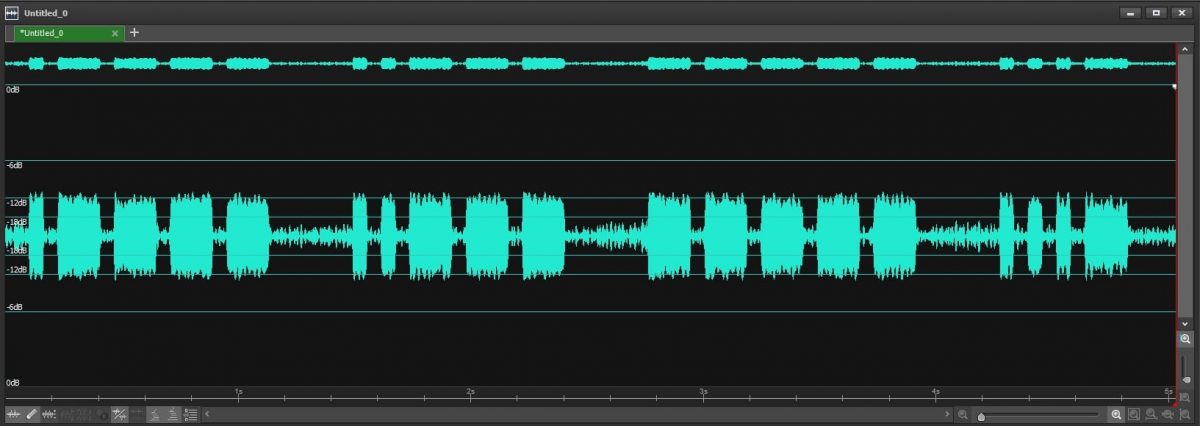
At the end of last year it appeared for the first time: a telemetry transmitter in CW on 7039.60 kHz. It always transmits at the 2nd, 22nd and 42nd minute of every hour. Every day.
Reception reports are available from Germany, the Netherlands, France and Greece. Three numbers and a V are transmitted ten times in succession, as follows:
During the day the values increase, in the afternoon they decrease. It is assumed that voltage values are transmitted here, i.e. “121V” would correspond to 12.1 volts. You can listen to a recording here:
Any idea?
73 Tom
Thank you, Tom.
Post readers: If you can shed some light on these transmissions, please comment!
Many thanks to SWLing Post contributor, Dan Robinson, who shares the following guest post:
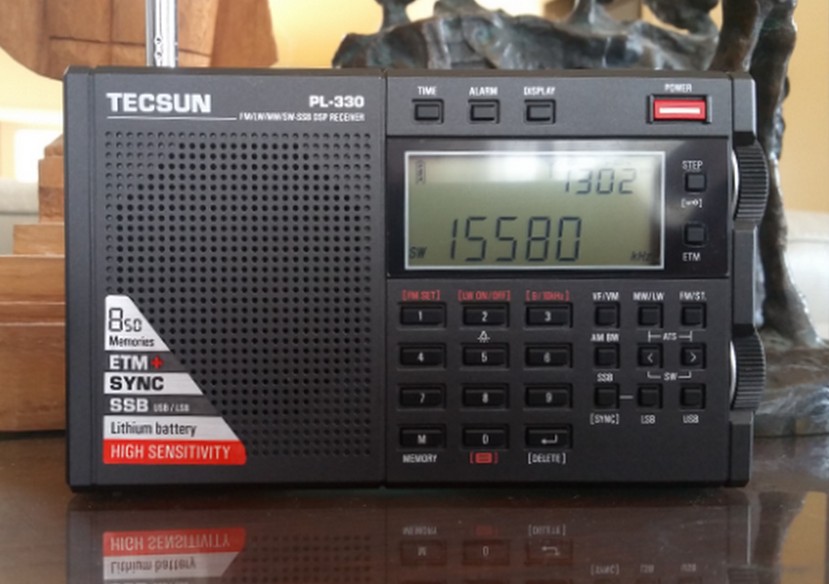
Tecsun PL-330: The Powerful Mini With One Serious Design Issue
by Dan Robinson
As SWLing Post readers know, I have a huge radio collection – including premium receivers and portables, now nearly 100 in all.
So, these days I am hesitant to add too many, but I continue to take interest in what companies such as Tecsun and Sangean are doing in the way of stuffing the latest chip technology and capabilities into portables radios.
The last receivers I reviewed included the Tecsun PL-990x, which has developed quite an enthusiastic following since its consumer version was released in 2020, and the Tecsun S-8800.
Out for some time now is the Tecsun PL-330. By now there are many reviews of it on You Tube and elsewhere.
It’s become a familiar observation for many of us – if this were still the 1960’s and 1970’s – even into the 1980’s, which could be considered the golden days of shortwave and we had receiver technology like this, well what a joy that would have been.
When I traveled around the world both before and after college, and professionally for Voice of America in the 1980s and 1990s, wow what a good time I could have had with today’s portables!
Some world band portables radios back then were superb performers. The Grundig Satellit series 500/700/600/650 come to mind – but these were not exactly what I would call small portables.
Paging through Passport to Worldband Radio from 1990 (wow, that’s 30 years ago!) you see others such as the SONY SW-1, Panasonic RF-B65, and of course, the SONY ICF-2001D/2010 which introduced killer synchronous tuning technology in the 1980s and remains popular today decades after it first appeared.
Also available were the SONY ICF-SW55 and later in competition with the 2010, the SONY ICF-SW77. Today, I have four SW-55s and two SW-77s and still use them regularly.
Tabletop receivers back in the good ol’ days offered multiple selectivity positions. One of those was the Lowe HF-225 (and later Europa version) along with the HF-250, Kenwood R-5000 and R-2000, ICOM IC-R71A, and Yaesu FRG-8800 among many others.
But as far as smaller portables go, features such as synchronous detection and multiple selectivity were still pretty limited, and a number of receivers didn’t offer selectable synchronous as was eventually offered on the Drake R8B and later production of the SW-8.
The RF-B65 by Panasonic – which today remains sought after for its amazing sensitivity – was hobbled by having a single selectivity position. Same with SONY’s SW-1 and SW-100, and 7600GR, though SONY’s PRO-80 had two bandwidths.
Indeed, it wasn’t until Eton brought out the E-1, with its three bandwidths combined with Passband Tuning (though no notch filter) that a portable finally reflected capabilities of some of the better tabletop radios (though lacking a notch filter).
The Grundig Satellit 800 was close in competition with the E-1 (though the earlier Sat 600/650 series also had multiple bandwidths) but was bulky.
Fast forward to 2021 – credit due to Tecsun and more recently to Sangean with its 909X2, for some years now we have enjoyed Asia-originated portables with multiple selectivity and synchronous mode, though sync implementation on some has left much to be desired.
Which is where the PL-330 comes in. When I look at the 330, I am reminded of one of the now ancient SONY portables, the ICF-4920 which was a super small slide-rule receiver that nevertheless was quite sensitive.
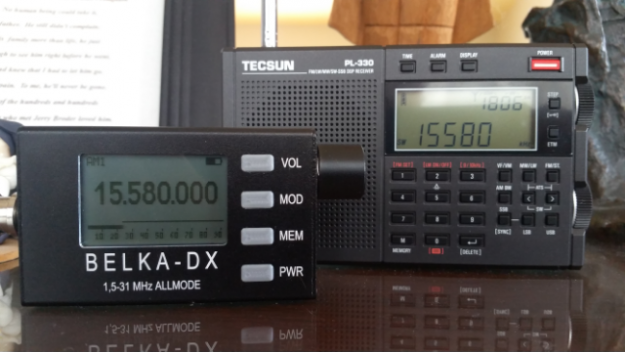
Like the 4920, which you could easily slip in a pocket, the PL-330 is a perfect travel portable. Only the Belka-DX SDR and still wonderful SONY SW-100 compete in terms of performance and size.
The 330 is basically a PL-990x in miniature: smaller speaker obviously, shorter antenna, no bluetooth capability or card slot. But as many people who frequent the Facebook groups have observed, pretty much anything the 990x can do, so can the 330.
This radio has ETM/ATS tuning, synchronous detection, multiple bandwidths in AM, SSB and MW, FM mono-stereo speaker control, alarm/timer functions, external antenna jack, display light, and other features.
Tecsun decided to go with a BL-5C battery here – the same with the new PL-368. I think this is unfortunate, since it requires one to obtain a number of those flat batteries if you want to travel and not have to re-charge. On the other hand, this is not a crippling design decision.
What is an unfortunate design problem, in my view, involves the simple question of tuning the receiver.
The main and fine tuning knobs on the right side of the PL-330 are embedded into the cabinet just far enough as to make easy rapid finger tuning of the radio nearly impossible.
In fact, in my testing it’s impossible to thumb tune the radio more than 10 kHz at a time. The same applies to using the lower knob which controls volume. When in FM mode, this issue make tuning just as frustrating almost forcing one to use rapid scan mode.
Another puzzler: Tecsun limited bandwidths in AM SW to three, while in SSB you have 5 bandwidth options. In AM mode, you have a 9 kHz bandwidth, another puzzling choice. Longwave too is limited to 3 bandwidths.
But overall, none of these problems really knock the PL-330 down very far. This is one mini powerhouse of a radio, one that makes you think “wow, if I had just had this back in 1967 or 1973 or 1982.
Some additional thoughts. My particular PL-330 was supplied by Anon-co but is a pre-production version and so does not have the latest firmware. Thankfully, I have not experienced the issue of SSB tuning running in reverse as others have.
NOTE: As most users know by now, but some newer users may not, you cannot charge one of these radios – whether Tecsun or Sangean – using the mini-USB port and use them at the same time. . . there is just too much noise introduced from the charging process.
This little mentioned feature: just as the Tecsun 909x has a re-calibration function, so does the PL-330. Tecsun itself initially declined to acknowledge this, but finally confirmed through Anon-co.
The procedure: Switch to LSB/USB. If the station is not zero beat, hit STEP button once and then quickly again to move the flashing display down arrow so it’s above the far right digit. Then fine tune the station for zero beat. Hold LSB or USB in for a couple of seconds. The LCD blinks. You then have zero beat – but be sure to repeat the process for LSB and USB.
I should mention that just like on the 990x, the re-calibration process doesn’t mean the receiver is then zeroed up and down the shortwave bands. You will likely have to repeat the process from, say 25 meters, to 19 meters, to 49 meters, etc.
I have come to enjoy using the PL-330 here in my house, though like other portables in my collection I need to position it in one particular corner of my home away from incoming cable TV lines.
The PL-330 and the Belka DX are currently king of the pile when it comes to my smaller travel portables.
I fully expect there will be no further receiver development by Tecsun after the PL-330/990x/H-510 radios – but that company will certainly have left us with some great receivers as the days of shortwave approach an end.
“Apparently, even stations with URLs stored locally on the radios as presets, will eventually stop working. The Reciva chips require a token to be renewed periodically from the Reciva server; once the server is turned off, the token can no longer be renewed, and the radio becomes a dead parrot. Apparently Reciva did this to prevent their chips from being pirated.”
Another contributor wrote:
“….when I asked Grace about it, their reply was that while the presets would work for a time, eventually even that function won’t work because the radios require a token to be renewed periodically from a Reciva server. If the server is gone and the token can’t be renewed, the radio becomes a doorstop. It wasn’t clear how long the radio will work…”
I don’t know if this is true or not (time will quickly show), but when I asked C.Crane about this a while back, they seemed aware of the possibility and their experts gave it a 50/50% chance of success/failure based on tokens.
Speaking with a very knowledgeable friend on the topic, he has described that the real, ultimate way to tackle this problem is to have a ‘packet sniffer’ and monitor all the traffic in/out of the network to understand what data is being used (like if there is a token for example) and reverse engineer what Reciva is doing.
Thank you for bringing this to my attention, Rob.
Tokens: Can someone prove or disprove this?
There are some savvy programmers, network specialists, developers, and hackers in the SWLing Post community. My hope is that someone can use a packet sniffer or similar device to determine if this is true or not. Since the Reciva service will close down by the end of the month, time is of the essence.
My hope is that if there is a token, it won’t shut down functionality to a point that we can’t stream from our own IIS or perhaps the token can be reverse-engineered. Or maybe there is no token at all, or if there is it will have no impact on usability after the Reciva service has closed.
Please comment and/or reach out to me with any evidence. I’d like to clear this up with some facts. Many thanks in advance!
Many thanks to SWLing Post contributor, Pete Madtone who notes that WRMI will repeat the first in the Radio Lavalamp series of broadcasts on Sunday 4 April @ 2300 UTC on 9395 kHz.
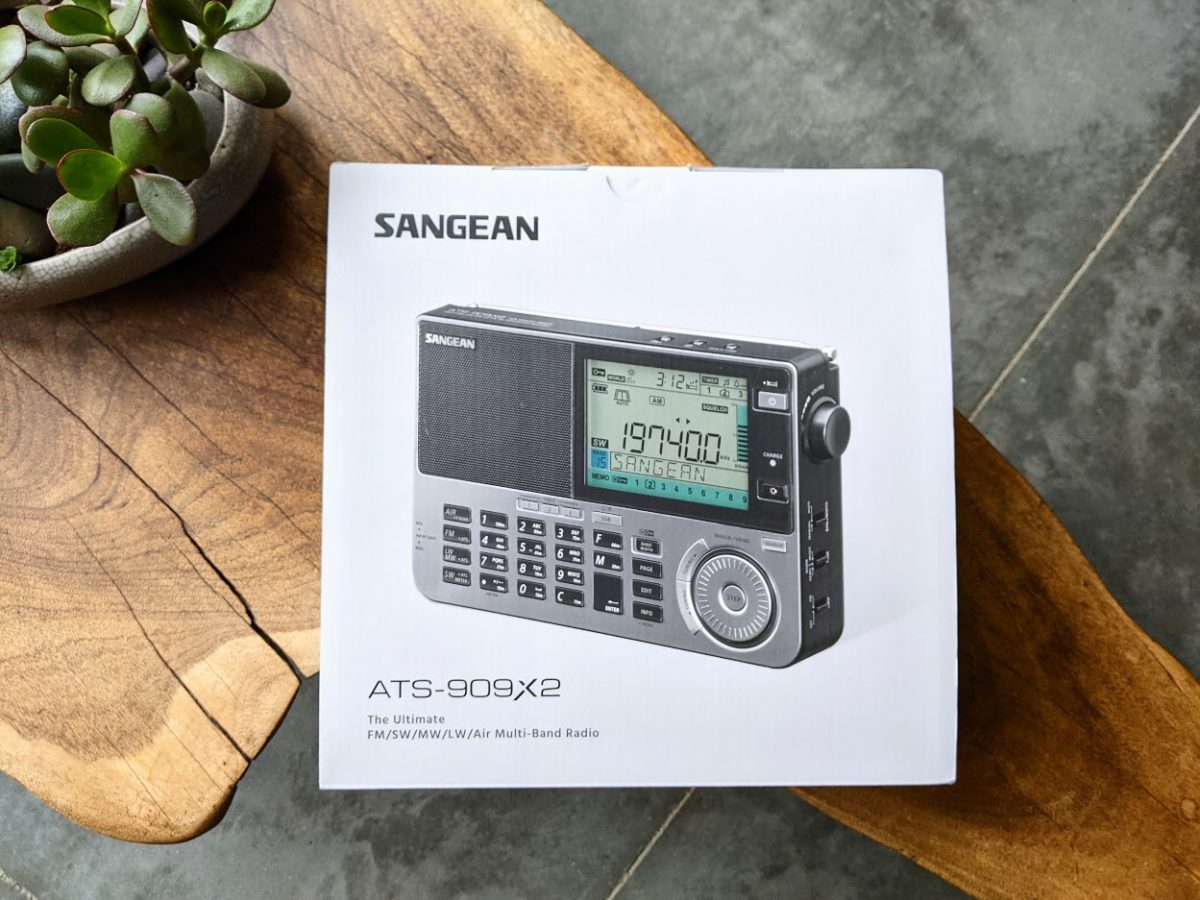
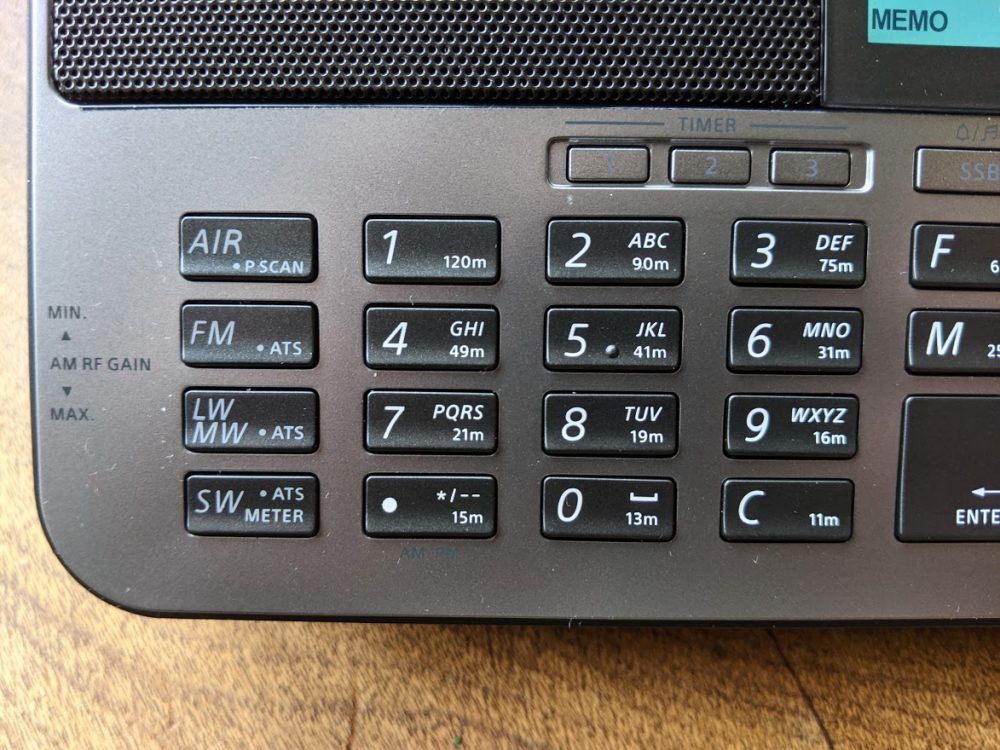
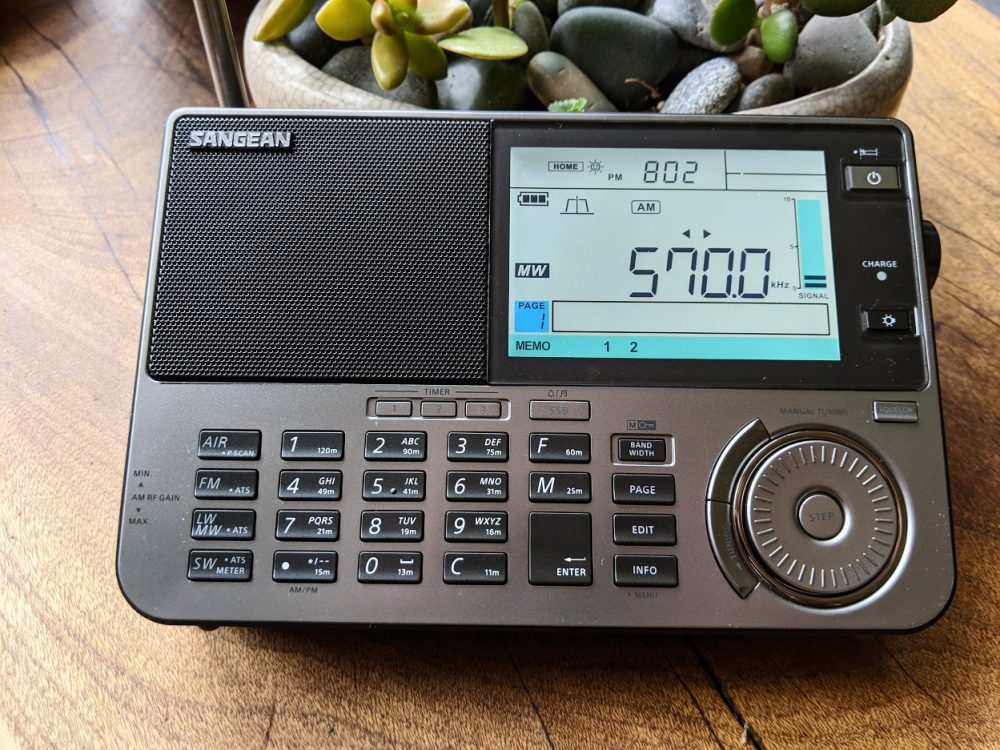
This morning, I took delivery of an ATS-909X2 that Sangean dispatched for me to evaluate. I’ll be writing a review of this radio for an upcoming issue of The Spectrum Monitor magazine.
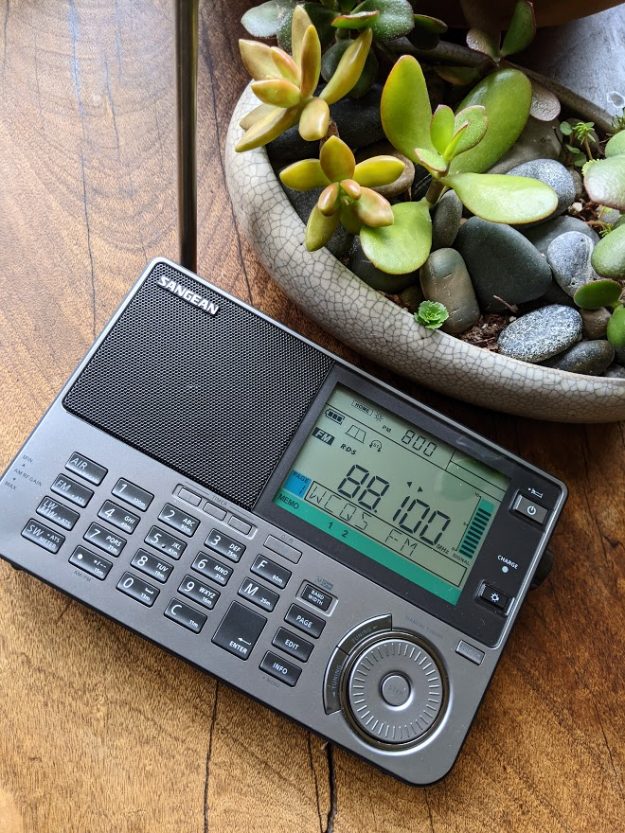
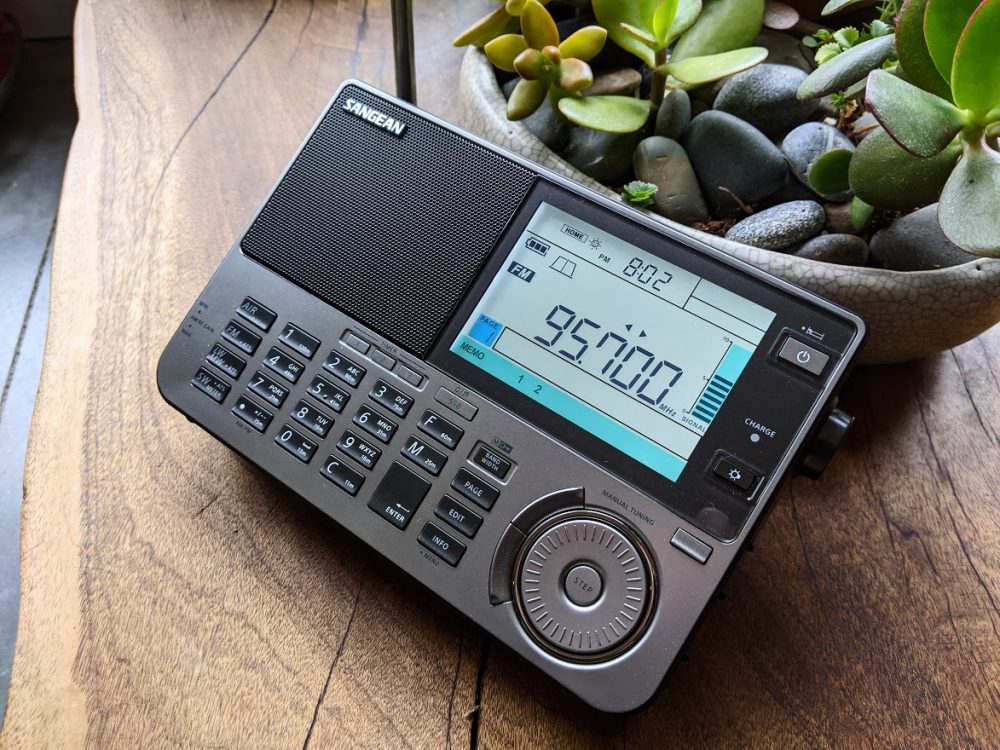
I won’t lie: this is a handsome radio.
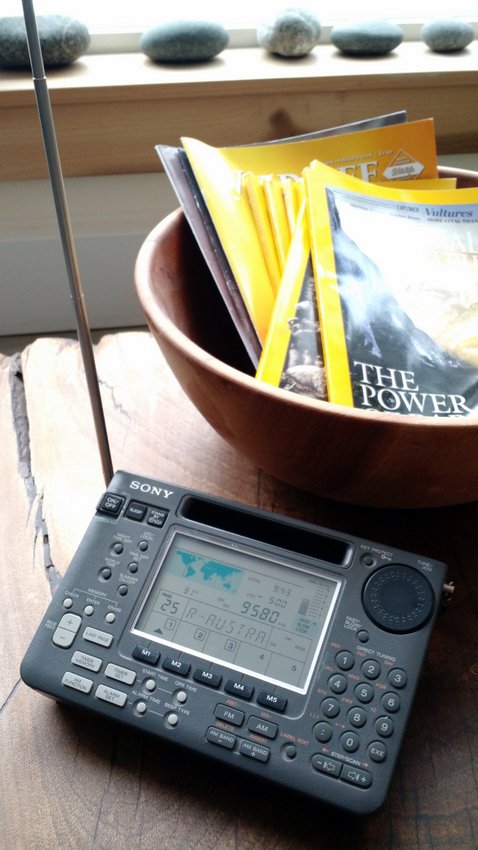
I know some SWLs dislike the front panel tuning dial, but I like it. It reminds me of one of my all-time favorite radios: the Sony ICF-SW55:
I also love the ‘909X2’s large display and intelligent backlighting.
I’ve just started setting up the ‘909X2: inputting local time, setting DST, changing the format to 24 hours, and learning my way around manual and direct-entry tuning.
The manual appears to be very comprehensive and I plan to go through it page by page because this radio actually has quite a lot of settings/configurations.
SWLing Post contributor, DanH has had his ATS-909X2 for quite a while and I expect he’ll be updating us on his findings when he has time. Also, I understand Dave Zantow has been evaluating this radio and should also be sharing his thoughts soon. We’ll provide updates when available.
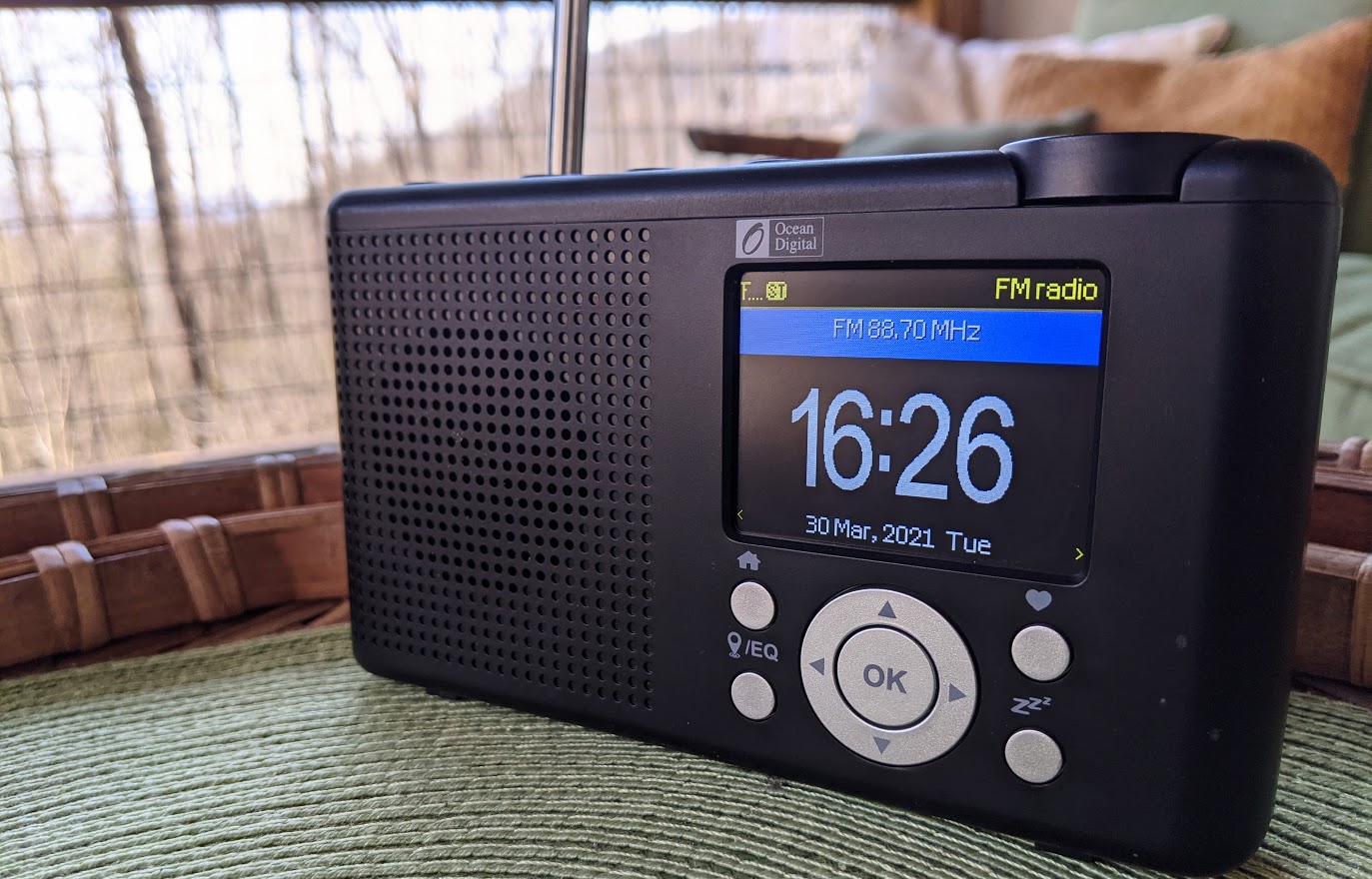
Although it turns out a number of SWLing Post readers were familiar with Ocean Digital and had purchased some of their radios, I hadn’t heard of them until an SWLing Post contributor encouraged the company to contact me.
I must say: all of my communications with Ocean Digital have been very positive and the company has also been very receptive to my frank feedback. All good things.
Ocean Digital reached out to me last month and asked if I would like to test their WR-23D portable radio. Why not? They dispatched on immediately from their Amazon stock here in the USA.
In the spirit of full disclosure, Ocean Digital sent this review sample to me at no cost and as soon as this review has been published (as in, right now), I’m sending it to one of our SWLing Post Patreon supporters I pick at random.
Initial impressions
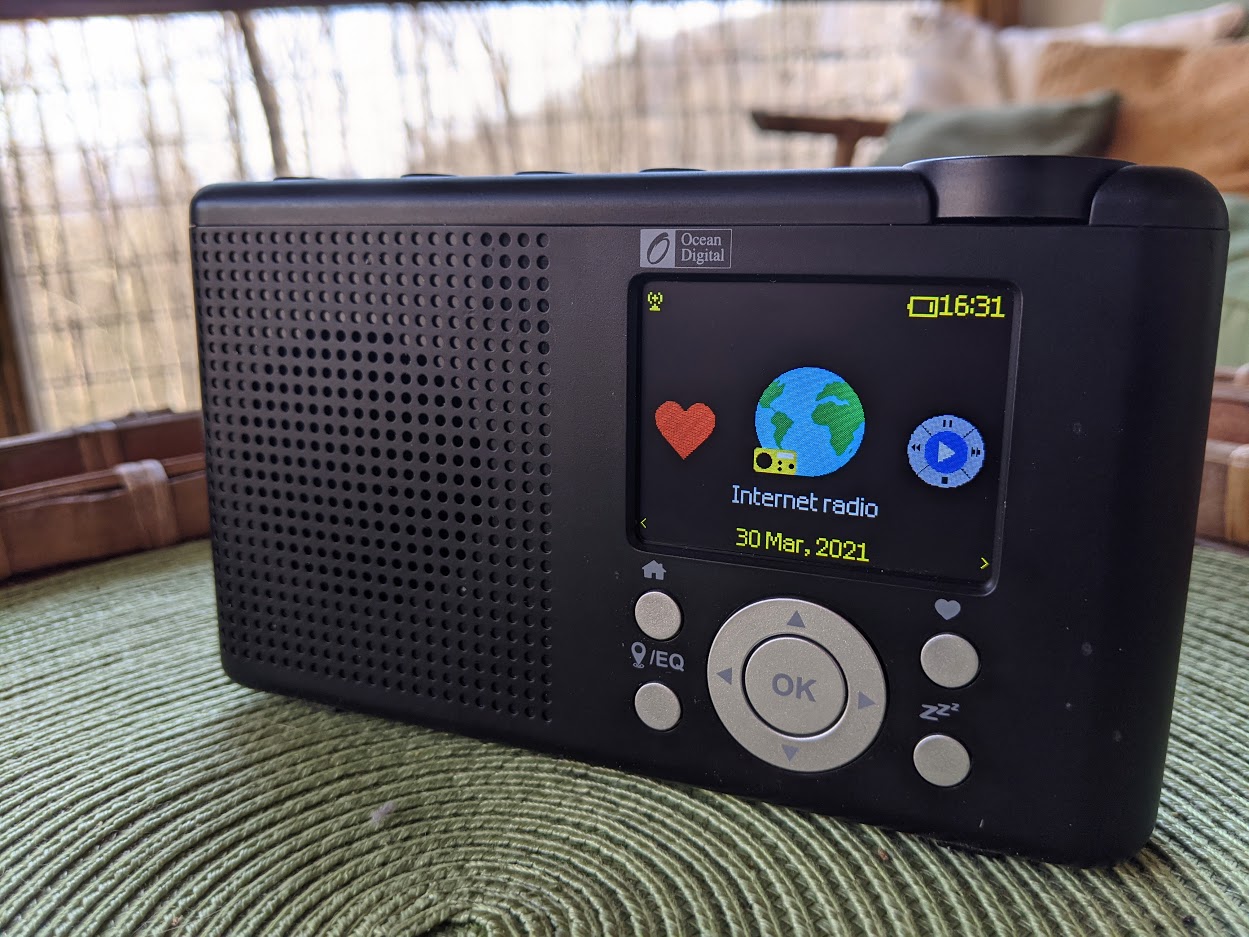
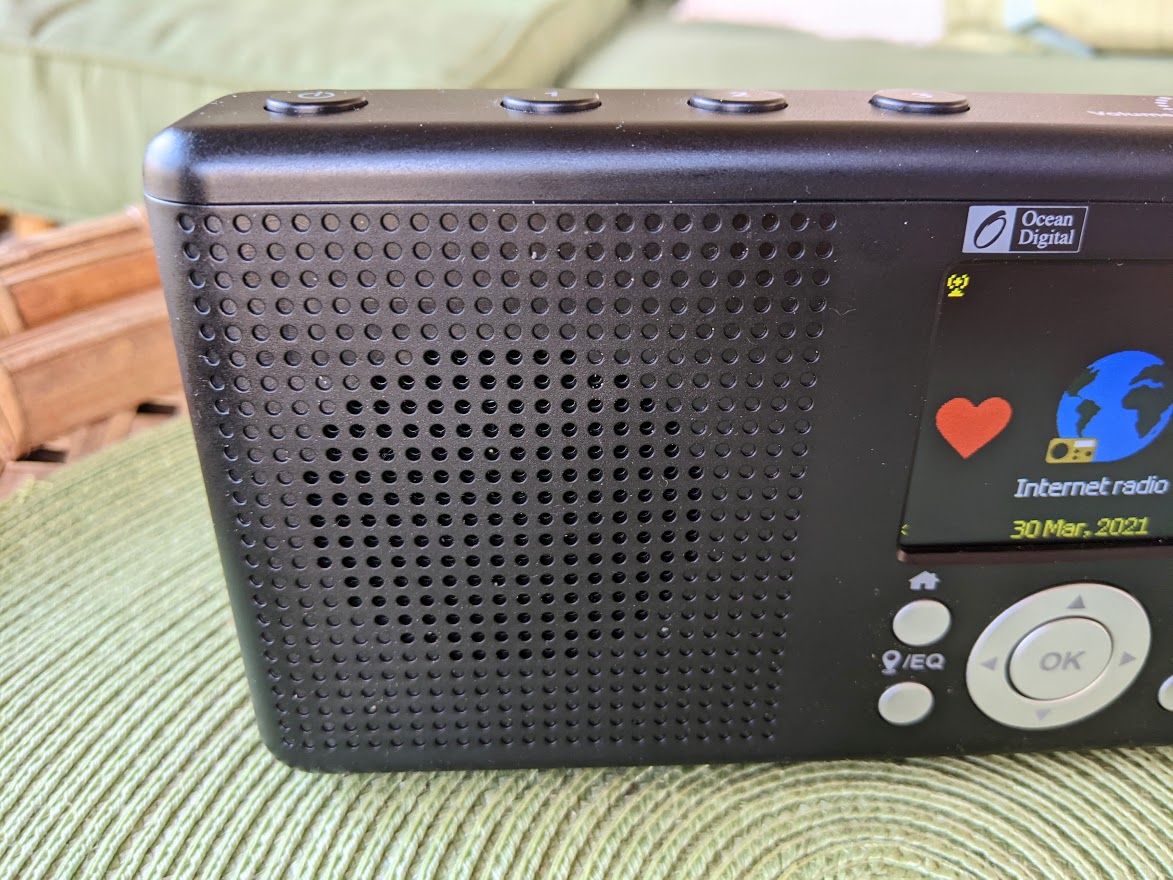
The Ocean Digital WR-23D sports an ABS plastic body that feels very solid in the hand. Indeed, some shortwave portable manufacturers should take note–the ABS structure is so solid, there’s no give when I press into the middle of the speaker grill, for example. I feel like this radio would survive falling off of a table or shelf with no problems.
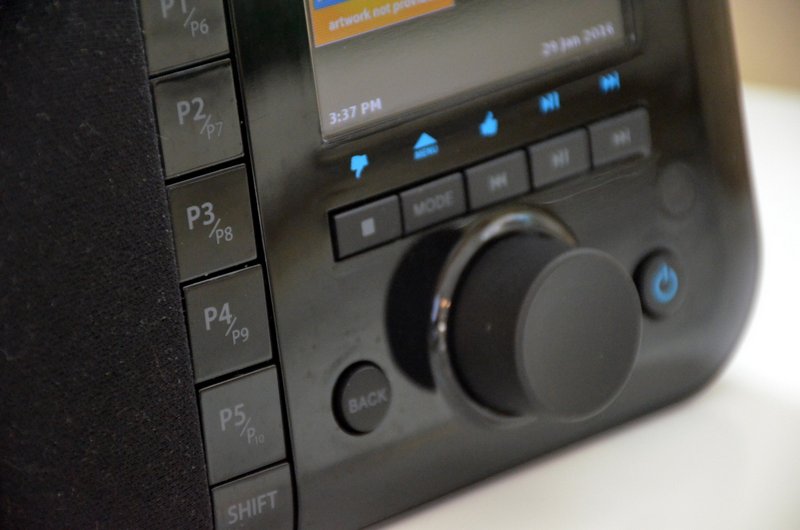
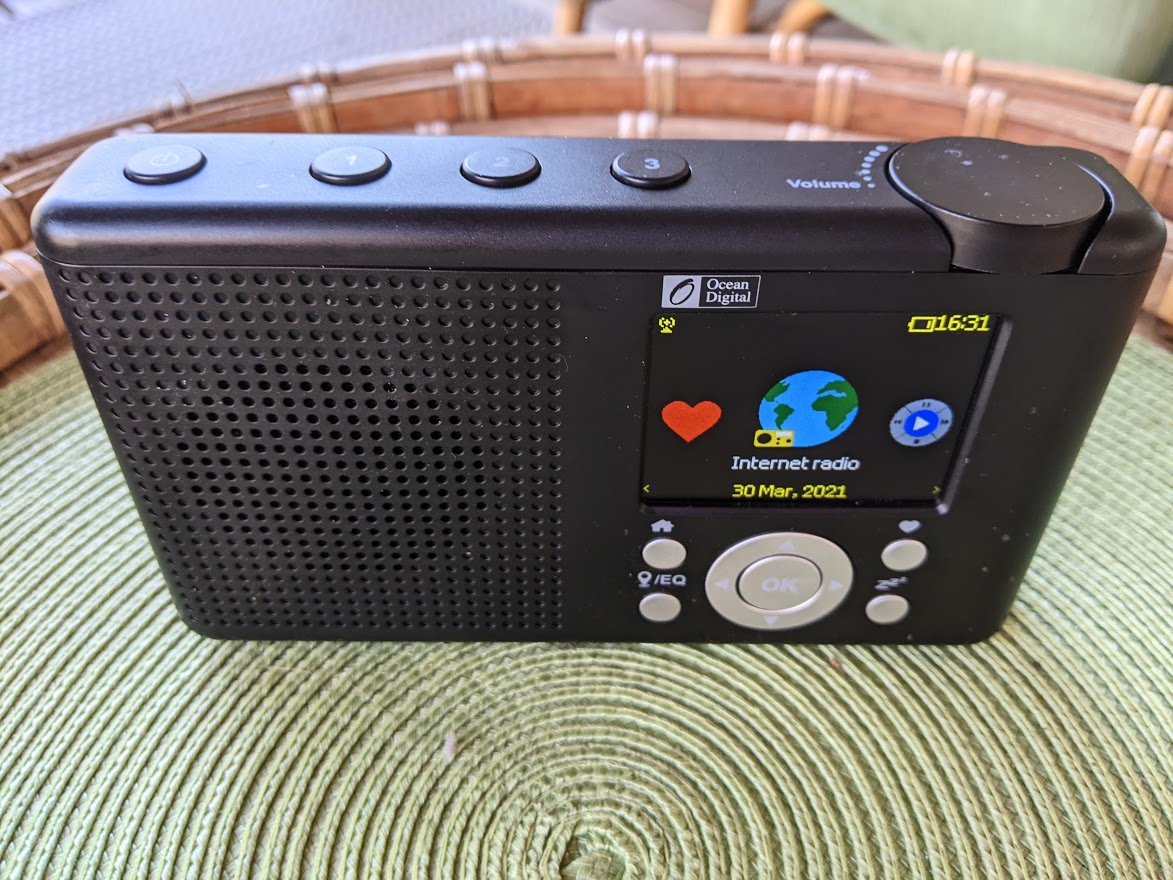
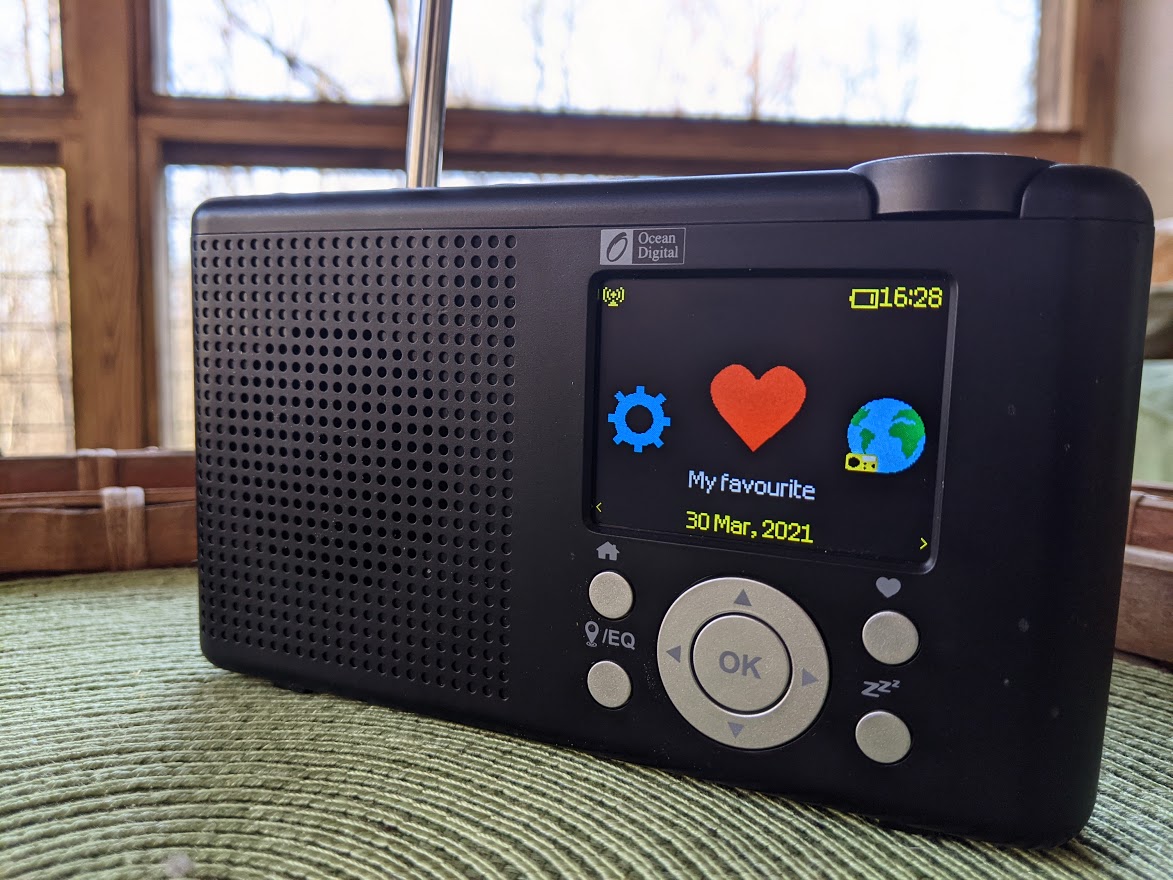
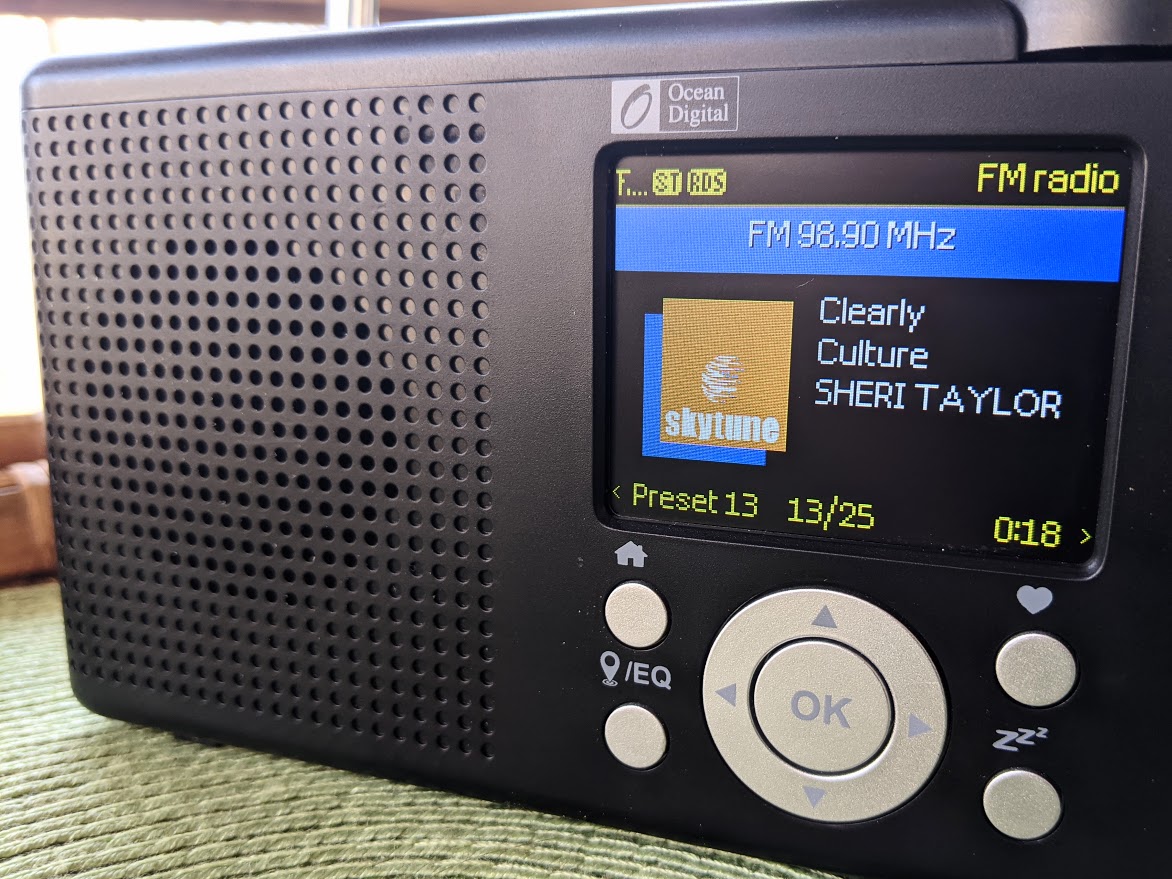
The backlit 2.4″ color display is very easy to read with crisp graphics, text, and ample contrast.
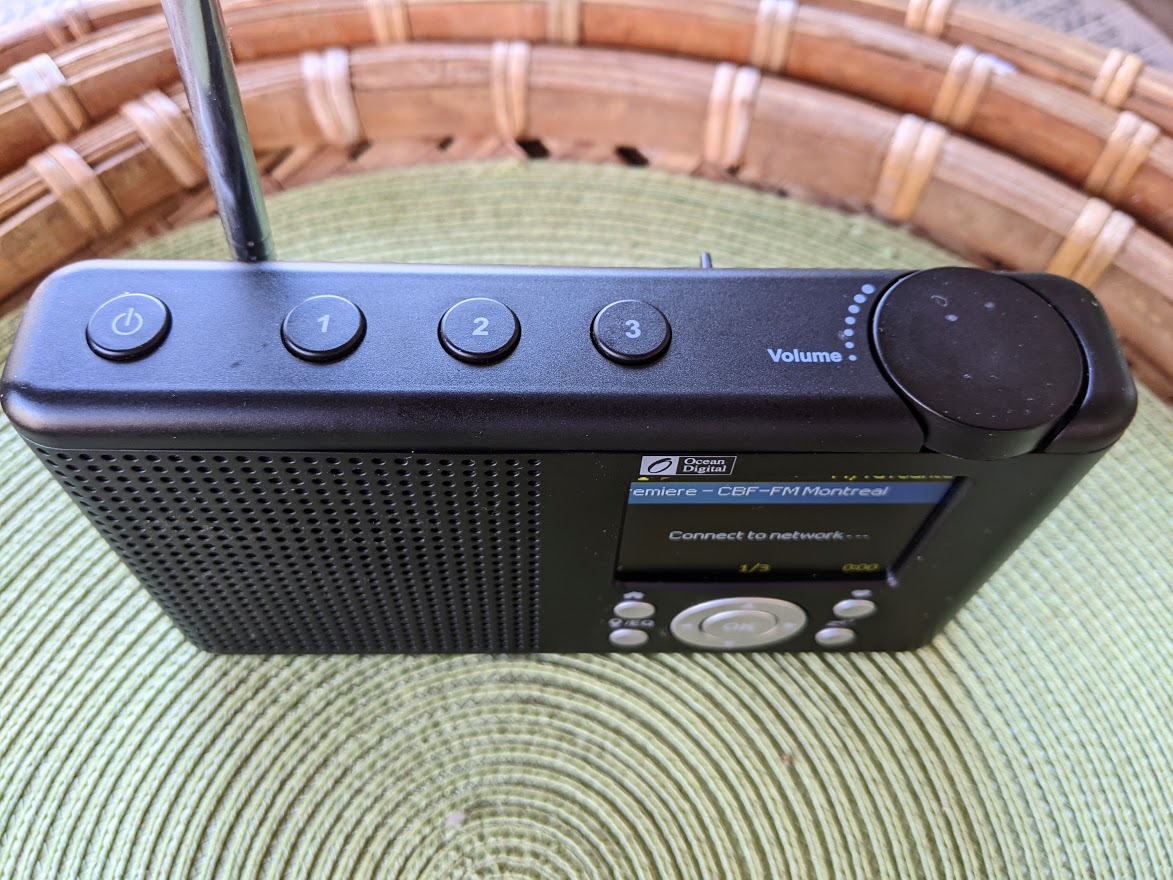
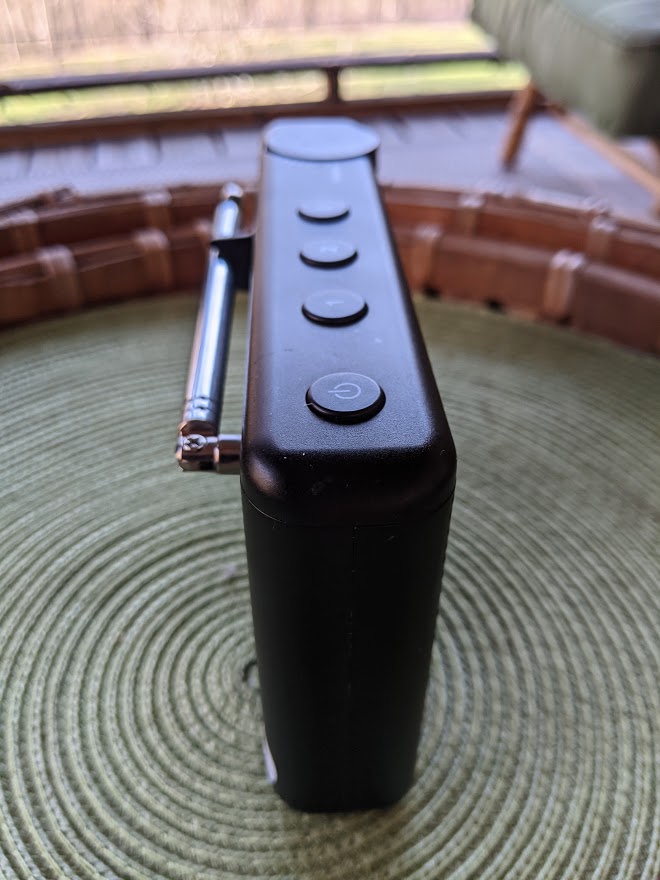
The top of the radio features a power button and three dedicated memory preset buttons. The volume control is also mounted on the top of the radio and protrudes out of the front slightly so your thumb can move it.
On the front of the radio, there are dedicated buttons for the Home screen, EQ/Local button, Favorites, and Sleep Timer.
In the center, there’s a circular navigation control and selection button.
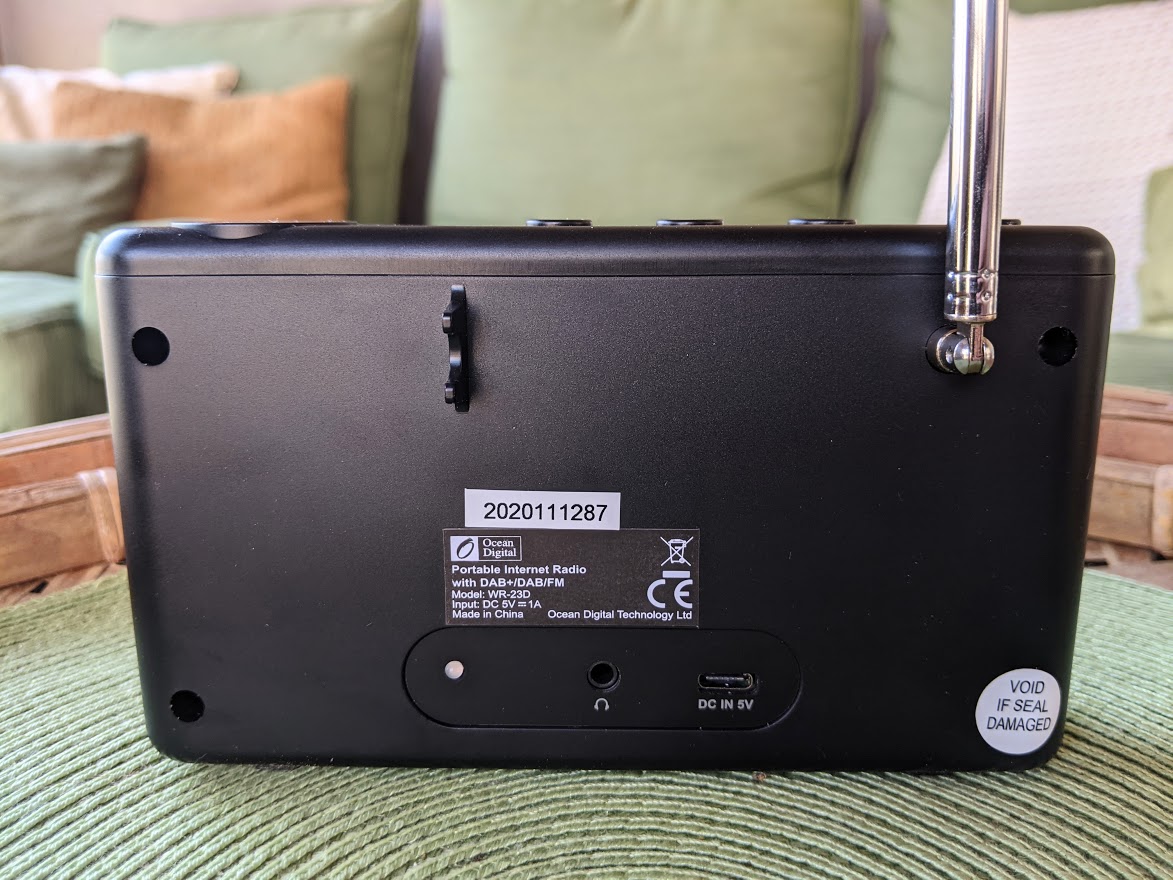
On the back of the unit, you’ll find the telescoping whip antenna for FM, DAB/DAB+, an LED indicator for charging, a 3.5mm earphone jack, and (yes!) a USB-C charging port. I’m so happy to see a USB-C port rather than the older Micro USB variety.
Sound
The front-facing speaker delivers balanced audio. There has obviously been some attention given to the speaker enclosure because it produces a bit more bass than I would have anticipated. There are 12 EQ presets you can use to tailor the audio as well. The WR-3D is not an audio powerhouse–in fact, the audio level stops short of allowing the speaker to splatter–do don’t expect a “boom box” response.
For listening to music or voice in your office, bedroom, or living room? Yeah, it’ll work a charm!
Portability
What I love about these Ocean Digital units is that they have a built-in rechargeable battery.
In my household, this is huge.
I often carry my WiFi radios around the house, moving from the kitchen, to my office, to outdoors near the wood shed (it’s the time of year I start splitting firewood again!).
I’ve found that not only does the battery power the WR-23D for many hours at a time, but the WiFi receiver in the unit is also robust enough that the radio can communicate with our router outside the house. With that said, the WiFi reception is not as good as it is with the recently reviewed CC WiFi 3 which actually sports an external WiFi RX antenna. Then again, the CCWiFi 3 doesn’t have a rechargeable battery either.
Internet Radio
The Ocean Digital WR-23D uses the Skytune radio station aggregator to search for Internet radio station streams.
In short: I like Skytune. It’s easy to search, they’ll add streams if they’re missing any, and it’s well-organized. Instead of reviewing the aggregator again, I’ll point you to the Ocean Digital WR-26 review for more detail as the navigation is identical other than the WR-23D has a nice color screen to display information.
Of course, I’m sure a number of readers have been put off by the whole idea of a dedicated Internet appliance for listening to radio in the wake of Reciva’s announced closure. For more on this topic, I’d strongly encourage you to read my thoughts in the CC WiFi 3 review (note that the CC WiFi 3 also uses the Skytune aggregator).
On Internet appliances like the WR-23D, one does worry about WiFi radio functionality failing if the station aggregator disappears. We recently posted a way you can hack some Grace Digital and C.Crane radios that use Reciva.
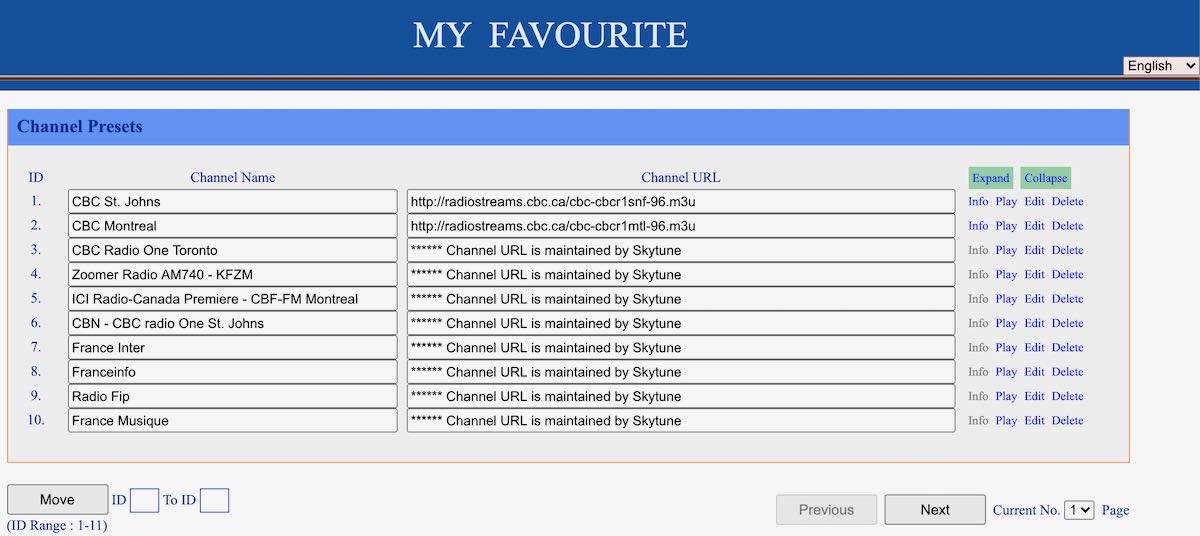
In the case of the WR-23D, WR-26, and CC WiFi 3 (basically all of the Skytune receivers I’ve reviewed) you can actually program your favorite radio stations manually. In fact, it’s very easy. You simply find the radio’s IP address on your network (the manual describes how to find this in the Configuration menu selection). Then, enter the radio’s IP address in a browser on a computer or device that is connected to the same WiFi network. You’ll get a window that looks like this where you can add your own streams, organize memories, and even perform basic control of the radio:
But, again, if the whole idea of an aggregator-tied device like the WR-23D is unappealing, I get it. You might simply pair your smartphone or tablet with a Bluetooth speaker and use a system like Radio Garden or TuneIn to cruise the world of online radio stations.
Bluetooth
Speaking of Bluetooth speaker, yes, the WR-23D is one of those, too! Simply select “Bluetooth” from the home menu and pair it with your favorite device. Couldn’t be easier!
FM radio
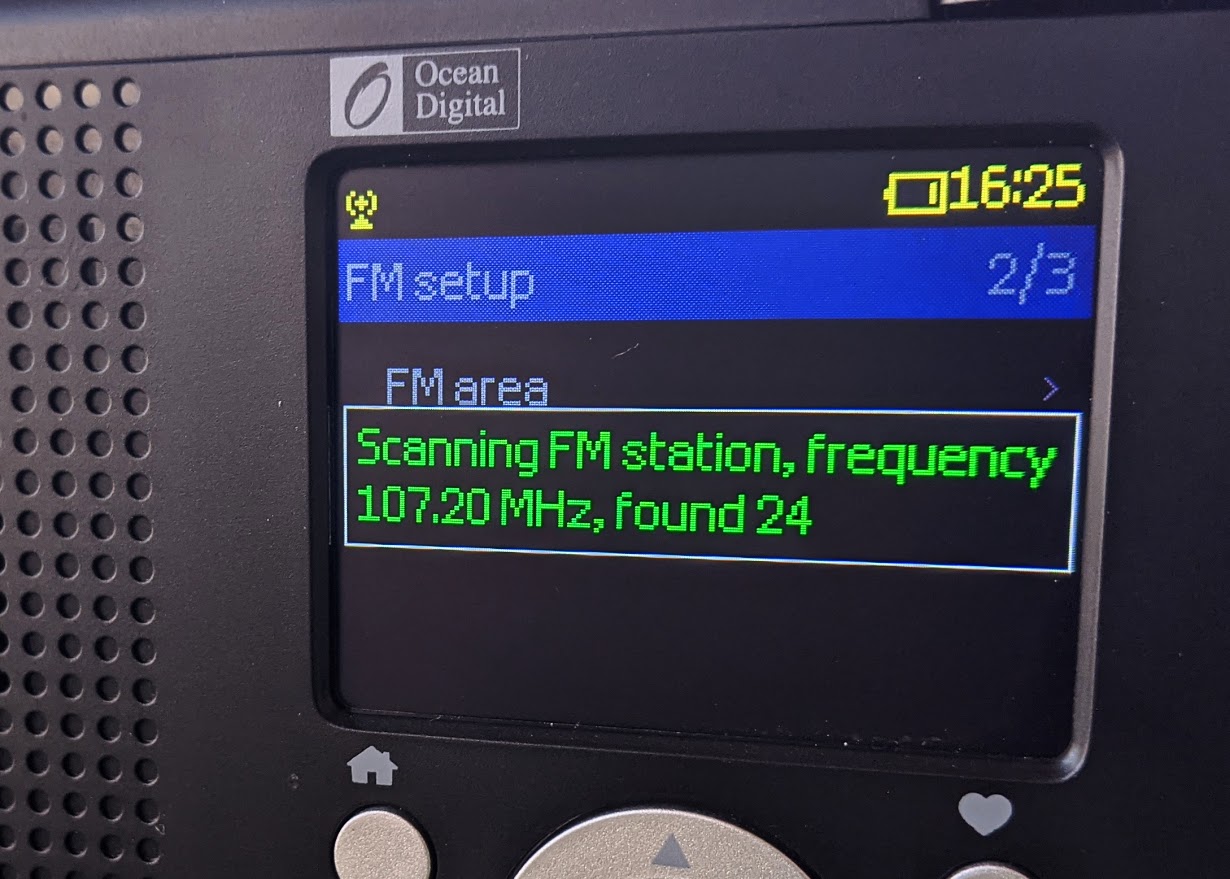
The WR-23D has a very capable FM radio. I had it scan my local FM dial and it automatically picked up all of the stations I would have expected. The radio has both auto and manual tuning.
In addition, the WR-23D displays RDS information on the screen. This is a feature I love especially when travelling as it helps me ID the station I’m tuned to.
DAB/DAB+
Unfortunately, we have no DAB/DAB+ stations in the US, so I was unable to test this functionality.
Summary
As I mentioned, I really appreciate the matte finish ABS chassis. I like to know that my portables can survive a fall.
I’ve been using the WR-23D here at SWLing Post HQ for about one month and only have a few minor/personal complaints. For example, I wish the headphone jack was on the side of the radio instead of the back. Also, I wish the telescoping whip antenna fit into a recess on the chassis rather than being fully mounted on the outside. I would like to see a fold out tilt stand on the back of the unit (I’ve actually used the antenna to prop this radio at an angle, but that’s not ideal).
If you’re looking for a truly portable WiFi radio and Bluetooth speaker with a proper FM and DAB/DAB+ receiver the Ocean Digital WR-23D is a solid choice. Amazon’s current price is $79.99 US with shipping and free returns–I feel like this is a value for all this radio has to offer.
I can say this: the SWLing Post Patron who wins this WR-23D will really enjoy it! I have.
Many thanks to SWLing Post contributor, TomL, who shares the following guest post:
Indoor Noise and Ferrites, Part 1
by TomL
My magnet wire loop antenna on the porch reminded me to revisit aspects about my noisy Condo that I still needed to understand. Some RF noise I could control if I could find the right kind of information that is understandable to a non-engineer like me. There is a lot written about the general problem of noise and radio listening, for instance this ARRL article with web links to research – www.arrl.org/radio-frequency-interference-rfi, but I needed to get more specific about my particular environment.
I had tried some common clamp-on TDK ferrites I had obtained from eBay a long time ago but they only seemed to work a little bit. I have since found out these are probably the ones which are widely used on home stereo system connections used to reduce noise on those systems. There must be a better way.
The more I researched topics, like a portable “Loop on Ground” antenna, or, using RF chokes on the magnet wire loop, it dawned on my feeble, misguided brain that I was wrongly thinking about how to use ferrite material. For one thing, the material used to suppress RF noise is made with a certain “mix” of elements, like Manganese-Zinc, that electrically “resists” a specified frequency range. Fair-Rite has a useful Material Data Sheets web page which lists the Types of ferrite material. For dealing with noise (at the Source causing the problem), I needed to use the right kind of “Suppression” materials and proper placement. So, it (partly) made sense why the TDK snap-on ferrites might not fully work to reduce certain noise coming from my computer screens, LED lights, USB devices, and cheap Chinese-made power adapters.
A very good paper is by Jim Brown (K9YC) of Audio Systems Group entitled, “Understanding How Ferrites Can Prevent and Eliminate RF Interference to Audio Systems [PDF]”. There is a longer paper speaking directly to Amateur Radio folks, but the Audio version is simpler and it uses some of the same graphs and ideas. I was drawn to the very detailed Impedance measurements of many different “Types” of ferrite material used for different noise mitigation. I remember the traumatic pain of my college experience trying mightily to understand the Van Vlack Materials Science text book to no avail. But Jim’s paper reminded me of the importance of using the correct type of ferrite material and in an optimal way that reacts favorably in the target frequency range to solve a particular noise problem. So, what are my problem areas?
Shortwave Noise
Loop antennas have been what I have experimented with the most. They do not pick up as much man-made noise (QRM) and they have a space saving footprint. Fortunately, there is a wooden porch where these things have been tried. I had successfully built a broadband amplified “ferrite sleeve loop” (FSL) in the past. It was useful for a while but it fell into disrepair and also the Condo building has steadily increased in noise output. The amplifier was just amplifying the noise after a while. I also tried phasing two antennas but found the ever increasing noise cloud was coming from all directions and I could not null it out. I even tried a “mini-whip” from eBay but that just produced a wall of noise.
I recently tested AirSpy’s YouLoop written about before, and the results were good. However, it seemed obvious to me that it was too small as a passive loop to capture shortwave signals strongly enough without resorting to another amplifier attached at the antenna and would not improve the signal/noise ratio. My current solution is a unamplified stealth magnet wire loop about 32 feet in circumference. In that article, I mention things like common mode RF chokes at both ends of the antenna connection, horizontal polarization, and basically accepting that only the stronger shortwave signals will be received in a predictable manner. I think for now, this is about all I can do for shortwave and mediumwave noise, as far as my own Condo-generated noise. Neighborhood noise is a different topic.
VHF Noise
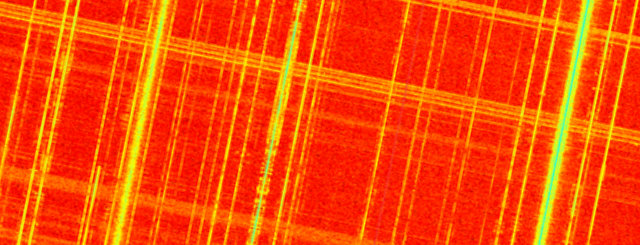
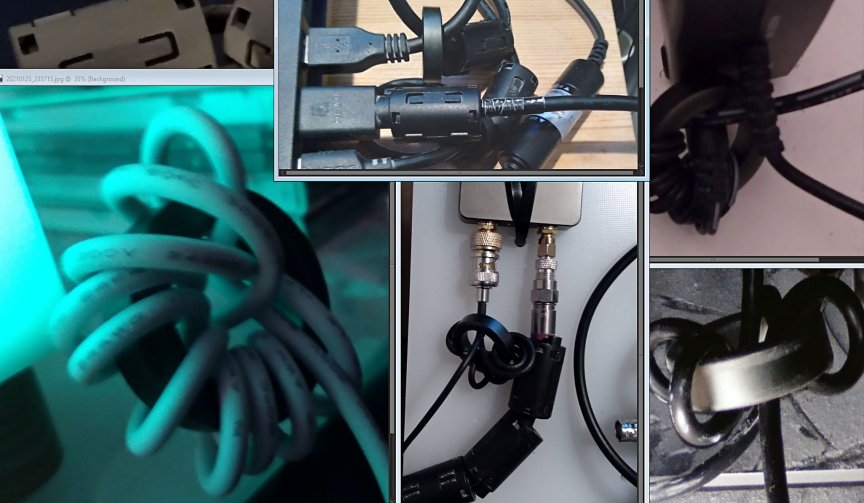
I then started to isolate which devices caused which kind of noise when listening to my outside amplified antennas for FM/VHF and UHF-TV transmissions. Many consumer Power adapters make a lot of noise from VLF up into UHF ranges. One thing I did right was to try a 10 pack of these little miracle “Wall Wart” toroids from Palomar Engineers. One by one, I put one of these small toroids (19mm inside diameter) on my home AC adapters as shown in the pictures, and the noises started disappearing. It does not explicitly say, but I believe it is Type 75 material which suppresses the noise generating AC adapter (at very low frequencies) when wrapped 8 – 12 times.
Most egregious of these was my CCrane FM2 transmitter. A strangled warbling sound kept emanating from the monitor closest to my laptop. Installing ferrites on the laptop and back of the monitor were not working. I moved the FM Transmitter and noticed a reduction in noise. So, I put one of these little toroids on the power input of the device and the noise disappeared. Apparently, it was picking up noise from the monitor (as well as its own power adapter) and rebroadcasting it to all my other radios! The strangled warbler is no more, I choked it (HaHa, sick bird joke).
While looking for the monitor noise, I put the eBay TDK ferrites on all the USB ports and HDMI ports. This has helped greatly on VHF and confirms my suspicion that these cheap TDK ferrites are indeed a common type of ferrite material. Some informative graphs can be seen in Jim Brown’s Audio paper mentioned before. One example might be Figure 22, which shows the #61 Series Resistance which peaks around 100 MHz when using a toroid with three “Turns”. More confused, I could not find a definition of a “Turn”. Eventually, in his longer paper to Amateur Radio operators, he defines it, “…is one more than the number of turns external to the cores”. Somewhere else he describes using many single snap-on ferrites being electrically equal to just one toroidal ferrite with multiple Turns. And interestingly, more Turns shifts the peak impedance substantially lower in frequency. So, using the graphs he supplies, one can target a noisy frequency range to try to suppress.
I then put 6 of the TDK ferrites on the VHF input to the AirSpy HF+. Some FM grunge was reduced and was thankful for that. The rest of the background noise truly seems to be coming from the outside picked up by the amplified antenna.
Also, I juggled a couple of the amplifiers around and now have separate VHF/FM and UHF/TV amplifiers which cleaned up the FM reception a little bit more – https://www.youtube.com/watch?v=zkDsy95et2w .
UHF TV Quality
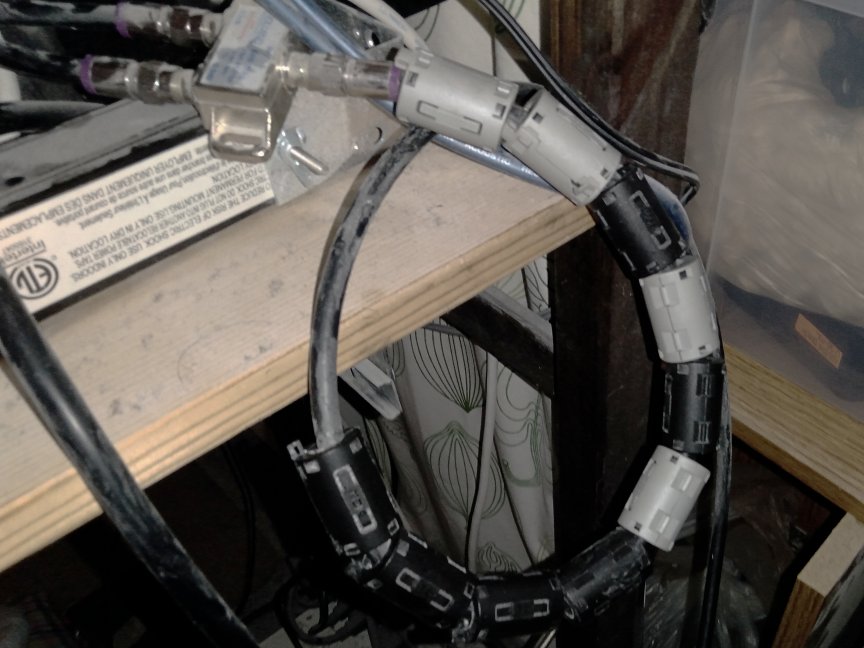
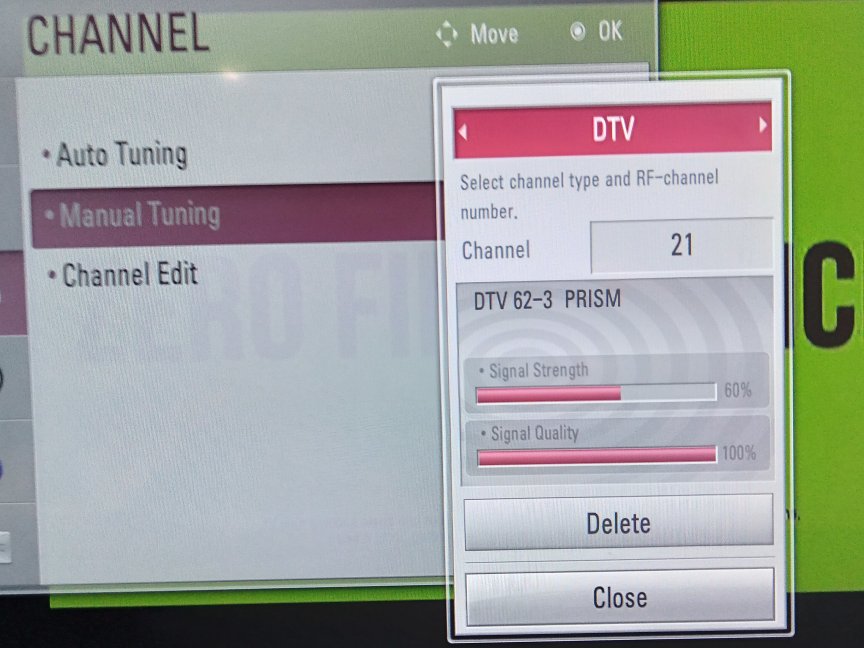
On a whim, I put the balance of the TDK ferrites on the FM/TV splitter input cable, 10 in all. The FM reception did not improve but the Over The Air UHF TV reception Quality improved noticeably. My weakest TV station now has a stable Signal level and the Quality is pegged at 100%. This is a nice surprise since it means that now all local TV stations on UHF will come in cleanly without dropouts and I can view all digital subchannels. I was even able to rescan and added two more low-power stations never seen before. ?
LED lights
I have common LED lights hanging over a number of fish tanks and some grow lights over an indoor plant box and can hear this noise on upper shortwave and higher radio bands. In a future article, I will explore RF noise from lights as its own special topic. For instance, why do some LED lights generate RFI and how to know before buying (I am using BR30 spot bulbs from name brands)? Also, there is a new kind of LED “filament” light out now that uses much smaller LED’s on both sides of an aluminum strip, greatly reducing electromagnetic noise output (or do they??). More questions than answers.
I will explore creating my own customized AC power cord attached to the AC power strips of the LED lights. I will need to test this for safety and efficacy, so I will want to take some time to do this right. The hope is that, using Jim’s info, I will be able to create a broad spectrum RFI suppression AC power cord and cost less than $30 each cord. We’ll see.
Finally, I will look at “stacked” toroids using different mixes of ferrite Types, creating a custom RF suppression better than using just one Type of ferrite material, using AC cords as the main examples. For instance, the best set of graphs in Jim’s paper, in my opinion, are Figures 21 and 24 compared to each other. Something I did not know before is that one can not only use multiple turns on a single toroid to get a lower, peaked frequency response, but also stack multiple toroids of the same Type to get a smoother frequency response. Then on top of this, combine that set with other Types to create a customized frequency response curve.
Radios are quieter now. Those pesky grow lights are still a problem as well as the upstairs neighbor’s lights which seem to be on a timer, making FM reception noisy again after 5pm!
Please support this website by adding us to your whitelist in your ad blocker. Ads are what helps us bring you premium content! Thank you!