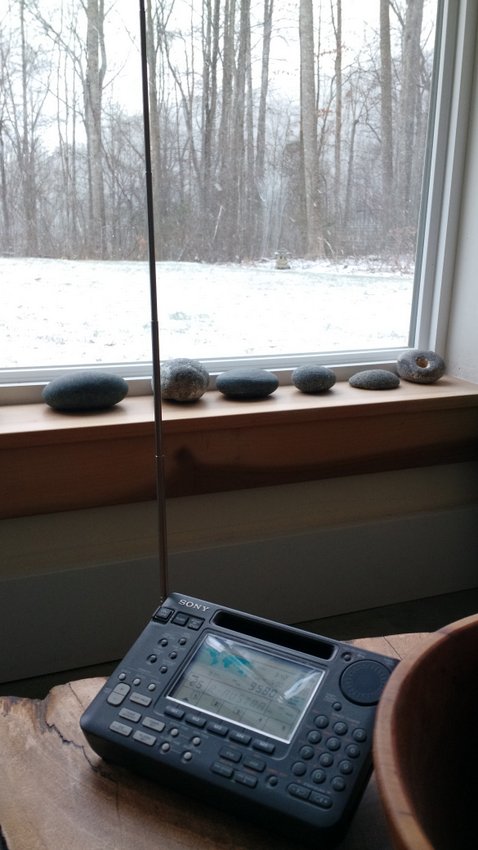
Regular SWLing Post readers know that I’m a sucker for classic solid-state portables and vintage tube radios.
What many of you may not know, however, is that I’m not a fan of auction-style bidding for radios. Those who are familiar with it will recognize the story: it begins on an optimistic note, when I find something I’m enthusiastic about. Then the bidding war begins, and invariably, the price quickly ratchets upwards to far beyond my comfort zone. It’s only then I find I’ve wasted my time on the entire process, and my hopes are dashed. So it’s not a purchasing method I relish.
Therefore, despite all of the radio gear I’ve purchased over the years, I’ve only bid for a radio in an online auction perhaps three or four times.
But a couple of weeks ago, my buddy David Korchin (K2WNW)––who has a knack for finding deals on radios, and often alerts me to them––mentioned that he was bidding on a Sony ICF-SW55.
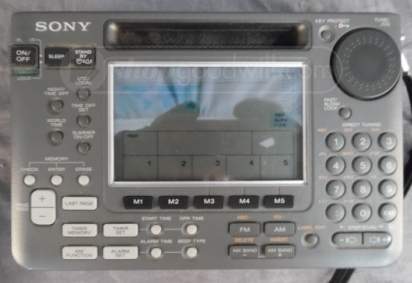
Photo of the ICF-SW55 from auction listing.
David wasn’t bidding on the popular online auction eBay––rather, he’d found this deal on ShopGoodwill.com.
A note about ShopGoodwill.com
In case you haven’t heard, ShopGoodwill.com is Goodwill Industries International’s online auction site. Goodwill employees select exceptional donations, items they feel are worth more than typical Goodwill retail prices, and post them there for online auction.
I believe it was SWLing Post contributor, Mario Filippi, who first introduced me to ShopGoodwill.
The cool thing about ShopGoodwill is that it’s not as popular as, for example, eBay. Thus a bidder has a better chance of finding a good deal, with the added benefit that less enthusiasts will be hiking up the price with rapid bidding.
There are issues with ShopGoodwill.com, though, some of which are very off-putting:
- Items are often poorly described, thus:
- searching through the collection can be rather difficult
- you often can’t trust these condition descriptions, as they’re written by someone who is clearly not an expert
- Photos are sometimes of low quality, low resolution, and rarely offer enough detail for an informed decision
- Buyer beware: nearly all items are sold “as-is,” and are untested
- No returns on most items
- No real seller feedback: if you’re frustrated with a Goodwill shop, you have no real recourse other than complaint
So, in summary: unless otherwise specified in the listing, you must assume that any item offered for auction on this site doesn’t function and may be in poor cosmetic condition as well. After all, these are donated items.
With that said, even though the risk is higher than on eBay–where sellers are rewarded with positive feedback and endeavor to fully describe merchandise––some good deals are occasionally to be found on ShopGoodwill!
Now back to my story…
The Sony ICF-SW55 listing that David found on ShopGoodwill.com kept a steady bid of $28 until the day before the auction’s end, when it increased to $48 US.
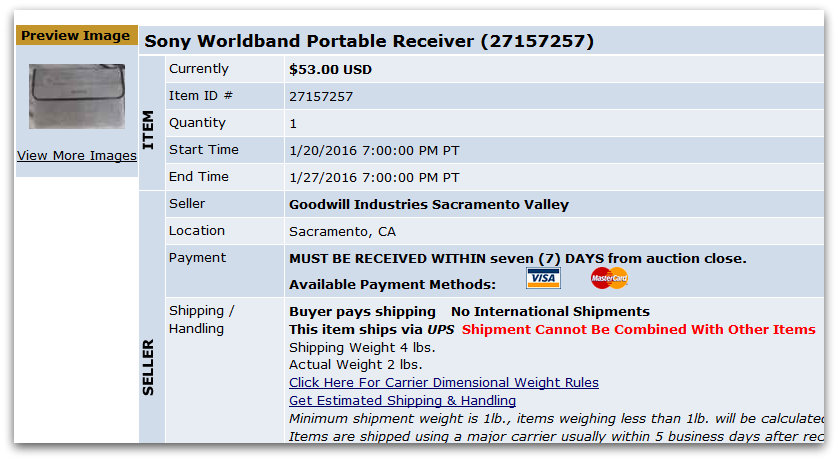
It’s likely that this listing would have seen more active bidding if the description were better––it didn’t even provide the model number, and was listed as “Sony Worldband Portable Receiver.” Moreover, the feature photo for the listing was of the radio’s case, not the radio itself (see below), yet another reason the listing got so little attention. But David, being the deal hound he is, found it!
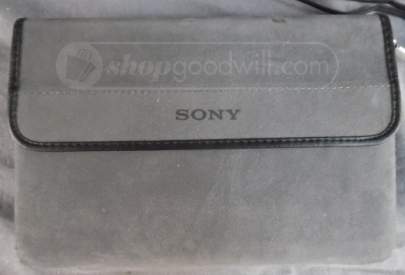
The feature photo.
I encouraged David to really go for it, saying that this could be an excellent opportunity to snag one of these classic portables for a good price. And if it didn’t work, there would be a good chance Vlado could fix it for a fair price.
The morning the auction concluded, David messaged me that he’d decided to pull out of the bidding. He found something else he wanted to snag, so he encouraged me to take the baton and bid on the ICF-SW55, myself.
I read the vague description…then took a deep breath, and decided to go for it!
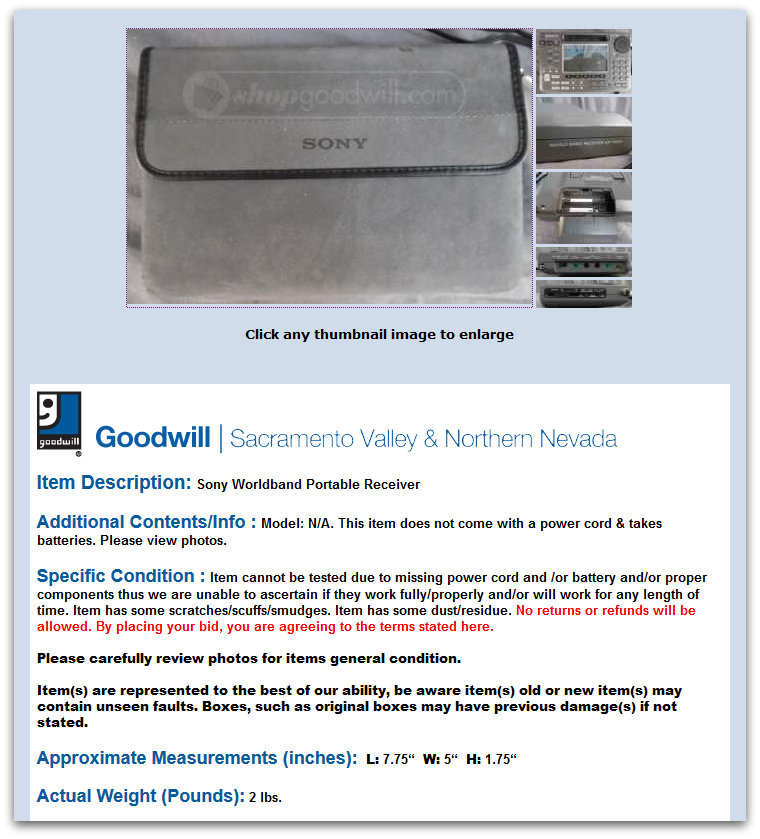
Again, I’m not adept at bidding, but at least I have a method that has worked for me in the past. My simple rules:
- Only bid once.
- Wait until the last few seconds, then offer my highest comfortable bid.
Final bidding, blow-by-blow
Here’s how the final moments of the auction played out:
I waited until one minute before auction end. I decided I would go as high as $120––a little rich for my modest budget, considering this could amount to a parts radio, but it was late in the day and I admit I wasn’t thinking clearly.
Then, at thirty seconds before auction’s end, the ShopGoodwill.com site simply stopped responding––!
No, it wasn’t my dubious Internet connection this time––their site was having problems loading.
I finally got the auction screen to pop back up ten seconds before auction’s end. I quickly attempted to place my bid: the web page churned…and churned…and churned.
Finally, up popped the review screen at literally the last breath of a second. I clicked “confirm/submit” (thank you, LastPass, for filling in my password immediately) and just managed to record the bid!
I’m certain that my bid was received within the last second. I had the countdown clock running on my Android phone so I’d know when the auction’s end was coming up. Unlike eBay, there is no dynamic counter on ShopGoodwill: you must refresh the page to see the time remaining. The Android countdown was set to end three seconds before the actual end of auction. When I confirmed the bid, it read “-3 seconds.”
The Goodwill site was having so many problems, that it took it two full minutes before I could get the auction screen to refresh after it accepted my bid––it was still stuck on the screen that confirmed my bid was recorded and that I was––for the moment, anyhow––the highest bidder.
When the page finally loaded, I saw that I had, by the skin of my teeth, snagged the SW55, and for a mere $53.
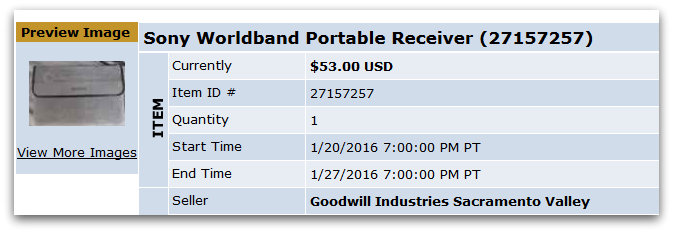 That is one of the lowest prices I’ve ever seen one of these units go for in an online auction, even when listed as a “parts-only” radio. Needless to say, I was exhilarated! My heart pounded.
I’m certain that the problem with the Goodwill site helped me win the auction. There were multiple bidders, and I think mine just happened to trigger a bid, leaving the competition no way to outbid me in the last 1/10 of a second. This wasn’t bidding skill. And it surely wasn’t a fat wallet. Frankly, I was just lucky.
I was thrilled to have won the radio at such a relatively low price, but the relief afterward reminded me why I don’t like auctions like this. I definitely prefer a more straightforward, less exciting (and less anxiety-producing), approach to making purchases.
Good news comes in small packages
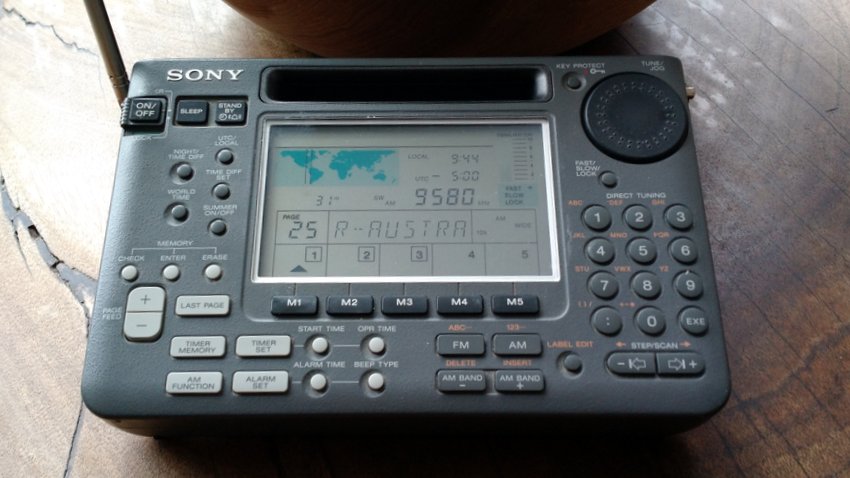
Goodwill can be relatively slow to ship. It took about two weeks, but on Monday, I received the package from Goodwill in California. The rig, save a little dust, looked fine. But…how would it function?
I put in some freshly-charged Enloop AA batteries and turned it on.
Much to my surprise, the rig turned on…I rapidly tested all the functions. Again, I couldn’t believe my luck: it functions perfectly!
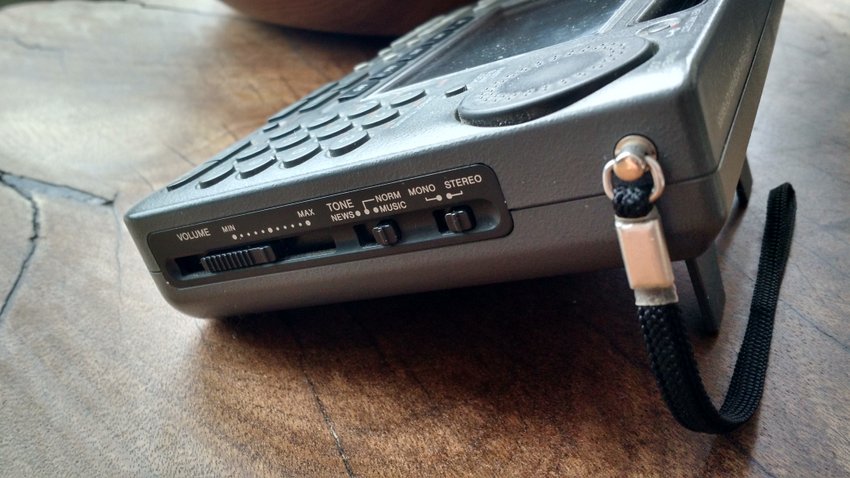
The only feature in need attention is the DX/Normal/Local switch, which makes the rig sound a bit scratchy when I change positions––an easy fix, however, with the aid of a little DeOxit.
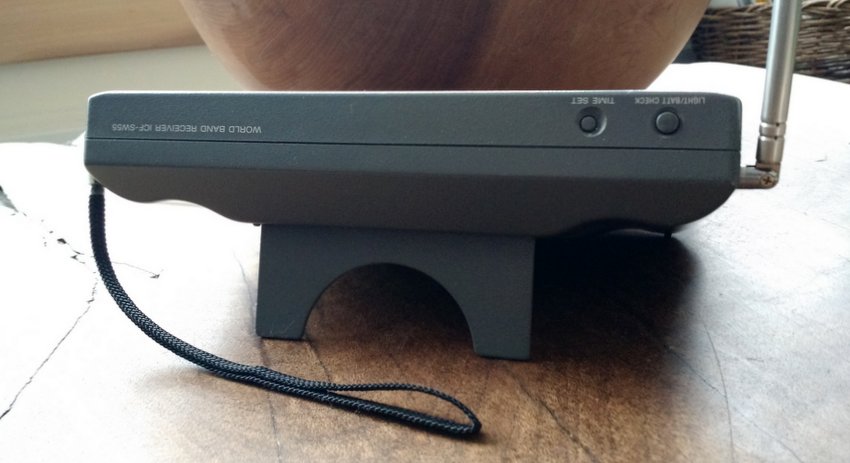
This auction had a happy ending: I got a radio I’ve always wanted for a price I could swing, I didn’t need my friend Vlado to come to my rescue (though I’ve no doubt he would have), and best of all, I find I absolutely love the ICF-SW55.
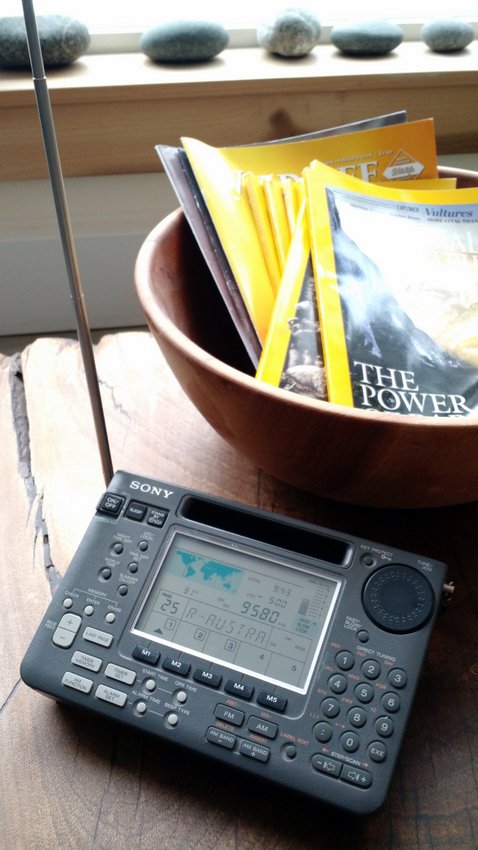
Stay tuned…A review of the classic SW55 is in the works, and will be here on the SWLing Post in the coming weeks!