Shortwave listening and everything radio including reviews, broadcasting, ham radio, field operation, DXing, maker kits, travel, emergency gear, events, and more
Alexa skills come in all shapes and sizes, from the trivial random fact skill, to a fully fledged news reader.
Some have little or no input, while others try to carry out a conversation with you.
Recognising that Alexa might be new to some people, and that the Shortwave Signals skill tries to capture everything from you in a single phrase, I wanted to give readers a guide on how to get the best from the skill, as well a little background on how Alexa ‘understands’ or ‘misunderstands’ what you said.
The Basics
You have two ways of starting an Alexa Skill:
Open the skill using its name
Ask the skill using its name
Opening the skill is a great place to start when you’ve first installed a skill. It should provide you with an introduction, then offer to answer a question or suggest how you can get further help.
Once you are familiar with a skill, you can save time by ‘Asking’. This cuts through the opening pleasantries and gets on with the job.
A skill doesn’t get approved by Amazon unless it supports these approaches in an appropriate way.
With that out of the way, the essential thing is to make sure that your words are clear and don’t blur together. I remember eating lunch at my desk while developing the skill, and then wondering why Alexa was making such a mess of my questions.
How Do Alexa Skills Recognise What You Say?
The short version is that skill developers have to provide training phrases to Alexa with two objectives in mind; to figure out what you want to do, and to recognise the parts of those phrases that contain important information.
If you were writing a weather skill, those phrases might look like this:
What is the weather like in [placename]
Will it rain in [placename] on [date]
What will the weather be like on [date] in [placename]
The challenge is to figure out the different ways that people might ask a question, and then help Alexa know what parts of the question are important to the skill. This data can can include numbers, dates, times, real world locations, famous places, famous people, countries, languages, and much more.
So let’s see how that works in the Shortwave Signals skill.
The Simplest Possible Question
The simplest question you can ask is to identify a signal by frequency – you’ve stumbled across something of interest and you’re not sure what it is.
A question directed to your Alexa device would sound like this:
Alexa
Ask Shortwave Signals
Who broadcasts on one five five eight zero kiloHertz
I usually leave a slight pause after each line, and make sure that words don’t run into each other. Always say the frequency as digits, as this is much more reliable than trying to express it in thousands, hundreds, tens and so forth.
It’s good practice to put kiloHertz on the end as this aids Alexa in interpreting the frequency part of your question.
A common gotcha is not leaving enough of a gap between the frequency and the word kiloHertz. If the words blur together, Alexa sees a mixture of words and numbers where the frequency ought to be and doesn’t pass it through to the skill.
Adding a Broadcast Time to your question
Depending on the frequency you pick, you might get quite a few results.
This is particularly common when the frequency belongs to one of the main international broadcasters, or a commercial shortwave station like WRMI.
At present, I’ve set a limit of 15 results so you’re not stuck listening to a long list of broadcast information, although if all else fails, you can say:
Alexa
Stop!
To make it clear you want to specify a broadcast at a particular time, add this to your question:
at 3PM
Note that times are always in UTC, and using AM and PM is a reliable way of qualifying your time.
Now your question sounds like this:
Alexa
Ask Shortwave Signals
Who broadcasts on one five five eight zero kiloHertz
at 3PM
Make sure you put the word ‘at’ in front of the time, as it makes it clear that this is the time ‘at’ which the broadcast is active. It also neatly separates the frequency part of the question from the time part.
Searching across a time range
If you are sitting on a frequency and wondering what might be coming up next, you can add a time range to your question.
A time range is instead of using a broadcast time.
You would add this to your question:
from 3PM to 4PM
Notice how the range is described FROM 3PM TO 4PM
Now your question sounds like this:
Alexa
Ask Shortwave Signals
Who broadcasts on one five five eight zero kiloHertz
from 3PM to 4PM
Using FROM and TO makes it easier for Alexa to detect the time range in your question.
Adding a Language to your question
Adding a commonly recognised language to your question is easy.
To specify a language in your question you would add:
in English
Putting the word ‘in’ makes it clear that the word that follows is a language, and it also makes sure that the word kilohertz is separated from the language word. If you let the words run together, Alexa might think the language is ‘kiloHertz English’.
Now your question looks like this:
Alexa
Ask Shortwave Signals
Who broadcasts on one five five eight zero kiloHertz
In English
The Most Complex Questions
The most complex questions you can ask combine a frequency with a language and broadcast times. For example:
Alexa
Ask Shortwave Signals
Who broadcasts on one five five eight zero kiloHertz
In English
From 3PM to 8PM
Or:
Alexa
Ask Shortwave Signals
Who broadcasts on one five five eight zero kiloHertz
In English
At 4PM
Some Languages are tough to search
Commonly recognised languages are easy for Alexa to detect. These include English, French, German, Russian and many more.
Things get tricky when using more obscure languages.
A good example that I’ve struggled with is Oromo. No matter how carefully and comically I try and pronounce the word Oromo, Alexa always hears something similar to but not quite the same as Oromo, the most frequent misspelling being Orono. This phonetic re-interpretation of less common languages is a tough problem, even though my training data tells Alexa that this part of the question is a language.
Perhaps this will improve over time as Amazon tweak their service.
In Summary
It’s all about clarity and how you phrase your question. I’ve mumbled my way through Alexa’s built-in skills as well as third party ones, and it’s amazing how well it copes.If you’ve tried a skill and it’s stumbled, double check the sample phrases that come with the skill and give it another try.
Amazon use those phrases to test the skill before it is approved, so you know that they are a good place to start forming your own questions.
Thank you, Mark! Almost every Alexa skill is subject to the same issues you mention above. I find that I need to “think like Alexa” in order to ask skill questions properly. I’ve actually found your skill to be one of the easiest I’ve used. The tutorial above really helps form questions properly.
Many thanks to SWLing Post contributor, Dan Robinson, for the following guest post and review:
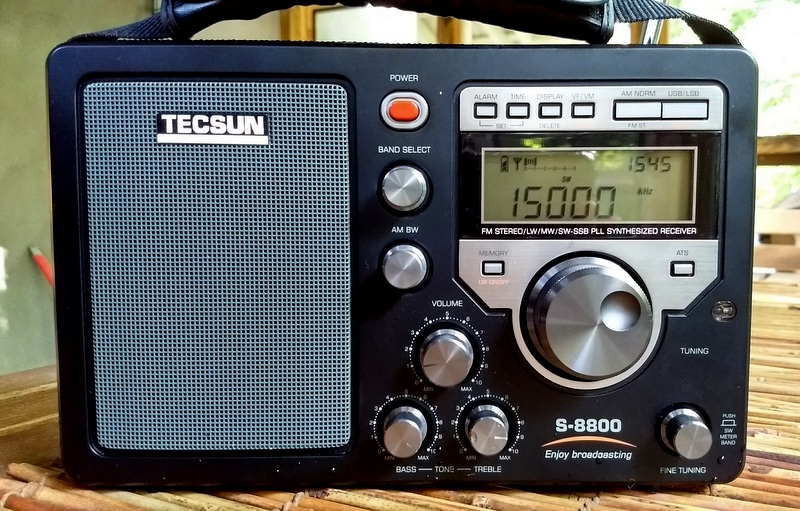
Tecsun’s S-8800: Is This All The Radio You Will Ever Need?
These days, we who still derive enjoyment from listening to shortwave broadcasts, be they larger international broadcasters or smaller stations that remain on the air against all odds in the Internet age, also enjoy using the many types of radio receivers that enable this activity.
One of the cruel ironies is that today’s technological advances have made possible the kind of worldband radios (the term that first came into wide use way back in the 1980’s) that years ago we could only dream of, be they full communications receivers or portable receivers.
Having begun my own DXing/SWL career in the late 1960’s, and pretty much maintained my hobby activities over the decades, I have used pretty much every receiver that ever existed, from tube radios to today’s latest DSP wonders.
I have a soft spot for classics from SONY — my list of portables today includes the fantastic SONY ICF-SW77, SW-07, SW-55s and SW-100. Panasonic is represented in my portable collection by the wonderful RF-B65.
Only in recent years did I decide to test the main higher end portable offerings from Tecsun: the PL-660/680, and PL-880. What I discovered, as have most people who own the Tecsuns, and similar receivers such as the XHDATA D-808, are the wonders of DSP chips and the great flexibility they provide, such as multiple selectivity options, along with excellent sensitivity.
Though it’s been on the market for going on three years now, one of the receivers I had not been able to test was the Tecsun S-8800. There are quite a few reviews already online. Some go into extensive detail in describing the plus and minus points of the radio.
With so many people having already assessed the radio — and most of them in fairly glowing terms — I won’t repeat a long list of technical specs, as you can find those in other reviews, and on the site of Hong Kong-based Anon-co, which is probably the main seller of the S-8800.
Headline
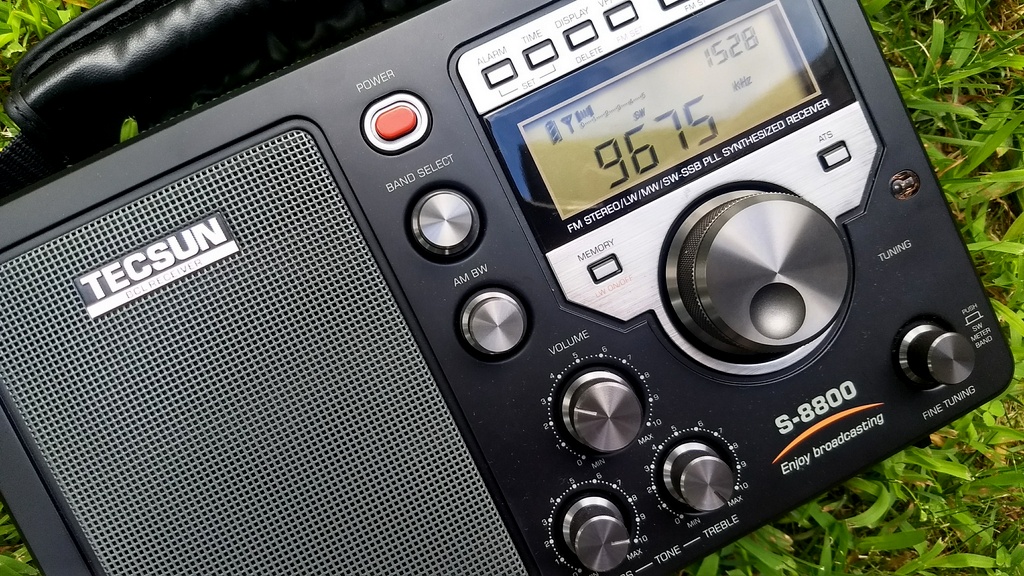
The S-8800 is arguably the best multi band radio portable among portable category offerings on the market today. It combines superior audio delivered from its superb front-firing speaker, with equally superb sensitivity (triple conversion), and multiple selectivity options, with an amazingly professionally-executed remote control.
I used the S-8800 in a number of physical locations, from public parks where I hoped to avoid high noise levels, to my back yard where noise levels are, unfortunately, quite high. I have compared the S-8800 to a number of portables in my collection, including: SONY ICF-2010, SW-77, SW-55, along with Tecsun’s 660 and 880, Grundig SAT-500.
Audio
Hands down, the S-8800 wins the audio competition when compared to pretty much every other radio. Where the competition gets tight is with receivers such as the classic Grundig Satellit 500, and Tecsun’s PL-880.
Sensitivity
This is a TRIPLE conversion radio. As everyone knows by now, Tecsun did not merely adopt the cabinet of the old Eton S350 but basically stuffed a hot rod racer into the cabinet of what was previously a mediocre radio at best.
Selectivity
Widely used in a number of radios these days, the S-8800 uses a DSP chip that is seen in a number of other receivers. The best description I have seen so far is in the review by Jay Allen who notes that Tecsun “decided to utilize a combination of DSP (Digital Signal Processing) circuits along with traditional analog circuits . . .most of the AM/SW circuitry is PLL/analog along with the 1st and 2nd IF’s, while the 3rd IF is DSP.” It appears that after a bit of a rocky period in the beginning when initial units suffered from images and birdies, Tecsun got it right.
Ergonomics
Much has been said about the fact that Tecsun decided not to include a keypad on the radio itself. I too was skeptical. We have all become accustomed to keypads as standard equipment on portables.
Personally, I do a lot of my listening on the beach during vacations, and am used to being able to hold and operate the radio in such situations, so the thought of having to carry a remote control seemed uncomfortable at best.
However, the reality is that it’s still possible to navigate the shortwave, AM, and FM bands easily even without the remote — call me old fashioned, but I am from a group of older listeners who have most frequencies memorized anyway, so I know where I want to go to hear certain stations.
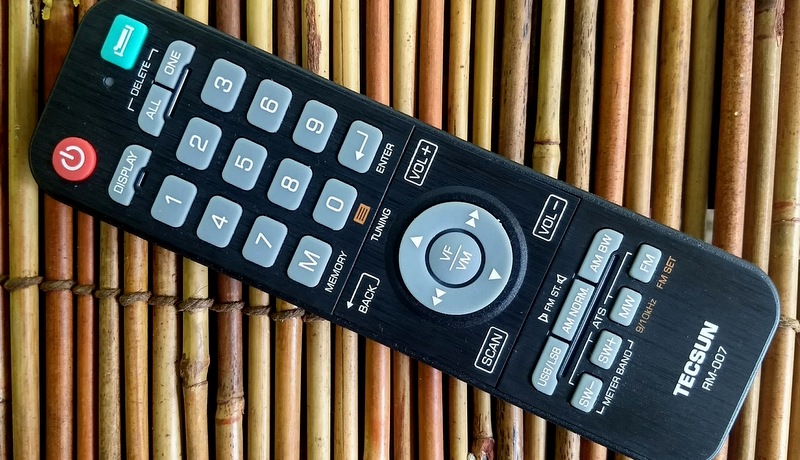
Tecsun hit it out the ballpark with the remote supplied with the S-8800. It looks like something you would find with high end stereo equipment and clearly much thought went into making sure it can control every aspect of the receiver, from SW band slewing to selectivity, volume, readout — everything except BASS and TREBLE control, Timer/Alarm, and master volume (i.e. as other reviewers note, you have to set the on-radio master volume to a high enough level first, then use the remote to vary).
Power
The radio requires two 18650 lithium (Li-ion) rechargeable batteries, with individual indicator LEDS inside the battery compartment. This choice is perhaps one of the most controversial aspects of the 8800. Among other things, 18650s usually receive more attention from airport security personnel if one is taking the radio on a trip — this is something everyone should keep in mind. Any radio being transported on a flight these days is going to be subjected to added scrutiny, simply because almost no one uses radios anymore.
As for the power needs of the receiver, the 18650s seem to do a good job and last quite a long time, even days. Included in the box is one of those white USB charger blocks — quite small and convenient. I usually travel with separate 18650 chargers, the kind used with high end flashlights, so having spare sets of charged batteries is not a problem. But if both 18650’s in the Tecsun are drained, the radio definitely needs to re-charge to a minimum level required for operation.
As I write this, I plugged the S-8800 into a wall outlet (a blue LED indicator on front indicates charging mode) and I was unable to use the radio as the battery level had completely zeroed out. Also keep in mind that the USB charging brick throws off EMI to other radios in the vicinity, and makes it impossible to use the S-8800 itself — there is just too much interference from the charging process to the radio’s receiving circuitry.
Comparisons
As mentioned, I compared the S-8800 with a number of other portables in my collection. Each of these other radios, including the classics from SONY such as the SW-55 or SW77 have their strengths. For example, the SW77 has the best implemented synchronous reception of any portable since the ICF-2010 along with superb sensitivity. However, even the large speaker on the SW-77 was unable to compete with the S-8800. Only radios such as the older Grundig SAT 500/700 had the advantage when compared to the S-8800’s speaker, with the Tecsun PL-8800 close behind.
Receiving Comparisons
I decided to take the S-8800 out to my back yard for a receiving comparison with the receiver I consider to be among the top five best in what I call the small portable category (which is above the mini-portable category in which we find the SONY SW-100 and SW-07 and similar size radios).
Rather than produce several separate videos, I have combined one listening session comparing the S-8800 with the RF-B65. It’s a bit long, so my apologies, but gives you an idea of how these two fine portables did going head to head.
Leaving aside the obvious superiority of the Tecsun where audio is concerned, the S-8800 competes well with the Pan RF-B65, often superior to the smaller radio, but sometimes inferior in one respect.
While there was nothing the S-8800 could hear that the Panasonic could not, signals seem to jump out of the S-8800 in a way that they did not with the smaller radio. However, there appeared to be an interesting difference when it came to the ability of each radio to deal with interfering stations 5 kHz above or below.
As shown in the video, the Panasonic was able to distinguish more clearly between a station on 9,650 kHz (Guinea) and a station 5 kHz above (in this case, Algeria via France, using 9,655 kHz) than the Tecsun, which seemed to struggle. Indeed, at one point I was forced to attempt ECSS (Exalted Carrier SSB) mode to separate the two stations, whereas on the Panasonic, being the older and simpler radio design was an advantage in that the RF-B65 was actually able to more clearly separate the two stations by “de-tuning” from the center frequency.
One huge advantage of the S-8800 by the way is that there is a hidden software change that enables one to adjust SSB zero beat to zero or near zero. This means that in theory using LSB/USB to improve reception is possible, though keep in mind that there may be some variation from unit to unit. So far, after performing the so-called ‘secret’ fix (among a list of tweaks discovered so far) my particular S-8800 appears to be able to zero beat LSB/USB with little or no variation between the side bands, pretty much up and down the SW bands.
Conclusions
For me, the S-8800 has turned out to be the biggest surprise of the last several years. Coming seemingly out of nowhere, packaged in the cabinet of a receiver that was seen as mediocre at best, we have a triple conversion beauty (it seems to weigh almost nothing by the way) that provides pretty much every tool required these days to tackle what is left of shortwave broadcast reception. It has superior audio, unless one compares to older Grundig and similar sets.
Drawbacks are quite few to be honest. A case can definitely be made that using 18650 batteries was a poor choice by Tecsun. This means, for example, that if you’re out on the beach or elsewhere for many hours, the only way to charge up the radio would be to use a separate phone battery charger rather than simply be able to slip in regular alkalines. But then, I carry separate battery charge units already for my phone.
The big criticism that synchronous reception could have been included is also valid. The same was said about the SONY ICF-SW55 — with synchronous reception, and a bit more careful design of the tuning circuit, that radio could have been a heavier hitter, a mini-ICF 2010, something the much more expensive SW-77 was designed to improve upon.
However, so far radios utilizing DSP chips have struggled when it comes to synchronous reception capability. Indeed, the feature has ended up being discovered only as one of a number of ‘secret’ features. Only the PL-660 has a decent synchronous feature, but that radio is hobbled by limited selectivity options, while sync on the PL-880 is pretty much useless.
Finally, I have to say thank you to Tecsun for doing everything possible to avoid the dreaded ‘MUTING’ problem that has been seen on so many small portables.
As I found to my disappointment when using even the much-praised Eton Grundig Satellit, and even the C Crane Skywave SSB, this problem can be a killer for those of us who consider it absolutely critical to be able to hear EVERYTHING on and between frequencies.
So, the big question — would I recommend the S-8800? As with almost everything, the answer to that is, it depends on what kind of a listener you are, and expectations.
From a performance perspective, if you are like me, a die-hard DX’er at heart who gets a kick out of searching for the last Peruvians on the air, the S-8800 should be more than sufficient. If you’re both a die-hard DX’er and enjoy FM and AM, the 8800 should also be a perfect selection, since it’s been reviewed quite well in terms of medium wave and FM capability.
A personal note — for me, part of the fun of shortwave portables has been their ‘cool factor’. I’m just one of those who likes to carry around complicated looking radios with lots of buttons. The SONY 2010, SW-55, SW-77s, older Grundigs all fit the bill.
I never thought the S-8800 or radios similar to it in appearance would. So, for me it’s going to require a bit of a change, since the S-8800 looks like, well . . . it looks like a ‘toy radio’!
But it’s one hell of a toy-looking radio. It’s a triple conversion monster packed in the frame of something that, at one point in the past, you might have considered getting for your kids (if they even knew or know what a radio is!).
As many of us are at this point in our lives, I am also thinking ahead — to the day when my numerous premium Watkins Johnson and JRC radios, and a few boatanchors hanging around, will have to go because of downsizing.
When I’m 65, as the Beatles song goes — or more likely 85 or 90 — what will I be able to fit on a bedside dresser and use easily to tune in whatever is left on shortwave (if anything)?
The answer to that question is a radio that’s small enough and enough of a performer, preferably with a well-designed remote, to bring in anything that’s still on HF, MW, and FM. With those needs in mind, the answer is already here, in the Tecsun S-8800.
[I want to express sincere thanks to Anna at Anon-co who responded quickly when I proposed a review of the S-8800 and supplied the receiver on which this article is based. Anna was patient as my original plan to have a review in by September was delayed by unavoidable personal matters. Thanks also to Tom Witherspoon for getting the review up so quickly].
Many thanks to SWLing Post contributor, Bruce Atchison (VE6XTC), who shares the following notes from a DXpedition over 30 years years ago. Bruce writes, “While going through some old blog posts, I found this one about a DXpedition I took in 1984.”
HUNTING FOR RARE GAME.
In past posts, I’ve mentioned my passion for radio. It began with my discovery of distant stations on my dad’s car radio when I was ten years old and continues to this day. Because my memoirs deal with subjects other than distant signal reception, referred to by radio aficionados as DX, I haven’t been able to write much about this infatuation.
One aspect of hunting for DX is travelling to remote locations that are free of man-made interference. When I learned that my cousin Wayne, was going hunting near Lodgepole in October of 1984, I begged a ride with him.
In a clearing along a cut line, I erected a seventy-foot-long wire antenna and connected it to my general coverage receiver which I powered with a car battery. While Wayne hunted moose, I tracked down exotic stations. Just as the fresh autumn air invigorated me, so did the crystal-clear reception of stations which I could barely hear back home.
At our makeshift camp site, I often let my cousin listen to the radio. This occasionally led to some strange situations. As we ate breakfast early one morning, I tuned in a station from Papua New Guinea. To my astonishment, the announcer began playing country music. There we were, two Canadians in the Alberta wilderness, listening to American country tunes from a station on the other side of the Pacific ocean.
Another memorable radio moment happened one night when I picked up a coast guard station in contact with a ship somewhere in the Pacific. Somebody on board it was hurt and needed a doctor. The radio man could barely speak English and the American on shore could barely understand the sailor’s accent. If it wasn’t a serious situation, it would have been comical.
My uncle Bob, who hunted in a different part of the forest, met us one evening as we relaxed by the fire. When he asked what I was doing with that fancy radio, I showed him by tuning in Deutsche Welle, Germany’s international broadcaster.
Uncle Bob gawked at the set and listened in awestruck silence for a minute. “I can understand that,” he exclaimed as a news announcer droned on in German. “I can understand everything he’s saying. How can you pick up a signal all the way from Germany?” he marvelled.
I couldn’t even begin to explain the intricacies of F2 radio wave propagation to him so I said, “Signals like that always come in like that on the short wave bands.”
I felt sad at the end of the week when we packed up and drove toward Edmonton. Though Wayne came back empty-handed, I had the fulfilling experience of listening to far away stations free of annoying buzzes from TV sets and power lines.
Thank you for sharing those wonderful memories, Bruce!
Many thanks to SWLing Post contributor, Gary DeBock, for sharing the following guest post:
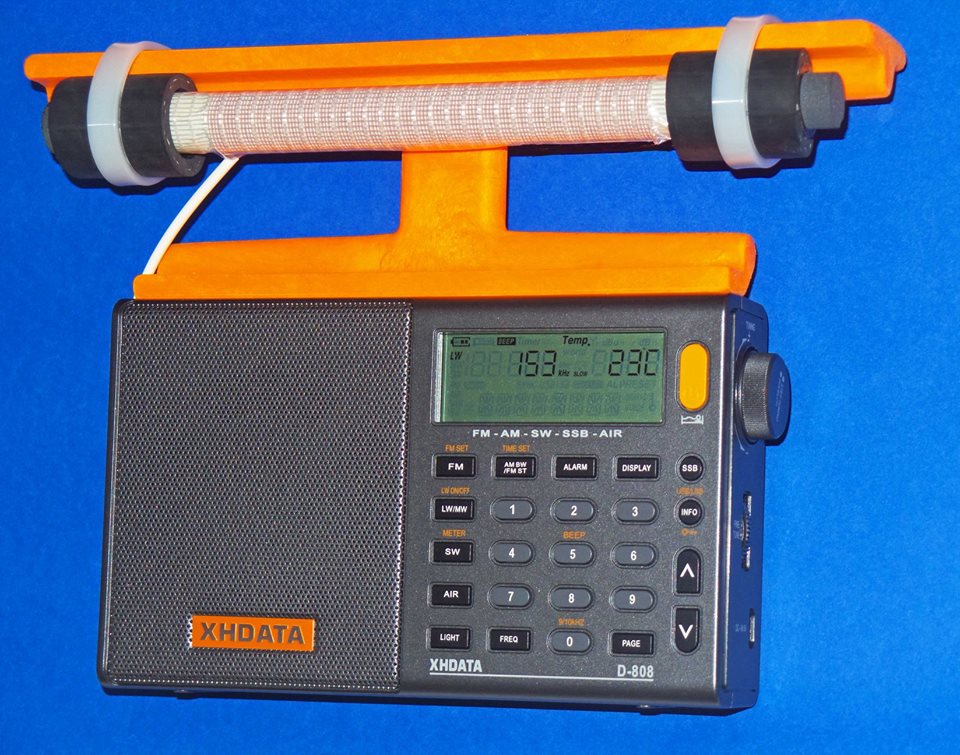
Supercharging the XHDATA D-808
Installation of High Performance AM and LW Loopsticks
By Gary DeBock, Puyallup, WA, USA, September 2018
Introduction
As a stock receiver the Chinese-made D-808 AM-LW-FM-SW-AIR portable is a very capable performer, with AM reception superior to that of any current Ultralight model, and impressive FM reception as well. The radio was certainly “inspired” (to use a generous term) by the C.Crane Skywave SSB model, which coincidentally was manufactured in the same part of China by C.Crane’s Redsun partner—with the first units going out the door a few months before the D-808 came into existence.
Because foreign intellectual property is routinely copied in China with no punishment from the government, XHDATA essentially had the chance to copy all the good points in the Skywave SSB design and improve upon its weak points as well. The only precaution that XHDATA took after this wholesale design appropriation was to forbid direct shipments of the D-808 from China to North America—presumably to avoid a copyright lawsuit by C.Crane. As such, the first D-808 models were sold to the rest of the world around January of 2018 at a price about half that of the Skywave SSB, while North American DXers were told that since the model couldn’t be shipped to the USA or Canada, they were out of luck.
Of course some D-808 models did make it into North America, where it was found to be a very capable portable with astonishing value for the price. Finally around March, an enterprising Chinese eBay seller came up with a plan to ship the model to North America through Israel, thereby skirting around XHDATA’s direct shipment prohibition. As of late August this eBay seller (harelan ecommerce) has already sold 62 of the D-808 models this way, even though he charges a premium for shipment to North America. Whether this single supply source will continue to serve North American customers is currently unknown, but out of the 7 models that I have purchased from him there hasn’t been a single D-808 model with any issues– despite the apparent lack of any manufacturer’s warranty offered on the radio.
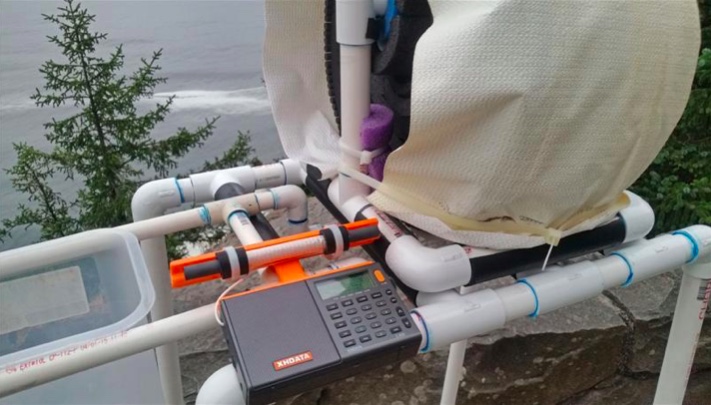
Despite the D-808’s rather dubious design pedigree there is no doubt that the Chinese engineers (or reverse engineers?) did a superb job in creating an awesome radio for the money. Besides directly copying the Skywave’s SSB design and controls, XHDATA also made significant improvements, including a longer loopstick (providing clearly superior AM sensitivity), a much more powerful audio amplifier (correcting a serious shortcoming in the Skywave SSB) and a much lower price (about half that of the $169.99 Skywave SSB, for models shipped outside North America). Another great advantage for someone wishing to perform this loopstick upgrade are the perfectly located, highly accessible Litz wire connections on the RF circuit board—apparently used by the Chinese engineers to conveniently test out various loopsticks, and retained in the final product. The radio’s high quality construction and survivability in adverse conditions were proven repeatedly over the summer here, with the model surviving accidental exposure to a 104 degree (43 degrees C) car trunk temperature, exposure to moderate rain, repeated travel bumps, and use as the main receiver during a 9-day DXpedition to a plunging ocean side cliff in Oregon state. The 3.7v lithium-ion rechargeable battery provides superior run time for extended DXing sessions, and is included in the D-808 shipping package, along with a USB cord to charge the battery, a plug-in wire antenna (for FM,SW and AIR), a vinyl carrying case, and a pretty basic English instruction manual.
One thing you will NOT find supplied with the D-808 is a warranty card– either in the shipping box, or online. This is pretty standard practice in China, incidentally, where concepts like refunds and warranties aren’t generally part of customers’ expectations. This doesn’t necessarily mean that XHDATA won’t repair obvious problems in a new D-808, but it does mean that they aren’t assuming the obligation to do so. I have heard from one North American purchaser who received a new D-808 with a defective speaker, and he is still waiting for the model to be repaired (after paying the shipping charge to send it back to China). Each individual purchaser must decide whether or not this lack of any warranty is a deal breaker. But if you are looking for a final reason to perform this loopstick transplant, why not consider the fact that you will not be violating any manufacturer’s warranty by doing so??
Realistic Expectations
Although this 7.5” loopstick upgrade will certainly make your D-808 far more sensitive than the stock model on Medium Wave or Longwave, it is not designed to compete with large (2’ sided or larger) inductively coupled box loops, or any of the new FSL antennas. The sensitivity upgrade will boost the D-808’s MW band weak-signal performance up to the level of classic portables like the ICF-2010 and RF-2200; however, and since the D-808’s DSP-enhanced selectivity will generally exceed that offered by these classic portables, the overall DXing capability in the AM mode could be considered slightly greater. The D-808 does have SSB capability, although it lacks the SSB tuning convenience offered by the ICF-2010 and RF-2200. It also lacks the ICF-2010’s superb Synch detector, a big advantage in weak signal DXing. But in portability, versatility and DXing value for the price, the “Supercharged” D-808 is a real winner.
Project Overview
This construction article will provide the builder with step-by-step instructions to upgrade the XHDATA D-808’s loopstick to a much more sensitive, externally-mounted 7.5” Medium Wave or Longwave loopstick replacement. Both the Medium Wave and Longwave 7.5” loopstick designs have been thoroughly tested and proven effective in actual DXing by hobbyists other than the author, and as long as the instructions are followed carefully, this relatively inexpensive modification will provide a major improvement in the D-808’s weak-signal reception capability.
This modification project involves close-order soldering on the D-808’s circuit board, and should only be attempted by builders with reasonably good eyesight, good hand coordination and soldering experience. The project also calls for the use of a precut plastic loopstick frame to attach the antenna to the top of the D-808’s top back cabinet surface, and the construction of this precut plastic frame requires either the use of a 12” (or larger) power miter saw, or some rather lengthy cutting with a hacksaw. Use of a power miter saw SHOULD NOT be attempted by those without serious power tool experience! The author assumes that only qualified power tool operators will attempt to use a 12” miter saw to cut these frames quickly, and that other builders who wish to construct them will use a hacksaw. As such, only basic cutting instructions are provided for the 12” power miter saw users, while detailed instructions are provided for the hacksaw users. To assist builders who are not qualified to use power tools, the author has prepared a LIMITED number of these precut plastic loopstick frames on a power miter saw, which will be offered at cost to these builders on a first come, first served basis.
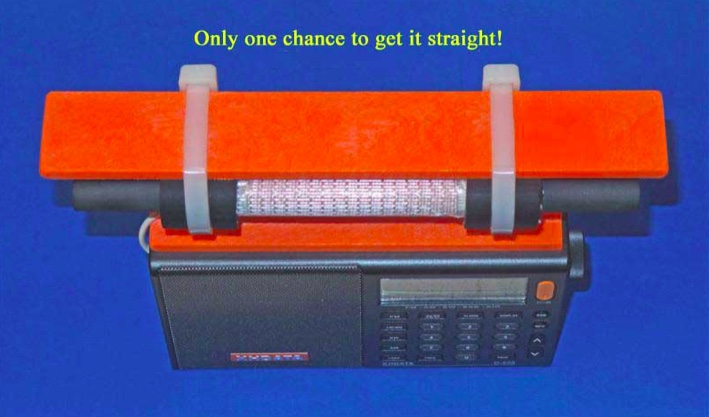
A final warning is in order concerning the step of gluing the precut plastic loopstick frame to the D-808’s top back cabinet surface. Although this step is not dangerous, it is pretty tricky. Since the superglue “grips” very rapidly, you will only get one chance to ensure that the frame is straight, and centered on the D-808’s top cabinet surface. Do yourself a favor, and make multiple “dry runs” to practice this important step before applying the glue! Failure to take this step seriously will probably result in a crooked loopstick frame—which will hold the antenna just fine for DXing purposes, but which will be an eternal reminder to the DXer (and everyone else) of the hazards of haste.
Construction Parts Required
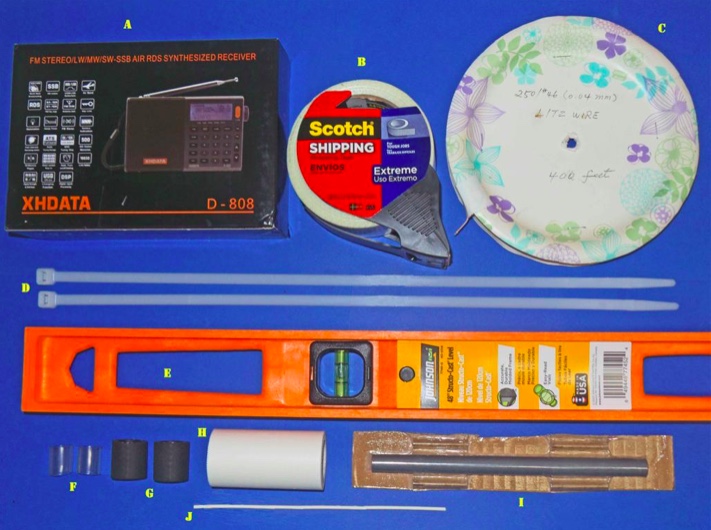
This 7.5” loopstick D-808 construction article will guide you through the assembly of either a 7.5” Medium Wave loopstick D-808 or a 7.5” Longwave loopstick D-808, so make sure that you order the parts necessary for construction of your chosen model. The picture above shows the parts that will be necessary for construction of either model, but the Litz wire and 7.5” ferrite rod components differ according to whether you are building the Medium Wave or Longwave model.
A) XHDATA D-808 Receiver, currently available to North American purchasers (for $112.87 + $10. Click here to search eBay.
B) Scotch brand “Extreme” strapping tape (any size roll)
Miscellaneous: One packet of Duro Super Glue (.07 ounce size), solder, 25w (low heat) soldering iron, hacksaw (or power miter saw), screwdriver set, sandpaper, needle nose pliers, diagonal cutters
D-808 Radio Preparation
Before starting the modification give the radio a thorough test on all bands, ensuring that all the stock model functions work properly, and that there are no issues with the display, speaker, headphone jack, battery or charging system. It’s also a good idea to run a daytime DX band scan on the AM or Longwave band (for whichever band you plan to construct an upgrade loopstick) and document the results—to use as a benchmark for the upgrade loopstick’s performance.
Step-By-Step Construction
Antenna Frame and 7.5 inch Loopstick Preparation
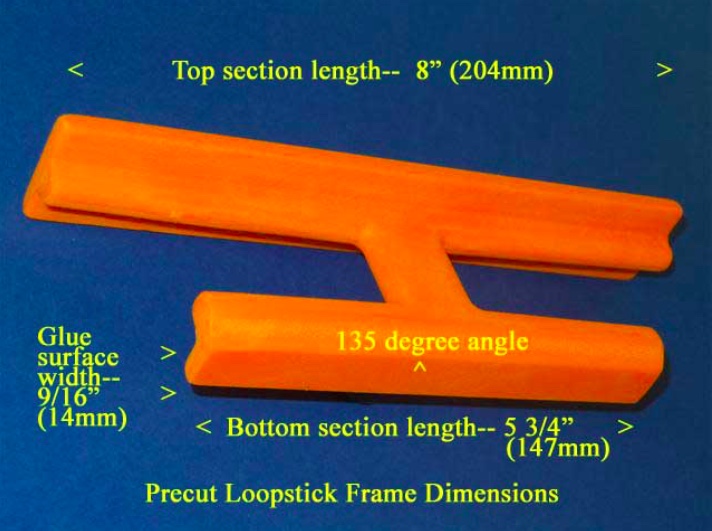
1) Refer to the photo below. Using the “Supercharging the Tecsun PL-380” article (posted at http://www.mediafire.com/file/du3sr5cd9thqvau/7.5inch-LS-PL380.doc/file or available directly from the author) carefully prepare the orange loopstick antenna frame according to construction steps 1-9, EXCEPT note that the lower (glue surface) edge of the antenna frame should be cut to a length of 5 3/4” (147mm), NOT 5” (127mm) as described in the PL-380 transplant article. Pay close attention to the safety precautions concerning power tool usage, and DO NOT attempt to use a power miter saw unless you have SERIOUS power tool experience!
2) If you are constructing an AM (Medium Wave) loopstick, follow construction steps 10-16 in the PL-380 transplant article to construct the antenna. If you are constructing a Longwave loopstick, follow construction steps 10a-16a in the PL-380 transplant article to construct the antenna. If you are constructing both loopsticks, MAKE SURE that the ferrite rod and Litz wire are only used in the antennas for which they were designed. Mixing up these items is very easy, and such a mistake will make both loopsticks perform like clunkers.
3) After construction of either the AM or Longwave loopstick, follow the instructions in steps 29 and 30 of the PL-380 transplant article to install a piece of 3 1/8” (79mm) shrink tubing, EXCEPT note that this length is slightly longer than the 3” (76mm) length called for in the PL-380 article.
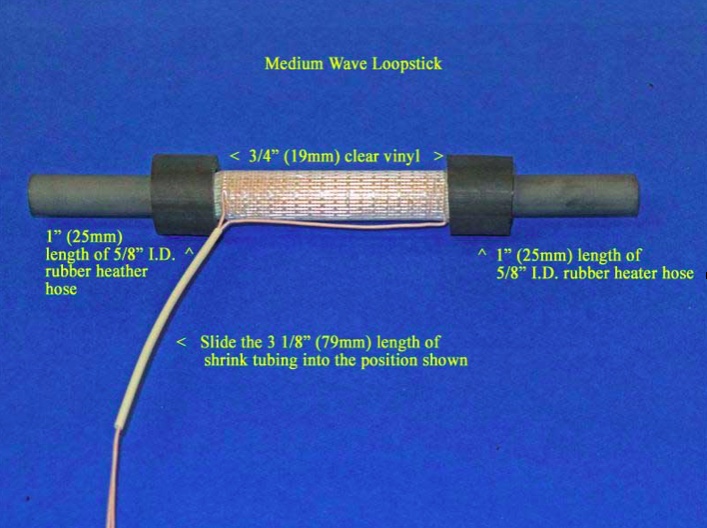
4) Refer to the photo below for the following three steps. [NOTE: Although this photo shows the AM (Medium Wave) loopstick, the procedures in this step are the same for the Longwave loopstick, although the position of the rubber hose lengths and clear vinyl inserts will be closer to the ends of the ferrite rod]. Carefully slide the length of 3 1/8” shrink tubing into the position shown, ensuring that there are no Litz wire kinks or bends inside the shrink tubing.
5) Take the two 3/4” (19mm) clear vinyl inserts and slide them onto the ferrite rod ends, twisting them up against the border of the Scotch “Extreme” tape ends to lock the tape in place under the vinyl inserts. Ensure that the clear vinyl inserts do not touch any Litz wire leads or coil turns.
6) Slide the 1” (25mm) lengths of rubber heater hose over the clear vinyl inserts until the appearance of the loopstick resembles the above photo. Ensure that the rubber hose sections also do not touch either the Litz wire leads or any coil turns. Finally, place the completed loopstick in a safe place until it is called for in Step .
Radio Disassembly
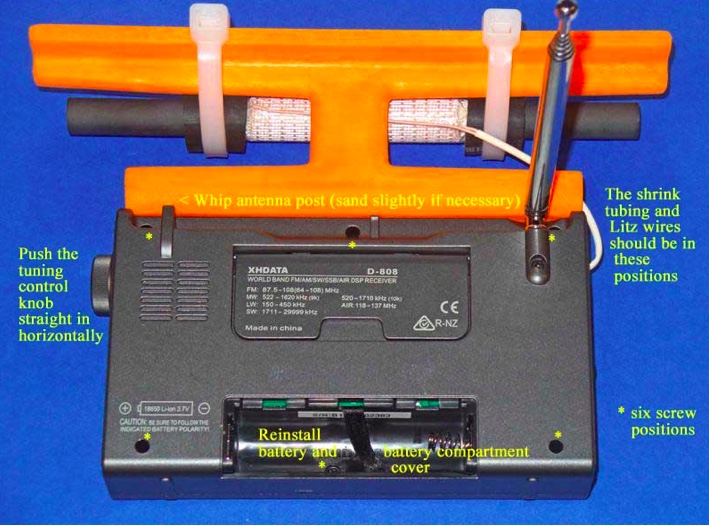
7) Refer to the photo above for this step. Remove the battery from the radio, and using a Jeweler’s Phillips screwdriver of the correct size, remove the six identical screws in the positions shown (NOTE: These screws have a tendency to stick inside their slots, even when the slots are turned upside down. If you cannot remove all six screws it’s not a major problem, but at least ensure that the screws are completely loose in their slots, and that you don’t lose any of them during the remaining steps). Grasp the tuning knob, and pull it out horizontally in a completely straight manner to remove it from the radio. Ensure that the battery, tuning knob and all removed screws are placed in a safe place until the radio is reassembled.
8) Carefully separate the front and back cabinet sections and place them down in the position shown in the photo below. Note that the front and back sections of the radio are connected by a ribbon wire plug-in system– ensure that this plug remains securely inside its slot at all times, and that no great stress is placed on the speaker wires.
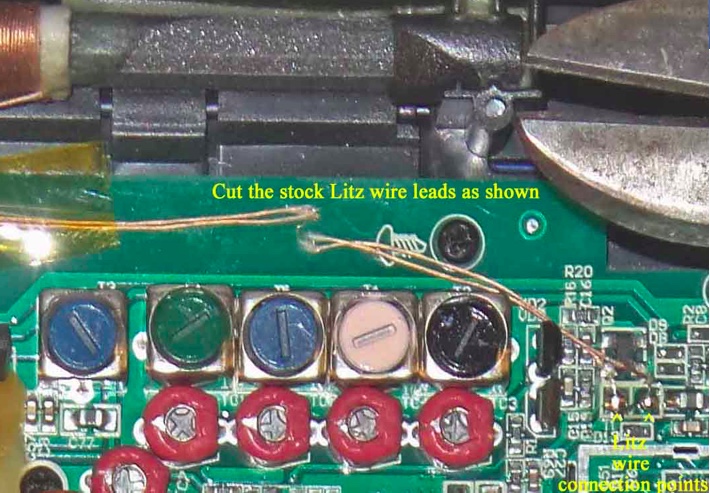
9) Refer to the close up photo below, and note the position of the two Litz wire soldering points on the circuit board (in the lower right corner of the photo). Using diagonal cutters, cut the two Litz wire leads at the position shown, UNLESS you wish to salvage this stock loopstick for other projects—in which case you should desolder the entire lengths of the Litz wire leads from the circuit board at the positions shown in the lower right corner (NOTE: The stock loopstick is of a fairly good design, and has an inductance that would be compatible with any DSP-chip Ultralight radio, providing an AM sensitivity boost in the process).
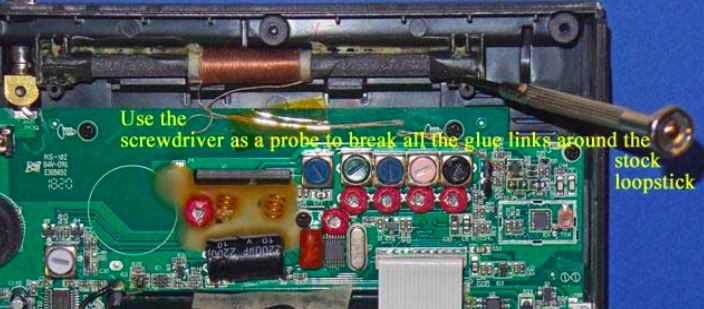
10) Refer to the photo below. Using a flat Jeweler’s screwdriver with a 1/16” blade, carefully probe around all four sides of the stock loopstick to break all of the glue bonds. Work slowly and carefully around the perimeter of the ferrite rod, including the plastic covers on each end. Once most of the glue bonds have been broken the ferrite rod will begin to shift around as you break up the few remaining bonds, but until this point work slowly and patiently to break up the glue.
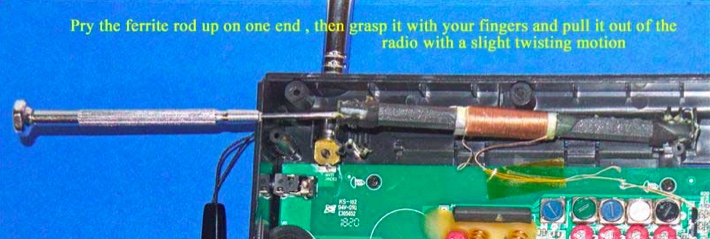
11) Refer to the photo below. Using the flat Jeweler’s screwdriver, once all of the glue bonds have been broken and the ferrite rod is loose in its slot, lift the ferrite rod out of its slot on one side by prying up under the plastic cover on the end of the ferrite rod. Ensure that the Litz wire leads have either been cut or desoldered from the circuit board, then grasp the ferrite rod with your fingers and pull it completely out of the slot with a slight twisting motion.
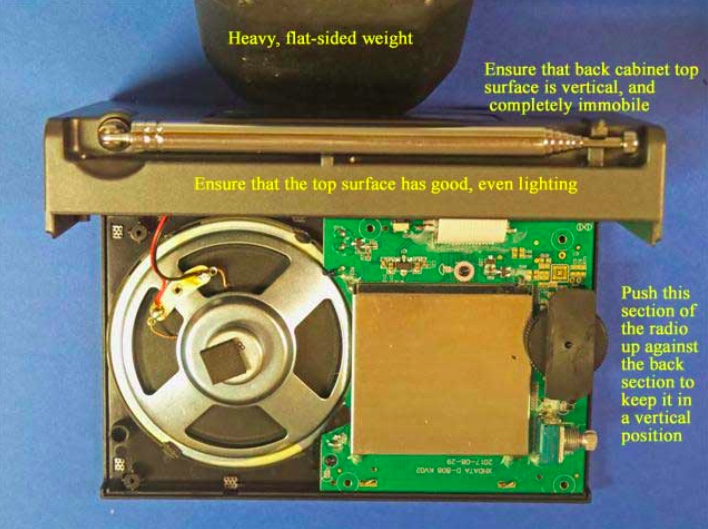
12) Remove the wrist strap, and refer to the photo below. Carefully pick up the two sides of the radio and place the back section in a vertical position as shown, with a heavy flat weight (barbell, or other heavy flat item) pressing up against the back cabinet section to keep it in a vertical position. Ensure that there is adequate, even lighting on the top cabinet section for the gluing process in the next step, and that the back cabinet surface will not shift around as you make the gluing “dry runs,” and perform the actual gluing of the loopstick frame to the top of the cabinet.
13) Take the previously prepared orange plastic loopstick frame, and ensure that its bottom glue surface is completely smooth and flat, with no uneven ridges on the edges of the glue surface (remove these with fine sandpaper, but ONLY on the ridges, and not on the rest of the flat glue surface). Using a damp paper towel, wipe the top cabinet glue surface and the loopstick frame glue surface to remove any dust or debris, then wipe them again with a dry, clean paper towel to ensure that they are both completely dry.
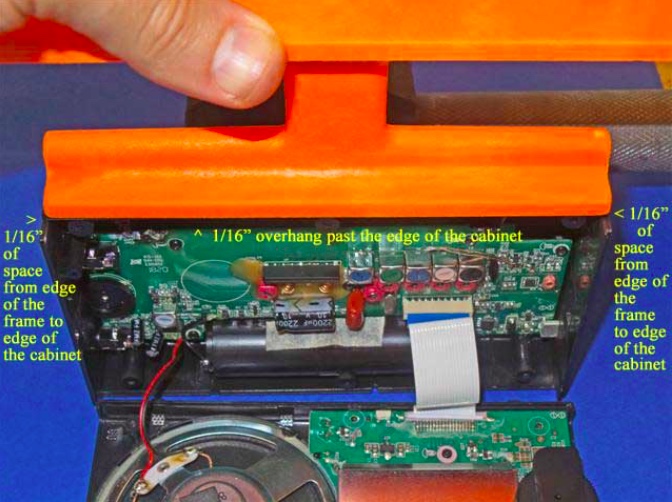
Take the loopstick frame and gently slide the frame over the top cabinet surface to ensure that both surfaces are smooth and flat. Refer to the photo at the top of the next page. Ensure that there is even, bright lighting on the top cabinet surface, and make several “dry runs” to place the loopstick frame in the exact center of the top cabinet surface (with 1/16”, or 1.5mm of space between the frame ends to the cabinet ends), and also 1/16” (1.5mm) of overhang above the front edge of the cabinet’s glue surface (NOTE: if you wish to simplify the process by lining up the front edge of the loopstick frame with the front edge of the cabinet’s glue surface it will still provide an acceptable result, but you will need to do some minor sanding of the whip antenna’s plastic slot post, as shown in the photo below. In either case, make repeated “dry runs” with the loopstick frame to practice placing it in the exact center of the top cabinet’s glue surface, since you will only get one chance to place it in the proper center position once the superglue is applied.
NOTE: The back of the loopstick frame has a beveled surface to permit full operation of the radio’s whip antenna after the frame is glued on the top of the cabinet surface. If the loopstick frame is glued with a 1/16” (1.5mm) overhang in front of the front edge of the cabinet surface then the whip antenna should have enough space for free operation. The alternative is to glue the two front edges lined up with each other to simplify the gluing process, in which case minor sanding may be required on the whip antenna slot post, as shown in the photo below.
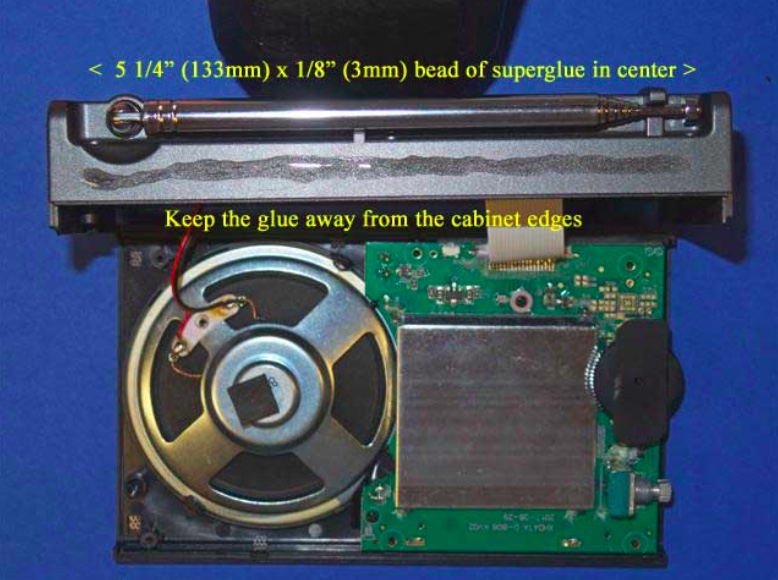
14) After making multiple “dry runs” and becoming familiar with accurate placement of the loopstick frame on top of the cabinet, refer to the photo at the top of the next page. After once again ensuring that the back cabinet section will not shift around during the gluing process, take the Duro superglue packet and apply a thin (1/8”, or 3mm) bead of glue along the center of the cabinet’s glue surface, extending it 5 1/4” (133mm)long, with equal spaces on both ends (as shown). While sighting the two sides place the loopstick frame carefully down in the correct center position as practiced previously, with the 1/16” overhang if desired. If satisfied with the position, press down on the frame to lock the two surfaces together securely. Usually the frame may be shifted around slightly within 1 or 2 seconds of placing it on the superglue, so use this brief time to promptly shift the frame to a straight position, if necessary. After a couple of seconds, though, you will need to be satisfied with whatever position the frame has ended up with (regardless, it will still hold the loopstick just fine, for DXing purposes).
15) After the loopstick frame is securely placed and locked on top of the D-808’s cabinet surface, place downward pressure on the loopstick frame along its length in order to ensure a tight glue bond throughout the entire top cabinet surface. Continue this process for about one minute, and sight both ends of the loopstick frame to ensure that they are both completely flat against the D-808 cabinet.
16) Inspect the front and back edges of the loopstick frame’s border with the D-808 cabinet for any glue seepage, and if any is found, remove it promptly with the 1/16” flat Jeweler’s screwdriver blade. Glue should not be allowed to run past the frame edges. This completes the process of gluing the frame to the D-808 cabinet.
7.5” Loopstick Installation
17) [NOTE: The installation procedures of the Medium Wave (AM) and Longwave loopsticks are identical, except that the plastic tie wraps and rubber hose sections are closer to the ends of the ferrite rod in the Longwave version. The following photos are for the Medium Wave (AM) version, but Longwave loopstick builders should follow the same steps, while referring to the Longwave model photo in the “Operation” section as a guide]
Refer to the photo below. Carefully take the previously prepared 7.5” loopstick and hold it in the position shown—in its slot, centered in the middle of the orange antenna frame, with the shrink tubing and Litz wire leads running down to the left. Take the two plastic tie wraps and install them in the position shown, centered over the rubber hose sections on the loopstick, while ensuring that no Litz wires or shrink tubing is bound under the plastic tie wraps.
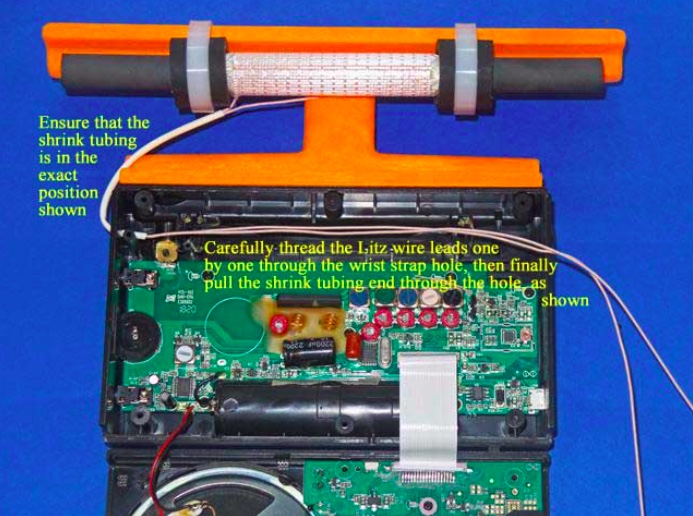
18) Refer to the photo below. Lay the two cabinet sections down flat as shown, ensuring that the Litz wire shrink tubing is in the exact position shown (if it isn’t, carefully slide it along both Litz wires until it is in this exact position). Carefully thread one Litz wire end through the empty wrist strap hole, then thread the other Litz wire end through the hole, as shown. Finally pull on the two Litz wires together from the right while guiding the end of the shrink tubing into the empty wrist strap hole, and pull a short section of the shrink tubing through the hole (as shown) to protect the Litz wire insulation from friction damage.
19) Refer to the photo below. Using the previous procedure to install shrink tubing (which is described in the PL-380 transplant article) install a 2.5” (63mm) length of shrink tubing over the two Litz wire ends, and shift the shrink tubing into the position shown in the photo. After this is done cut the two Litz wire leads to the lengths shown in the photo (NOTE: make sure that the ends of both Litz wires are cleanly cut, not frayed and at the minimum diameter before attempting to insert them into the shrink tubing. The process is much easier when the Litz wires pass smoothly through the shrink tubing).
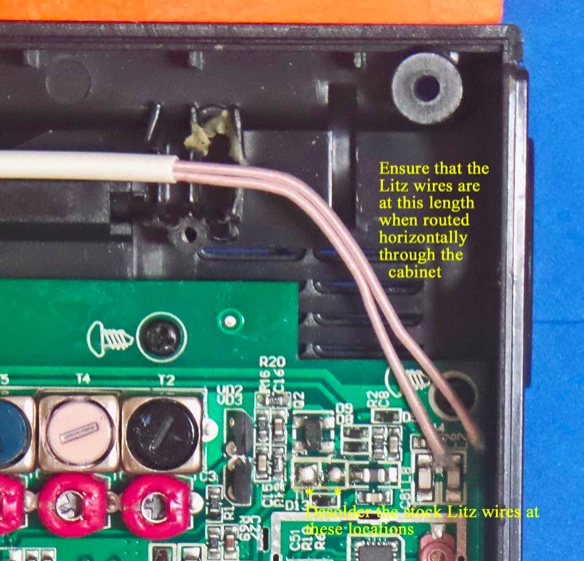
20) Refer to the close up photo below. Using a low heat (25w) pencil-type soldering iron, remove the two stock Litz wire leads at the positions shown, taking care not to use excessive heat, or touch the adjacent components. Ensure that the new Litz wire leads are at the length shown when the leads are in a horizontal position throughout the cabinet, and cut them to this length if they are not.
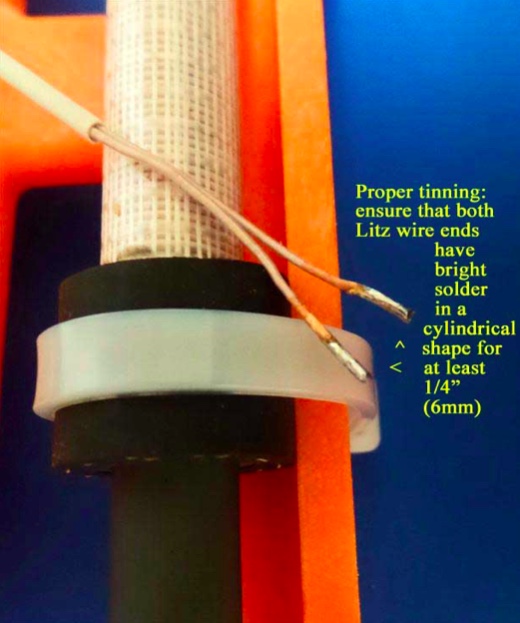
21) NOTE: When tinning the 250/46 Litz wire it is essential that all of the individual Litz wire strands be completely soldered together for a length of at least 1/4” (6mm), with bright, shiny solder around the circumference of the Litz wire ends for this minimum (1/4”) length. The Litz wire must be heated with a clean, hot soldering iron around its circumference in order to melt the solder properly for this step]
Refer to the photo above. Pull the Litz wires up out of the previous position, and place a clean rag underneath them (on top of the circuit board) to completely protect the circuit board from any solder which might accidentally drop down during the tinning process. Using your hot 25w soldering iron melt a generous amount of solder on its tip, and work the soldering iron tip slowly and patiently around the circumference of each Litz wire end until there is a bright, shiny solder length of at least 1/4” (6mm) in a cylindrical pattern at the end of each Litz wire. When doing this, take great care not to allow any solder to drip down onto the circuit board below (i.e., make sure that your rag completely covers the circuit board). The final appearance of your Litz wire lead ends should resemble those in the photo.
22) When your Litz wire lead ends resemble the photo above, cut the soldered portion down to a length of 3/16” (5mm) and observe the appearance of the end of the Litz wire. It should have a bright, solid circular shape, with no gaps or individual Litz wires showing. If not, reheat the end of the Litz wire while adding some solder, and repeat this step.
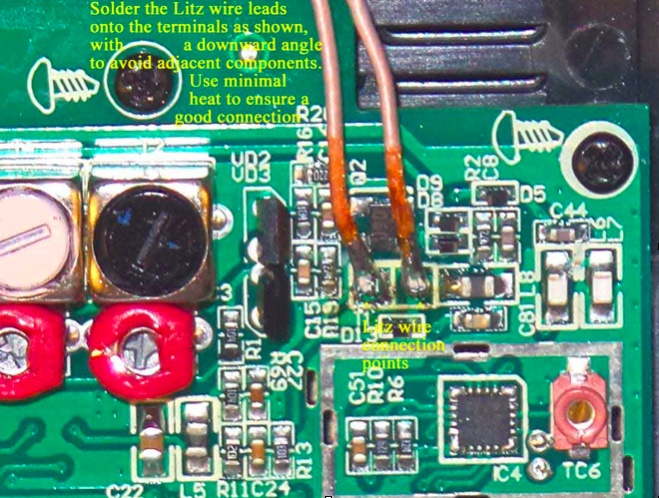
23) NOTE: The Litz wire connection points on the circuit board are surrounded by other important components. It is important to avoid solder drips on these components, or solder bridges to their leads. Solder the Litz wire leads down at an angle to avoid these surrounding components, and use the minimum amount of heat and solder to ensure good electrical connections)
Refer to the close up photo above. Following the precautions described, solder the two Litz wire leads down onto the circuit board at an angle, as shown in the photo. After soldering, make a close visual inspection to ensure that there are no solder bridges across the Litz wire connections, or nearby components. The remaining length of the Litz wire leads should be routed in a horizontal manner to the wrist strap hole.
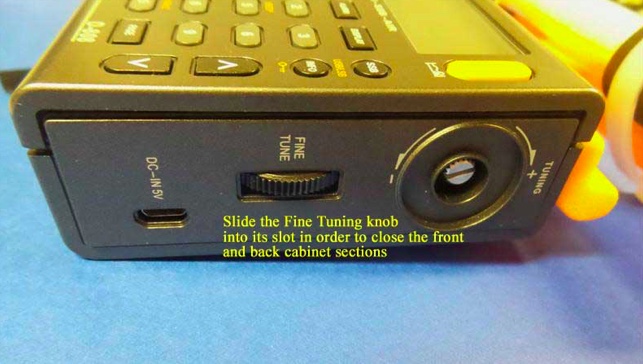
24) Carefully pick up the front and back cabinet sections, and hold the back cabinet section fairly close to the front section (as the radio would normally be oriented, when assembled). Refer to the photo below, and carefully insert the “Fine Tuning” control thumbwheel from the front cabinet section into its slot on the back cabinet section in a sideway movement. This will allow you to fully close the front and back cabinet sections in the next step.
25) Refer to the photo below. Pick up the two cabinet halves and carefully snap them together (this action should not require any great force). Place the radio face down in the position shown (with a soft surface underneath, for protection), and using the Jewelers Phillips screwdriver of the correct size, carefully screw in the six screws that were loosened previously, starting with the screw near the whip antenna post (you should pick up the radio temporarily and hold the two cabinet sections together tightly at this corner, as you do this).
After all six screws have been retightened take the Tuning control knob and press it back onto its shaft in a straight horizontal motion. Finally, reinstall the battery and battery compartment cover to finish up the reassembly.
TESTING AND OPERATION– MEDIUM WAVE MODEL
This 7.5” transplant loopstick is designed to provide a major boost in sensitivity from 530-1700 kHz, and if the antenna is working properly both the weak signal reception and the radio’s nulling capability should be greatly enhanced. It is normal for the antenna to receive more background noise on the low band frequencies, although the sensitivity boost should be substantial across the band.
The construction design of the orange antenna frame allows full usage of the whip antenna for checking SW parallels of MW-DX stations, although if you chose to glue the antenna frame flush with the front of the back cabinet surface to simplify the gluing process, you may need to sand the whip antenna slot post slightly to allow free movement of the whip antenna (see step #13).
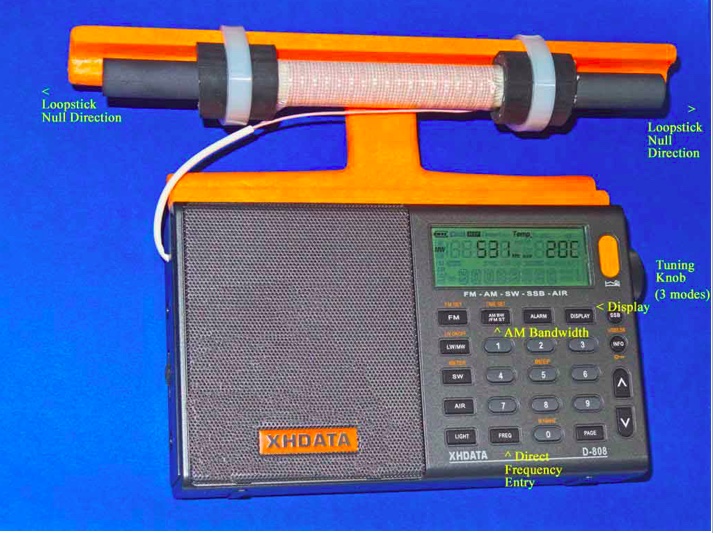
In the photo above, some of the important controls for Medium DXing are highlighted. The AM Bandwidth control allows you to choose multiple DSP filtering selections to enhance selectivity as desired, with the narrowest filtering (1 kHz) providing both the sharpest selectivity and the best weak-signal sensitivity. However this 1 kHz setting also has the poorest audio fidelity, with the higher audio frequencies typically cut off by the DSP filtering. As such, for regular DXing far away from strong local pests, the other AM Bandwidth settings may be more suitable. The Direct Frequency Entry key allows you to manual enter in any MW frequency, to which the radio will shift once the numbers are pressed on the keypad. The Tuning knob has three different modes, which can be toggled by pressing the knob horizontally. The first mode is tuning in either 9 kHz or 10 kHz steps (depending on which of these step you have selected), while the second mode is tuning in 1 kHz steps. The third mode is to lock the frequency in place. Pressing the knob again will return the tuning to 9 or 10 kHz steps.
The XHDATA D-808 has multiple display functions, which can be toggled by the indicated key. The first option is the temperature in either Centigrade or Fahrenheit (depending on your pre-set preference), while the second option is the alarm time. The third option is the current time (which you need to set according whether you prefer UTC or local time), while the fourth option is the received signal strength in both dBu and dB.
The supplied 3.7v lithium ion battery has superior run time, and may be easily charged using the supplied USB cable to either a computer or AC outlet (with the appropriate adapter). As reported in various posts throughout this year, the D-808 model has rugged construction with an excellent record of survival under tough conditions, including hot summer days, moderate rain exposure and extended usage as the main receiver during a 9-day ocean cliff DXpedition in Oregon—performing flawlessly at all times.
Conclusion
It is the author’s sincere hope that this “Supercharged” D-808 model will bring you a lot of DXing fun during travel, as well as at other times. When conditions are good you should never underestimate this enhanced model’s potential of receiving awesome DX beyond your expectations—as an example, here is the stand-alone performance of a 7.5” loopstick D-808 in receiving 1017-A3Z in Nuku’alofa, Tonga (10 kW at 5,632 miles/ 9,063 km) on the ocean cliff near Manzanita, Oregon at 1301 UTC on August 8th of this year:
Not only Tonga is received, but even the Australian horse racing station 1017-2KY in Sydney (5 kW at 7,630 miles/ 12,280 km) is received as a weak co-channel in the middle of the recording. My hope is that you all will be so lucky with your new Supercharged D-808!
73 and Good DX,
Gary DeBock (in Puyallup, WA, USA)
Absolutely amazing! Thank you for taking the time to put this procedure together and describing the process in such fine detail, Gary! Hats off to you!
Click here to read all of Gary DeBock’s posts on the SWLing Post.
Many thanks to SWLing Post contributor, 13dka, for the following guest post:
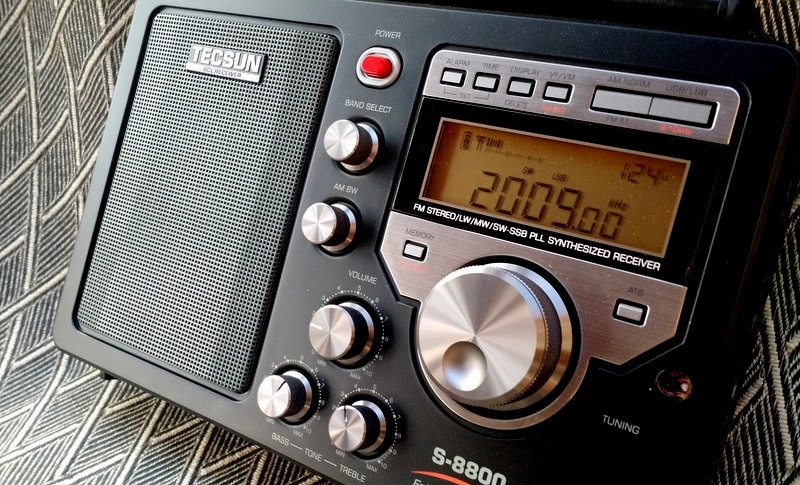
Tecsun S-8800 Review
by 13dka
Looking for a new toy again I recently revisited the Tecsun S-8800, which looked like it could replace both my battered old Grundig Satellit and my Tecsun PL-660. Being in production for a few years now, and with the “birdies” situation ironed out long ago, the S-8800 has gathered much acclaim by now but also a few somewhat contradicting reviews. For example, one review reports that the S-8800 can cope with larger antennas, another one states the exact opposite, one praises the MW performance, another one attests only average sensitivity, and only one mentioned an unpleasant detail I’m going to emphasize on in a bit.
All reviews touted the improved SW performance in AM and SSB though, and that was reason enough to make my own experiences. Testing it turned out to be a bit of an emotional rollercoaster though.
I hope I can share more than only redundant bits of information about the radio, and I’ll skip most of the general information you can read in most other reviews.
Off to the 13dka radio test site at the dike!
13dka’s SWL Happy Place
General
Like the technically somewhat similar Tecsun PL-880, the S-8800 is a triple conversion receiver and has 2 conventional IF stages, the third IF stage is using a Si4735 DSP chip again, providing the filters and all that jazz.
Tecsun seems to have thrown a lot more parts into it than in previous radios, plus a pretty big ferrite rod (covering 8-9/10th of the radio’s width) with individual LW and MW coils (most of the smaller receivers have only one coil), a 108mm telescopic whip and of course the “gun metal” knobs. Designing a radio with a rather simple front panel and making a remote control an integral part of the operation concept (like it is reality with TVs for a long time) is a charming oddball approach, in a way reviving an utmost luxurious feature of 1930s high-end radios. So let’s cut to the chase and talk performance:
Longwave and Mediumwave
On LW and MW, I first compared the S-8800 with my old Grundig Satellit 400 at home. The old clunker has similar dimensions, a big old speaker bass/treble controls and it was known to have an average sensitivity on the AMBC band in its time, when all the great, now vintage AM performers were still ubiquitous, so that’s rather a “Jay Allen average” than an “average of the mediocre AM radios of this millenium”. I think Jay Allen might rate it 3 stars.
Longwave
The first station I tuned in was the BBC LW transmitter network on 198kHz and it turned out a tad more noisy on the Satellit. Great! I could also pick up Medi1 and Kalundborg a smidge better than on the Grundig, and in the early evening, out at the beach I was picking up stations on all still populated channels on LW (minus 180kHz where it has one of the remaining birdies). The other new portables I currently own (PL-660, D-808) are far away (PL-660) and far, far, far away (D-808) from that kind of performance.
Mediumwave
Unfortunately that good impression vanishes gradually when leaving the long wave for the NDB band (still good) and finally medium wave. Before I left the house to test the radios on the electrically quiet beach again, I was checking out one of my favorite border case stations (low power station from The Netherlands on 1602kHz, whatever their name is this week) and that made very clear already that the S-8800 can’t hold a candle to the Satellit, at least not on the top end of the MW band. Despite all the noise indoors, on the Satellit I could easily recognize the song being played while the S-8800 didn’t pick up anything at all.
On the beach it turned out that – despite the ferrite rod being twice the size – I find it only marginally better than the PL-660, and not close enough to the little XHDATA D-808 (if you’ve read my D-808 review you already know that this little radio is almost on par with the Grundig on MW):
Of course I have read Thomas’ assessment of the AM performance so I was prepared to be underwhelmed. But at least you can connect some high gain MW antenna to make up for the missing sensitivity and be happy again, or can you?
A not so nice surprise
The unpleasant detail I mentioned before is: the Int/Ext Antenna switch does not turn off the internal ferrite bar antenna. Jay Allen mentioned it in his review, it was the only review with that detail and unfortunately I overlooked it. How does that matter?
The main issue is this: if you’re (like me) forced to use outdoor antennas to escape high indoor noise levels, the internal loopstick just won’t let you. The external antenna will just increase the SNR a bit when the station is strong enough anyway. Even in a low noise environment, the internal loopstick will needlessly add noise to the signal received from a high-performance active loop or FSL antenna.
That also explains a paragraph in Thomas’ S-8800 review:
“I also hooked up the S-8800 to my large horizontal loop antenna. This certainly did improve MW reception, but not as dramatically as I hoped. Additionally, it seemed to be very sensitive to RFI in my shack even when hooked up to the external antenna.”
There’s more external antenna idiosyncrasy: only the BNC jack is wired to the “Ext” position of the antenna switch, the “hot” (red) Hi-Z terminal is active when the switch is in the “Int”-position, it just seems to save you an alligator clip on the whip.
The dedicated “AM antenna” terminal was in part what sold the S-8800 to me. The label made me assume this would be specifically wired to the AM circuit but as it turns out it’s just a generic high impedance input and I really didn’t anticipate that the internal loopstick remains always active (or in case of the Hi-Z terminals, the retracted whip). Yes, technically you can connect an external antenna for MW, practically…YMMV.
To conclude this section, the final outcome of this antenna connector issue plus the not so brilliant MW sensitivity was that not even my active ML-200 loop (connected to the BNC-jack) could improve reception on 1602kHz enough to make the S-8800 get at least a bit into the ballpark of the Grundig with its loopstick antenna. The currently mounted small 80cm rigid loop on the ML-200 just couldn’t produce enough signal to lift the station over the noise that much.
Shortwave SSB
As the other reviews reported already, Tecsun has obviously worked on the AGC issues their former products had. I can confirm this so far, the AGC does not show the distorted onset of leveling anymore – unless the signal is very strong. But the leveling happens much faster than e.g. on the PL-880 so the remaining blasts of distortion are quite short:
A more relaxed AGC release time would save us most of those too. I noticed AGC pumping effects from strong signals in the spectrum neighborhood only with a big antenna connected. But unfortunately there is more…
Stuff you have to live with:
In his great review, Thomas mentioned the auto mute sometimes interfering with reception. I noticed this too (with all bandwidths on SSB) and I credited this to very low noise figures. When the bandwidth is narrow (=less noise) or if you have a very low noise floor anyway like when tuning through 25-30MHz, the receiver gets muted over the entire chunk of spectrum, just to intermittently and pretty suddenly pass the noise again. Sounds like a broken antenna cable and has some potential to confuse people:
Too bad that setting auto mute to ’00’ doesn’t actually turn it off in SSB mode so there’s likely no remedy for that.
On my example, there is absolutely no difference between the 3kHz and 4kHz SSB filters. A working 4kHz filter would have been a good choice for ECSS reception.
Another remaining quirk at least on my specimen of the S-8800 is a slight FM modulation of an oscillator in SSB, particularly with strong signals. You can hear it best if you create a heterodyne or listen to CW, the tone sounds a bit hoarse, so do voices and I’m not sure whether or not this could affect narrow-bandwidth digimiode decoding. The front panel (namely the bandwidth knob area) is quite susceptible for “hand capacity”, the frequency varies a bit when you move your hand in front of the S-8800. This is not uncommon with portables of course, but my D-808 for example has its “Theremin playing area” on the back of the radio.
In this clip you can hear both the “hoarse” modulation and my hand waving to you.
This leads me to calibration and frequency drift. The S-8800 can be calibrated on SSB (see the “Hidden features” section below), however this turned out to be a (too) fast moving target. I don’t know if it’s the VFO or the BFO but it is so temperature-dependent that 6°C temperature difference equates to a quite substantial (for SSB) drift of 150Hz. Whatever oscillator it is, it seems to lack any temperature compensation measures, with all the implications that may have on relaxed SSB listening, digimode decoding and ECSS reception when the temperature isn’t quite stable where you want to use it. After calibrating it, it’s often slightly off again within the same minute. My cheap little D-808 won’t drift even when I take it from an overheated apartment into a -5°C cold winter storm.
The good stuff
Now to the fun part! When I compared the SSB performance of the S-8800 with my PL-660 the first time, I found them very close for some reason. I could find only one weak station that came in noticeably better on the S-8800 and while I was happy that it wasn’t worse than the PL-660 I was also a bit disappointed.
Timeline: 0:00: PL-660, 0:10: S-8800 receiving the “Gander Radio” VOLMET.
Then I repeated the test a few days later, this time a bit more into the evening and the outcome was very, very different. The S-8800 won every single weak signal comparison with ease and sometimes in a way that made me think my PL-660 must be broken.
But then I could help the PL getting a lot closer by simply holding it in my hand, the difference was that I had placed the PL-660 differently so I could record both radios easier. The factor I forgot to put in the equation was that the S-8800 is absolutely not depending on anyone holding it to give it some counterpoise – that and the long whip is certainly a part of its advantage, and the receivers would be much closer when used with the same external antenna. With the radios just standing there tho (and that’s what most people will do with their radio instead of holding it in their hand), the difference is remarkable nonetheless and I also learned that you should always look and listen twice when testing radios!
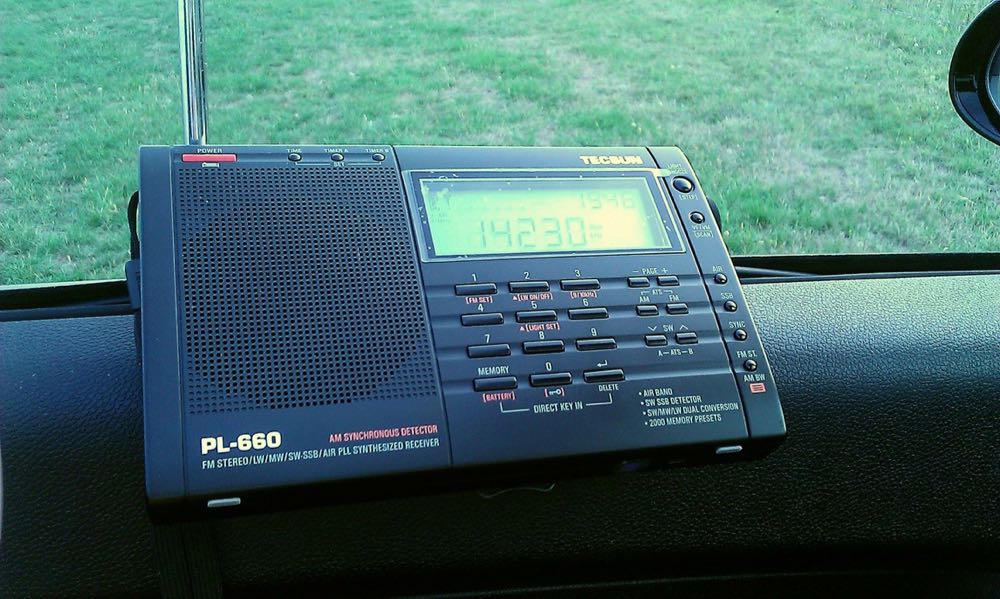
When I repeated the test yet again but granted the PL-660/D-808 the litte bit of counterpoise they seem to need (I let them rest on the car door instead of holding them), the results were not that unequivocal anymore. However, the receivers were 50% on par, the S-8800 was clearly better the other 50% and overall the other two receivers could not score a single point for them. I think that shows that the S-8800 really is a hair or three better. Beyond the increased sensitivity and minus the frequency drift, SSB reception feels more mature, the the S-8800 behaves more like a regular communications receiver now and the big speaker is a big plus. Of course that means there should be also an improved reception of…
Shortwave Broadcasts
I know that the S-8800 has inherited the “Enjoy broadcasting” and “BCL RECEIVER” lettering from the cheap S350, but after stepping the PL-660 and the S-8800 through all shortwave broadcast bands, I felt that’s exactly hat it was made for, and it shows!
There is no doubt that a big speaker can create the illusion of better reception, but I think I don’t fall for that easily and rather listen to the background noise and how intelligible the “content” is. While the comparison with the PL-660 often ended up in a tie when I subtracted the impact of the speaker in my mind, there were indeed some stations where the S-8800 had remarkably less noise than the PL-660. But of course the big speaker is giving the S-8800 a permanent edge on all reception cases, and it’s a real joy to listen! Combined with lower noise and a generally more stable signal (through better AGC) this made quite a difference between the two.
Bottom line is that when listening to shortwave broadcasts, the S-8800 gives you the warm and lush sound of yesterday’s famous receivers while it technically delivers the best performance of all Tecsun portables so far. If you fancy music programs on shortwave and if you don’t mind the price for the luxury and performance, you’ll enjoy this radio a lot.
FM
Short story: my specimen of the S-8800 lacks the very good FM band sensitivity of the PL-660 or the XHDATA D-808. While the latter radios present my favorite marginal case station 100km away fairly with some noise at sea level, the S-8800 just doesn’t receive that station at all, no matter how I position the whip. It’s not exactly worlds between them but considering that (assumedly) most of the FM receiver is in the Si4735 chip that it shares with a couple of great FM performers from the same company, this is a bit surprising.
Signal handling capabilities
The S-8800 is said to have a pretty robust frontend, which I found true but I want to put that a bit into relation. My “lonely beach/dike listening post” sports 2 abandoned steel flag poles of 6 and 8m height. They can serve as support for wire antennas, or easily be used as an antenna themselves by inductively coupling them to the receiver – IOW by winding a wire 2-4 times around the pole (you could use the Eiffel tower as an antenna this way) and connecting the other end to the radio.
For some reason this contraption produces quite massive output voltages, but I could always use it for a quick and thorough (and due to the location QRM-free!) reception improvement with my PL-660 anyway. Why?
The PL-660/880 have a 3-position (DX, Normal, Local) switch. I think it turns off the input preamp in the “Normal” postion and adds a simple attenuator circuit in the “Local” setting. The latter is sufficient to tame the output of all sorts of antennas (including the flag pole) enough to make my PL-660 work just fine with that on all bands.
The S-8800’s sensitivity switch on the other hand has only 2 positions and telling from the results it really only turns off the preamp. Now it actually acts up much less on the flag pole than the PL-660 in its comparable “DX” and “Normal” positions, so obviously Tecsun has put some effort into making the frontend more robust indeed. But it seems they thought “that should do, let’s ditch the 3rd (attenuator) position and save 3 resistors” and that left me with many (but tolerable) images across the entire shortwave above 3 MHz, and a heavily image-infested 160m band. BTW, a few soft images from (I guess) 49/41m blowtorches could be heard around 29MHz with only the whip.
A word on the audio
I believe that the “legendary” status of the Grundig and Zenith lines of world band receivers is partly owed to their big sound. They had their music loving and program listening audience in mind, and Tecsun’s choice of casing, big speaker, the bass and treble controls are certainly taking the same line.
Compared to my Satellit 400 (80s model, but still has much of that “legendary” sound), the Tecsun sounds a bit more boomy in the lower mids while having a less super-deep bass response than the Grundig, which also sounds more neutral. Besides these very unimportant distinctions, the S-8800 does sound big and that also helps reception – lacking low mid/bass content can impair intelligibility as well, and it causes more fatique on long DXing sessions.
The bass/treble shelving EQ is certainly more sophisticated than the Grundig’s, it has quite sharp cutoffs at very sensibly chosen frequencies, so turning the knobs down will leave the main chunk of the mid range completely unaffected and just helps removing rumble or the 5kHz beat frequency from a band neighbor, or add some nice hifi-highs and beefy low end when you turn them all the way up. In other words you can continuously blend the speaker sound from perfect “voice communications” style to “dad’s big old radio”.
Hidden functions
Of course the S-8800 has some unofficial “power off” and “power on” extra functions assigned to the number keypad on the remote (they all work by pressing and holding a number key for up to 10 seconds). Some are identical to the PL-880, some are different:
0.) I found calibrating the S-8800 on SSB works with the same method used on the PL-880: Tune to a station with a known frequency, switch to USB or LSB and use the fine tuning knob to tune for best audio/music playback. An alternative way of doing this is downloading a free spectrum analyzer app for your smartphone (“SpecScope”), tuning the radio 1kHz off frequency so you get a nice heterodyne tone on USB or LSB, then using the fine tuning knob to tune the tone to hit exactly the 1kHz mark on the analyzer display. Your last 2 (Hz) frequency digits will now show an offset frequency.
1.) Then press and hold the ‘0’ button until a ’00’ appears in the top right corner of the display and the last 2 digits of the frequency readout start flashing. Release the button and quickly use the fine tuning knob to reset the last frequency digits to ’00’ (the number on the top right corner should be changing while doing that), then immediately hold the ‘0’ key again to confirm – tadaa, the offset should be gone while the last 2 frequency digits show ’00’ now. This all needs to happen pretty quickly and with the right timing, so it may take a few attempts to get it right.
2.) With the radio off, button ‘2’ turns the LW band on/off.
3.) Press and hold the ‘3’ button while the radio is off to toggle between permanent and “intelligent” display illumination.
4.) When the radio is turned on, this button enables access to the extra functions of the number 6 and number 9 keys. The display will read “On” when you perform this the first time, doing it again will turn it off again.
5.) Radio on, set to FM band: this toggles between 75 (US) and 50 (anywhere else) microseconds deemphasis on FM.
6.) Radio on: When enabled using the ‘4’-button as described before, holding the ‘6’ will toggle the (annoying) dynamic bandwidth feature off and on. You can set this independently for AM and SSB. Ideally to zero, because it automatically resets your bandwidth setting and since this is happening in steps, it sounds quite strange. The PL-660 uses a stepless dynamic envelope following low pass filter (which is I believe what they called “DNR).
7.) This is still a mystery to me. On the PL-880, this button apparently controls the line out level on FM. On the S-8800 it (ostensibly) seems to control the S-meter bias with numbers running from ’00’ to ‘+99’ and ‘-99′ for all bands. Positive values reduces the S-meter display which made me curious if it rather controls AGC level or gain at some stage, but it really seems to affect the S-meter display only.
8.) Radio off: Toggles the seconds display on the main clock (when the clock is displayed instead of frequency).
9.) Another important one: this controls the threshold of auto squelch/soft mute. If you want to turn that off, turn it down to ’00’ with the main tuning knob, then hit the ‘9’ key again. You need to do this for AM, FM and SSB separately.
Random stuff
The S-meter was indicating a permanent base level of 2 bars even at my remote beach listening post. But even though it can apparently be “calibrated”, a 5-bar indicator is quite a step backwards from the 99-step RSSI meter of the PL-880.
After an initial discharge and recharge cycle, the 2x2000mAh “18650” batteries gave me a continuous runtime of 21 hours. When you connect the charger and then turn on the radio, it stops charging unless – and this seems odd – you are in FM mode. A full charge while listening to FM radio took 4:41.
Verdict
I had a pretty hard time making my mind up about this radio. It has so elaborate details, so much design improvement and costly parts went into it but I feel like it doesn’t quite meet the expectations Tecsun created with this radio. Sadly, it has a few things that were started ambitious and ended underwhelming.
It got a huge 2-coil loopstick and somehow they managed to make it perform slightly worse than a 70€-radio with not even half of that loopstick size, they gave it 2 external antenna ports but they disappoint MW enthusiasts right again by keeping the loopstick always active, and how FM could turn out less sensitive than many radios with the same Silicon Labs chip (including their own models) is beyond me.
They improved the front end but then they dropped the attenuator, which costs the overall flexibility and better overloading-resilience their other radios have, they fixed the SSB issues of the predecessors and introduced a free-floating BFO with a mind of its own.
The price tag is making these downers certainly weigh heavier, and I think without them this radio may have turned out to be a real classic.
On the plus side I found a radio that really excels on shortwave. Shortwave program listeners can feast on a most sensitive, selective, luxurious and well-behaved portable with a big sound and I think there’s probably no current portable that could compete with that.
Ham radio aficionados get improved SSB reception and if there wouldn’t be this “cheap 70s receiver trademark” unstable oscillator, it would come close to communications receiver performance levels (minus the frontend needed for big antenna voltages).
That the price reaches into the ballpark of pre-loved high-end(-ish) JRC/Icom/Yaesu communication receivers or buys you a mint-condition ICF-2010/2001D may seem like a problem too. But then again, none of those radios is perfect either, and only the Sony is a portable.
Despite the quirks, the S-8800 is still a great, valuable radio that revives an out-of-fashion style of radios in a pretty unique and modern way.
What a brilliant, critical review of the Tecsun S-8800! Thank you so much for taking the time to properly test and compare the S-8800 with the venerable PL-660 and the XHDATA D-808 (readers, also check out his review of the D-808).
You’re right, too, in that I’ve noticed some contradictions in reviews–I do wonder if part of this might be variations between US and EU versions of the radio, or perhaps small quirks in production runs.
No doubt, however, that the Tecsun S-8800 is a champion of the shortwave broadcast bands and its audio fidelity is in a class of its own.
Many thanks to SWLing Post contributor, TomL, who shares the following guest post:
Stupid Radio Trick – DSP “Hi-Fi”
by TomL
If you can remember the 1960’s, there was an audiophile rage going on called Hi-Fi. The base unit consisted of a ponderous piece of furniture consisting of a rectangular cabinet and equally large mellow sounding speaker of fairly smooth frequency response, say in the range of around 40 – 15000 Hz. They would have a built-in radio (using vacuum tubes) with large analog scale. Most would also have a “record player” embedded on the top to spin some vinyl discs (78 or 33 rpm).
For pedestrian consumers, it became a decision of how to keep up with the Joneses, so-to-speak. And that meant a trip to Sears to look at the latest offerings. When the decision finally came to purchase, of course no one could buy it outright. So, to add to the suspense, one had to put money down on “Lay-A-Way” plan that did not allow you to take possession of your prized choice until the last monthly payment! One had to visit or mail in a check every month.
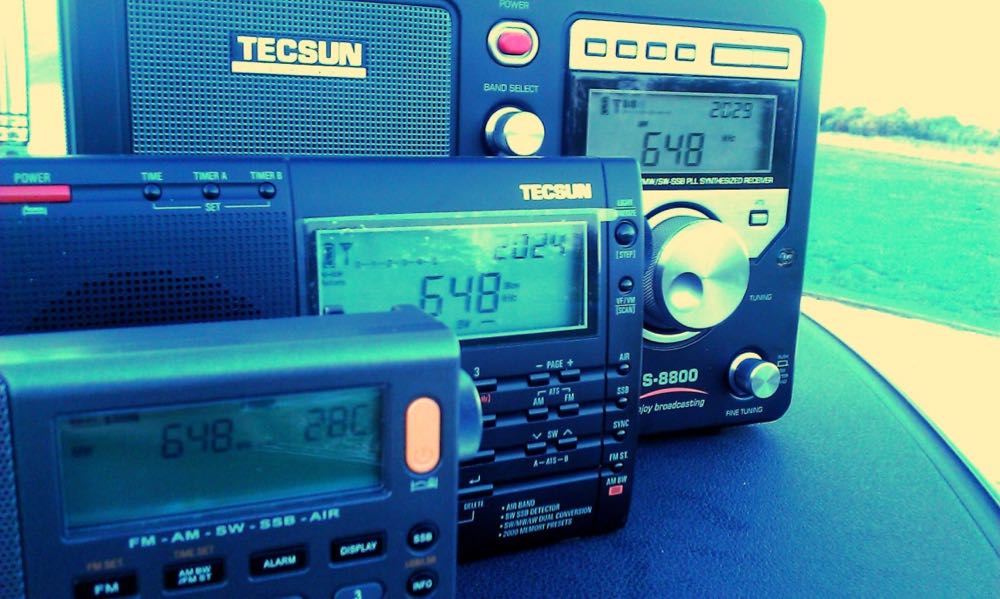
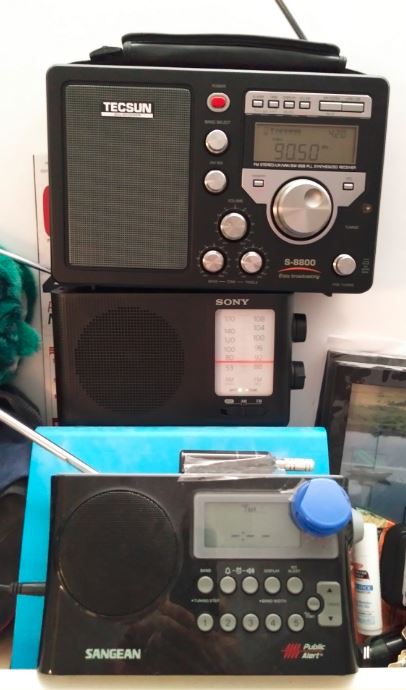
So where am I going with all this? Well, as you can see from the photo [above], I have purchased three portable radios for three very different purposes. All three were painstakingly studied and reviewed and weighed against all other possible choices. All are highly rated by the usual reviewers like RadioJayallen, SWLing Blog readers and other internet personalities. The Sangean is for home use and listening to baseball games when I did not want to fire up the stereo hooked up to the Grundig Satellit 800. The small Sony ICF-19 is a phenomenal knock around radio for the car and listening while out to lunch or a walk in the park. The large Tecsun S-8800 is a possible replacement for my ailing 20+ year old Sony ICF-2010 for shortwave use.
Well, I was tired of listening to any one of them in terms of sound quality. The Sangean has too much upper bass/lower mid range, the small Sony is very carefully maximized for total speech clarity, and the Tecsun seems to lack a little in the mid range frequencies (compared to highs and lows). Staring at them, I thought to self, “What if I turn on the Sangean and Sony together???” What ensued was a revelatory sonic experience (it sounded pretty good)! One seemed to fill in the other in certain ways. But it was not perfect.
Duh, I had the new Tecsun in a carry case while trying to decide if I send it back for a tuning quirk and dug it out and plopped it on top. Turning it on, I heard more lows and highs, just like a Field Radio should have but with the mid range filled in! After very careful volume adjustment, I now have something that could rightly be called DSP Hi-Fi. At least, that is what I am calling it for now. ?
Violin and piano pop-out of an orchestra but not too harsh sounding. Rock & Roll sounds loud and punchy without that boombox effect. Bass lows are there (could be better, now all I need is a small subwoofer connected to the Tecsun line-out ???). Highs are there too but well controlled. Mid range voice clarity is stunning, as if someone is in the room with me but not sounding too forward! It is not room-filling but acts more like a near-field monitor. I like that I can line-up the speakers over each other.
The really fortunate thing is that all three radios have complete DSP for FM and receive my favorite over-the-horizon station with very similar reception quality. Also, they process DSP with a similar delay before output to its respective speaker. The sound is fairly coherent and even though it is still mono output, the full range of musical fidelity can be appreciated better. It is not audiophile quality but it is very satisfying and I can actually hear more details in the music than with any one of the radios by themselves. Just goes to show you that you CAN teach a new Radio dog old Tricks (LOL)!
Happy Listening,
TomL
I love it, Tom! Thanks for pointing out that sometimes it takes a “stupid radio trick” to really produce some amazing audio fidelity! This reminds me that in the early 90s, I used to have a Zenith Transoceanic and RadioShack DX-440 on my radio table in my room. If I recall correctly, the Zenith was on my left and the DX-440 on the right. I used to tune to shortwave, MW and FM stations and produce a makeshift “stereo” effect by playing both at the same time. Sometimes, on shortwave, it actually helped me discern voices in weak signal work!
Many thanks to SWLing Post contributor, Mark Hirst, who shares the following guest post:
Micro Go-Box for the ICOM IC-7100
by Mark Hirst
You’ll be familiar I’m sure with the IC-7100 base unit and separate head unit design. It lends itself very nicely for vehicle installation.
Using it in any ‘portable’ situation however has always presented something of a challenge. A FT-857 or FT-891 can be carried as a single physical package with the head unit integrated into the body. The radios can sit and potentially operate on their tail in a backpack, with products like the Escort from Portable Zero making that process even easier.
I’ve had a few attempts at solving this portability conundrum, driven by a concern that there could be long term problems continually connecting and disconnecting the component parts for transport and operation, but knowing that a permanently assembled IC-7100 will always be an awkward dispersed structure.
My first solution was a Stanley 16 inch toolbox, which is fortuitously sized to accommodate the base unit and provides enough space to loop the original connecting cable and head unit. The box is not a bad fit, but certainly bulkier than necessary and leaves enough room for things to rattle around. When tilted vertically, the head unit can start moving.
Fast forward to this week when I discovered that the IC-7100 base unit will also fit inside a 5 litre XL storage box made by Really Useful Boxes:
The XL version of the 5 litre box has a taller lid, and as you can see from the accompanying photos, accommodates the base unit with the head unit sitting on top of it in a ready to use configuration. The tolerances for height are also exact, the VFO knob very lightly touches the lid, so don’t put something heavy on the box:
Once the lid has been removed, the radio can operate directly from the container:
To make the whole thing fit, I used a 25cm CAT 6 cable in place of the original connection cable and a significantly shortened power lead. As luck would have it, I created the shortened power lead a while ago because I often put the battery right next to the radio.
You can see that I removed a section between the power plug and the fuses, and now use the removed length as an extension should the battery be further away. Although it wasn’t my intention at the time, the main part is about 2 feet long, the secondary about 8 inches.
For transport, the power cable is coiled behind the head unit, ensuring the fuse holders sit in the void immediately behind it, while the microphone cable is coiled on top leaving the microphone resting inside its own coil. You can see the arrangement below:
In the next photo, you can see how the cabling emerges from the back of the base unit:
There’s just enough space for the power cable to leave the base and bend around without undue pressure, and likewise for the CAT 6 cable to curve round into the back of the head unit. Two angle connectors make the antenna ports accessible from above, while a short USB external drive cable provides access to the USB port for data modes and CAT control. A longer USB extension cable is attached to this short cable only when required, and the extension uses much more substantial ferrite chokes to mitigate noise from the computer.
To complete the transport package, I’ve cut out a kaizen style foam insert to make sure the base unit can’t move back into the cabling space, and another to make sure the head unit doesn’t slide towards the front.
The last problem of course is cooling. The fan is located in the front of the base unit, with slots along the sides and top to allow air flow. The box unfortunately is exactly the right size for the base, leaving no gaps for air to circulate. In the absence of a proper workshop or professional tools, I opted to use a hole cutter designed for putting pipes through wood panels. It turns out that plastic has a tendency to deform rather than cut under the blades due to friction heating. A sharp knife was essential in dealing with the effects of that deformation to produce the final smooth edges around the holes:
While I’m happy with the port exposing the front fan, the two holes on each side do not completely expose the side slots. Do I drill out the space between them knowing how tricky and flexible the plastic can be, and would a larger hole compromise the strength of the box? For now, I’m going to keep a careful eye for any temperature issues.
The current arrangement is to carry the box horizontally in a cheap travel bag:
Could the box be tilted vertically with the base unit nose down and carried in a back pack for longer excursions? Yes, but experience has told me that the lid latches on Really Useful Boxes have a tendency to pop open when you do that, so a luggage strap around the box may be required to prevent its very expensive cargo from spilling out. I’m also mindful that the box lid gently touches the VFO knob, so might put load on it in the vertical position.
The final result is something of a Swiss watch, and there isn’t much room for error. Things have to be arranged ‘just so’ to fit, but it does mean I can pack and pick the whole thing up in a handy container. The radio only needs a battery and antenna to be connected on site and then it’s ready to go.
There’s something oddly satisfying when unrelated objects come together like this. Who knew that this box was just the right size to fit the radio?
So, what do you think?
Thank you for sharing this project, Mark!
I love your Micro Go-Box: it’s practical, affordable and makes an otherwise awkward field radio easy to deploy and use. Looking at your photos, I realize that the IC-7100 does have one strong suit for field use. The IC-7100 front panel is tilted at a very comfortable 45 degree angle for use.
Post Readers: What do you think? Any other IC-7100 owners out there who take their rig to the field? Please comment!