Shortwave listening and everything radio including reviews, broadcasting, ham radio, field operation, DXing, maker kits, travel, emergency gear, events, and more
Many thanks to SWLing Post contributor, Dan Robinson, who shares a radio comparison he initially posted in the excellent Extreme Shortwave Listening Facebook group. Dan writes:
When the Sangean ATS-909X was first released a few years ago, I decided that I would hold off obtaining one to let whatever bugs there might be in production get worked out.
I have always been impressed by the design of the 909X, but was cautious when it came to the question of overall sensitivity. I once owned the 909, had it modified by Radio Labs, but that seemed not to do much — the 909, in my view, suffered too much from the well-known deafness issue when using the whip antenna.
Over the years, I used and still own many of the classic portables. This includes the SONY 7600GR, Grundig SAT 500/700, 2010, E-1, SONY SW100/SW07, SONY SW-55, and the radio I consider to be at or near the top of the small portable heap, the Pan RF-B65. But a couple of weeks ago, I broke down and bid for a new in box Sangean 909X. It’s the black version, and arrived a couple of days ago.
I remain impressed by the 909X’s design — beautiful radio, wonderful large LCD and backlight, excellent filtering, along with a feature we used to see in the SONY’s — adjustable/variable attenuation. But I wondered how the 909X would stack up against two of my favorites, the SW-07 and RF-B65. I was crossing my fingers — but alas, initial results are not encouraging.
While the radio initially on its own seems to be quite sensitive, I lined it up next to the SW-07 and RF-B65 and did a comparison. Now, first I must note that propagation continues to be in the dumpster and I conducted this test in late afternoon.
All three receivers were tuned to Cuba on 11,760 khz — they were located next to one another on a table in the top level of my home here in Maryland. The results are seen in the video below.
You can hear how much more clearly the SW-07 and especially the RF-B65 handle a signal. With the Panasonic, stations just pop. Same with the SW-07.
Disappointingly, as you can hear, stations on the 909X appear to be buried in noise. It’s quite extraordinary — I was very surprised by this comparison and intend to perform additional side-by-side tests in different areas of my home, which does suffer from high noise levels likely produced by electric lines and a transformer outside (which is why a run a Wellbrook on my main radio stack downstairs). But it is notable that the 909X appears to struggle so, while the old classic portables SW-07 and B65 excel. Interested in the views of others . . .
Dan, this is very similar to my experience with the Sangean ATS-909X.
I find that the Skywave is so stable on the air band, I can use it to decode ACARS with the Android App!
Listened to WBCQ, and Arnie Coro’s show last night from Havana along with some Jazz music.
It pulled FM stations out of the air like nothing else, meaning the weaker ones here in my rural Ohio location. And I could pick up three NOAA broadcasts, two very strong, one scratchy…. Since the NOAA system is of course designed to let you pick up one station in whatever particular area of the county you live in, I consider this excellent!
With the AM I pulled in Canadians, Boston , stations in IOWA and KFI. I also note it’s very directional on AM… I could null out WTVN and pick up Texas with no problem. I have owned and do own lots of shortwave radios, and I MUST say, this is one hell of a good set!
It’s going into my Winter zip-up jacket pocket so it will always be handy for the DX Season, and I also notice that the headphones are VERY good, and have a long enough cord so it’s not pulling at my ears like some sort of damned harness… I HATE short earphone cords!
(And while I am on the subject of ear phones, and while I haven’t been zapped in the ear with static this year yet by dry air causing that annoying problem, I wonder how these earphones are going to do in that regard… the Sony’s are unbearable in Winter! Ouch! I wonder if anyone else out there has this problem besides me, and has found a solution?)
First of all, thank you for making me aware of the ACARS app and that you can successfully use it with the CC Skywave. I will add the ACARS app to my growing list of HamRadio/SWL applications and also try it myself!
Your experience with the CC Skywave is very similar to mine. It is a fabulous portable receiver. If it only had SSB and sync detection, it would be the ultimate compact portable. The CC Skywave is an everyday carry (EDC) radio for me–either it, or the Sony ICF-SW100, accompany me everywhere in my Timbuk2 messenger bag.
Regarding static discharge from headphones, I don’t think I’ve ever had this happen to me; sounds annoying, though! I suppose walking in dry winter conditions with a thick winter jacket could increase chances of discharge. Perhaps the in-ear design of the included CC earbuds–with silicon earpieces–will minimize and insulate you from this problem? Let us know!
Thank you for your assessment of the CC Skywave, William!
Many thanks to SWLing Post contributor, Richard Langley for the following guest post:
AFVN: The GI’s Companion — A Tribute To Our Vietnam Veterans
Radio station WEBY on 1330 kHz in Milton, Florida (near Pensacola and Elgin Air Force Base), has produced a 10-hour documentary on the American Forces Vietnam Network. This documentary aired in two-hour segments in the afternoons of 26 through 30 October 2015. But it is being repeated in its entirety between 8:00 a.m. and 6:00 p.m. CST (14:00 to 24:00 UTC) on Veterans Day (known as Remembrance Day in Canada and elsewhere), 11 November.
WEBY runs 25 kW during daytime hours (and a puny 79 watts at night) and can be heard in parts of four states (Florida, Alabama, Mississippi, and Louisiana) but it also streams its programs on the Internet and so can be heard around the world. I’ll try to record some of the streamed audio in case the documentary is not available after the broadcast.
I was alerted to this documentary by a recent episode of PCJ Radio International’s Media Network Plus (24 October) during which Keith Perron interviewed the producer. That interview is worth listening to, too.
AFVN transmitted on AM and FM throughout South Vietnam. I never had the opportunity to listen to AFVN personally, but as a high school student, I did use to listen to the Armed Forces Radio and Television Service (AFRTS) on shortwave from time to time. AFVN received some of their broadcast material via AFRTS broadcasts from Voice of America transmitters in Delano, California, and the Philippines. A scan of a QSL card I received for a broadcast from AFRTS Los Angeles via Delano in April 1964 [see below].
Many thanks to SWLing Post contributor and noted DXer, Guy Atkins, for the following guest post:
Wellbrook 1530LNPro vs ALA1530S+ Imperium Loop Antennas
-Guy Atkins
This past weekend I found some interesting results from medium wave DXing with both models of Wellbrook Imperium loop antennas at the “fabled” Rockworks cliffs near Manzanita, Oregon USA. This location has become popular the last few years with Oregon, Washington, and British Columbia DXers due to the signal enhancement at this narrow strip of land approx. 450 feet above the Pacific ocean. The main benefit seems to be splatter reduction of “pest” stations due to the signal blockage of the rock walls blasted into the cliffs for the coastal highway 101. However, a boost of signals around local sunrise is also beneficial, and is a common occurrence near salt water beaches.
Because of the limited space along this scenic coastal highway, all antennas used for DXing need to be both compact and temporary. Wellbrook loops supported on pro-audio speaker stands are a great way to go, and can easily be set up in the pre-dawn darkness.
Comparison
Both Wellbrook loop antennas mounted on “pro-audio” tripod stands right at the cliff edge at Rockworks Cliffs. (Photo: Guy Atkins)
This is a comparison file of weak signal reception with the two models of Wellbrook Communications “Imperium” series loop antennas: the ALA1530LN “Pro” Imperium and the ALA1530S+ Imperium.
Both models of compact, 1-meter dia. active loops are excellent for reception from longwave & medium wave upwards. However, the ALA1530LN “Pro” excels at LW & MW with its low overall noise level and 9dB higher gain, engineered by Wellbrook for improved signal-to-noise ratio (S/N) of up to 10 dB. S/N on the HF bands is reportedly better also.
My laptop running HDSDR software in my SUV; the receiver is an Elad FDM-S2. (Photo: Guy Atkins)
On the weekend of October 24th, 2015 I was DXing at the “Rockworks” cliffs on the Oregon coast near Manzanita, OR. Both of these Imperium series antennas were in use and I was recording the medium wave band with an Elad FDM-S2 SDR receiver. Both antennas were fed with identical 25 ft. lengths of RG-58 coaxial cable.
The demonstration in this video begins with 10 seconds using the ALA1530LN Pro Imperium loop, alternating with 10 seconds with the ALA1530S+ Imperium loop.
The first signal tuned is aviation voice beacon “SQM” from Level Island, Alaska on 529 kHz (400 watts). The signal is weak, but audible as it rises above the noise floor. The reception improvement with the ALA1530LN Pro is evident.
Half way through the recording the frequency is switched to 1710 kHz, where an unidentified station (possibly a MW pirate) is audible playing the 1967 Zombies tune “Time of the Season”. Again, the clip starts with 10 seconds with the ALA1530LN Pro alternating with 10 seconds of the ALA1530S+ Imperium.
Each antenna is a worthy, compact loop for DXing, but for chasing the weakest signals with the best readability I think the ALA1530LN Pro shows its advantages.
Many thanks, Guy, for sharing your loop research!
What I love about your portable SDR set-up, is that you can go to the cliff side, set up your antennas and equipment, record the spectrum on your SDR, then go back home to analyze and listen to what you captured. It takes some of the pressure off while you’re on-site.
This year at the Dayton Hamvention, I purchased the Pixel Technologies RF PRO-1B mag loop antenna. I used it (for the first time) at the PARI DXpedition. We were all impressed with its performance. I would love to compare it with the ALA1530LN Pro at some point in the future.
Many thanks to former VOA correspondent and noted DXer, Dan Robinson, for the following guest post:
A Late Summer Visit to Howard Mills’ Radio Restoration
-Dan Robinson
The end of summer is a wistful time, as we begin to mourn the passage of warm days and anticipate the arrival of autumn.
For those of us in love with shortwave, even in these waning days of HF broadcasting, August brings changes in propagation that herald the approach of improved reception, thoughts of getting antennas in shape, and preparing receivers for the new DX season.
It’s also a time when Hamfests are winding down for the year — for me, it’s still great fun to attend these and see what equipment is available.
A few months ago, I and fellow Washington, DC area SWL Dave Malick took the opportunity to visit a couple of Hamfests. At one of these, in Berryville, VA, I ran across someone who over the years has become somewhat of a legend in the field of radio restoration — Howard Mills.
Howard lives in rural West Virginia, at a point about equidistant from Harper’s Ferry and Sheperdstown. That’s about an hour or so from DC and the immediate Maryland suburbs. From DC, you drive out Rt 270 to Frederick, Maryland and then up Route 15 and 340.
It’s beautiful country — on the way you pass through small towns, past farms, and in late summer, roadside stands selling huge ears of corn and about every type of vegetable, along with peaches and apples of every type and size.
Back in the late 1990’s I first became aware of Howard Mills when I brought my Collins 51J4 to him for refurbishing. Howard is one of the few persons remaining in this country capable of going through classic tube receivers from top to bottom.
A visit to Howard is an experience everyone should have at least once in a lifetime. Restoration activities take place in the lower/ground level of his home.
Outside there are some amazing antennas, long wires, and beams which support both his amateur radio and receiver activities. Under a porch, covered in tarps, are some of his latest equipment and parts acquisitions, from thousands of tubes to some of the rarest radios and transmitter items one may ever see.
Inside, you find a wonderland of receivers. You name it, Howard has it. In racks, there are specialized Beckman 51J4s, SP-600s, AR-88s and R-390/As, Eddystones, and others. In another room, you see some of the most beautiful, and collectible and valuable, American and foreign-made radios dating back to the earliest days.
On tables in one portion of the basement of Howard’s place, you find several R-390s in various stages of refurbishment. One, he notes (probably among his “keepers” ) was found still new in its original crate (how I would love to have that one!).
On the day Dave and I visited, the purpose was to pick up one of the most beautiful R-390s I have ever seen — a Capehart that was refurbished by Howard in 2007 and placed in a custom cabinet, complete with an easy-left-off top, similar to the HQ-180 design. This black beauty is now sitting in my shack at home.
Howard has been at it for many decades, as I said. A conversation with him is a voyage through radio history, punctuated by references to a range of major radio manufacturers. He clearly loves what he does, though one wonders how much longer he will be at it.
Howard emphasizes by the way that his work is in restoring TUBE radios — he doesn’t get into solid state. There are a few well-known receivers in his place — I noticed an ICOM IC-R72 and a JRC NRD-535– but most of what you see are the classics that we have all come to know and love.
His primary specialty appears to be the 51J series. A link to him on the Collins site notes that his main focus is on A line equipment, J series, and 32V series, but he is certainly capable on a number of models, including as I saw, HQ-180s and AR-88s (http://www.collinsradio.org/howard-mills/)
I was able to take some photos of Howard’s operation and offer them to SWLing Post readers here. At this point, Howard remains in business. He has had customers from all over the U.S. and I assume around the globe.
For each refurbishing job, Howard provides an extensive print out of every single modification and component replacement he does, along with the results of sensitivity and calibration tests done for each set.
Please do note that Howard makes clear that basically as long as it takes him to refurbish a radio — is as long as it will take. If you give him one of your radios, you basically agree to it being with him for several months if not longer. He does have a backlog.
Things like sandblasting front panels for R390s (I am not certain to what extent he does this himself or out-sources this particular aspect) also takes time. And the detail with which he approaches a breakdown of an R390/A, evidenced by the sets I saw in process, is quite extraordinary and time-consuming.
Howard gets mostly superb reviews from those who have used his services. If you look him up on the Internet, and he has time for you to visit, it’s an experience you will always remember, though it’s not that I would suggest a crowd descend on him.
Hope everyone enjoys the photos — I had intended to get this article to Tom much sooner than October. Keep in mind, of course, that though Howard is one of the last to do this kind of work, there are a few others, including Chuck Rippel in Virginia.
We are indeed lucky to have anyone still doing this work. We know they do it not just as a business, but out of a love for this wonderful old equipment.
Photo gallery
This slideshow requires JavaScript.
Many thanks, Dan, for taking us on this virtual tour of Howard Mills’ collection and workshop!
Your Capehart R-390A is absolutely gorgeous; Howard, no doubt, brought it back to mint status through loving, considerate restoration. What a great addition to your collection, Dan.
Many thanks to SWLing Post contributor, Mario Filippi (N2HUN), for the following guest post:
International Radio Broadcasts via Satellite
by Mario Filippi
I find your SWLing Post blog a constant fountain of information on the world of shortwave listening. Having been a shortwave listener since the early 1960’s, I’ve depended mainly on shortwave radios to hear foreign broadcasts. I’ve owned more shortwave radios than shoes (hi hi)–! However, there is a not-so-well known way of receiving radio broadcasts from around the world, and this is by Free To Air Satellite (FTA).
Free To Air satellite reception requires using a minimum 30 inch Ku band satellite dish, an LNB (Low Noise Block) amplifier, a Free To Air satellite receiver, and skills to aim at a satellite carrying these broadcasts.
There are several Free To Air satellites in the Clarke Belt, and the reception is cost-free as these broadcasts are for expatriates living around the world who need to tune in to stations back home. One satellite in particular that carries many foreign radio broadcasts is Galaxy 19, located at a longitude of 97 degrees, and is readily accessible from the USA.
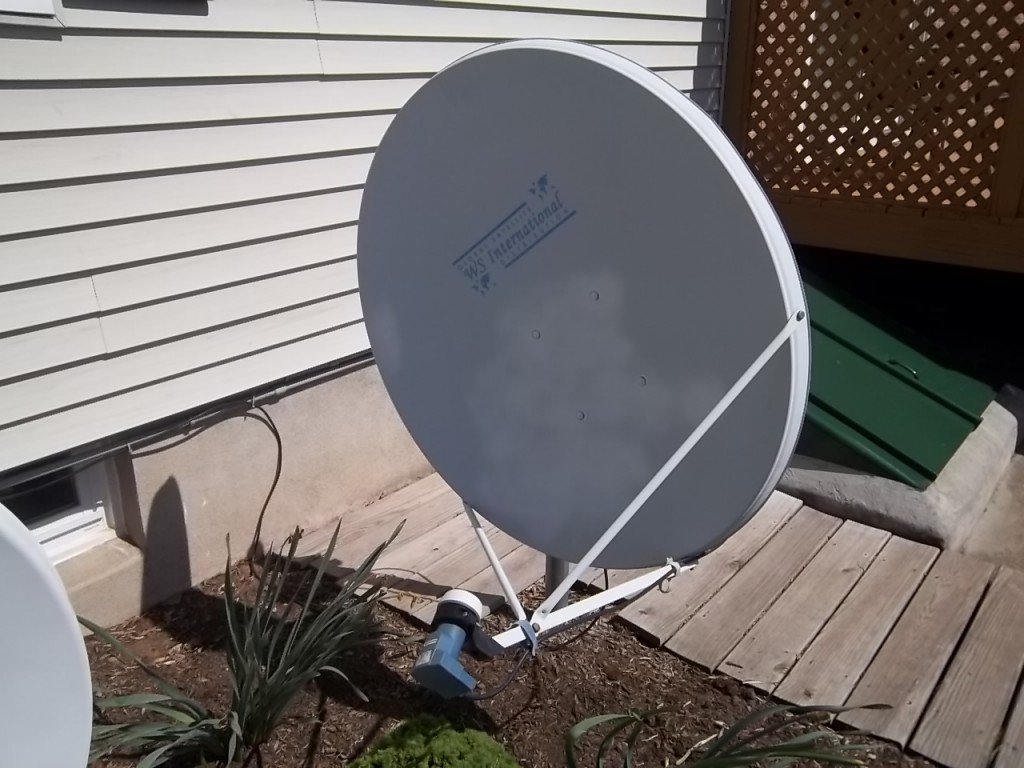
Now let’s start on what an FTA dish set-up looks like for this type of reception. Below is an installation of mine, consisting of a 30 inch WS International satellite dish and LNB. A 30 foot length of RG/6 coax is run into the shack and hooked to an AMIKO Mini HD SE FTA receiver. Typical cost for a dish, LNB, coax is under $200.
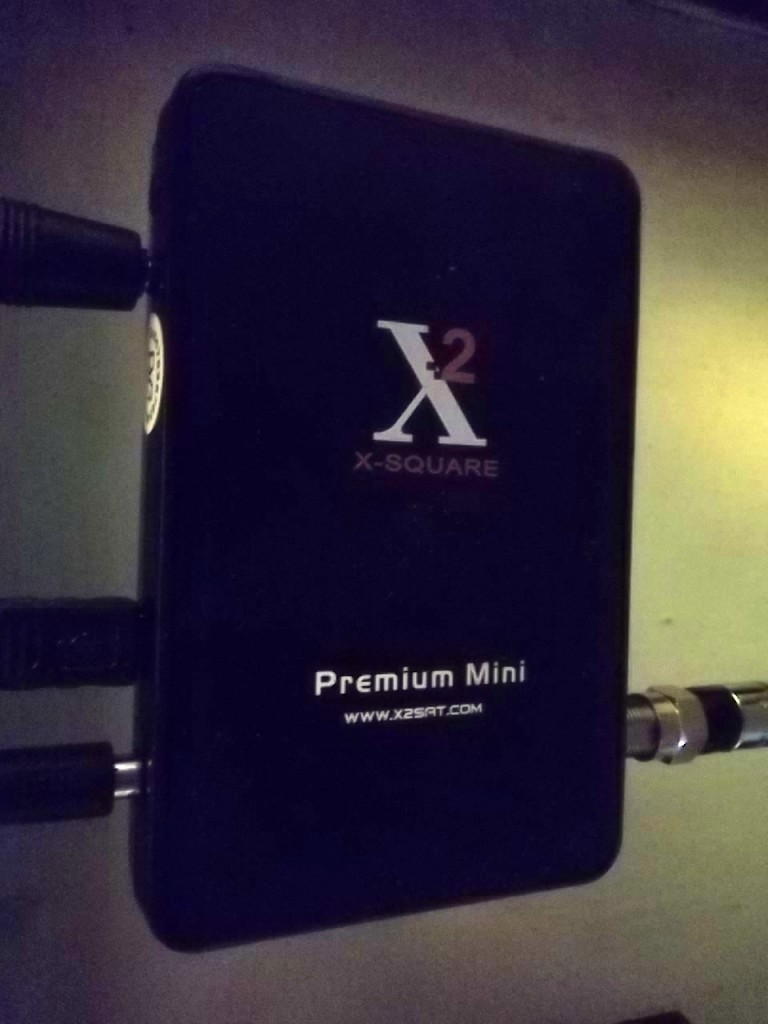
Below is my AMIKO Mini HD SE FTA receiver, also known as an STB (Set Top Box), which can be purchased from a number of FTA vendors. This allows one to receive international television and radio broadcasts. They run about $90.
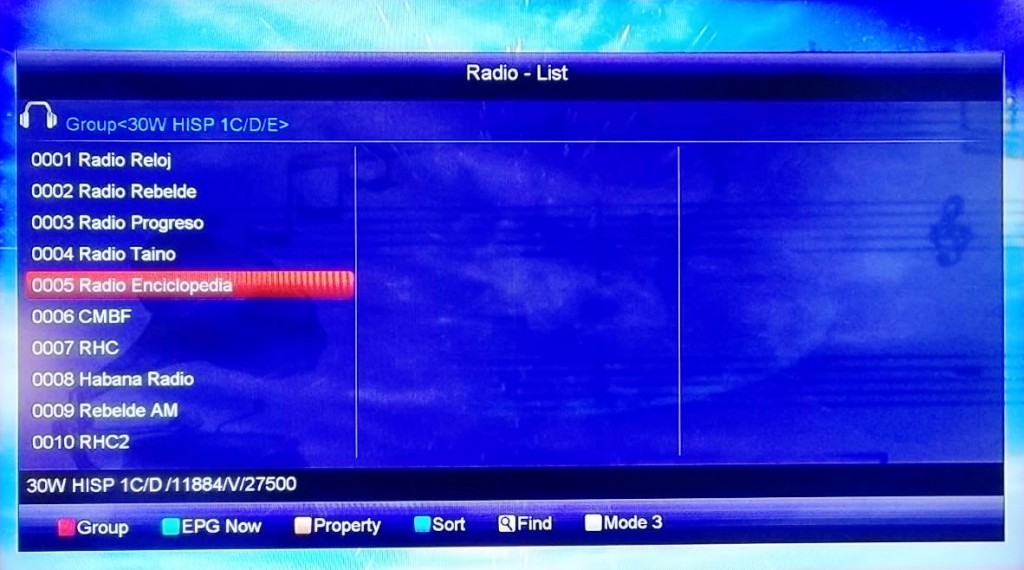
As stated earlier, Galaxy 19 is one of the best satellites to use for international radio broadcasts–currently, it has about 90 radio channels available for listening. I did a scan today of what is available, and below are three screenshots of the stations available to the listener.
Duna World radio is from Hungary. IRIB stands for Islamic Republic of Iran Broadcasting. 3 ABN is Apostolic Bible Network. TGN is Thai Global Network.
Kuwait, Syria, and the Middle East are well represented by the radio stations above. Voice of Russia, and Congo radio are good ones.
Voice of Turkey, Polski Radio found above. Not too shabby!
[Y]ou’ll find a good how-to on FTA at the following link:
[T]his is just a little introduction to the world of international listening using satellite. I hope this is something you and SWLing Post readers might find interesting.
Indeed I do, Mario! Thanks so much for taking the time to show us how to tune in a variety of international broadcasters via satellite. Each year at the Winter SWL Fest, we have demonstrations showing what can be done via FTA satellite. Perhaps I should bite the bullet and invest in one!
Many thanks to SWLing Post contributor, London Shortwave, who is kindly sharing this guest post–a brilliant article he recently posted on his own website.
I’m very grateful: one of the most common questions I’m asked by readers is how to cope with the radio interference so many listeners and amateur radio operators experience in high-density, urban areas. If this is you, you’re in for a treat–just keep reading:
Dealing with Urban Radio Interference on Shortwave
Shortwave radio listening is an exciting hobby, but for many of us city dwellers who either got back into it recently or tried it out for the first time not long ago, the first experience was a disappointing one: we could barely hear anything! Station signals, even the supposedly stronger ones, were buried in many different types of static and humming sounds. Why does this happen? The levels of urban radio frequency interference, or RFI, have increased dramatically in the last two decades and the proliferation of poorly engineered electronic gadgets is largely to blame. Plasma televisions, WiFi routers, badly designed switching power adapters and Ethernet Over Powerlines (also known as powerline network technology, or PLT) all severely pollute the shortwave part of the radio spectrum.
Does this mean we should give up trying to enjoy this fascinating medium and revert to using the TuneIn app on our smartphones? Certainly not! There are many angles from which we can attack this problem, and I shall outline a few of them below.
Get a good radio
The old adage “you get what you pay for” certainly holds true even when it comes to such “vintage” technologies as shortwave radio. Believe it or not, a poorly designed receiver can itself be the biggest source of noise on the bands. That is because many modern radios use embedded microprocessors and microcontrollers, which, if poorly installed, can generate interference. If the receiver comes with a badly designed power supply, that too can generate a lot of noise.
So how does one go about choosing a good radio? SWLing.com and eHam.net have fantastic radio review sections, which will help you choose a robust receiver that has withstood the test of time. My personal favourites in the portable category are Tecsun PL310-ET and Tecsun PL680. If you want a desktop radio, investigate the type of power supply it needs and find out whether you can get one that generates a minimal amount of noise.
It is also worth noting that indoor shortwave reception is usually best near windows with at least a partial view of the sky.
Tecsun PL310-ET and Tecsun PL680, my two favourite portable shortwave radios.
Identify and switch off noisy appliances
Many indoor electrical appliances generate significant RFI on the shortwave bands. Examples include:
Plasma televisions
Laptop, and other switching-type power supplies
Mobile phone chargers
Dimmer switches
Washing machines / dishwashers
Amplified television antennas
Halogen lighting
LED lighting
Badly constructed electrical heaters
Mains extension leads with LED lights
Identify as many of these as you can and switch them all off. Then turn them back on one by one and monitor the noise situation with your shortwave radio. You will most likely find at least a few offending devices within your home.
Install an outdoor antenna
If you have searched your home for everything you can possibly turn off to make reception less noisy but aren’t satisfied with the results, you might want to look into installing and outdoor antenna. That will be particularly effective if you live in a detached or a semi-detached property and have a garden of some sort. Of course, you will need a radio that has an external antenna input, but as for the antenna itself, a simple copper wire of several metres will do. An important trick is making sure that the noise from inside your home doesn’t travel along your antenna, thus negating the advantage of having the latter installed outside. There are many ways of achieving this, but I will suggest a configuration that has worked well for me in the past.
Fig.1 Schematic for an outdoor dipole antenna.
I have used a three-terminal balun (positioned outdoors), and connected two 6 metre copper wires to its antenna terminals to create a dipole. I then connected the balun to the radio indoors through the feed line terminal using a 50? coaxial cable. In the most general terms, the current that is generated in the antenna wires by the radio waves flows from one end of the dipole into the other, and a portion of this current flows down the feed line into your radio. The balun I have used (Wellbrook UMB130) is engineered in a way that prevents the radio noise current from inside your house flowing into the receiving part of the antenna.
Wellbrook UMB130 balun with the feed line terminal disconnected
Antenna preselectors
There is a catch with using an outdoor antenna described above — the signals coming into your radio will be a lot stronger than what would be picked up by the radio’s built-in “whip” antenna. This can overload the receiver and you will then hear many signals from different parts of the shortwave spectrum “mixing in” with the station you are trying to listen to. An antenna preselector solves this problem by allowing signals from a small yet adjustable part of the spectrum to reach your radio, while blocking the others. You can think of it as an additional tuner that helps your radio reject unwanted frequencies.
Fig.2 Schematic of a preselector inserted between the outdoor antenna and the receiver
There are many antenna preselectors available on the market but I can particularly recommend Global AT-2000. Although no longer manufactured, many used units can be found on eBay.
Global AT-2000 antenna coupler and preselector
Risk of lightning
Any outdoor antenna presents the risk of a lightning strike reaching inside your home with devastating and potentially lethal consequences. Always disconnect the antenna from the receiver and leave the feed line cable outside when not listening to the radio or when there is a chance of a thunderstorm in your area.
Get a magnetic loop antenna
A broadband loop antenna (image courtesy of wellbrook.uk.com)
The outdoor long wire antenna worked well for me when I stayed at a suburban property with access to the garden, but when I moved into an apartment well above the ground floor and without a balcony, I realised that I needed a different solution. Having googled around I found several amateur radio websites talking about the indoor use of magnetic loop receive-only active antennas (in this case, “active” means that the antenna requires an input voltage to work). The claim was that such antennas respond “primarily to the magnetic field and reject locally radiated electric field noise”[*] resulting in lower noise reception than other compact antenna designs suitable for indoor use.
Interlude: signal to noise ratio
In radio reception, the important thing is not the signal strength by itself but the signal to noise ratio, or SNR. A larger antenna (such as a longer copper wire) will pick up more of the desired signal but, if close to RFI sources, will also pick up disproportionately more of the local noise. This will reduce the SNR and make the overall signal reading poorer, which is why it is not advisable to use large antennas indoors.
The other advantage of a loop antenna is that it is directional. By rotating the loop about its vertical axis one can maximise the reception strength of one particular signal over the others, once the antenna is aligned with the direction from which the signal is coming (this is termed “peaking” the signal). Similarly, it is possible to reduce the strength of a particular local noise source, since the loop is minimally sensitive to a given signal once it is perpendicular the latter’s direction (also known as “nulling” the signal).
It is further possible to lower the effect of local noise sources by moving the antenna around. Because of the antenna’s design, the effect of radio signals is mostly confined to the loop itself as opposed to its feed line. Most local noise sources have irregular radiation patterns indoors, meaning that it is possible find a spot inside your property where their effects are minimised.
Many compact shortwave loop antennas require an additional tuning unit to be attached to the loop base (much like the preselector described above) but broadband loops do not. Wellbrook ALA1530S+ is one such antenna that is only 1m in diameter, and it was the one I chose for my current apartment. I was rather impressed with its performance, although I found that I need to use a preselector with it as the loop occasionally overloads some of my receivers when used on its own. Below is a demo video comparing using my Tecsun PL680’s built-in antenna to using the radio with the Wellbrook loop.
As you can hear, there is a significant improvement in the signal’s readability when the loop is used.
Experiment with a phaser
Although the loop antenna dramatically reduces the levels of ambient RFI getting into the radio, I also have one particular local noise source which is way too strong for the loop’s nulling capability. Ethernet Over Powerlines (PLT) transmits data across domestic electrical circuits using wall socket adapters, as an alternative to wireless networking. It uses the same frequencies as shortwave, which turns the circuits into powerful transmitting antennas, causing massive interference. One of my neighbours has PLT adapters installed at his property, which intermittently become active and transmit data. When this happens, it is not merely noise that is generated, but a very intense data signal that spreads across the entire shortwave spectrum, obliterating everything but the strongest stations underneath. Fortunately, a mature piece of radio technology called antenna phasing is available to deal with this problem.
Fig.3 The principle of antenna phaser operation (adapted from an original illustration in Timewave ANC-4’s manual)
Signal cancellation using phase difference
A phaser unit has two separate antenna inputs and provides one output to be connected to the radio’s external antenna input. The theory of phase-based signal cancellation goes roughly as follows:
The same radio signal will arrive at two different, locally separated antennas at essentially the same time.
The phase of the signal received at the first antenna will be different to the phase of the same signal received at the second antenna.
This phase difference depends on the direction from which the signal is coming, relative to the two antennas.
The phaser unit can shift the phases of all signals received at one antenna by the same variable amount.
To get rid of a particular (noise) signal using the phaser unit:
the signal’s phase at the first antenna has to be shifted by 180° relative to the signal’s phase at the second antenna (thus producing a “mirror image” of the signal received at the second antenna)
its amplitude at the first antenna has to be adjusted so that it is the same as the signal’s amplitude at the second antenna
the currents from the two antennas are then combined by the unit, and the signal and its mirror image cancel each other out at the unit’s output, while the other signals are preserved.
Noise sampling antenna considerations
To prevent the possibility of the desired signal being cancelled out together with the noise signal — which can happen if they both come from the same direction relative to the antennas — one can use the set-up illustrated in Figure 3, where one antenna is dedicated to picking up the specific noise signal, while the other is geared towards receiving the desired broadcast. That way, even if the phases of both the noise and the desired signals are offset by the same amount, their relative amplitude differences will not be the same, and thus removing the noise signal will not completely cancel out the desired signal (though it will reduce the latter’s strength to some extent).
It is possible to use any antenna combination for phase-based noise signal cancellation. However, one has to be careful that, in the pursuit of removing a specific noise source, one does not introduce more ambient RFI into the radio system by using a poorly designed noise-sampling antenna. After all, the phaser can only cancel out one signal at a time and will pass through everything else picked up by both antennas. This is particularly relevant in urban settings.
For this reason, I chose my noise sampling antenna to also be a Wellbrook ALA1530S+. The additional advantages of this set-up are:
It is possible to move both loops around to minimise the amount of ambient RFI.
By utilising the loops’ directionality property, one can rotate the noise sampling loop to maximise the strength of the noise signal relative to the desired signal picked up by the main antenna loop.
Two Wellbrook ALA1530S+ antennas combined through a phaser
And now onto the phaser units themselves.
Phaser units
DX Engineering NCC-1 (image courtesy of dxengineering.com)
I have experimented at length with two phaser units: the MFJ 1026 (manual) and DX Engineering NCC-1 (manual). Both solve the problem of the PLT noise very well, but the NCC-1 offers amplitude and phase tuning controls that are much more precise, making it a lot easier to identify the right parameter settings. Unfortunately this comes at a price, as the NCC-1 is a lot more expensive than the MFJ unit. As before, a preselector is needed between the phaser and the radio to prevent overloading.
Below is a demo of DX Engineering NCC-1 at work on my neighbour’s PLT noise. I have chosen to use my SDR’s waterfall display to illustrate the nefarious effect of this type of radio interference and to show how well the NCC-1 copes with the challenge.
Cost considerations
Fig.4 Final urban noise mitigation schematic
It would be fair to say that my final urban noise mitigation set-up, shown in Figure 4, is quite expensive: the total cost of two Wellbrook antennas ($288.38 each), a DX Engineering phaser ($599.95) and a Global AT2000 preselector ($80) comes to $1257. That seems like an astronomical price to pay for enjoying shortwave radio in the inner city! However, at this point another old saying comes to mind, “your radio is only as good as your antenna”. There are many high-end shortwave receivers that cost at least this much (e.g. AOR AR7030), but on their own they won’t be of any use in such a noisy environment. Meanwhile, technological progress has brought about many much cheaper radios that rival the older benchmark rigs in terms of performance, with Software Defined Radios (SDRs) being a particularly good example. It seems fair, then, to invest these cost savings into what makes shortwave listening possible. You may also find that your RFI situation is not as dire as mine and you only need some of the above equipment to solve your noise problems.
Filter audio with DSP
If you have implemented the above noise reduction steps but would still like a less noisy listening experience, consider using a Digital Signal Processing (DSP) solution. There are a number of different approaches and products available on the market, and I shall be reviewing some of them in my next post. Meanwhile, below are two demo videos of using DSP while listening to shortwave. The first clip shows the BHI Compact In-Line Noise Elimination Module at work together with a vintage shortwave receiver (Lowe HF-150). The second video compares using a Tecsun PL-660 portable radio indoors on its own and using the entire RFI mitigation set-up shown in Figure 4 together with a DSP noise reduction feature available in the SDR# software package, while using it with a FunCube Dongle Pro+ SDR. As a side note, it is worth remembering that while DSP approaches can make your listening experience more pleasant, they can’t recover what has been lost due to interfering signals or inadequate antenna design.
Set up a wireless audio relay from your radio shack
The above RFI mitigation techniques can result in a rather clunky set-up that is not particularly portable, confining the listener to a specific location within their home. One way to get around this is by creating a wireless audio relay from your radio shack to the other parts of your house. I did this by combining the Nikkai AV sender/receiver pair and the TaoTronics BA01 portable Bluetooth transmitter:
Head for the outdoors!
So you have tried all of the above and none of it helps? As a last resort (for some, but personally I prefer it!), you can go outside to your nearest park with your portable radio. After all, if shortwave listening is causing you more frustration than joy it’s hardly worth it. On the other hand, you might be surprised by what you’ll be able to hear with a good receiver in a noise-free zone.
Acknowledgements
Many of the above tricks and techniques were taught to me by my Twitter contacts. I am particularly grateful to @marcabbiss, @SWLingDotCom, @K7al_L3afta and@sdrsharp for their advice and assistance over the years.
Thank you–!
What I love about my buddy, London Shortwave, is that he didn’t give up SWLing just because his home is inundated with radio interference–rather, he saw it as a challenge. As you can see, over the years, he has designed a system that effectively defeats radio interference.
I also love the fact that he uses an even more simple approach to defeating RFI: he takes his radio outdoors. A kindred spirit, indeed.
I encourage all SWLing Post readers to bookmark and search London Shortwave’s website. It’s a treasure trove for the urban SWL. We thank him for allow us to post this article in its entirety.