Shortwave listening and everything radio including reviews, broadcasting, ham radio, field operation, DXing, maker kits, travel, emergency gear, events, and more
LED Bulb RF Pollution – Elektor Magazine investigates
DARC, the German national amateur radio society, are requesting amateurs to send LED bulbs which pollute the RF spectrum to the magazine Elektor for investigation
A Google English translation reads:
Elektor-Verlag GmbH calls all readers and especially all radio amateurs to send non-compliant LED bulbs including power supplies. Elektor wants to investigate this EMC-technical and then forward it to the competent market surveillance of the BNetzA.
The reason for the action: As a result of a press release of the DARC in September 2017 on the significantly increasing interference of radio communications, other radio services and the DAB reception by non-EMC compliant LED bulbs Elektor had investigated such lamps (as well as LED strips). The result showed a progressive electromagnetic pollution.
The Federal Network Agency as competent authority for market surveillance in accordance with the EMVG has welcomed the call for the submission of suspicious copies. In addition, the Federal Agency would like to be informed if disturbing lamps attract attention. She then wants to investigate this situation and take the products out of the market, if they are still offered.
Please send suspicious copies
Elektor-Verlag GmbH
Kackertstr. 10
52072 Aachen
Please enclose a note with the words “EMC LED lamp” so that everything runs correctly in the inbox. You can also announce your submission via e-mail to [email protected] with the subject “EMC-LED-Lamp”. Elektor Verlag GmbH then checks the lamp, publishes an update if necessary and informs the Federal Network Agency.
Many thanks to SWLing Post contributor, Gary (W4EEY), who writes:
I want to recommend an excellent presentation on RF Interference from
the Radio Society of Great Britain (RSGB) Convention in 2015. The
presenter is Ian White, GM3SEK, who has a Blog website here:
Many thanks to SWLing Post contributor, Luke Perry, who writes:
I am experiencing a issue with my shortwave reception at my part-time home. I have been helping out my mother so I have brought over my Sony portable, along with the Sony active antenna. I have a constant ‘clicking’ sound starting at about 5 kHz or thereabouts that make listening unbearable. As the video shows the problem is non-existent below 4 kHz. I tried moving the radio throughout the house thinking it could be something in the room and still get the same interference.
I was hoping that the filter on the active antenna would help but it does little to remedy the problem. I have no issues with MW or FM reception at all.
I have made a short YouTube video to document the problem in the hopes that one of the blog readers can identify it. I looked online at other instances of RFI and I could not find one that is similar. Hope that someone can help me!
After listening to the first few seconds of your recording, I thought it sounded a bit like an electric fence controller. However the interval between pops is nearly random, which suggests a different source. I suppose it’s possible a faulty fence controller could do this. I believe the only way you could defeat this noise (without shutting it down at the source) would be to use a radio with a durable noise blanker. Of course, I know of no portable radios with an NB function (though most SDRs and tabletop receivers include an NB).
Post readers: Can help Luke ID the source of this noise? Does it sound familiar to you? Please comment!
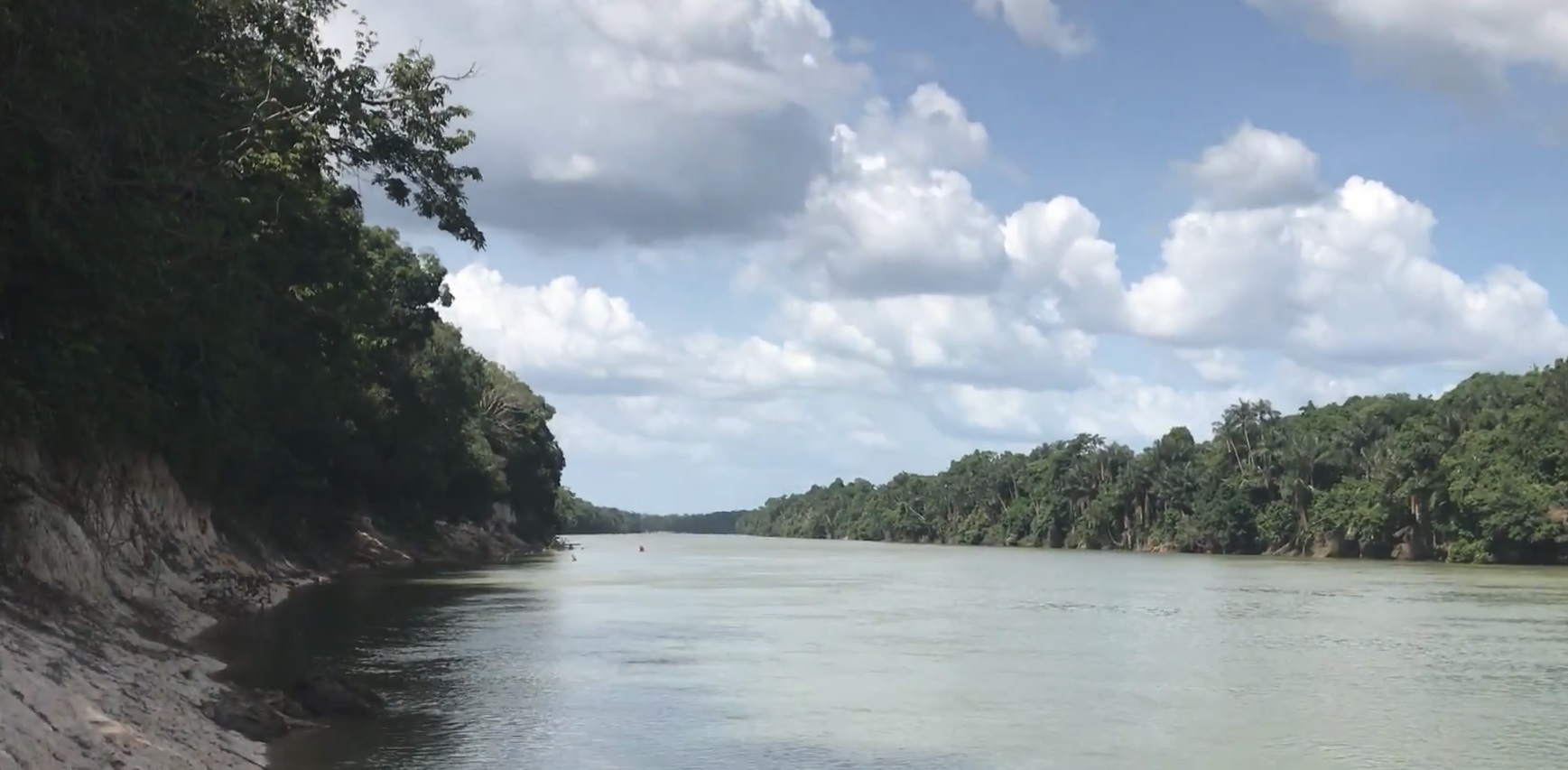
The beautiful Capim River in a land of Jaguars, Tarantulas and occasionally, wonderful shortwave DX
Hi there, I returned from my third trip to the Rio Capim area of Pará, Northern Brazil about 5 weeks ago, having been out there for exactly a month. Now, whilst this was strictly a business trip I always make time to tune around the bands, mostly shortwave, in the hope of copying some interesting DX. My previous two trips were reasonably successful; however, I didn’t really hear anything new – just lots of Tropical Band – and tropical stations with much greater signal strength and clarity. Part of the problem is one of which most of us suffer from – the dreaded local QRM. Even in the depths of the rain forest noise is present from building electrical systems (particularly lighting) and other equipment. In my first attempt to escape the noise on this trip I ventured out of my accommodation building (basically a very large hut) to the wire fence that separates us and the larger fauna (although having said that, the monkeys and everything else that lives in the area appears to have no difficulty scaling a 6 foot fence – funny that! ). Anyway, ultimately, you’ve really got to want to hear something special quite badly to venture out. I suppose it could be the definition of hard-core DX! I tried this only once because as I was copying a very nice signal from Radio Guinea on 9650 kHz, I found myself about 2 feet from a Tarantula Hawk Wasp dispatching a very large spider (check out the very brief video on my YouTube channel). That was me done for alfresco DXing in the jungle.
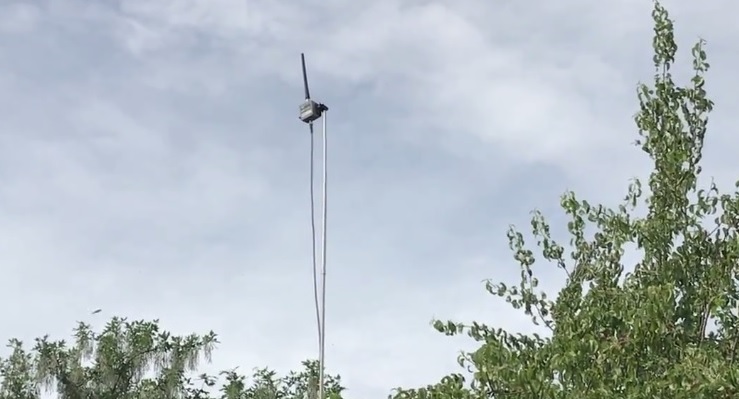
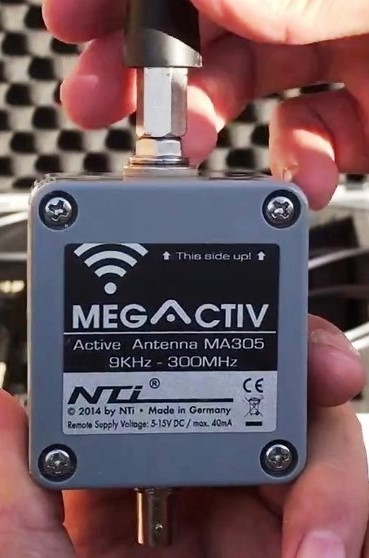
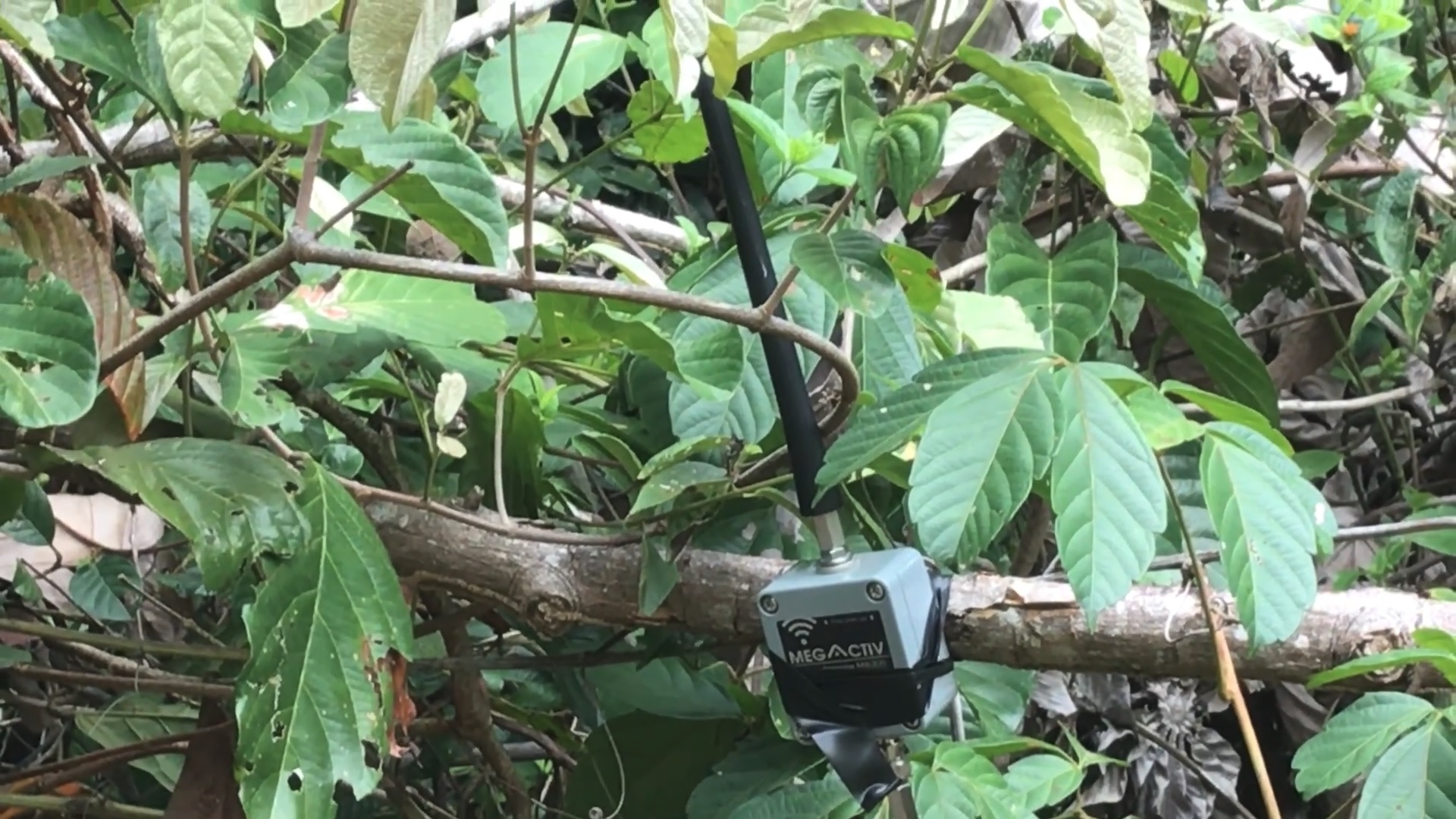
Bonito’s USB-powered MegActive MA305 E-field antenna up a tree…performed superbly in Brazil
Fortunately, I was lent a 4-wheel drive truck for the duration of my visit and so I decided to find a quiet location to park up and listen to the radio – therefore only having to venture outside (at night) to place my antenna. One evening after dinner I got in the truck and drove around the site for a while until I found a location, effectively on the edge of the jungle that was mostly very quiet. Perfect…as long as I didn’t end up as something else’s dinner. I took the super-compact USB-powered Bonito MegActive MA305 antenna with me on this trip because I’d already tested it at home on DXpeditions and in Crete and thus I was confident as to how superbly well it would perform in a quiet location. To supplement my antenna choices, during the first weekend, I made the 90 km drive to the nearest town and bought, amongst other supplies, a 40 metre length of speaker wire and a 3.5 mm jack connector to make a temporary long-wire antenna.
In my experience, there are roughly 3 tiers of Tropical and Tropical Band DX on short wave. There’s the bottom tier of stations which with a decent portable and a few metres of wire can be readily heard in the UK on a Dxpedition – and at home with a magnetic loop antenna, for example and a good quality table-top receiver or SDR. Amongst this group of signals I would include Rádio Clube do Pará, Brazil on 4885 kHz, Radio Difusora Roraima on 4875.3 kHz, Emisoras Pio XII 5952.5 kHz, Radio Santa Cruz, 6134.8 kHz etc. etc. On the next tier are tropical stations that are really difficult to hear in the UK – but can be heard with good propagation and good equipment. This group includes Radio Aparecida on 6135.2 kHz particularly, Rádio Educação Rural on 4925.2 kHz, Radio Tarma Internacional on 4774.9 kHz, Rádio Evangelizar (formerly Radio RB2) on 6040.7 kHz etc. There are many more examples from these two groups I could use, but you get the picture. Lastly, there is a tier of stations that are very rarely or never heard in Europe, irrespective of equipment or propagation. Often these stations operate with low TX power which makes them extremely difficult to copy anyway – and that leads to ambiguity farther as to whether they are even on-air. Furthermore, some of these stations broadcast very irregularly, which makes copying them even more of a lottery.
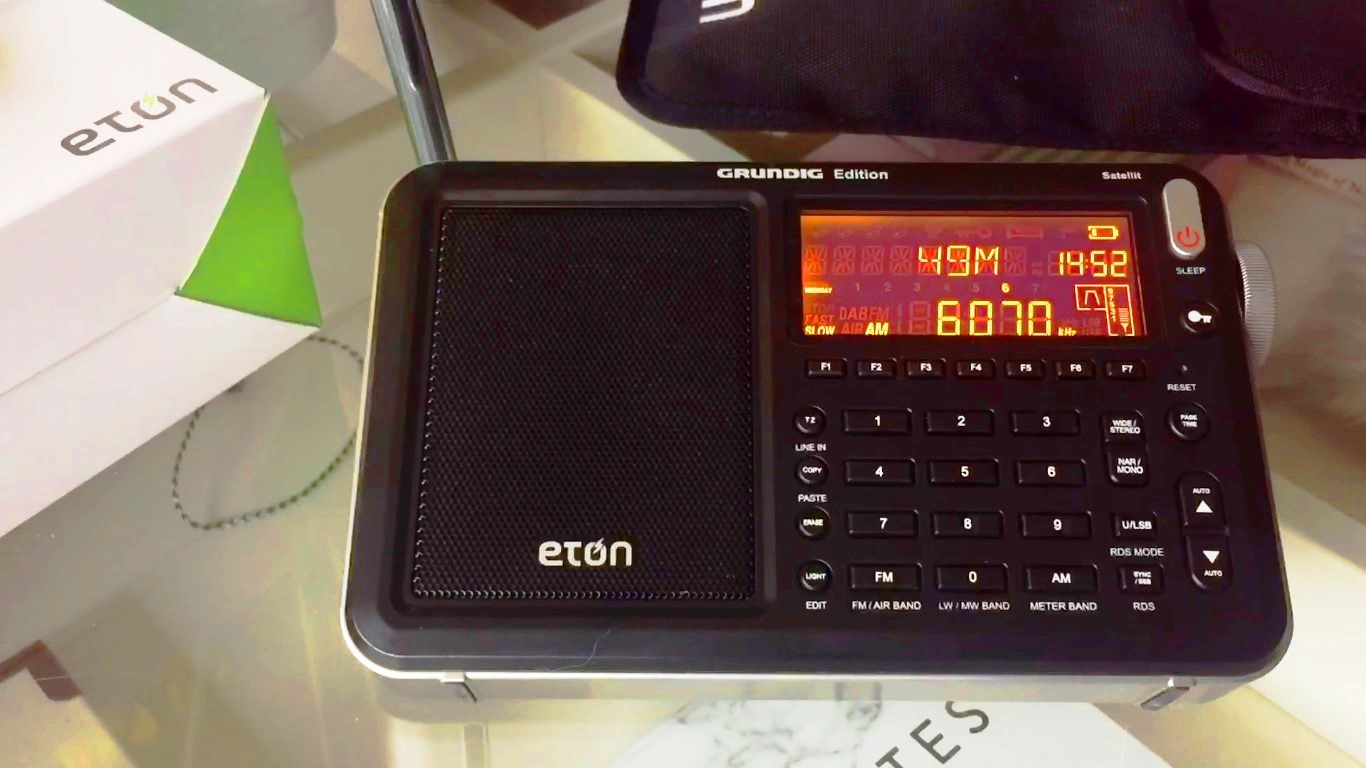
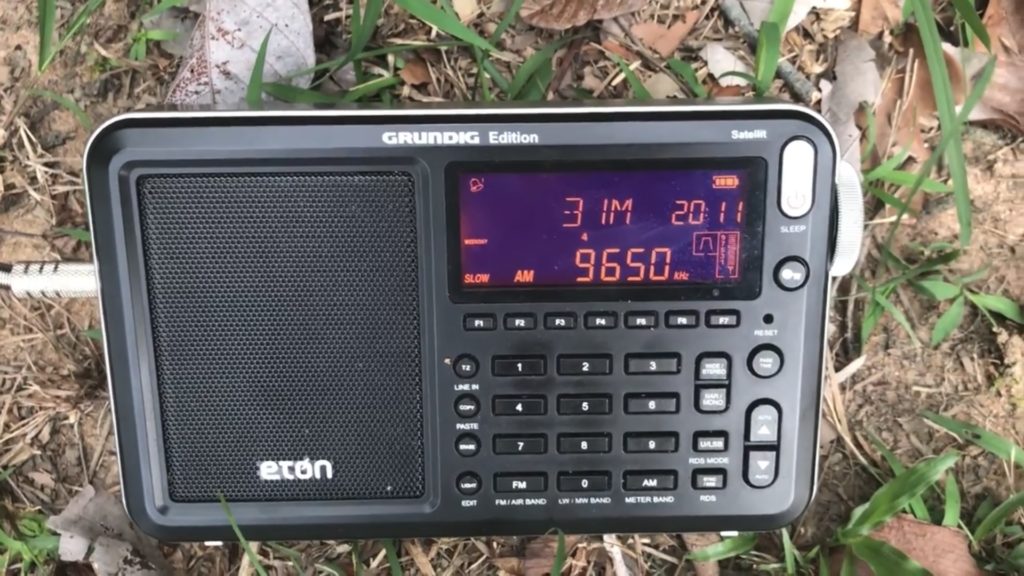
My mainstay travel receiver, the brilliant Eton Satellit..two-time veteran of South American DXing
In this context, a month in Northern Brazil was a useful timescale for surveying the Tropical Bands and geographically tropical stations for the presence of very rare signals. Fortunately, over many hours of listening in Rio Capim with the Eton Satellit and mostly the Bonito MegActive MA305 antenna, I manged to record six signals that are very rarely heard outside of South America. The list of stations follows below, complete with the antenna arrangement. Further below you will find embedded reception videos and text links to the same videos on the Oxford Shortwave Log YouTube channel. Please take the time to watch the videos and note the comments made by some of my subscribers with local knowledge. In particular, Rádio Gaúcha and Rádio Canção Nova on 4825 kHz are very irregular broadcasters and therefore I was fortunate to be in the right place, at the right time to copy their signal. More luck came my way with the reception of Radio Sora de Congonhas on 4775 kHz – made possible because of a total power cut on site, reducing noise effectively to zero (I was indoors at the time). I, personally, never heard anything else other than Radio Tarma, Peru on or around 4775 kHz – itself something of a rarity, except when conditions are very good.
In conclusion, I have to say, once again, the DXing credentials of the Eton Satellit and the Bonito MegActive MA305 USB-powered antenna are clearly demonstrated here. The perfect travelling companions for the serious DXer and broadcast band listener alike, I had no issues getting through security at any of the airports and their combined weight is unnoticeable in a fully loaded backpack. I definitely recommend both products. It’s also worth noting that if you’re travelling to a relatively remote location, even with modest equipment, you might be able to copy rare signals that will provide good information to the rest of us trying to hear those same signals from 1000’s of km away. I will be returning to Rio Capim early in 2018 and I’m seriously considering taking my Perseus SDR with me. A superbly sensitive and selective receiver with noise reduction that actually works, it opens up the possibility of even more exotic DX on that trip.
As always, thanks for watching/listening/reading and I wish you all excellent DX and Season’s Greetings. 73!
The list of exotic catches and antennas utilised:
Radio Apintie 4990 kHz, Suriname – Bonito MegActive MA305
Radio Cançao Nova 9675 kHz Sao Paulo – 20 metre long-wire
Radio Verdes Florestas 4865 kHz, Cruzeiro do Sul – Bonito MegActive MA305
Rádio Gaúcha 11915 kHz, Porto Alegre – Bonito MegActive MA305
Radio Sora de Congonhas 4775 kHz, Congonhas – Bonito MegActive MA305 antenna
Rádio Canção Nova 4825 kHz, Cachoeira Paulista – Bonito MegActive MA305
Clint Gouveia is the author of this post and a regular contributor to the SWLing Post. Clint actively publishes videos of his shortwave radio excursions on his YouTube channel: Oxford Shortwave Log. Clint is based in Oxfordshire, England.
Hi there, the garden at my house is pretty small and as a consequence, I am very limited in terms of what antennas I can usefully employ. You can’t position anything further than about 10 metres from the brickwork and to compound this, we are surrounded on all sides by neighbours in close proximity. All very nice people, but all very noisy – electrically speaking lol. I simply can’t get far enough away from these sources of electrical noise to achieve excellent SNR.
The solution to my problem was ultimately a Wellbrook ALA1530 magnetic loop, but prior to that I used an end-fed random wire, the performance of which deteriorated as the months went by as the ubiquitous blanked of local QRM continued to increase. Eventually, I was forced outdoors, well away from my town – effectively catalysing my forays into the Oxfordshire countryside on DXpeditions. That first experience of listening to the radio on shortwave, in the absence of any QRM was enlightening to say the least and of course, subsequently, DXpeditions have become a mainstay of my listening activities. However, despite enjoying some great DX successes out in the woods, one has to be realistic about how often it’s possible to leave the house just to listen to the radio. This led me to the purchase of the Wellbrook ALA1530 magnetic loop. It proved to be a triumph of electrical noise mitigation and an absolute necessity in copying transatlantic medium wave signals in such a noisy and compact space. A total game-changer. The brilliant performance of the Wellbrook eventually led to me purchase a second, cheaper active antenna; the E-field Bonito Boni Whip and in turn, that purchase led me to the MegActive MA305, kindly supplied by Bonito themselves for objective testing.
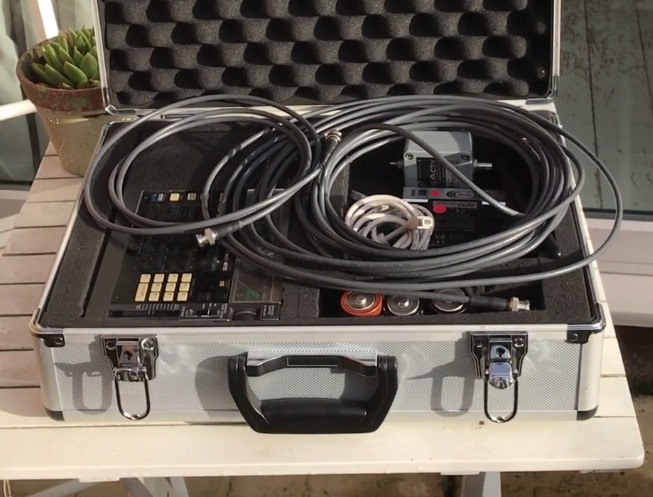
Have DXing kit, will travel…everything you need in a small flight case…
You might remember my initial tests at home confirmed, as expected, that E-field antennas don’t work well in electrically noisy environments (except at LW frequencies in my experience) but outdoors, away from noise, they are superb. I have a number of reception videos on my YouTube channel – Oxford Shortwave Log which clearly demonstrate identical performance of the Bonito MegActive MA305 antenna and Wellbrook ALA1530 magnetic loop out in the woods. So, what if you’ve got a large garden in a suburban area that allows you to be just far enough from sources of electrical noise…how much of a difference does it make to the noise floor of your receiving equipment? Can E-field antennas such at the Bonito MegActive MA305 do the job? Furthermore, how well does a random wire work in a larger garden?
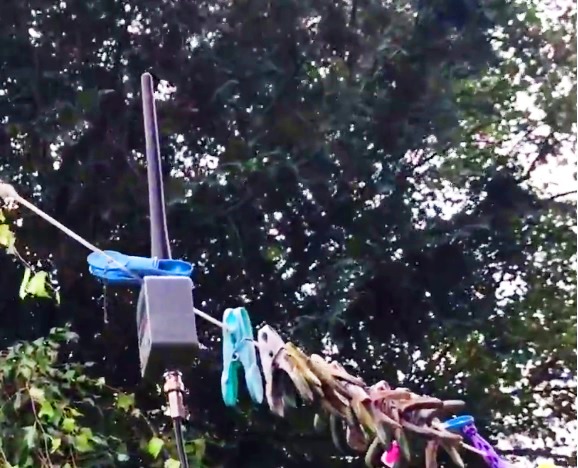
My MegActive MA305 antenna system for mobile DXing…and another use for a washing line…
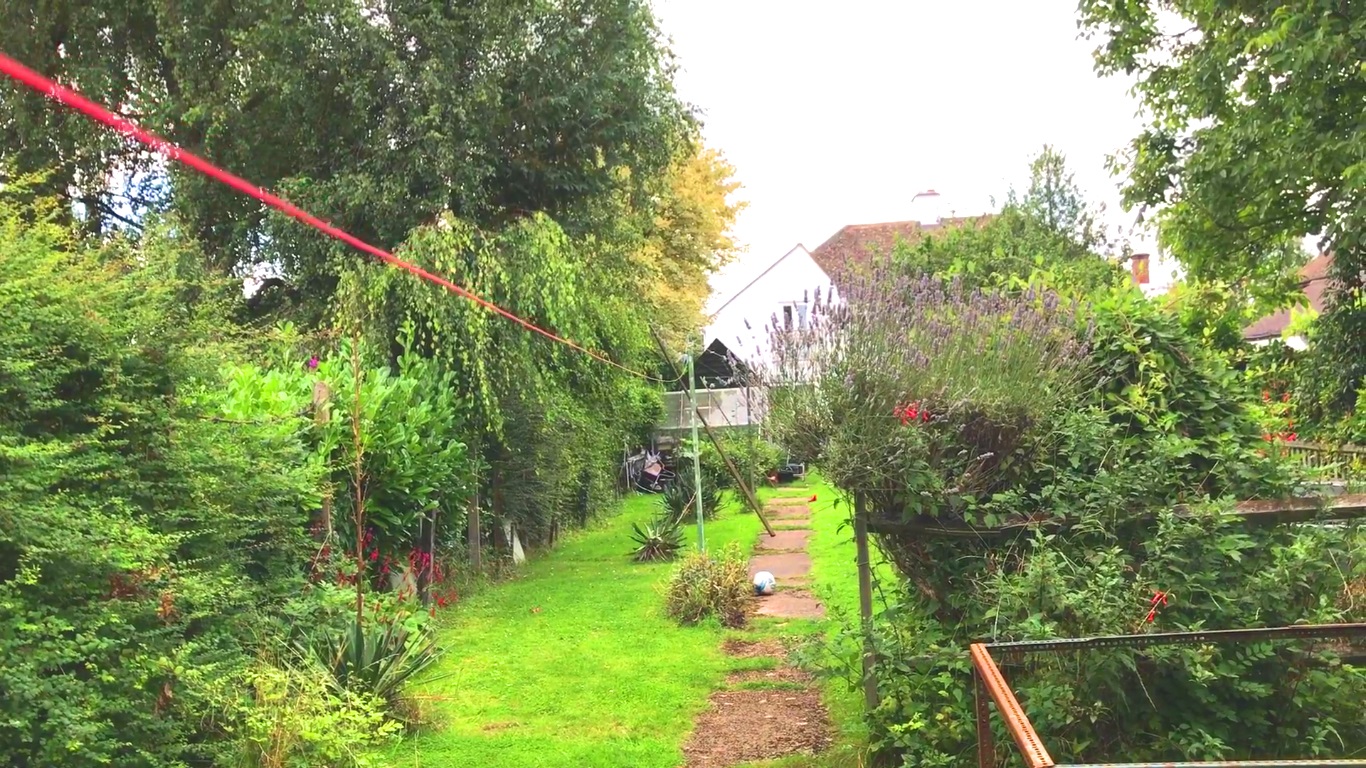
I was fortunate enough to know someone who owns a house with a large garden, quite close to my QTH (a 10 minute walk) and who was more than willing to let me set up my DXing equipment and sit around until the early hours of the morning, listening to and recording various signals on my Eton Satellit. In preparation, I set up the Bonito MegActive MA305 antenna and hung the radiating element on the washing line – sounds ridiculous but actually worked very well, placing it about 2.5 metres above the ground. I also set up a 40 metre longwire, which at its closest point, was still approximately 25 metres from the house, and 30 metres from the neighbours. This post will focus on the performance of the MA305; a subsequent post will detail the performance of the longwire.
The large garden I ‘borrowed’ for my DXing session with the Bonito MegActive MA305 antenna
Suffice to say, the MegActive MA305 performed admirably during my first listening session. In the middle of the afternoon I copied a very strong signal from The Voice of Korea around 15:44 hrs UTC on the 25 metre broadcast band, followed at 17:10 hrs UTC with a superb signal from The Voice of the Broad Masses 2, Eritrea, on the 40 metre ham band. Later on in the evening I copied Radio Mail with excellent modulation, CHU Canada with voice announcements (almost impossible at home), Myanmar Radio with an untypically strong signal and XEPPM Radio Educación from Mexico City with a signal I would normally expect on a DXpedition-proper with a large antenna.
My conclusions to this experiment are simply that E-field antennas can work in a suburban environment, if you are able to site them far enough away from adjacent sources of electrical noise. I don’t have empirical data on this, however, I can confirm that 10 metres proximity is too close at my QTH and 30 metres is sufficiently far away at this test location. One has to assume the houses nearby are similarly equipped to mine with electrical appliances that generate electrical noise. Thus, if you’re interested in a very well-priced, compact antenna and you live in an urban or suburban environment with access to a large garden/ outdoor space, an E-field Boni Whip or MegActive MA305 might well be suitable – and you’ll have a superb portable antenna for those listening sessions away from home!
Finally, I should mention the Eton Satellit. Much-maligned in certain quarters when it was first introduced into the market, it continues to demonstrate superb DXing credentials. I won’t forget some words of wisdom from a friend of mine and fellow DXer, with more than 3 decades of experience in listening to the bands on HF. He told me that Judging from his own experience with some of the original Grundig Satellit models of the 1980s and early 90s (namely the 400, 500 and 700) he was quite sure that the Eton Satellit is a considerably better DX performer than those vintage sets, that offered great sound for casual listening to international broadcasters, but didn’t perform too convincingly on weak DX signals. The Eton Satellit has been a revelation and I’m pleased to have played a small part in turning around the rather widely held view that it was less than worthy of the Satellit branding.
Fresh out of the box, the Eton Satellit has surpassed all my expectations…
Please find embedded reception videos below and text links to the Oxford Shortwave Log YouTube channel. My next post on this subject will cover the performance of a 40 metre longwire in this large garden environment. Thank you for reading/watching/listening and I wish you all great DX!
Clint Gouveia is the author of this post and a regular contributor to the SWLing Post. Clint actively publishes videos of his shortwave radio excursions on his YouTube channel: Oxford Shortwave Log. Clint is based in Oxfordshire, England.
Noise interference is the menace of all wireless broadcast communications services
Background noise interference is degrading the quality of broadcast reception, two-way communications, mobile cellphone services and every other form of wireless communications used today at an alarming rate.
The FCC and the ITU agree that the DC to 60 GHz+ wide-spectrum background noise floor is increasing as more and more unregulated electronic devices are used by more consumers in more ways every day.
While it is true that large numbers of these devices have been in use for some time, the question becomes: What can we do to lower the noise floor now that the floodgates of unregulated devices have been open for so long? Is this an impossible task? I believe the answer is an emphatic “no.”[…]
Hi there, you might remember my post from last month focussing on the Bonito MegActive MA305 E-field antenna, kindly supplied to me for testing, by Bonito themselves. That post was essentially a report on my experiences travelling to Crete with the MA305, navigating through security at London Gatwick and Heraklion airports (mostly with relative ease), but more importantly, how well it worked with the equally excellent Eton Satellit portable receiver. Whilst in Crete I managed to copy a number of personal firsts, including CRI on 7295 kHz, via their relay in Bamako, Mali, The Voice of Beibu Radio on 5050 kHz, Nanning, XSL ‘Slot Machine’ on 6251 kHz USB, Ichihara, Japan, S32 ‘The Squeaky Wheel’ on 3828 kHz and NHK World Radio Japan, 11910 kHz. I also copied RTM Wai/Limbang FM on 11665 kHz from Kajang, Myanmar Radio on 5985 kHz and AIR Bhopal on 4810 kHz, amongst others – all of which I would certainly consider to be difficult catches in Europe.
The USB-powered MegActive MA305 is perfect for DXing on the move…
Despite excellent all-round results from the ultra-portable USB powered MA305, there was one signal I copied, which more than any other, demonstrated the DXing credentials of this antenna; Radio Tarma from Peru on 4775 kHz. With a TX power of 1 kW, this is a very difficult station to hear in Western Europe, even with a longwire. To catch this station in Crete, with a 22 cm antenna was incredible and it was at that point during my trip that I realised E-field antennas really can work superbly well for hard-core DXers on the move.
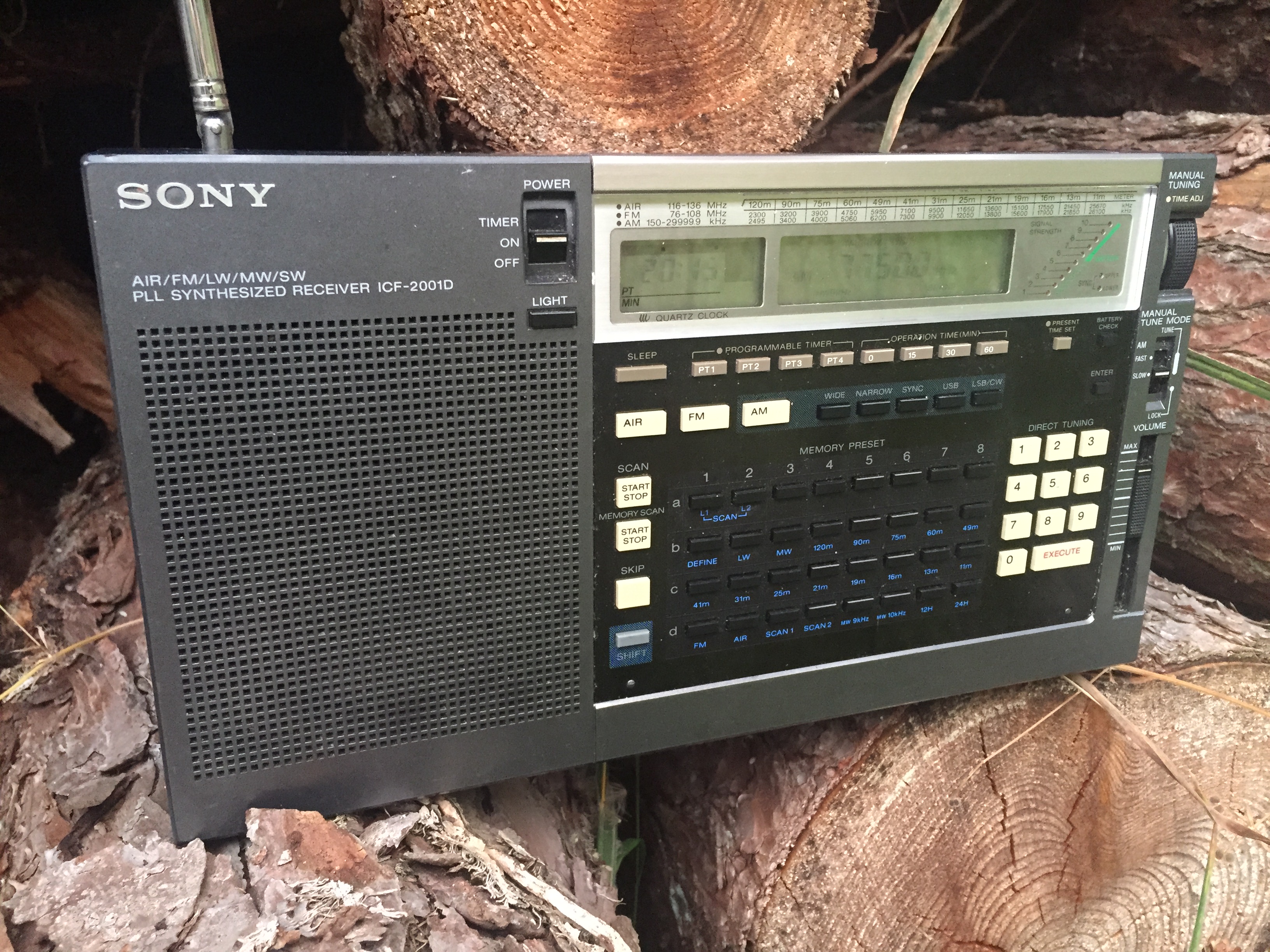
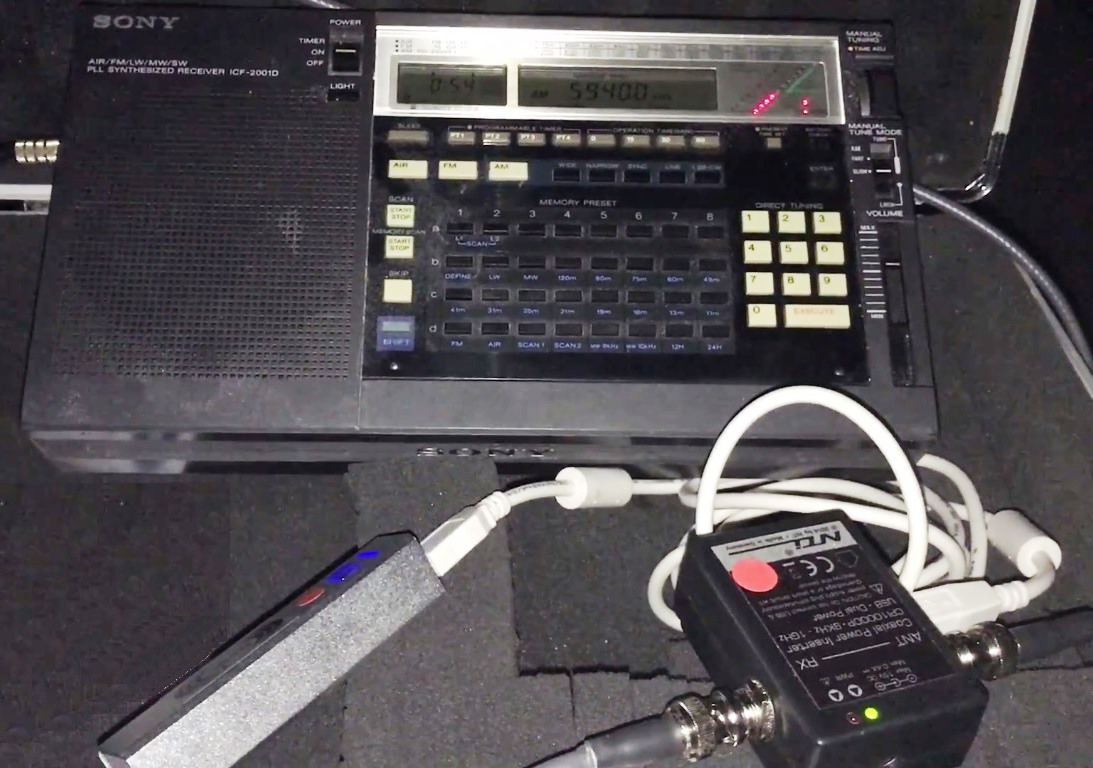
Upon my return to Oxford, I immediately started thinking about a DXpedition to the local woods I use for what I consider serious DXing. For obvious reasons, E-field antennas require an electrically quiet environment to ensure maximum SNR performance. In noisy environments, these types of antennas amplify the signal of interest and the background ‘electro-smog’, thus increasing signal levels but critically, not signal-to-noise. Fortunately, the Oxfordshire wood I have been using for a couple of years is only a 10 minute drive from my QTH as I sort of live in the countryside anyway and the QRM levels there are just about zero. Now, given that this was essentially an experiment to determine the best possible performance from the MA305, I decided to use my best portable radio. It was quite tempting to pack up the Elad FDM DUO which running on a home-brew battery pack has proven itself to be my best (pseudo) portable radio. However, this is supposed to be a real-world test and in this type of scenario, DXpeditions with the Bonito antenna are much more likely to be undertaken with a portable radio. For these reasons I decided to conduct the test with the venerable Sony ICF-2001D. Having proven to be a superb receiver over many, many dxpeditions (check out the evidence on my YouTube Channel Oxford Shortwave Log) and still regarded by DXers as one of the best ever portable radios – possibly the best – it was the obvious choice.
My portable DXing kit comprising the Bonito MegActive MA305 antenna and the Sony ICF-2001D…a bit of a legend in DXing circles…
I ventured out in early June around 23:00 hrs BST (22:00 hrs UTC), parked the car on the edge of the wood and proceeded to set up my cheap camera tripod, slightly modified to accept a 2 metre-long stainless steel tube, into which a slightly thinner 1 metre tube was mounted, topped off with my partially disassembled ‘Selfie Stick’ – which made it back from Crete lol. The antenna was set up in less than 5 minutes and approximately 4 metres above the ground – much quicker and easier than de-spooling 100 metres of wire! With fresh batteries in the Sony and the MA305 powered up using the USB power brick supplied by Bonito, I was ready to start listening. Almost immediately I heard and recorded a personal first; Lao National Radio, Laos, signing on 6130 kHz, with an excellent signal. Hearing them in the UK was only made possible by the annual two week shut down of the PBS Xizang transmitter in Lhasa, Tibet, but hey, I’ll take it. A brilliant start to my listening session.
Over the next two hours I was amazed at what could be heard using this 22 cm amplified antenna. Bearing in mind I have spent many hours at the woods previously, listening via various 100 metre longwires and a 200 metre Beverage, my expectations were, I thought, realistic in that the MA305 coupled to the Sony would catch some very good DX. However, I did believe there might be an absence of at least some of the more exotic low power stations on the Tropical Band – afterall the MA305 is a very short antenna. Clearly I was wrong, because what transpired during the session surpassed anything I thought possible with this set-up. A list of reception videos follows below and further below, a selection of embedded videos. Some of the entries on this list simply stunned me at the time. Rádio Educação Rural for starters is such an incredibly difficult signal to hear in Europe, even with a very large antenna. Thus, to hear them on an ultra-compact set-up felt very special. Radio Mali is another station that is very difficult to catch with any modulation, except on a large antenna and yet there they were – at the first time of trying. Similarly, Rádio Nacional de Angola and Alcaravan Radio are exotics that at best deliver very weak audio – and most of the time no audio. Furthermore, the signals from Emisoras Pio XII, Myanmar Radio and Rádio Clube do Pará were verging on what I would call superb…I’d never heard anything like it previously except via 100 (or more) metres of wire.
The ICF-2001D and MegActive MA305 Rádio Educação Rural transmitter site in Tefé, Brazil
So what’s next? Well it would certainly be an interesting experiment to compare the performance of the MegActive antenna with the Wellbrook ALA1530 active loop in a similar environment. I have used the Wellbrook on DXpeditions several times, with often excellent results, however, it’s not designed to be portable and if SNR performance could be demonstrated as similar between these two products, given a very favourable price delta, the Bonito antenna would add up to be a very compelling purchase decision. More on that to come. In the meantime, thank you very much for reading/watching/listening and I wish you all excellent DX.
Please click on the links below for the reception videos on the Oxford Shortwave Log YouTube channel.
Selected embedded reception videos from the list above:
Clint Gouveia is the author of this post and a regular contributor to the SWLing Post. Clint actively publishes videos of his shortwave radio excursions on his YouTube channel: Oxford Shortwave Log. Clint is based in Oxfordshire, England.


 Many thanks to SWLing Post contributor, Gary (W4EEY), who writes: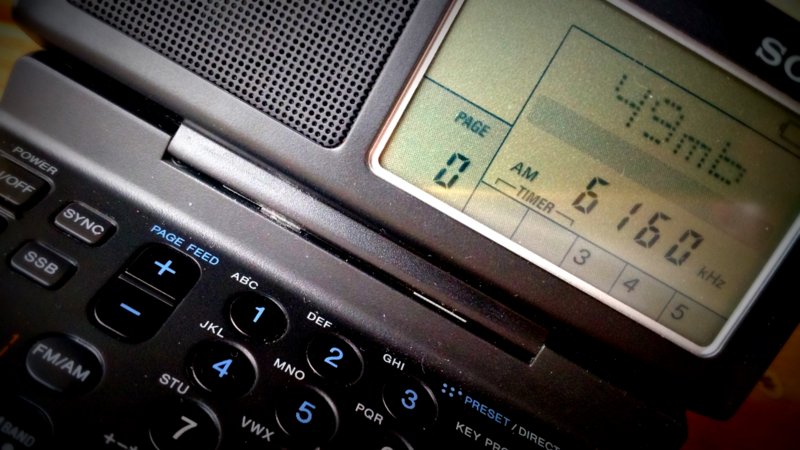
 My mainstay travel receiver, the brilliant Eton Satellit..two-time veteran of South American DXing