Category Archives: Radios

Guest Post: Hans reviews the Freeplay Lifeline and Unity self-powered radios

Many thanks to SWLing Post contributor, Hans Johnson, who shares the following guest post:


Irma-induced Radio Reviews

by Hans Johnson
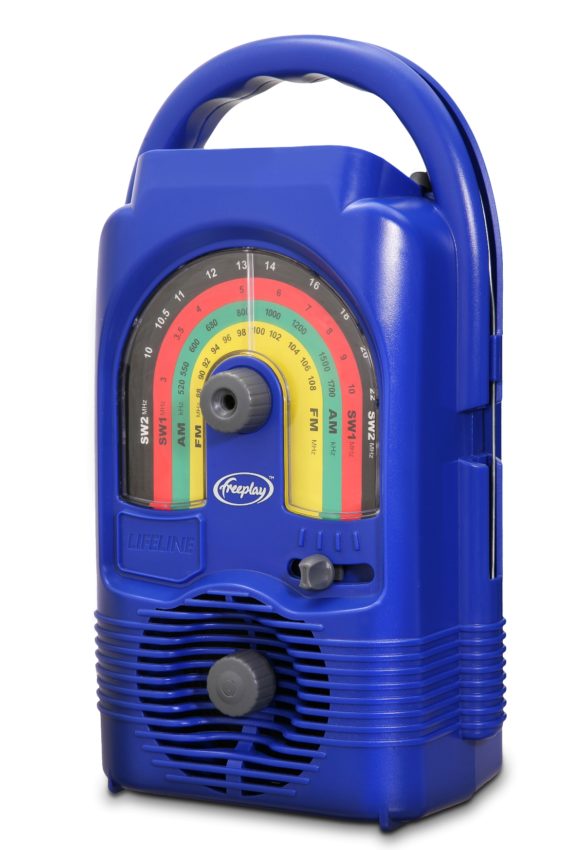
The primary disaster we face here in Naples, Florida, is hurricanes.  Naples had been spared for over a decade until Irma.  So while I had prepared, I had not needed my supplies or equipment for quite some time.  This included the radios.

I went into Irma with two Freeplay solar and windup radios, a Unity and a Lifeline.  I got these radios probably over a decade ago.  As part of some work I was doing with VT Communications (now Babcock), I was involved with a radio project called Sudan Radio Service.

Both of these radios were being given to listeners as part of this project.  I wanted to have a better understanding of what they faced.  I had some conversations with Freeplay in London, explaining who I was and why I wanted these radios.  During a visit, I was able to purchase both sets with the proviso that I not sell them.

I checked them both out at that time with my focus being on shortwave as that is how Sudan Radio Service was then transmitted.  They were ok at picking out the strongest stations but that’s about it.  I never really needed or wanted to use the radios day to day.  And then Irma struck.

We left Naples on Saturday when we received a mandatory evacuation notice.  The storm struck on Sunday and we returned on Monday.

We were spared.  Many lost everything.  Some lost their lives.  We had a lot of trees down and some roof damage, but nothing substantial.  But we had no power.  Water had to be boiled.  Sewage was backing up in places because the lift stations had no power.  The stop lights were out (this was a real danger, many did not treat them as four-way stops and just blew through them.  But you never knew who it would be.)  A curfew was in place.  The cell phone system was in really bad shape.  I could not call or text my brother across town, let alone get access to the Internet via cell.

This link will give you an idea of what we came back to.  I am the guy sawing wood at 1:47.  (Lesson learned, have two chainsaws in case yours blows a gas line):

http://abc7ny.com/weather/watch-josh-einiger-reports-from-naples-florida/2391120/.

I had blown up some air mattresses before the storm so we slept on them on the screened porch.  I saw the Milky Way from Naples for the first time.

We wanted information and also a bit of entertainment.  Television was out of the question.  The HDTV stations are hard to receive with a great antenna and set in the best of times where we live.  So a battery-operated TV would have been a waste.  Radio was the only game in town, so it was time to put the emergency radios in service.

Sudanese Listeners Receive Unity Radios (Source: Lifeline Energy)

Both of these analogue dial sets cover AM, FM, and shortwave.  The Unity covers 3-22 MHz, the Lifeline just goes up to 18.  The former covers the old American AM band and the latter the new one.   The Unity uses a whip antenna and has a fine tuning knob.  The Lifeline has a bendable wire that fits into the carrying handle and came with an alligator clip and a length of wire.

Ideally, one would be listening a set that has been charged via the solar cell or listening with the set in the sun.  The last place I wanted to be was in or near the sun.  Trying to charge the set and then listen to it is difficult in practice.  It seems that the ratio was about one to one.  15 minutes in the sun would get you about 15 minutes of immediate listening.  It doesn’t seem that the batteries will hold a charge for long periods of time.  I could not charge them during the day and expect to turn them on the next morning, which was the peak time of day for radio to be transmitting local information.  The ratio for using the hand-crank was better, but I grew tired of cranking quite quickly.

I was interested in local stations, so shortwave was not a factor.  We only have a few local AM stations in Naples and I could not receive them (Irma knocked off or damaged a number of stations.)  I tried FM.  Even with the antennas retracted, both sets were overwhelmed by the local stations with certain stations bleeding through over much of the dial.  I could receive some strong, local stations.  With the outlet at Marco Island off and the other apparently on reduced power, receiving NPR was out of the question.

Given how many sources of information I was cut off from, my flow was greatly reduced.  My ignorance increased and learning vital information was hit or miss.  A neighbor told me about the boil order.  Passing on information was difficult.  When we got power I wanted to tell my brother, but the only way to inform him was to drive to his house.

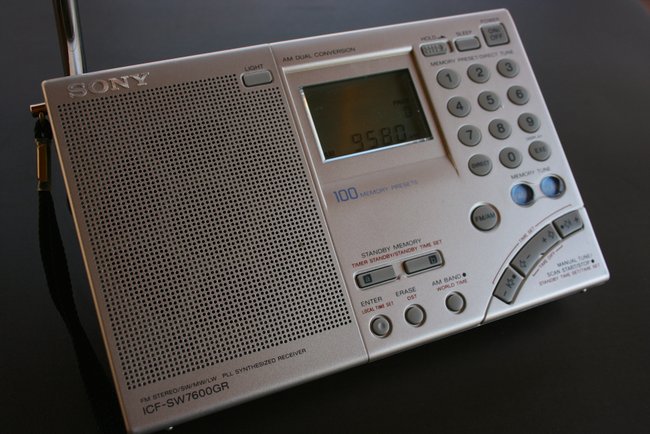
One result was that I put these sets away and broke out my old Sony
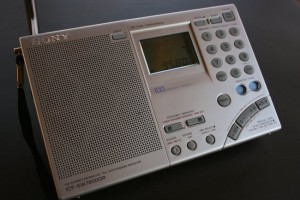
ICF-7600GR and used it instead.  I guess I could have used it until I ran out of AA batteries.  I had plenty on hand and can easily afford them.  But that is hardly the case in Southern Sudan and many other places.

The Lifeline came with a few stickers on it that I could not read when I got the set.  Now that Goggle translate is so good I can read them.  They say in part:  “Everyone has the right to receive information,”  “Everyone one has the right to search for, receive, and deliver information.”

The real result of the test was a greater appreciation for how good I have it in many ways.  With regards to information, I have many sources and can readily receive it and pass it on.  It increased my respect for services like Sudan Radio Service and how important they are.  But most especially, I have a much greater admiration for listeners using these sets and what is surely their perseverance, patience, and determination to get information.


Many thanks for your field report of the Freeplay Lifeline and Unity, Hans!

I’m happy to hear you had no serious damage post-Irma. So many in the SWLing Post community have been affected by hurricanes this season.

I have never, personally, reviewed either of these Freeplay units–both are now discontinued and have been replaced with other models at Lifeline, I believe. As you state in your post, these radios are only available to humanitarian organizations. Through Ears To Our World, I have considered acquiring Lineline Energy (Freeplay) radios in the past. However, their radios tend to be rather large in size–we tend to go with smaller receivers that can easily fit in suitcases. In the past we’ve been very happy with the Grundig FR200 (Tecsun GR-88). 
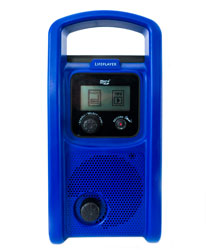
The Lifeplayer MP3

Last year, we did purchase a Freeplay Lifeplayer to test. The hand crank charging mechanism is very robust, though quite noisy. The radio is digital, but performance is mediocre and tuning couldn’t be more cumbersome (5 kHz steps, no memories, only a couple of band steps.  Tuning to your favorite station could literally take a couple of minutes, depending on where it is on the band. When you turn off the radio (or it runs out of power) you’ll have to re-tune to the station again. That’s a lot of extra mechanical wear on the encoder. The real utility of the Lifeplayer is the built-in MP3 player and recorder–a brilliant tool for rural schools. Also, it’s robust and can take abuse from kids much better than other consumer radios.

Your main point, though, is spot-on: these radios serve their purpose, but we radio enthusiasts are incredibly fortunate to have much better grade equipment to take us through information backouts.

Thanks again for your review, Hans!

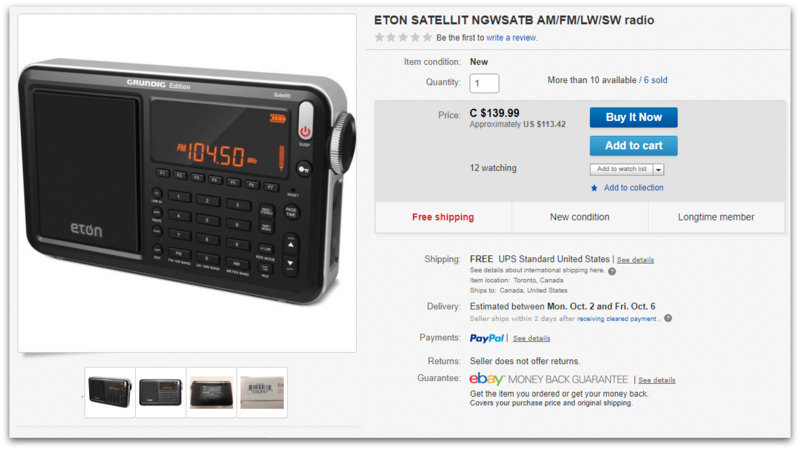
eBay Deal: Eton Satellit $139 CDN / $113 US shipped

Many thanks to SWLing Post contributor, Troy Riedel, who notes:

The Eton Satellit [Black Case] is on closeout from Radio World Canada on eBay right now for slightly less than $115 + Free Shipping.

Thank you, Troy. That is an excellent deal for an excellent portable! If you’ve been considering the Eton Satellit, you should grab this deal–I’ve never seen the price lower. The seller has 100% positive feedback and a deep history.

Click here to view on eBay.

The GR-227: Gospell introduces a new SDR digital radio car adaptor

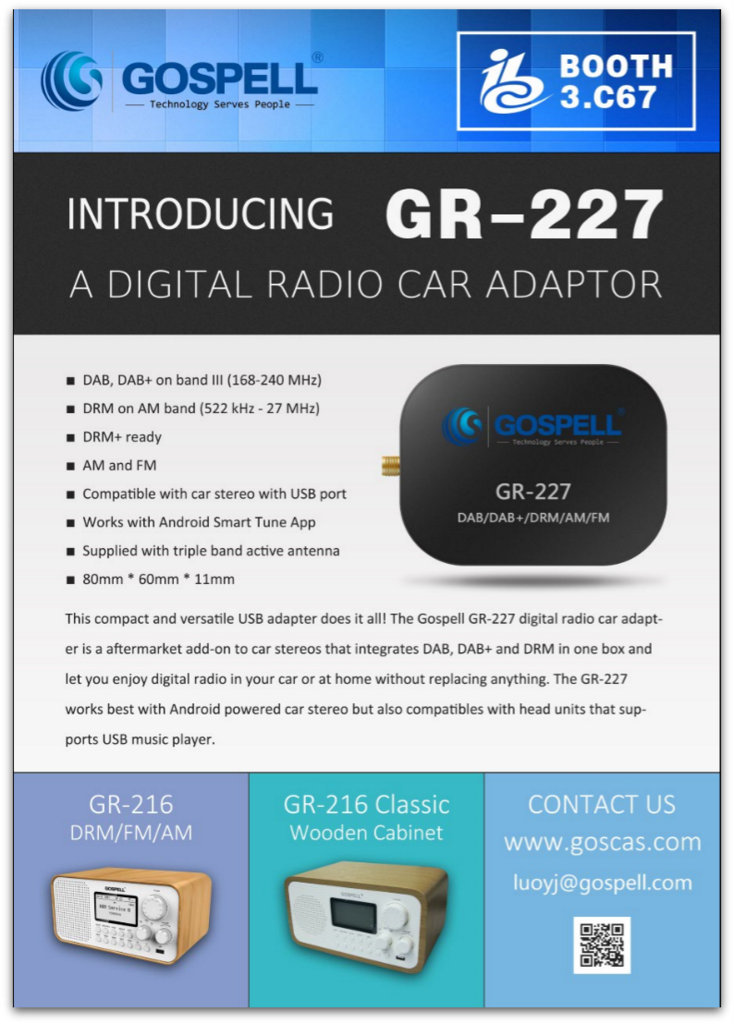
Many thanks to SWLing Post contributors Ed and Richard Langley for sharing information about the latest receiver from Gospell: the GR-227 digital radio car adaptor.

According to Radio World:

[…]The compact GR-227 can be added to car stereos, via a USB cable, in order to receive digital radio programs and corresponding data. Based on software-defined radio technology and using the xHE-AAC audio codec, the GR-227 is compatible with both modes of the Digital Radio Mondiale standard as well as the DAB/DAB+ digital radio standards.

According to Gospell, the GR-227 works with car stereos that are fitted with a USB port. Using the firm’s patent-pending technology, the adaptor behaves like a thumb drive when plugged into a USB port, making it compatible with most in-car receivers.

In addition, the GR-227 also features the Gospell Smart Tune App for Android. When partnered with an Android-powered car stereo, this lets users play back the broadcast audio program or benefit from data services.[…]

Read the full article at Radio World.

Richard comments:

“They call it an adaptor but perhaps it’s just an Android-controlled SDR receiver supplying audio output via a USB port, which could be connected to a computer or any other audio device with a USB audio input capability.”

I think he may be correct in that assumption because it may be the only way to get cross-manufacturer compatibility in a device like this.

The product information sheet noted that the receiver is supplied with a “triple band active antenna.” No doubt, the GR-227 will require adding a small external antenna to your car.

Still: an interesting product for sure! Perhaps the price point will be more reasonable that of previous DRM receivers? We’ll post updates from Gospell with the tag: GR-227

PantronX: Titus II is ready for production

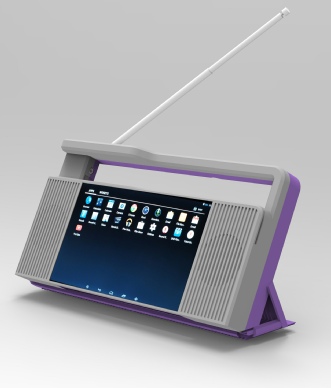
The Titus II portable SDR

(Source: Radio World via Richard Langley)

Titus SDR, a division of PantronX, says the Titus II multi-standard digital radio receiver is ready for production.

The consumer software-defined radio digital receiver platform, which is the result of collaboration between Titus SDR/Patron X, Jasmin-Infotech, TWR, and Fraunhofer IIS, supports multi-standard radio reception, including DRM, DAB and DAB+ and core data applications. The system is based on a custom Android tablet platform, featuring multipoint touch, WiFi/Bluetooth and stereo sound.[…]

Click here to continue reading the full article at Radio World.

DXing in a large suburban garden with the Eton Satellit & Bonito MegActive MA305 antenna

Hi there, the garden at my house is pretty small and as a consequence, I am very limited in terms of what antennas I can usefully employ. You can’t position anything further than about 10 metres from the brickwork and to compound this, we are surrounded on all sides by neighbours in close proximity. All very nice people, but all very noisy – electrically speaking lol. I simply can’t get far enough away from these sources of electrical noise to achieve excellent SNR.

The solution to my problem was ultimately a Wellbrook ALA1530 magnetic loop, but prior to that I used an end-fed random wire, the performance of which deteriorated as the months went by as the ubiquitous blanked of local QRM continued to increase. Eventually, I was forced outdoors, well away from my town – effectively catalysing my forays into the Oxfordshire countryside on DXpeditions. That first experience of listening to the radio on shortwave, in the absence of any QRM was enlightening to say the least and of course, subsequently, DXpeditions have become a mainstay of my listening activities. However, despite enjoying some great DX successes out in the woods, one has to be realistic about how often it’s possible to leave the house just to listen to the radio. This led me to the purchase of the Wellbrook ALA1530 magnetic loop. It proved to be a triumph of electrical noise mitigation and an absolute necessity in copying transatlantic medium wave signals in such a noisy and compact space. A total game-changer. The brilliant performance of the Wellbrook eventually led to me purchase a second, cheaper active antenna; the E-field Bonito Boni Whip and in turn, that purchase led me to the MegActive MA305, kindly supplied by Bonito themselves for objective testing.

Have DXing kit, will travel…everything you need in a small flight case…

You might remember my initial tests at home confirmed, as expected, that E-field antennas don’t work well in electrically noisy environments (except at LW frequencies in my experience) but outdoors, away from noise, they are superb. I have a number of reception videos on my YouTube channel – Oxford Shortwave Log which clearly demonstrate identical performance of the Bonito MegActive MA305 antenna and Wellbrook ALA1530 magnetic loop out in the woods. So, what if you’ve got a large garden in a suburban area that allows you to be just far enough from sources of electrical noise…how much of a difference does it make to the noise floor of your receiving equipment? Can E-field antennas such at the Bonito MegActive MA305 do the job? Furthermore, how well does a random wire work in a larger garden?

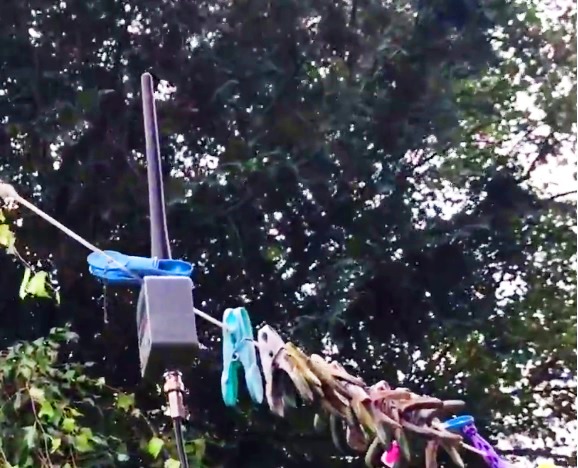
 My MegActive MA305 antenna system for mobile DXing…and another use for a washing line…

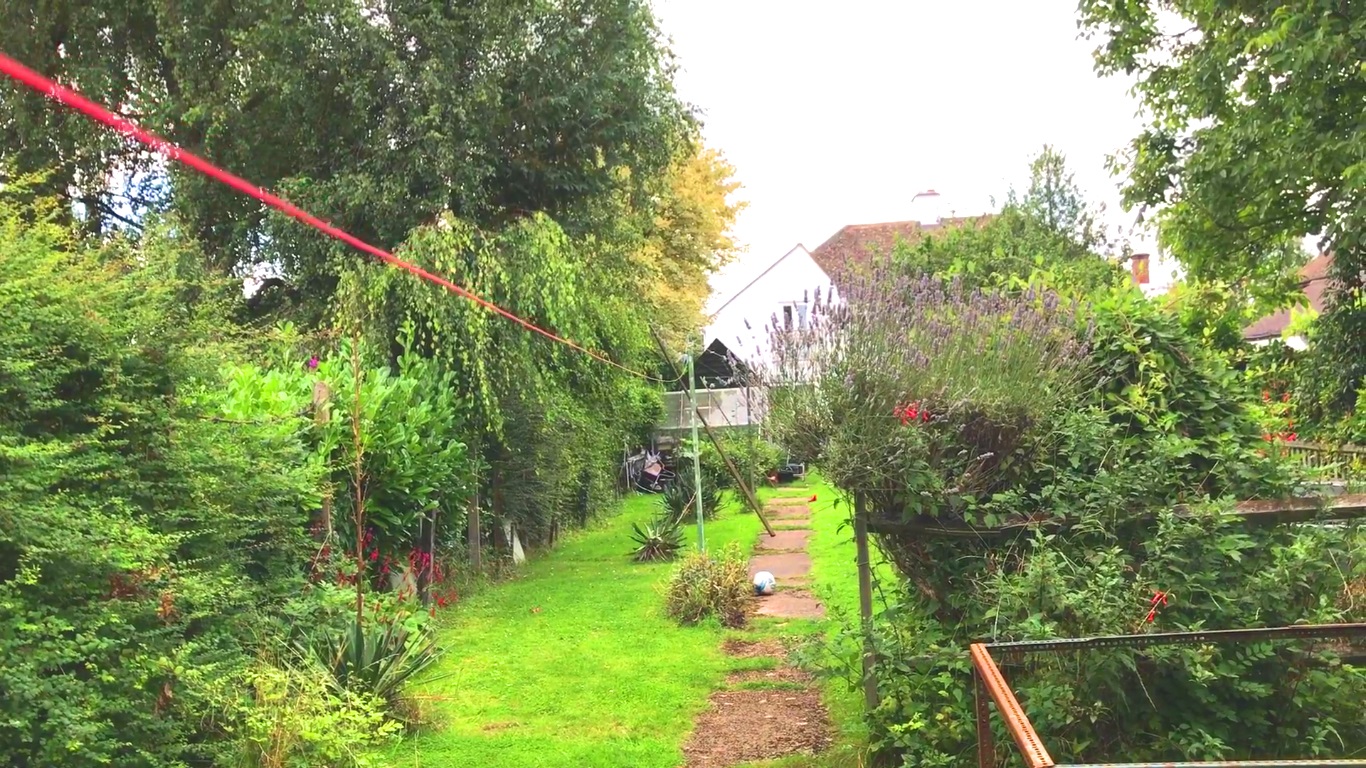
I was fortunate enough to know someone who owns a house with a large garden, quite close to my QTH (a 10 minute walk) and who was more than willing to let me set up my DXing equipment and sit around until the early hours of the morning, listening to and recording various signals on my Eton Satellit. In preparation, I set up the Bonito MegActive MA305 antenna and hung the radiating element on the washing line – sounds ridiculous but actually worked very well, placing it about 2.5 metres above the ground. I also set up a 40 metre longwire, which at its closest point, was still approximately 25 metres from the house, and 30 metres from the neighbours. This post will focus on the performance of the MA305; a subsequent post will detail the performance of the longwire.

The large garden I ‘borrowed’ for my DXing session with the Bonito MegActive MA305 antenna

Suffice to say, the MegActive MA305 performed admirably during my first listening session. In the middle of the afternoon I copied a very strong signal from The Voice of Korea around 15:44 hrs UTC on the 25 metre broadcast band, followed at 17:10 hrs UTC with a superb signal from The Voice of the Broad Masses 2, Eritrea, on the 40 metre ham band. Later on in the evening I copied Radio Mail with excellent modulation, CHU Canada with voice announcements (almost impossible at home), Myanmar Radio with an untypically strong signal and XEPPM Radio Educación from Mexico City with a signal I would normally expect on a DXpedition-proper with a large antenna.

My conclusions to this experiment are simply that E-field antennas can work in a suburban environment, if you are able to site them far enough away from adjacent sources of electrical noise. I don’t have empirical data on this, however, I can confirm that 10 metres proximity is too close at my QTH and 30 metres is sufficiently far away at this test location. One has to assume the houses nearby are similarly equipped to mine with electrical appliances that generate electrical noise. Thus, if you’re interested in a very well-priced, compact antenna and you live in an urban or suburban environment with access to a large garden/ outdoor space, an E-field Boni Whip or MegActive MA305 might well be suitable – and you’ll have a superb portable antenna for those listening sessions away from home!

Finally, I should mention the Eton Satellit. Much-maligned in certain quarters when it was first introduced into the market, it continues to demonstrate superb DXing credentials. I won’t forget some words of wisdom from a friend of mine and fellow DXer, with more than 3 decades of experience in listening to the bands on HF. He told me that Judging from his own experience with some of the original Grundig Satellit models of the 1980s and early 90s (namely the 400, 500 and 700) he was quite sure that the Eton Satellit is a considerably better DX performer than those vintage sets, that offered great sound for casual listening to international broadcasters, but didn’t perform too convincingly on weak DX signals. The Eton Satellit has been a revelation and I’m pleased to have played a small part in turning around the rather widely held view that it was less than worthy of the Satellit branding.

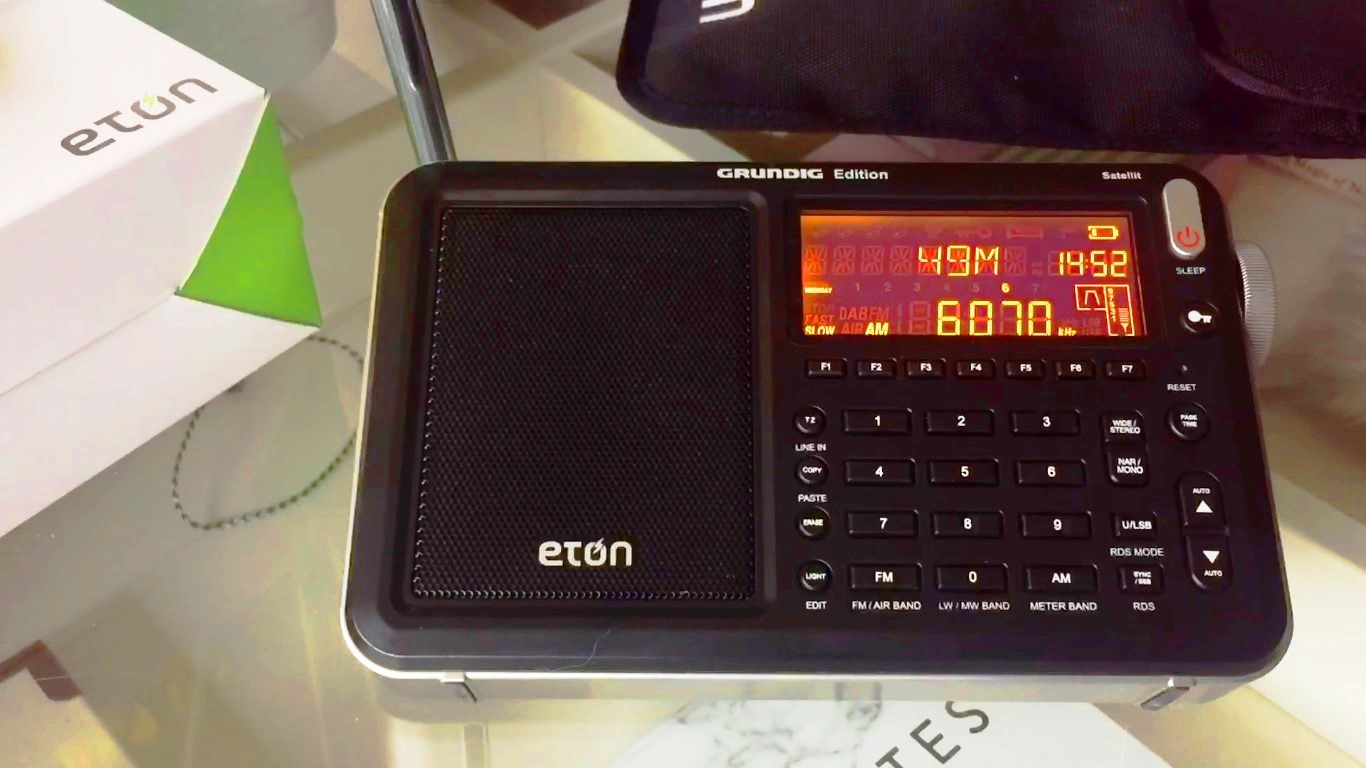
Fresh out of the box, the Eton Satellit has surpassed all my expectations…

Please find embedded reception videos below and text links to the Oxford Shortwave Log YouTube channel. My next post on this subject will cover the performance of a 40 metre longwire in this large garden environment. Thank you for reading/watching/listening and I wish you all great DX!


Click here for video on Oxford Shortwave Log


Click here for video on Oxford Shortwave Log


Click here for video on Oxford Shortwave Log


Click here for video on Oxford Shortwave Log


Click here for video on Oxford Shortwave Log


Click here for video on Oxford Shortwave Log


Click here for video on Oxford Shortwave Log


Clint Gouveia is the author of this post and a regular contributor to the SWLing Post. Clint actively publishes videos of his shortwave radio excursions on his YouTube channel: Oxford Shortwave Log. Clint is based in Oxfordshire, England.

Ed gives this Realistic DX-440 a bath!

Many thanks to SWLing Post contributor, Edward Ganshirt, who shares the following:
I found this critter [a Realistic DX-440–see photo above] at a flea market. At first I pondered as to when I had my last tetanus shot before handling it, then again it had something that I see rarely in these portable radios … a BFO..!

I always said that a shortwave radio without a BFO is like a Harley-Davidson with a top speed of 25 mph, so I bought it. On the way home I could smell a barnyard aroma. I ruled out chicken and hog but I think it could have been sheep or goat. So I decided to see how well it works. It took a little bumping around with loose connections to get it working. But first since it was going to be taken apart to service the case and knobs would get a nice hot bath in a sudsy ammonia citrus cleaner with a bristle brush. Also the PCB’s would get brushed down with a mixture of denatured alcohol and acetone.

Now for the hard part: finding the rickety connections. This turned out to be simple, just inspect each wire at attachment point. I found 3 broken wires that were re soldered. Now it is together I am looking for a 9 inch antenna. The one here is not original it extends 66 inches.

As to it’s performance, This Hogg can go up to 75mph now that I have the plug wires on. The user interface speaks to me as a lab instrument more than a daily listener which I think will become its role.


Absolutely amazing transformation, Ed!

I’m especially pleased to see you’ve given this level of TLC to a Realistic DX-440. I regret having ever sold mine as it accompanied me across the ocean when I studied in Grenoble, France, for a year just after high school.

The DX-440 and I did a lot of travel and a lot DXing together! I hope your DX-440 takes you across the globe, Ed!

Chris reviews the Eton Field BT and an important note about the discontinued Grundig S350DL

The Eton Field BT

Many thanks to SWLing Post contributor, Chris Freitas, who notes that’s he’s published a favorable review of the Eton Field BT on his blog: Chris Freitas on Radio

The Field BT shares the same basic chassis as the Tecsun S-8800 (check out the review published yesterday) and several other receivers including the Grundig S350DLS450DLX, and the C.Crane CCRadio-SW.

Chris and I both agree that one benefit to this type of large portable is the excellent audio fidelity they can provide.

Read Chris’ full review here.

Not all large portables are created equally

The S350DL may look like a digital radio, but it’s actually analog inside and tuning is prone to drift.

Important clarification: The Field BT–just like the S-8800 and S450DLX–does not have the flaky analog tuning of the discontinued Grundig S350DL series.

Since I started publishing videos of the Tecsun S-8800 in action, I’ve received feedback indicating that many assume the S-8800 will drift off frequency like the 2008 era GS350DL.

It’s true that both radios share a common form factor, but that’s where the similarities end.

The S350DL is actually an analog single conversion receiver with a digital frequency display. The S350DL tuning knob has an inner ring for fine tuning and an outer ring for speedy tuning. The big disadvantage of the S350DL is that it drifts off frequency every time the wind blows. At least, that’s how it seems. It’s a little frustrating, and that’s why mine pretty much stays tuned to one station on my kitchen shelf. Even then, it manages to drift off frequency every few days.

The Eton Field BT, Eton Field, Grundig S450DLX, C. Crane CCRadio-SW and Tecsun S-8800, on the other hand, all have a pure digital tuning experience with no drift at all. Most of these are at least double conversion and the S-8800 is even triple conversion.

Chris, thanks again for sharing your review of the Field BT! It sounds like a major improvement over its predecessor, the S450DLX. I understand you’re also evaluating the excellent Grundig Traveller III–we look forward to that review when published!