Category Archives: Shortwave Radio

Tamil Nadu State Disaster Management Authority plans shortwave weather broadcasts

(Source: The Hundu via Mike Hansgen)

After facing criticism for its failure to warn fishermen at sea during Cyclone Ockhi, the State government plans to use shortwave radio broadcasts to provide vital information.

The Tamil Nadu State Disaster Management Authority (TNSDMA) will soon hold a meeting with the Regional Meteorological Centre and All India Radio to discuss the possibility of starting a dedicated radio station to disseminate weather forecasts to fishermen at deep sea. Shortwave radio, which has a frequency band extending up to 30 Mhz, can be used for long-distance communication, officials said.[…]

Click here to read the full article at The Hundu online.

Portable SSB radios for people who are visually impaired

Many thanks to SWLing Post contributor, Svein Tore, who writes:

I’m blind. The type of shortwave radio I like best, is the analogue type with a tuning wheel, because I don’t need sight to use it, and I have full control over the receiver.

I would like to buy a radio with SSB, but it seems that all of the radios with SSB are digital, and you need to see the display to use the radio.

Are there any analogue radios with SSB?

If not, what is the simplest radio receiver with SSB?

I’m looking for a radio with as few functions and menus as possible, but it should have SSB.

I’m looking for a small or medium sized receiver, but if you are thinking of a big radio that seems to be right for me, please tell me about it.

Perhaps I have given you an impossible question now? I’m sorry for that.

Thanks 🙂

Greetings from Norway.

Svein Tore

Excellent question, Svien. I thought it would make sense to share your inquiry with the SWLing Post community as I know we have other readers who are visually impaired. Readers, please comment with any suggestions you may have.

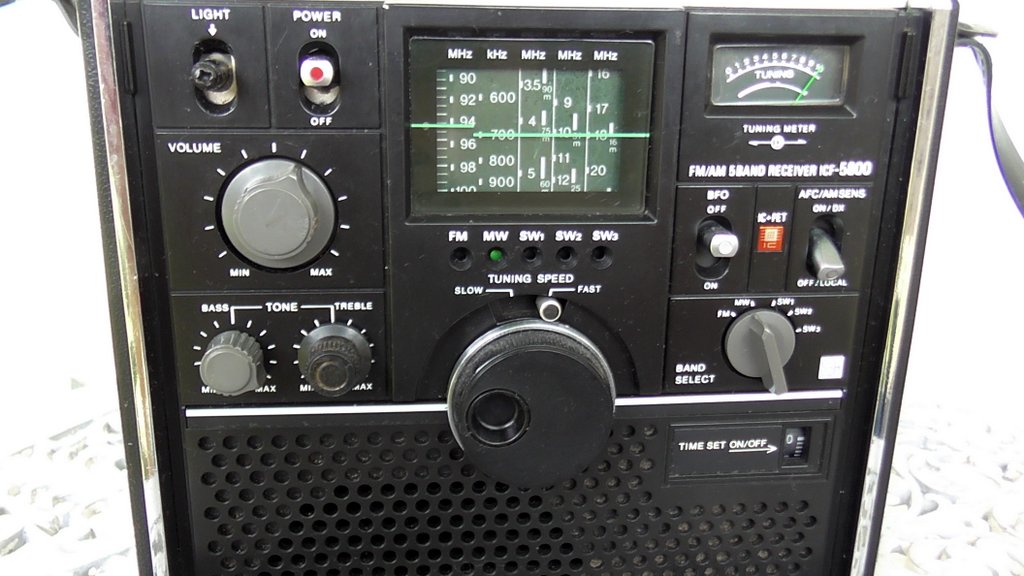
To my knowledge, there are no analog shortwave radios with a BFO (for SSB) that are in production today. There are, however, numerous analog models from the 60s, 70s and 80s with a BFO (two examples: the Sony ICF-5800H and the Panasonic RF-2200).

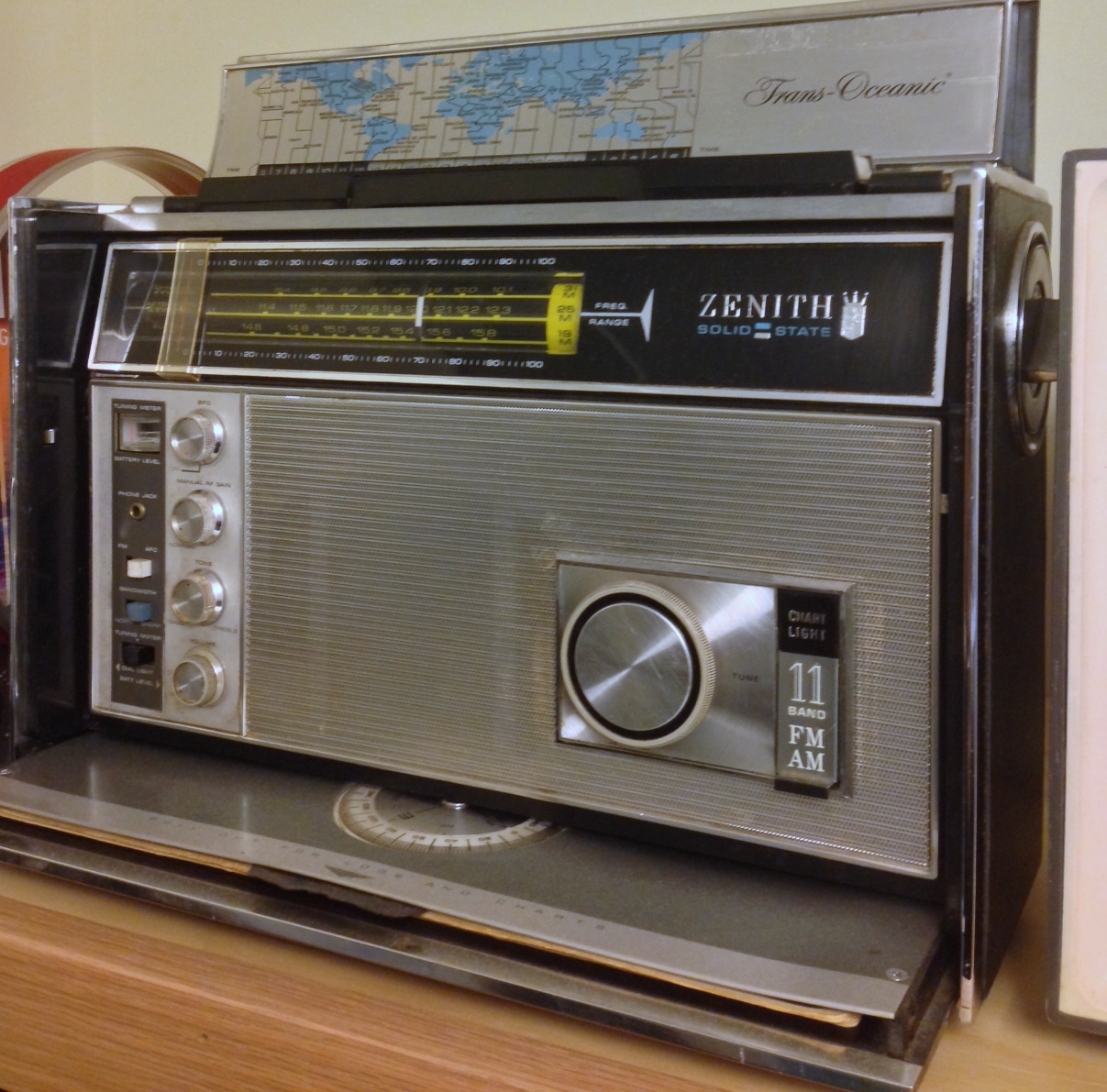
My trusty Zenith Trans Oceanic will always be a part of my radio collection (Click to enlarge)

In fact, my first proper radio was a Zenith Transoceanic. I’ll never forget taking it to our local RadioShack, when I was eight years old, to ask one of the employees (who I knew was a DXer) what the heck “this strange BFO knob” does!

There is the analog Sony ICF-EX5MKII that SWLing Post contributor Troy Riedel reviewed, but I don’t believe it has a BFO–only a synchronous detector which can be switched between upper and lower sidebands. Perhaps a reader can confirm this.

Since I can’t recommend a current analog model, I do have a digital solution that I believe may work for you:

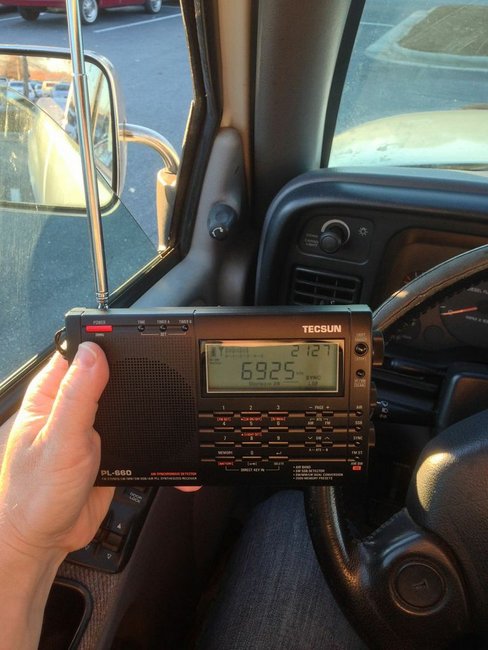
The Tecsun PL-660

Listening to Channel Z in a parking lot with the Tecsun PL-660.

Listening to Channel Z in a parking lot with the Tecsun PL-660.


Though not an analog radio, the menus on the PL-660 are not “deep”–most buttons simply toggle features. There is no hardware “switch” to change bands, but I think you would find it easy enough to use the direct frequency entry keypad to navigate across the spectrum. The SSB feature works more like an analog radio as it has a BFO dial on the right side of the radio. The buttons and dials are also raised and tactile. Best yet, the tuning sounds like an analog radio since there is no muting between frequency changes.

There are a number of other portables out there that are about as simple to operate as the PL-660, but I like the price point of the PL-660 and its overall performance characteristics. For a little less money, and a similar form factor and function set–minus a synchronous detector function–you might also consider the Tecsun PL-600 as well.

Again, I’m hoping Post readers might chime in with even better suggestions! Please comment!

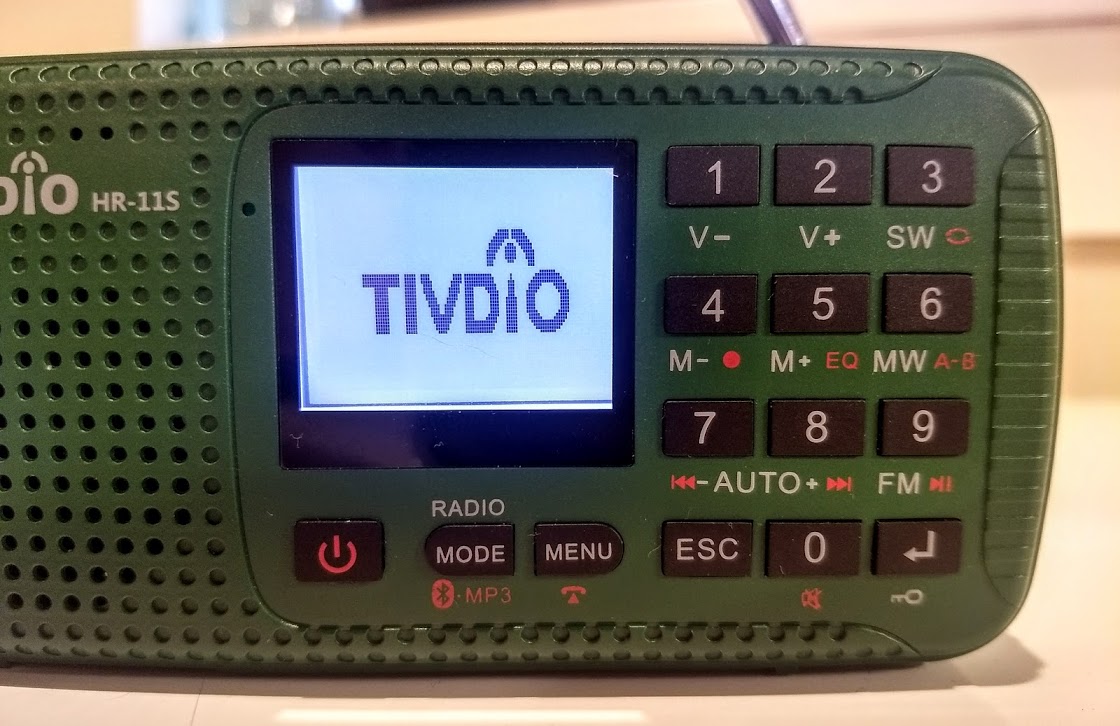
A review of the Tivdio HR-11S self-powered shortwave radio

A few months ago, the radio manufacturer Tivdio contacted me to see if I would be interested in evaluating their new Tivdio HR-11S self-powered emergency radio. I receive requests like this frequently, and often pass on the opportunity since I generally don’t have the time to evaluate the overwhelming number of inexpensive DSP radios that have hit the market in the past few years.

But this time, I seriously considered it.  There were two reasons I was interested in the HR-11S:

  1. I purchased a Tivdio V-117 last year, and have been pretty pleased with it; indeed, I’m overdue a review on this unit. We’ve also posted several positive reviews of the Tivdio V-115.
  2. At our non-profit ETOW, we’re always looking for reliable self-powered radios with shortwave for use in areas of the world where radio remains the primary news source.

Thus this radio is a rather rare breed.  Tivdio dispatched the radio very quickly, but my work with the Radio Spectrum Archive and several other reviews already in the pipeline took priority.

I’ve had the HR-11S in service for several months, and have now explored every feature to some degree. What follows is my summary and review notes.

Green and Red radios are different models
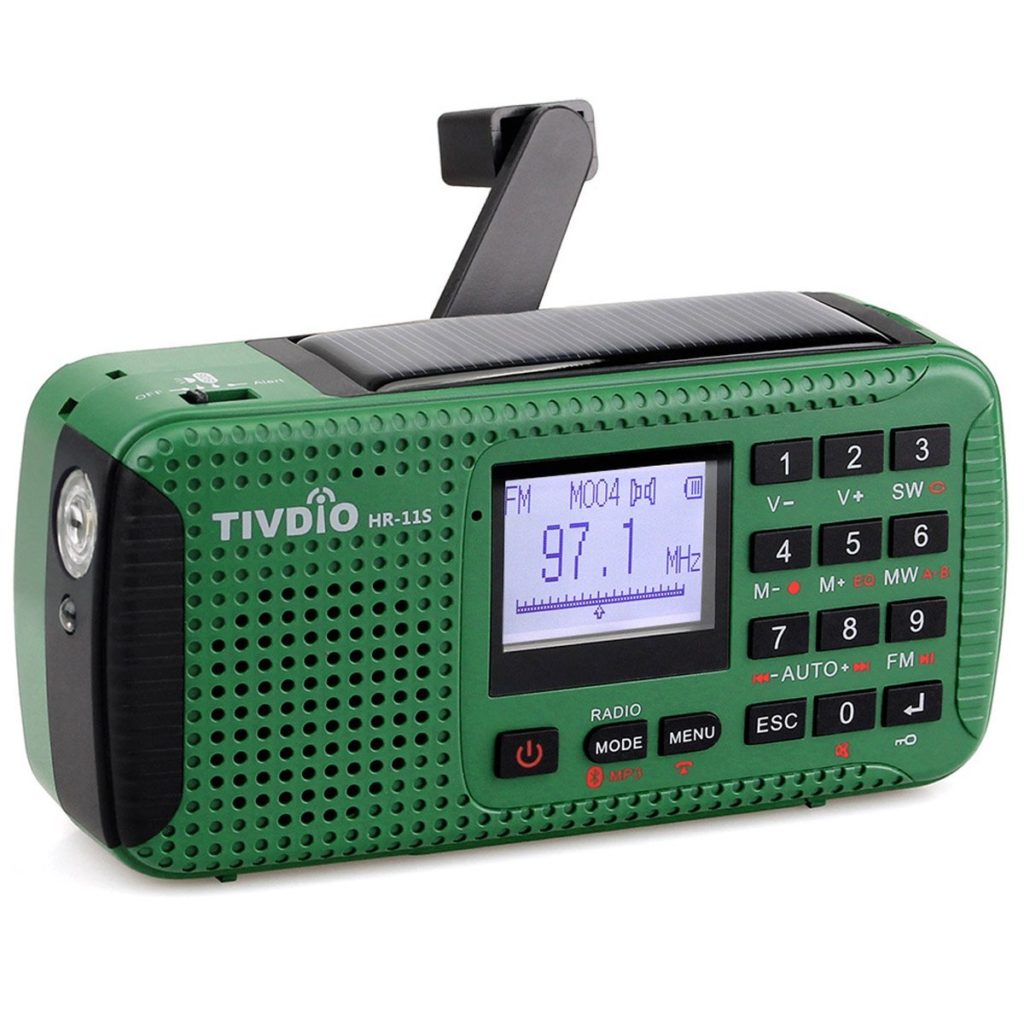
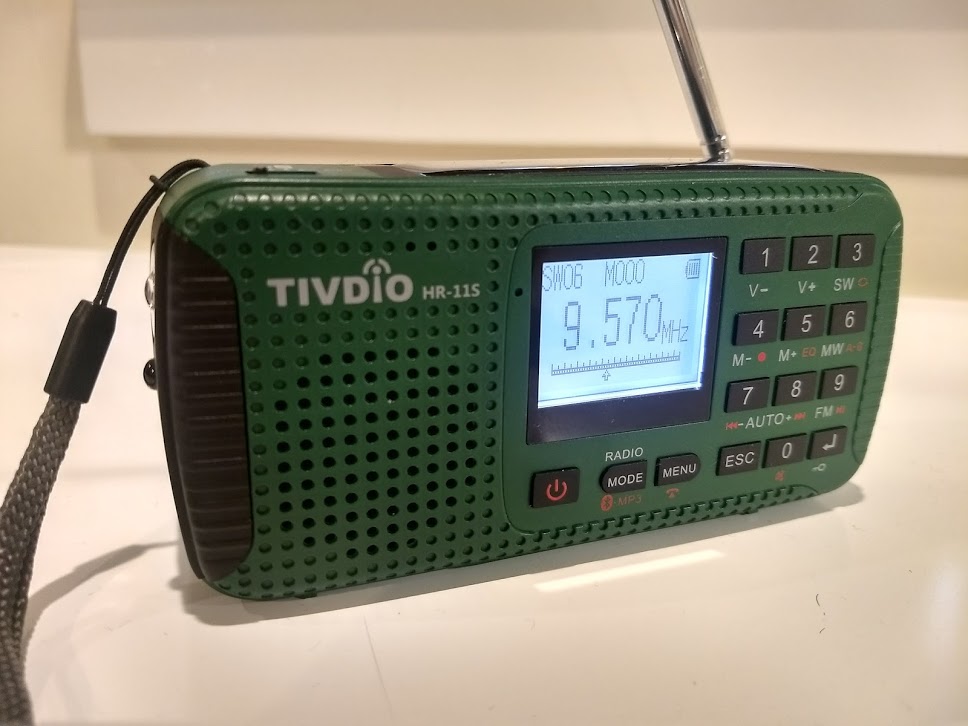
First things first: note that I’m reviewing the Green HR-11S. Tivdio also makes a Red version which is actually a different model number: the HR-11W.
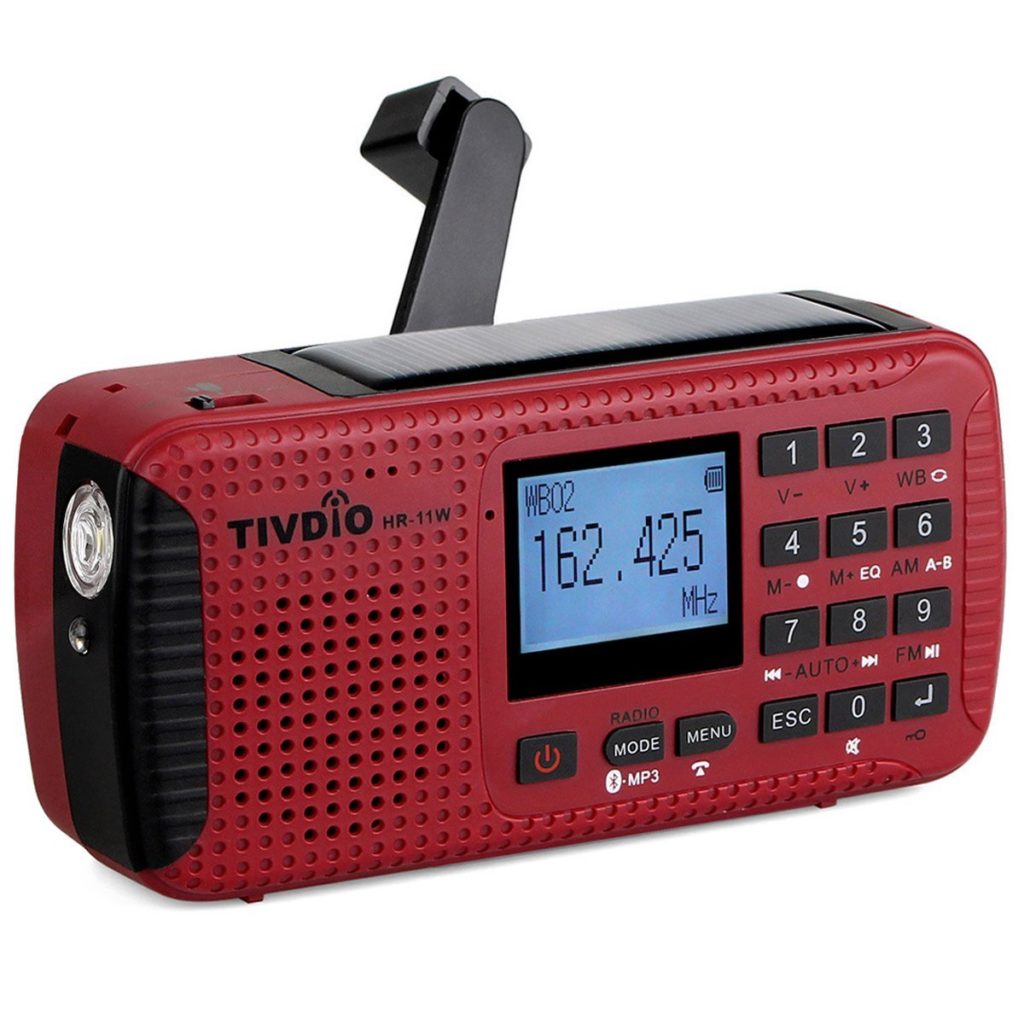
The main difference between these models, as I understand it, is the green HR-11S is a shortwave version, and the red HR-11W is a NOAA weather radio version.

Both are useful; why not combine the two roles in one unit?  I’m not surprised this radio can’t include both shortwave and NOAA weather radio. Through Ears To Our World, I’ve worked with self-powered DSP radios for many years, and know that a limitation of the DSP chip is that it can be set to feature either shortwave or weather radio, but not both, simultaneously, if both AM and FM are included.

Form factor
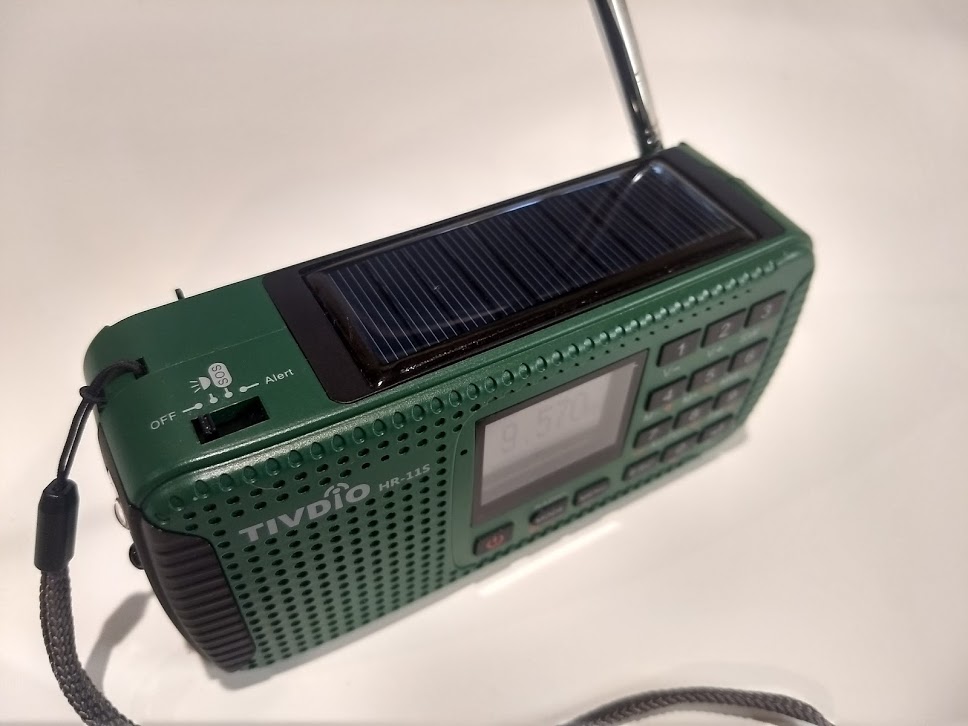
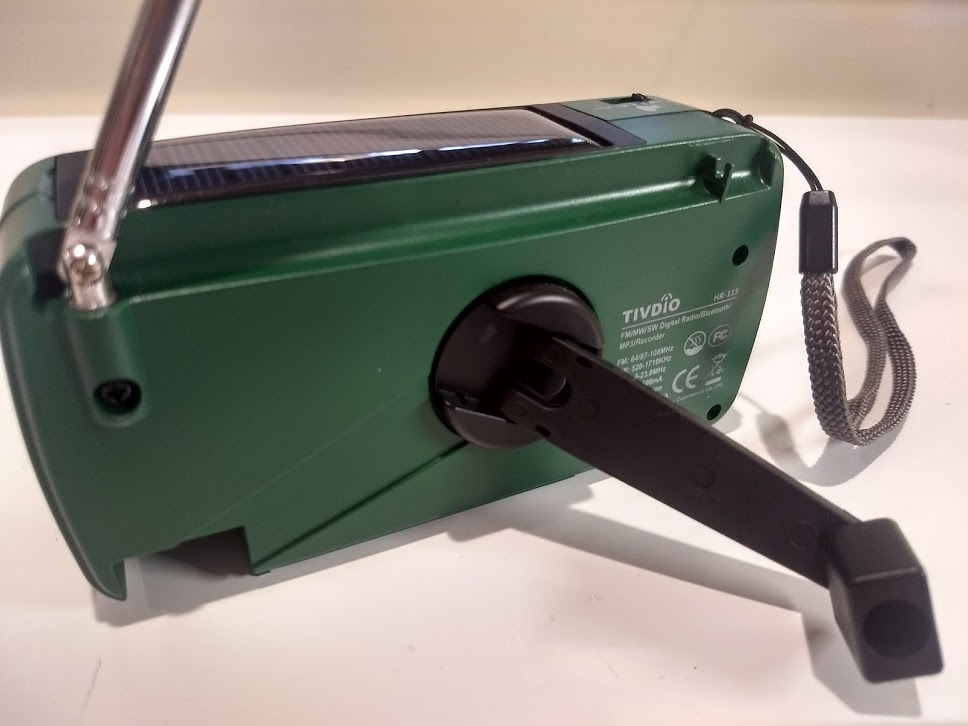
The HR-11S has a built-in solar panel.

The HR-11S adopts the standard “flashlight” form factor found in so many other self-powered radios. I think the flashlight functionality is a useful feature and results in a handy form factor.  It’s compact, lightweight, and seems relatively sturdy, so is suitable for camping, travel, and off-grid utility.

Flashlight/Siren switch

A small switch on top toggles between four positions. The first two positions are off/on for the main white LED. Though the flashlight aperture is relatively small, the white LED provides enough luminosity to light your immediate path at night, and certainly more than enough to read by.
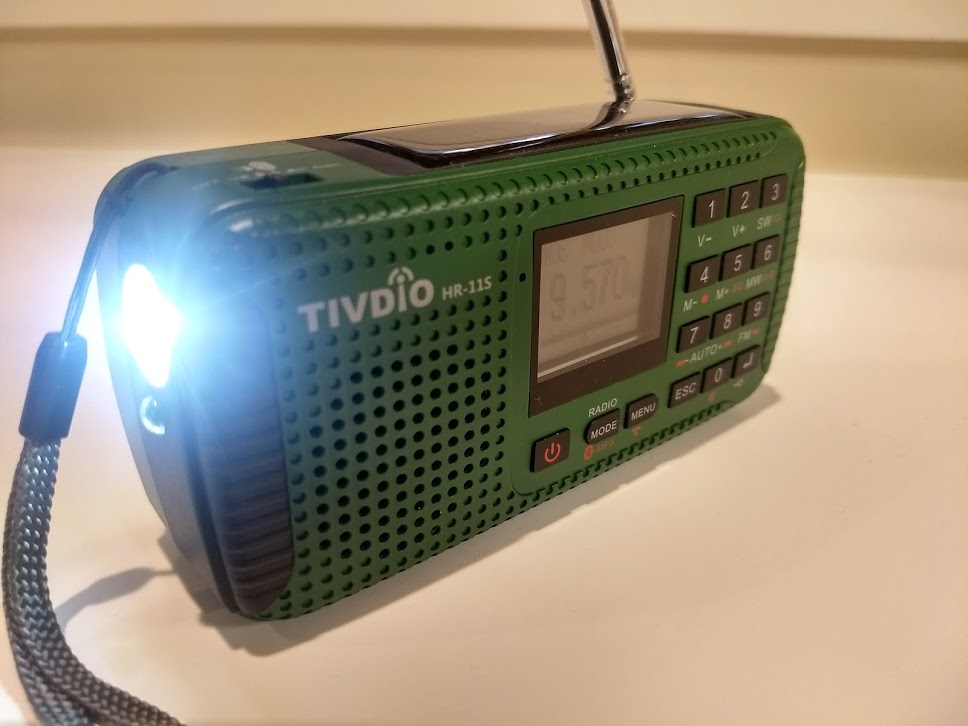
The third switch position engages a flashing red LED. The red LED is not terribly bright and I’m not sure how helpful this would be in an emergency situation.
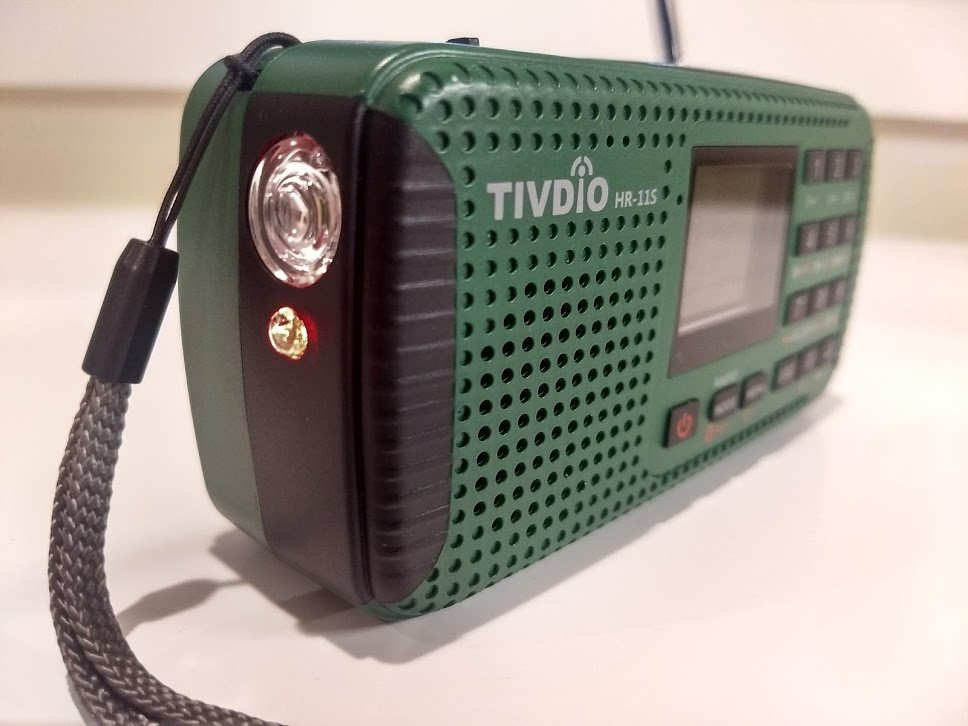
The red LED is rather dim and can only flash.

I would much rather have the red LED maintain a steady beam which would be great for amateur astronomers, campers, or anyone else wishing to preserve their night vision.

The fourth position engages a LOUD siren. More than once when attempting to turn on the flashlight in the dark, I’ve accidentally engaged this pain-inducing feature. The switch is small, thus it’s very easy to engage the siren. In a quiet campground, this might annoy your neighbors––not to mention you, yourself.  Of course, in an emergency situation, a loud siren could come in handy. I just wish its switch wasn’t combined with the flashlight switch.
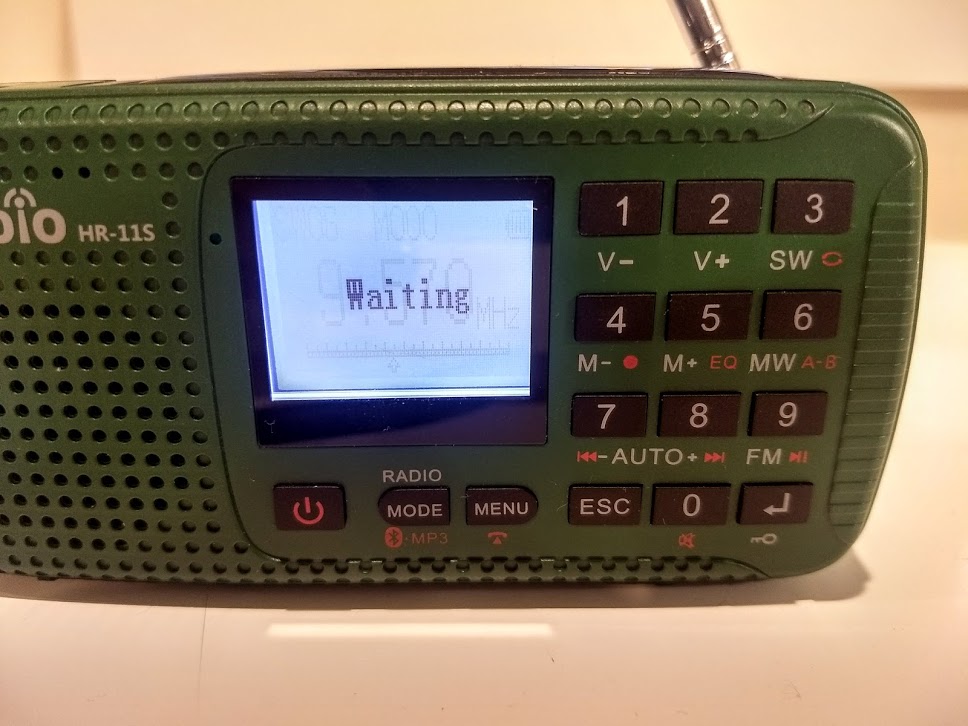
The display HR-11S display is backlit and easy to read.

The HR-11S sports a keypad that allows direct frequency input––a very good thing, considering there is no tuning knob.
To band scan, you must use the #7 and #8 key on the keypad to increase and decrease frequency in predetermined steps. And, yes, the radio mutes between frequency changes.

You can also press and hold the #7 or #8 buttons to engage an auto-tune feature that finds the next strong signal.
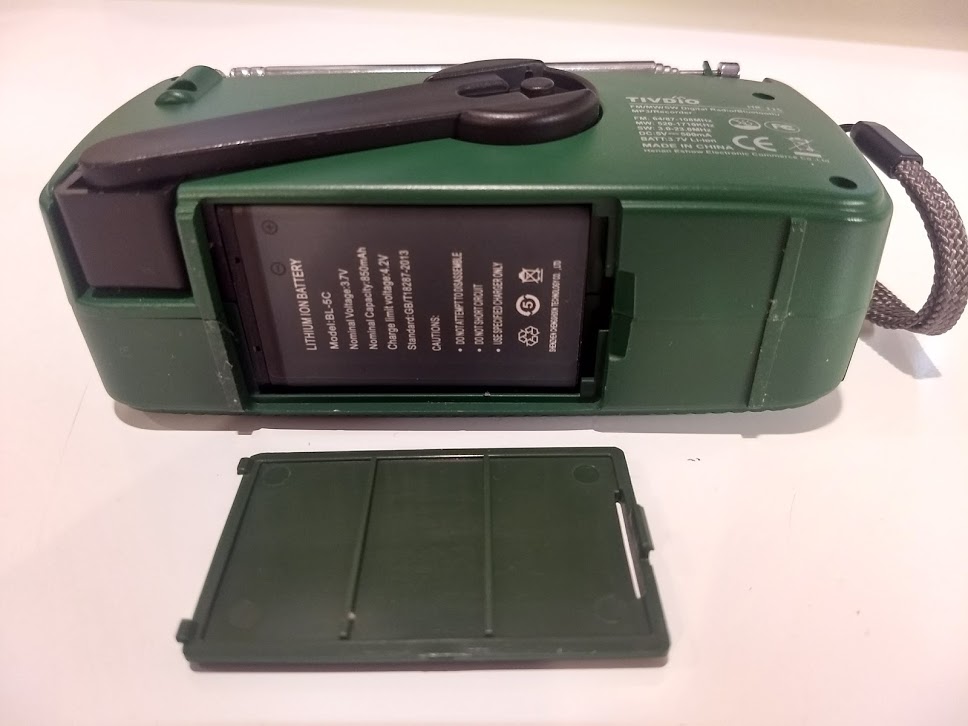
The HR-11S’ rechargeable battery pack.

To input a frequency directly, simply press the enter button, key in the frequency, then press the enter button once more to engage that frequency. Very simple.

The volume up/down buttons are #1 and #2 on the keypad.

The keypad is not backlit and the layout for volume control, tuning, mode switching, etc., is a bit confusing; it doesn’t match any other radio I’ve ever used.  Of course, with time you’ll master the keypad functions, but the design could be made more user-friendly.

Performance: setting expectations
SWLing Post community members know that I tend to review what I call “enthusiast grade” radios: receivers that perform well enough to attract the attention of DXers and dedicated listeners.

Self-powered radios, with few exceptions, rarely impress me in terms of performance. Indeed, some of the best that have been on the market have been analog units (I’m particularly fond of the Grundig FR200).
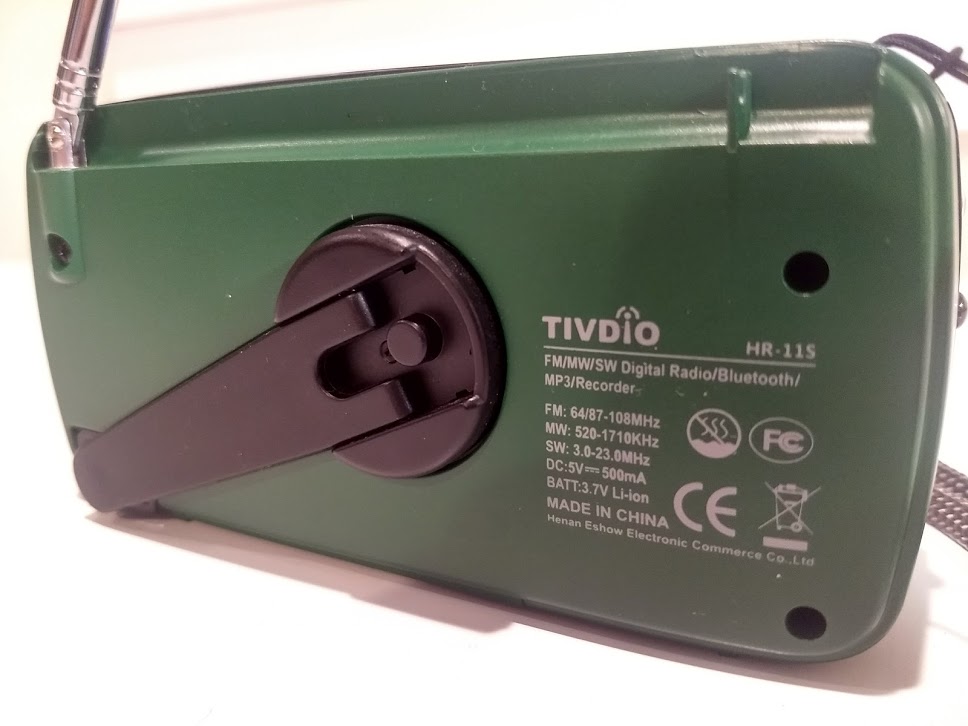
The Tivdio HR-11S is no exception––don’t expect to snag elusive DX with this unit. It’s not going to happen.

FM
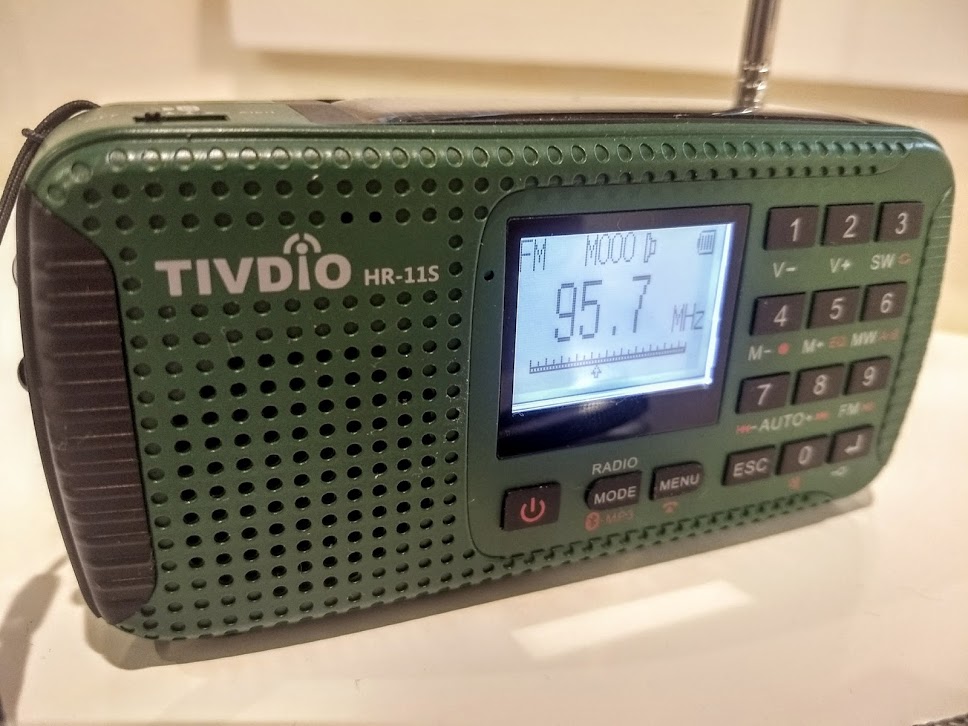
The HR-11S is a capable FM receiver. Performance is on par with most average FM radios: you’ll easily receive all of your local broadcasters, but distant stations may require holding the unit in your hand, careful positioning, or adding an extra bit of wire to the antenna.

The FM audio is quite good via the HR-11S’s built-in speaker.

AM
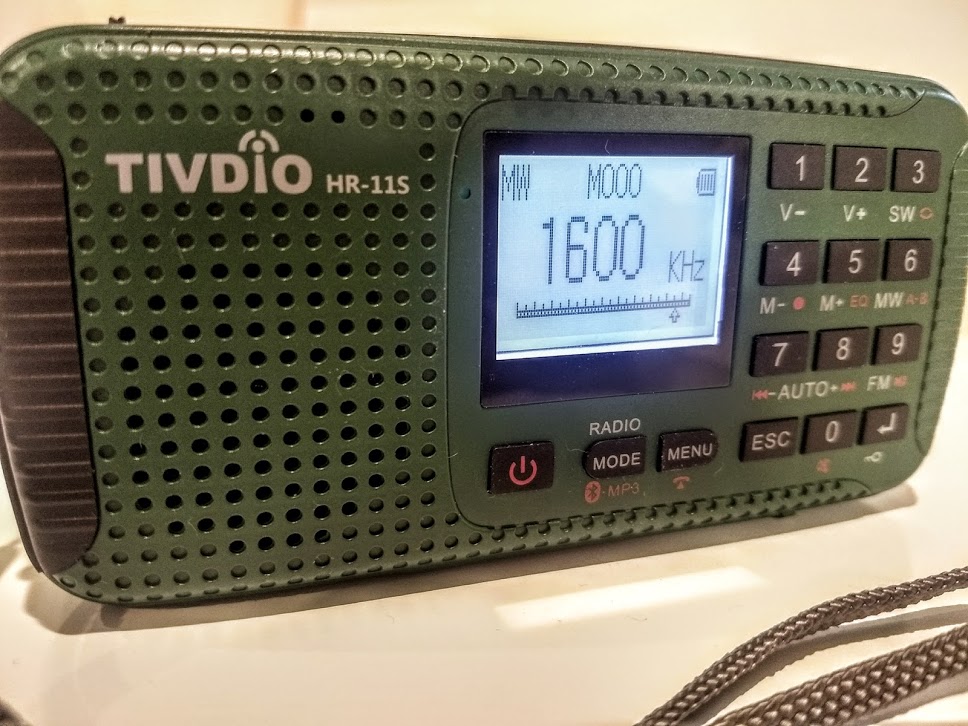
The mediumwave, or AM broadcast band, is the HR-11S’ weakest suit. AM is plagued with internally-generated noises–especially in the lower part of the band–thus you’ll only be able to clearly receive local AM broadcasters that rise well above the noise floor. Thus I cannot recommend this radio for AM reception.

Shortwave
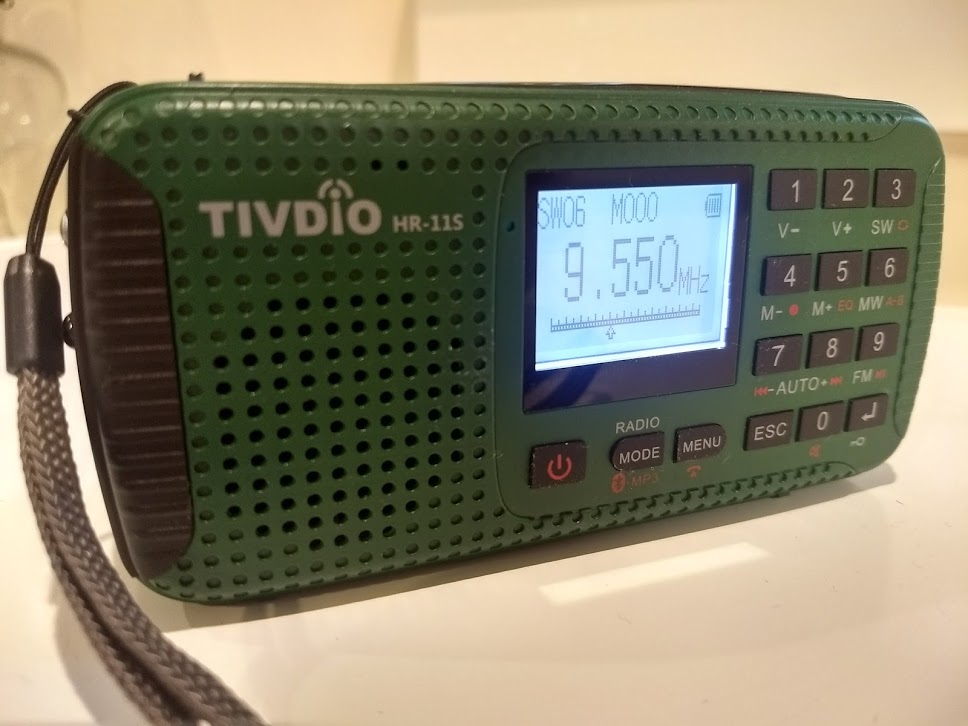
Shortwave reception is on par with other DSP self-powered radios I’ve tested. As I write this section of the review, I’m listening to China Radio International on 9,570 kHz in my office without even having the telescopic whip antenna extended. (CRI is a blowtorch station, however).

I find that the HR-11S can receive most strong broadcasters and even weaker stations, though the AGC is not ideal when fading is present.

If you’re seeking a self-powered radio with shortwave, the HR-11S is somewhat useful in this regard and is worth consideration.

Keep in mind, though, that an inexpensive dedicated ultralight shortwave radio like the Tecsun PL-310ET will perform circles around this unit.

Bluetooth
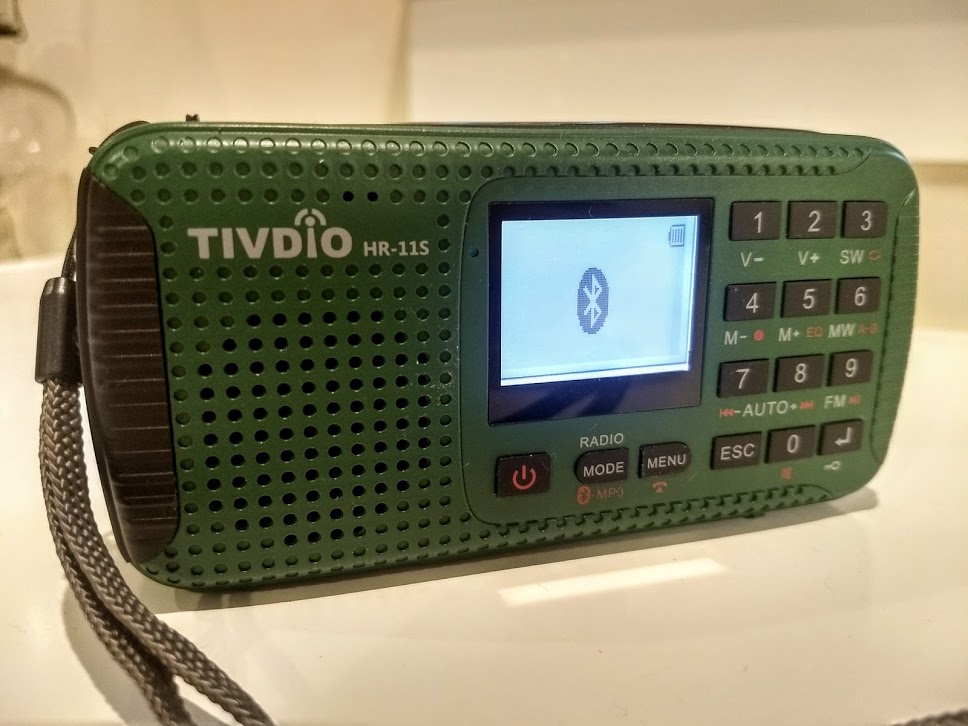
One feature I’ve found incredibly useful is the Bluetooth functionality.  With Bluetooth mode engaged, you can connect the HR-11S to pretty much any mobile device and use it as a wireless portable external speaker. Since the speaker has decent audio fidelity for the size, and can be powered by battery, it’s a brilliant feature and will make watching videos on your smartphone, for example, that much better.

One negative? At least in my unit, I can hear some internally-generated noises in Bluetooth mode. This is especially noticeable at lower volume levels.

Recording

In full disclosure, I haven’t tested the recording functionality extensively. Built-in radio recording is an interesting feature, but one I would rarely use in a self-powered radio. I did make a handful of test recordings, however, and like many other DSP radios with a recording function, the HR-11S injects noise in the recordings.

Summary
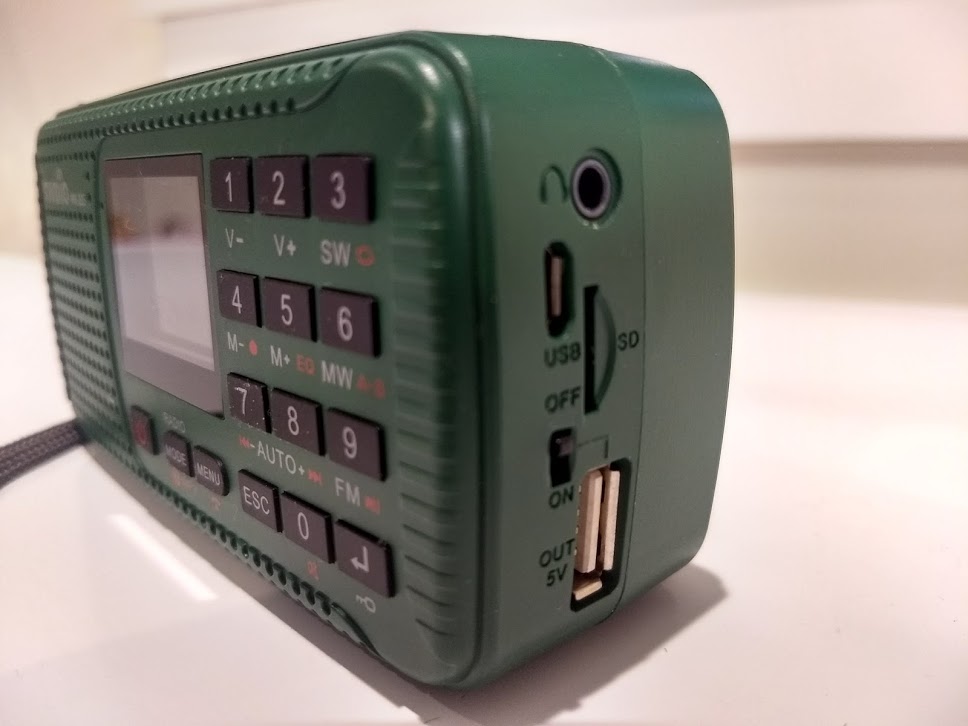
Every radio has its pros and cons. When I begin a review of a radio, I take notes from the very beginning so that I don’t forget my initial impressions and observations. Here’s the Tivdio HR-11S pro/con list, from the first moments I turned it on to the present:

Pros:

  • Keypad entry
  • Great audio for size
  • Replaceable battery (Note: after unboxing unit, you must place battery in battery compartment; it’s packed in the side box)
  • Siren  (see con)
  • Micro SD card for digital storage
  • USB can port audio from PC
  • Bluetooth––use as a portable wireless speaker for mobile devices (see con)
  • ATS (auto tune) function
  • Multiple power sources:
    • 850mAh rechargeable lithium battery
    • hand-crank dynamo generator
    • Mini solar panel
    • DC 5V input (standard micro USB)
  • Backlit informative display
  • Customer service: Tivdio representatives seem to respond quickly to customer emails and comments on Amazon.com.

Cons:

  • Tuning is cumbersome (no tuning knob)
  • Mutes between frequencies
  • Siren too easy to activate, resulting in accidental activation
  • AM broadcast band (MW) is plagued with internally-generated noises
  • Keypad configuration is not intuitive and difficult to memorize for use at night or low light settings
  • Hand strap is very difficult to insert (hint: use a thin loop of wire to help thread it)
  • At low volume, noises can be heard in Bluetooth mode
  • Noises heard in recording function

Conclusion
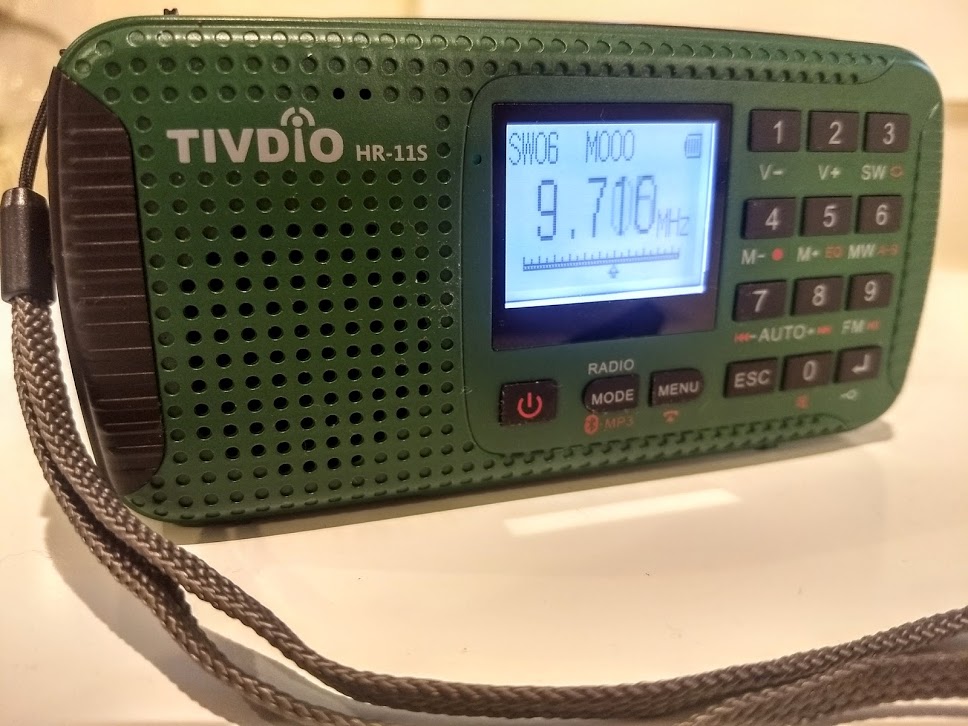
Running an ATS scan on shortwave.

As I mentioned early in this review, I must set realistic expectations when reviewing self-powered radios. When most consumers consider a self-powered radio, they’re seeking a simple, basic radio that will provide information during times of need: power outages, natural disasters, or while hiking, camping, boating, or simply in an off-grid setting.

Internally-generated noises––especially on the AM band––will disappoint radio enthusiasts. If Tivdio could address this in future iterations of the HR-11S, it would substantially improve this unit.

My overall impression is that the HR-11S is chock-full of features, but none of them are terribly refined. There are even some internally-generated noises in Bluetooth mode, which really surprised me as it seems like an oversight by engineering.

I see the Tivdio HR-11S is a bit of a “Swiss Army Knife” of a self-powered radio. It has more functionality and connectivity than any other self-powered radio I’ve tested to date. Its features will, no doubt, appeal to the average consumer––and a quick look at Amazon reviews seem to support this theory. As a radio enthusiast, however, I would pass on the HR-11S until the internally-generated noises have been addressed.

Click here to view to the Tivdio HR-11S on Amazon.com (affiliate link supports this site).

See coupon codes below.

For those who are interested, Tivdio passed along several coupon codes that SWLing Post readers can use to save money, should they decide to purchase the HR-11S:

For a 5% discount, use code:

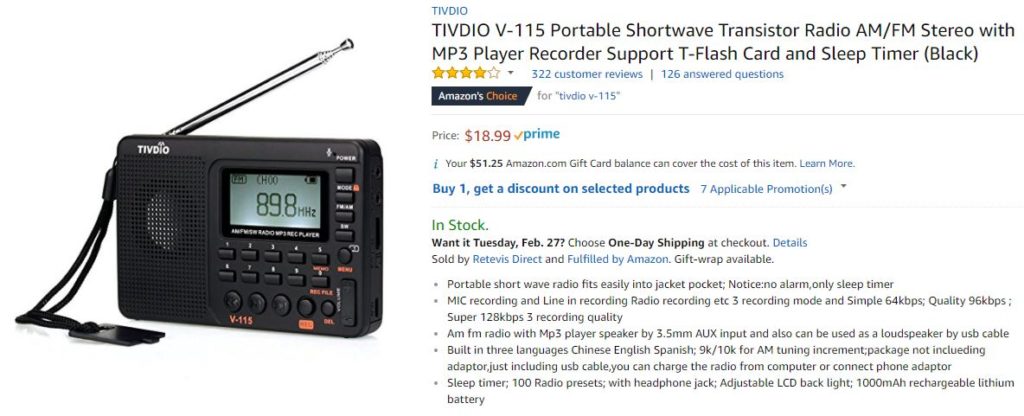
Radio Deal: TIVDIO V-115 $18.99 US shipped

I just noticed that the price for the TIVDIO V-115 has been lowered to $18.99 US shipped on Amazon.com.

Click here to read our previous reviews of this radio. This is the lowest price for the V-115 I’ve seen on Amazon.  As I mention with any Amazon sale–a now standard disclaimer–the price could change at any moment.

Click here to view on Amazon.com (affiliate link).

Yaesu FT-818 details emerge (and beware of the fake “leaked” photo!)

I’ve been following news about the Yaesu FT-818: the next iteration of the venerable Yaesu FT-817ND QRP general coverage transceiver.

The FT-817 series has been on the market for nearly two decades. I remember purchasing one of the first production models when I lived in the UK in 2001.

It was a revolutionary radio at the time.

It was exceptionally suited for portable use, sporting an internal battery pack, on-board keyer, had all mode/all band capability and antenna ports on the front faceplate and rear. It was the most compact full-featured transceiver on the market. All this for about $670 US.

In 2004, Yaesu made upgrades and launched the model FT-817(N)D. In no small way, I’m sure this little radio has been a cash cow for Yaesu. It’s had an exceptionally long market run and has been the only QRP transceiver in the Yaesu product line for decades.

Recently, Yaesu released specifications and retail pricing of the FT-818.  But before we go any further…

Don’t believe the fake prototype photos

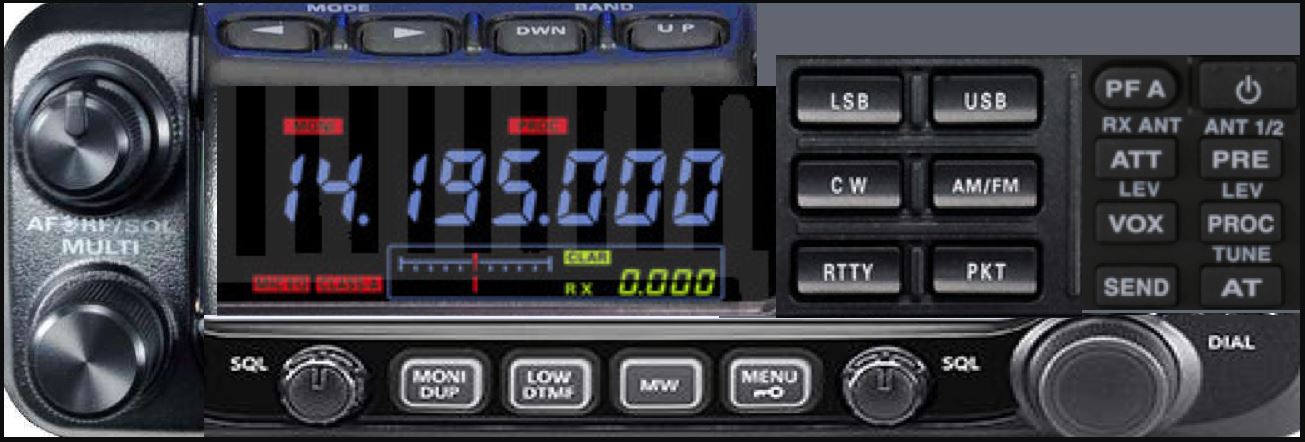
It seems like every time a new amateur radio transceiver is announced, someone quickly assembles a “leaked” prototype image and publishes it on the web. Here’s the one someone pieced together for the Yaesu FT-818:

Click to enlarge (and see obvious Photoshop chop job)

To be crystal clear: this is not a leaked photo of the Yaesu FT-818. It’s (frankly) a terrible Photoshop job–someone playing with cutting, pasting and resizing bits from other transceivers.

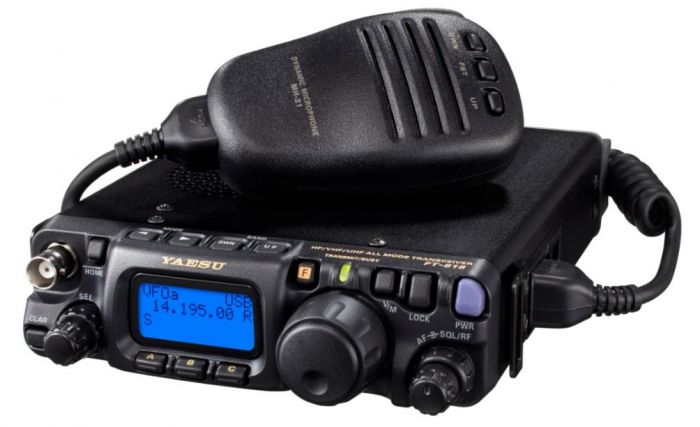
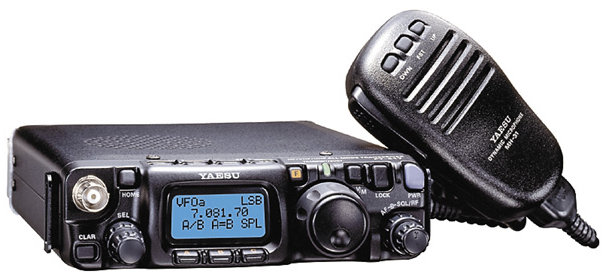
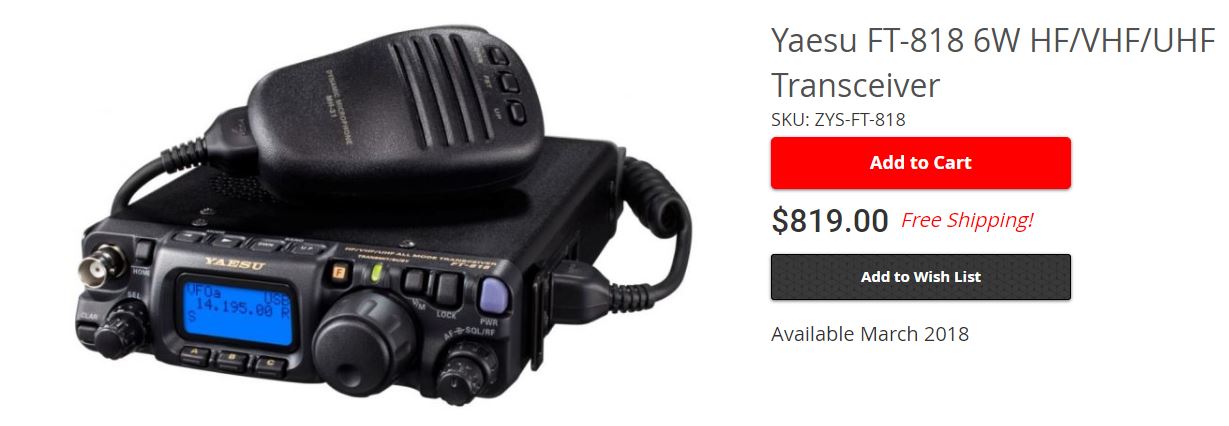
I fully suspect the new FT-818 will not be a dramatic departure from the FT-817 in terms of styling and design. Perhaps it’ll be nearly identical. In fact, radio retailers have been posting the following image on their FT-818 ordering page:

Image taken from GigaParts.

This may simply be a placeholder, or it may be that all of the upgrades are internal and the ‘818 form factor will be identical to the ‘817.

Enough said…

What we do know about the Yaesu FT-818

Rumors of an FT-818 have been floating around the ham radio community for years. No surprise given the extraordinarily long run of the ‘817 series!

We do have concrete details now since ham radio retailers have been given features, specifications and availability dates. It appears the upgrades are iterative–this is not a dramatically re-designed rig.

Here’s what Yaesu has released (I took this from GigaParts, but retailers are posting variations of the same announcement):

Yaesu FT-818 6W HF/VHF/UHF All-Mode Portable Transceiver

The new Yaesu FT-818 incorporates all of the basic and attractive features of the ever-popular FT-817ND while providing upgrades desired by many existing owners.

The FT-818 provides 6W of solid output power with an external DC power source. The supplied Ni-MH battery pack (SBR-32MH) has been upgraded to now provide larger battery capacity – 9.6v/ 1900mAh. The recent launch of several new satellites is a certain indicator that the large global community of satellite enthusiast are going to be very delighted to learn that the FT-818 includes a Built-in TCXO-9 oscillator that gives the FT-818 fantastic frequency stability (±0.5ppm).

The FT-818 includes all the useful functions that are included in the FT-817ND: Dual VFOs; Split-Frequency operation; IF Shift; Clarifier “R.I.T”; IF Noise Blanker; RF Gain and Squelch control; IPO (Intercept Point Optimization); AM Aircraft reception; AM and FM Broadcast reception; VOX; Built-in Electronic Keyer; Adjustable CW Pitch; Automatic Repeater Shift (ARS); Built-in CTCSS Encoder/ Decoders; 208 memory channels with 10 memory groups; two antenna connectors; Automatic Power-Off (APO) and Time-Out-Timer(TOT) functions; and so on.

Features

  • Increased power output 6W(SSB, CW, FM) 2.0W(AM Carrier) *NEW!
  • Improved frequency stability ±0.5 ppm : Built-in TCXO-9 *NEW!
  • Larger battery capacity : 9.6V/1,900mAh (SBR-32) *NEW!
  • 208 Memory Channels / 10 Memory Groups
  • Operates on 160-10m , HF, 6m, 2m and 70 cm Bands
  • Ultra Compact and Portable
  • Two Antenna Connectors
  • IF Shift, IF Noise Blanker, IPO, ATT
  • CW “Semi-Break-in”, CW Reverse, CW Pitch Control
  • Built-in Electronic Keyer
  • Multi-Color Easy to see LCD
  • Internal Battery Operation Capability
  • ARS Automatic Repeater Shift
  • APO Automatic Power Off
  • Front Panel Key Lock Mode

Specifications

Frequency Ranges:

RX:

  • 100 kHz – 33 MHz
  • 33 MHz – 56 MHz
  • 76 MHz – 108 MHz
  • 108 MHz – 154 MHz
  • 420 MHz – 470 MHz

TX:

  • 1.8 MHz – 29.7 MHz (5.3320 MHz/ 5.3480 MHz/ 5.3585 MHz/ 5.3730 MHz/ 5.4050MHz)
  • 50 MHz – 54 MHz
  • 144 MHz – 148 MHz
  • 430 MHz – 450 MHz (Amateur Bands only)

Circuit Type: Double-Conversion Superheterodyne (SSB/CW/AM/FM)
Single-Conversion Superheterodyne (WFM)
Modulation Type: A1A(CW), A3E(AM), J3E(LSB,USB), F3E(FM), F1D(PACKET), F2D(PACKET)
RF Power Output : 6 W (SSB/CW/FM), 2 W (AM Carrier) @13.8 V
Memory Channels: 208
Case Size(W x H x D): 135 x 38 x 165 mm (5.31″ x 1.5″ x 6.50″) w/o knob and connector
Weight: 900 g (1.98 lbs) (w/o Battery, Antenna and Microphone)

Includes

  • Yaesu FT-818 6W HF/VHF/UHF All-Mode Portable Transceiver
  • Hand Microphone(MH-31A8J)
  • Battery (SBR-32 9.6V 1900mAh Ni-MH )
  • Battery Case (FBA-28) (Requires 8 “AA: batteries)
  • Whip Antenna for 50/144/430 MHz (YHA-63)
  • DC Cable (E-DC-6)
  • Shoulder Strap, Ferrite Core, Rubber Foot
  • Operating Manual
  • Battery Charger (PA-48)

The retail price is roughly $819 US shipped via GigaParts and $849 via Ham Radio Outlet. I’m sure Universal Radio will post the FT-818 to their site soon as well. At time of posting, I haven’t noticed any retailers outside the US including the FT-818 in their catalog.

I will plan to review the Yaesu FT-818, so bookmark this tag to follow any updates: Yaesu FT-818

Video: CME’s and Solar Energetic Particles

Many thanks to SWLing Post contributor, TomL, who writes:

Regarding the last couple of posts recently about what affects Space Weather (and HF radio communications), this talk last week from Solar scientist Joan Burkepile of the High Altitude Observatory discusses what causes Radiation storms from Coronal Mass Ejections. She makes it interesting from a physics point of view. And as we understand the sun better, we also learn more about how the rest of the universe behaves.

Click here to watch via YouTube.

Thanks for sharing this, Tom!

Kamchatka broadcasting on shortwave

Many thanks to SWLing Post contributor, Ralf Bender, who writes:

Here a link to a German radio station website, which yesterday released that a Russian broadcaster is back on air. In times when many broadcasters/stations are closed [this is] good news.

Here there original German website:
https://www.radioeins.de/programm/sendungen/medienmagazin/radio_news/beitraege/2018/kamtschatka.html

And here with automatic Google translation:

Kamchatka on shortwave

According to the broadcasting companies of the republics Adygea and Sakha, in the Russian Federation, a third broadcaster is again active on shortwave: the GTRK Kamchatka from Petropavlovsk. Sent for each two hours from 8.00 and 13.00 clock local time on the frequency 5940 kHz.[…]

The transmission to 5940 kHz compensates the omission of the long wave 180 kHz. Like all others, it had been shut down at the beginning of 2014 by long-wave and shortwave recordings that had previously been recorded on the account of the All-Russian State Broadcasting Corporation (WGTRK). Thus, the radio coverage ended outside the areas reached by the FM stations.[…]

The article also includes the following reception video from a DXer in Asia:

Click here to view on YouTube.

Thanks for the tip, Ralf! Perhaps some of our Russian readers can shed some light on this development?  Please comment!