Category Archives: DX

RAE-Argentina: Update from Actualidad DX

Many thanks to Adrian Korol, at RAE, for sharing the following update from Actualidad DX:

ACTUALIDAD DX.COM.AR brings you the latest news of the radio world, the short waves, the media, the telecommunications, the DX, the ham radio and the digital context every week. A production of RAE Argentina to the world, edited by Arnaldo Slaen
This week

ACTUALIDAD DX.COM.AR No. 3

Greetings dear friends of Actualidad DX.com.ar, the DXing program about DXing, broadcasting media and new technologies that airs every week through RAE-Argentina to the World, the International Short Wave Station of the Argentine Republic.

We remind you that you can send your reception reports, suggestions, criticisms and comments to our email: [email protected]

We also invite you to contact us via traditional mail, to RAE Argentina to the World, PO Box 555, Post Code 1000, BA, Argentina.
RAE Argentina al Mundo keeps on incorporating new technologies and has now a new channel: AUDIONOW, that allows our listeners to follow our programs via their phones, at the cost of an local phone call.

AUDIONOW is a system to connect stations with their audiences in far-off places, as an alternative to SW and internet. In the specific case of the US, online listening is made only where there’s Wi Fi networks near, since 4G and 3G services don’t have flat-price data plans, but they do have flat-price plans for phone calls.

This radio-over-phone instrument is already used by other international broadcasters such as BBC, VOA, Radio Francia Internacional, Deutsche Welle, and the UN radio station.

On this first stage, RAE Argentina to the World will work with Audionow in English and Spanish for listeners in the US who will be able to tune in on our full hour-long programs or on our news bulletins.

Arrangements are being made to bring this option to Mexico and Canada in North America and Brazil in South America.

There’s the intention also of including football broadcasts.

And we kick off with SW hearings.

La Oesterreichischer Rundfunk, was picked up by transmitters in Moosbrun, Austria

0500-0620 en 6155 khz con 300 kW in German for the west of Europe, from Mondays to Fridays.

0500-0615 en 6155 khz also in German for western Europe, on Saturdays and Sundays.
From the same transmitting site, religious broadcaster FEBA goes on the air, between 0800-0830 on 15260 KHZ with 100KW in Arabic.

Also from Moosbrun, Austria, Radio DARC, broadcasts only on Sundays, between 0900-1000 UTC on 6070 khz con 100 kW in German.
Only the first Sunday of every month and always from Moosbrun, Radio JOystick can be picked up between 1000 and 1100 on 7330 khz, with 100 kW for Europe in German.

Now we share some news for the A17 broadcasting period by WCB-Madagascar World Voice.

Between 0200 and 0400, on its new frequency of 6190KHZ with 100KW, aimed at SOuth America in Spanish, with a program called “The Happy Voice”.

Between 0300-0400 on 15515 KHZ with 100KW for Southeast Asia with English-language program “African Pathways Radio”.

Between 1900 and 2000 on 9820 KHZ with 100KW in Russian for Eastern Europe, with a program generated by its sister station “KNLS New Life Station”.

Now we have more news from Argentina.

The Culture Secretary of La Rioja province, Víctor Robledo, together with other officials of the provincial administration met Cristian Arrieta, the delegate from the ENACOM, Communications Board.

The provincial secretariat had requested the federal authorities for an FM broadcasting license, to set up a public radio that broadcasts culture-related news.
We move on now to an international SW broadcaster, China International Radio proposed Sputnik China to create a joint brand, according to what was informed by Dmitri Kiseliov, director general of the Rossiya Segodnya, .media group

In addition, a project called “Russia and China on the Silk Road”, organized by both groups began last October.

25 journalists from both nations will visit the main stages of the New Silk Road between the cities of Xi’an and Urumchi.

And back to Latin America to visit Ecuador.

The Ecuadorian House of Culture reported that the Telecom Watchdog Agency, Arcotel, assigned an FM broadcasting licence to them.

Arcotel granted the entity the 100.9 frequency, with enough range to cover the province of Pichincha. The new station will be called Culture FM.

Pérez underlined the importance of getting the licence, something the House of Culture had been working for years. They already run an AM station, House of Culture Radio, that’s been on the air for almost 70 years, and is one of the forerunners in the field of cultural broadcasting in the country.

According to Pérez Torres, Culture FM will aim at contributing to the cultural enhancemente of Ecuadorians, bringing them closer to Latin America and the world.

Proaño, expects the station becomes a reference in culture for the country.

Let’s continue with the Americas. Now, Panamá.

The Panamanian National Authority of Public Services held two public hearings that seek to establish the reach and benefit for the population of granting Radio Licences Class B (non-proffit broadcasting) to the State-Ran SERTV broadcasting service and the Catholic Faith Radio Promotion Foundation.

During the hearings, which are part of the process the entity carries out every two years to assign FM licences, legal representatives of both organizations presented their arguments to obtain concession of the broadcasting rights, underlining they wanted them exclusively for divulging issues that strengthen national culture, democracy and transparency in public administration.

Moving on now to Venezuela, where various stations have closed down in the region of Yaracuy, because they were allegedly in violation of the law, and hadn’t met legal requirements to remain on the air.

The CONATEL telecom watchdog agency establishes that broadcasting is suspended until they meet the legal requirements.
These are the stations that were removed from the airwaves by the Venezuelan authorities: Yara 104.3, K-ndela 90.3, Más Network 98.9, Shaddai 101.9, Mix 98.3 y Criollísima 104.9, all of them FM stations.

Rumbera Network 106.5 was mentioned as one of the potential broadcasters in problems, but the station’s management dismissed this rumour, and explained they were off the air due to a broken transmitter that was fixed already.

When CONATEL inspectors visited the area of Nirgua, they closed down La Reina 96.7 FM, Agua Viva 90.3 FM y Tentación 90.9 FM. and also Divertida 104.7 FM, Sabor 89.9 FM, Auténtica 97.1 FM y Urbana 102.9 FM.

And the final part of our program is dedicated to cinema and radio.

Radio didn’t only revolutionize the telecommunications sector. It also enabled journalism and entertainment to explore new fields.

Therefore, the world of waves and transistors has generated a world of its own that has been depicted on various films. On the occasion of marking the World Radio Day, Non Stop People has prepared a clip reviewing the main radio-related films.

A highlight of the list is Good Morning Vietnam, of 1987, starring Robin Williams. The movie is a criticism of political correctness. The role of the radio presenter is key in other features such as Talking To Death of Lonely in the Night. Then, there’s also Radio Stories and Radio Days, that shows the effect the medium had on people’s day-to-day lives.

Not close to a radio receiver or internet? Now those who live in the US can listen to RAE-Argentina to the World live calling 641.552.8099 from any telephone, with no additional cost per call.

Call 641.552.8099 and listen to news and content by RAE – Argentina to the World. Save the number on your phone.

If you have friends and family in the US who enjoy being in touch with Argentine current affairs, tell them they can call 641.552.8099 and listen to RAE – Argentina to the World from any mobile phone.

The best part is that there’s no additional cost for the call when one calls from the US.

Link:

IN ENGLISH: https://www.spreaker.com/show/2051447

IN GERMAN: https://www.spreaker.com/show/2265789

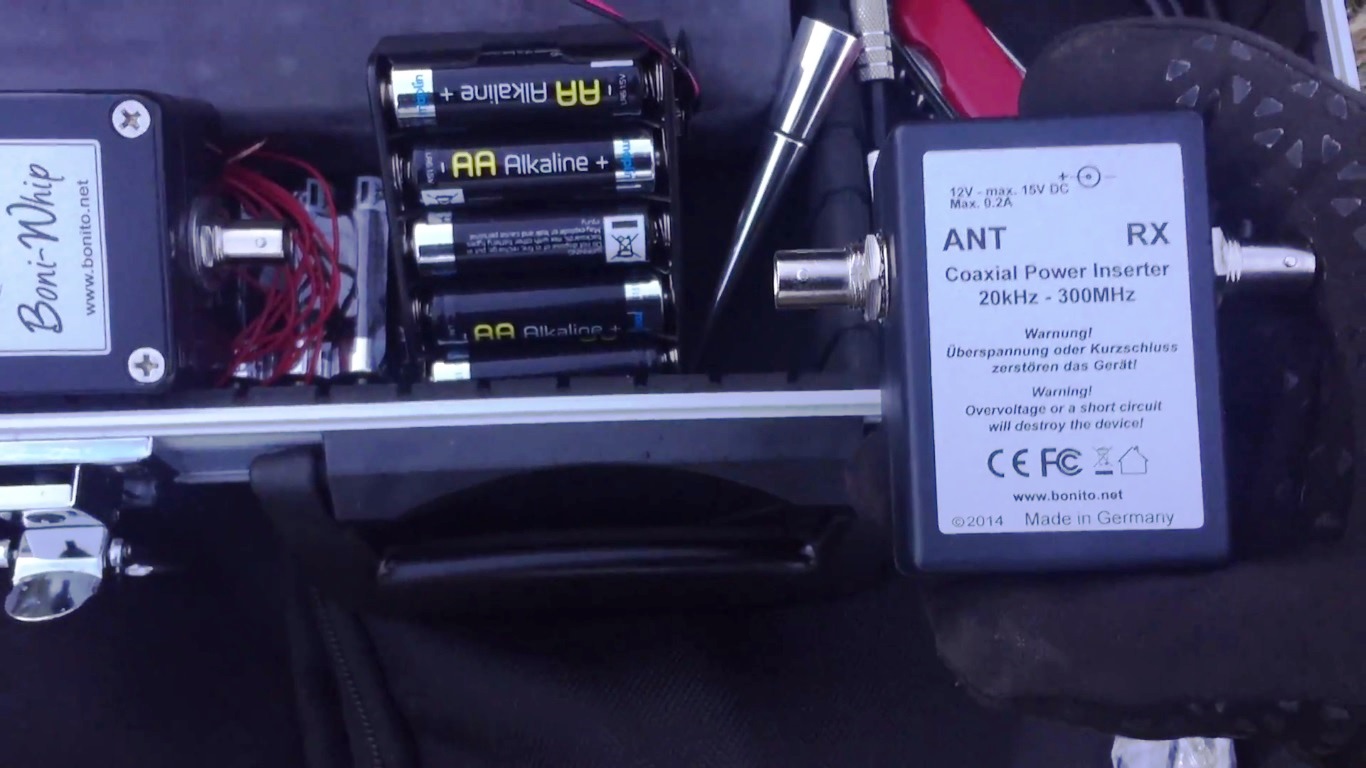
The Bonito Boni whip: proving to be excellent portable antenna for DXing

Hi there, if you’re a subscriber to the Oxford Shortwave Log YouTube channel, you will be aware that I have been using a Wellbrook ALA1530 H field antenna, for 15 months or so, with (at times) excellent results. A while back I was on the lookout for a second antenna, however at more than £250, I couldn’t justify purchasing a second Wellbrook. Ultimately I splashed out on the Bonito Boni whip E-field wideband active antenna (20 kHz to 300 MHz) and with a very compact form-factor suitable for DXpeditions/portable operation in general, the Boni whip definitely ticked all the boxes. Furthermore, with reasonable second and third order intercept points of +55 and +32.5 dBm respectively, the Boni whip, on paper at least, looked like a pretty good buy at around £100.


Initial testing at home confirmed, perhaps not surprisingly that the Boni whip could not match the SNR provided by the Wellbrook ALA1530 in a noisy, urban environment. However, less predictably, the Boni whip has proven to be a truly excellent antenna away from the ubiquitous blanket of ‘electrosmog’ at my QTH. Furthermore, it really is so compact, I simply leave it in the car in a small flight case, with a portable and connectors etc. for ad-hoc listening sessions. Since returning from my most recent trip to Brazil, I have had a chance to review my most recent catches with the Boni whip, some of which are realy pleasing and most definitely underline the excellent performance of this diminutive antenna. In particular, signals from Radio RB2  on 11935 kHz and Radio Aparecida on 11855 kHz, both low power Brazilian stations, are testament to how sensitive the Boni whip is in an electrically quiet environment. Check out also the quality of longwave signals from Poland and the  Czech Republic – simply amazing for such a physically short antenna. Finally, there’s a personal first from Lusaka, Zambia, Voice of Hope Africa on 13680 kHz. All the more rewarding that this was actually copied in my work office!

I hope you found this article interesting. There are embedded reception videos below and text links for all, which will take you directly to the relevant video on the Oxford Shortwave Log YouTube channel. Thank you for reading/watching/listening and I wish you all excellent DX!


Click here to watch on YouTube

Click here to watch on YouTube

Click here to watch on YouTube

Click here to watch on YouTube

Click here to watch on YouTube

Click here to watch on YouTube

Click here to watch on YouTube

Click here to watch on YouTube


Clint Gouveia is the author of this post and a regular contributor to the SWLing Post. Clint actively publishes videos of his shortwave radio excursions on his YouTube channel: Oxford Shortwave Log. Clint is based in Oxfordshire, England.

30 Year Flashback: From the April 1st Edition of the Cascade Mtn. DX Club Bulletin

Among SWLing Post readers, I’m sure there are others like myself who, decades ago, listened to the Zzzt…Zzzt…Zzzt! sound of a dot-matrix printer as it spit out copy for “pasting up” a DX club bulletin. In the 1980s I was one of those enterprising DXers, taking over publication of the Cascade Mountain DX Club (CMDXC) when a local hobbyist lost interest in producing it.

For a few years I found that creating a regular bulletin was almost as satisfying as DXing itself, and I went on to publish another local bulletin, DX/Northwest. It was a forum for DXers in the Pacific Northwest USA to share loggings and information. I also hosted occasional gatherings of Seattle area DXers who were members of the club.

I recently came across my collection of all the past bulletins and appropriately found the April 1, 1987 edition of the CMDXC. I had completely forgotten I’d made an effort every April 1st to “spice up” the bulletin content with some April Foolery.

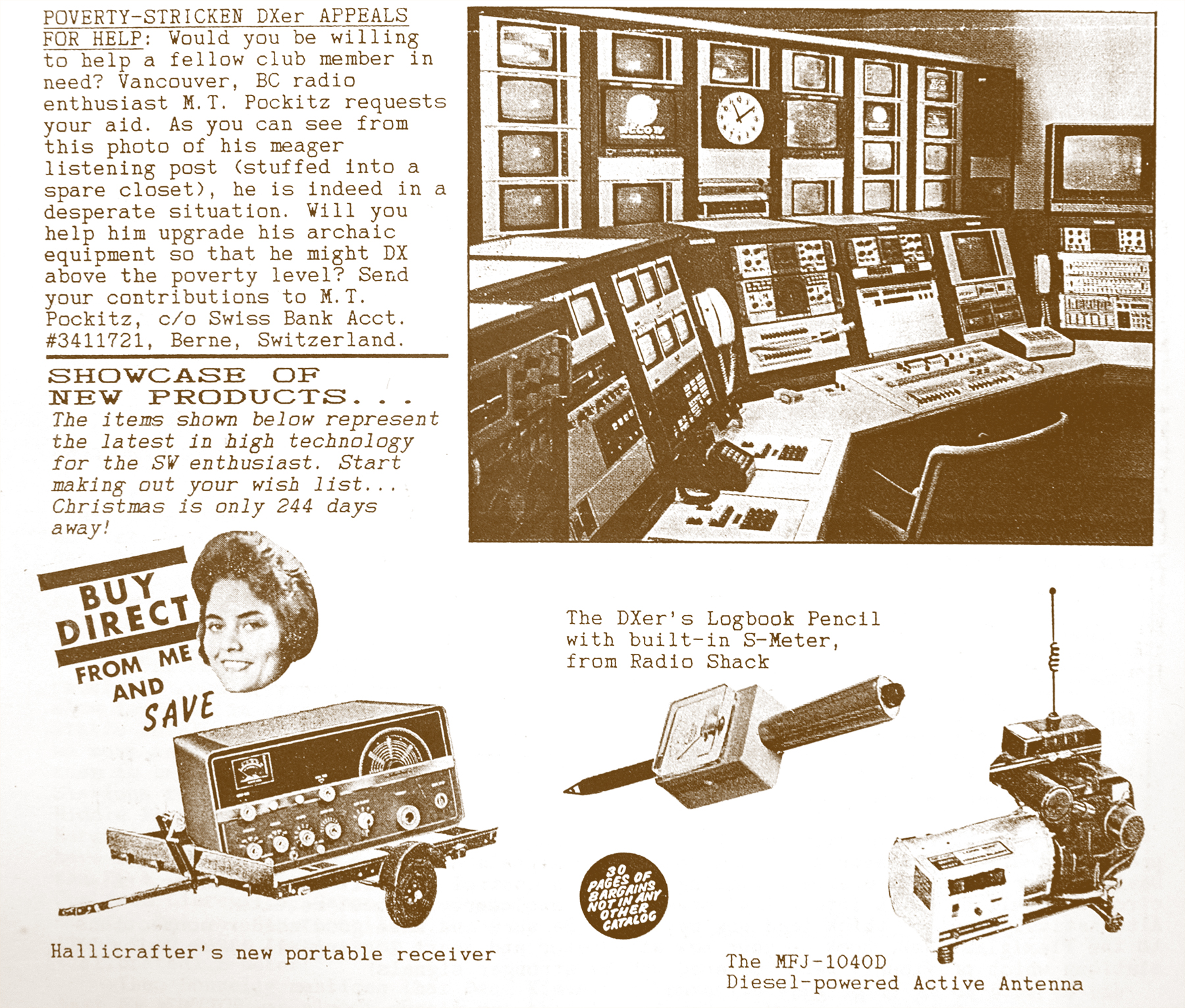
The first item was slipped into the midst of the monthly loggings, just to make sure readers were paying attention:

The fictitious DXer named “Grobe” in the spoof logging was a thinly veiled reference to radio hobby publisher Bob Grove of Grove Enterprises and Monitoring Times magazine. He actually wrote to me after the initial April 1st edition, beginning a running joke of humorous responses to my April Fool’s bulletin content, and always signing his letters “Bob Grobe”. I received similar letters from him after each year’s April edition. I don’t recall Bob ever being a member of the CMDXC, so I’m not sure how he knew of the content. I still have one or more of those letters stashed away somewhere.

Perusing the April 1st, 1987 bulletin again, I note that I was feeling charitable towards a certain down-on-his-luck DXer “M.T. Pockitz” from nearby Vancouver, BC Canada, and wanted other club members to help him in his time of need. I was also in close touch with new developments in radio technology, as I am today:

Who else remembers the old DX club bulletins–from the dot-matrix printer era–with fondness? You may even be senior enough to feel nostalgic over the “ditto machine” or Mimeograph produced publications!

To read more humor that only a DXer could love, I highly recommend Don Moore’s excellent web site BLANDX – Historical DX Humor. This site is the web archive of the classic BLANDX parody bulletins. I was an occasional contributor, and on the receiving end of Don’s wonderfully warped funny bone at times. If you can’t laugh at the BLANDX content, watch out–your WPE Callsign might have expired!

Guy Atkins is a Sr. Graphic Designer for T-Mobile and lives near Seattle, Washington.  He’s a regular contributor to the SWLing Post.

An EDC Bag for the Classic Sony ICF-SW100 Receiver

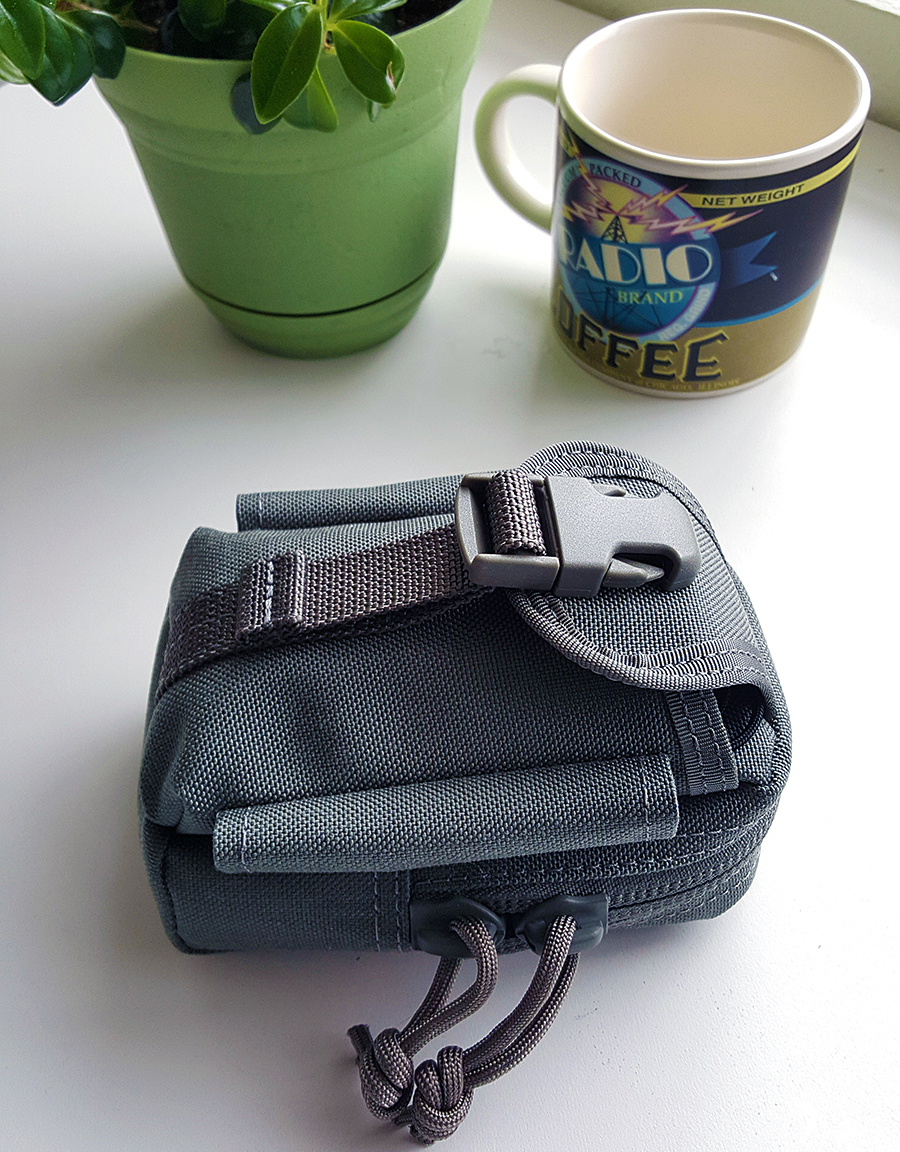
In a 2014 article, this site’s administrator Thomas Witherspoon introduced readers to the CIA’s Survival Kit which is housed in a superbly sturdy waistpack, the Maxpedition M-2. Thomas observed that the M-2 pouch is perfectly suited to holding the diminutive Sony ICF-SW100 receiver.

I was intrigued by that possibility, but only recently tried to combine the two after I resurrected another ICF-SW100 that fell silent to the chronic broken ribbon cable problem. Indeed, the radio is a perfect fit and the M-2 is impressively solid and well designed. I was not aware of the Maxpedition firm prior to learning of the M-2 bag, but I see in various forums they are a major player in well-made gear for the survivalist and outdoor enthusiast crowds. The M-2 is a very popular item, and one or more of the four available colors are sometimes out of stock at the manufacturer. Fortunately there are many sellers on Amazon and Ebay who have these waistpacks available.

What is EDC you may ask? It refers to “Every Day Carry”, the essentials that an individual deems necessary for their lifestyle or a particular activity. For me, an EDC bag is taken along on hikes or other outings to the countryside and typically contains a compact shortwave radio and related accessories. It’s always fun to stop for lunch or a break in a remote location and be able to search for interesting stations whenever the mood strikes.

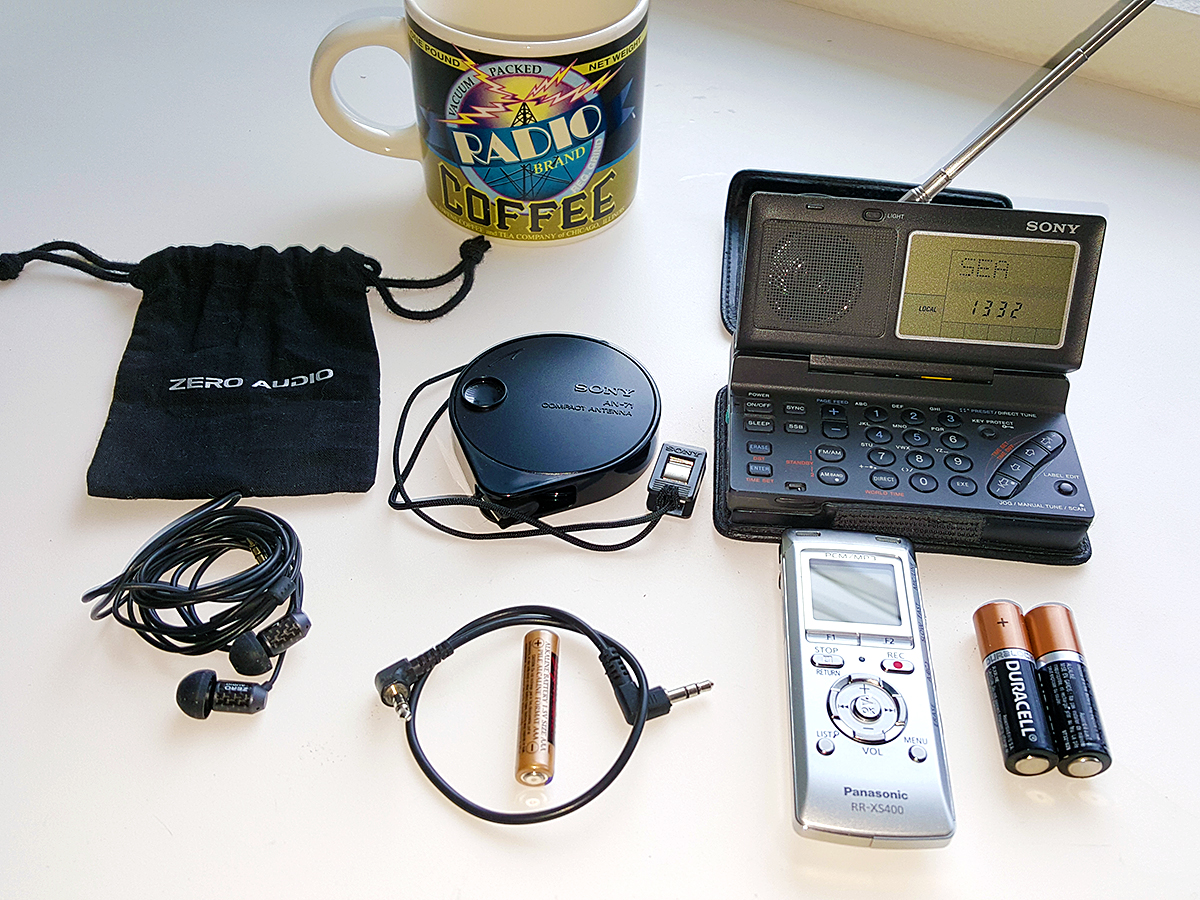
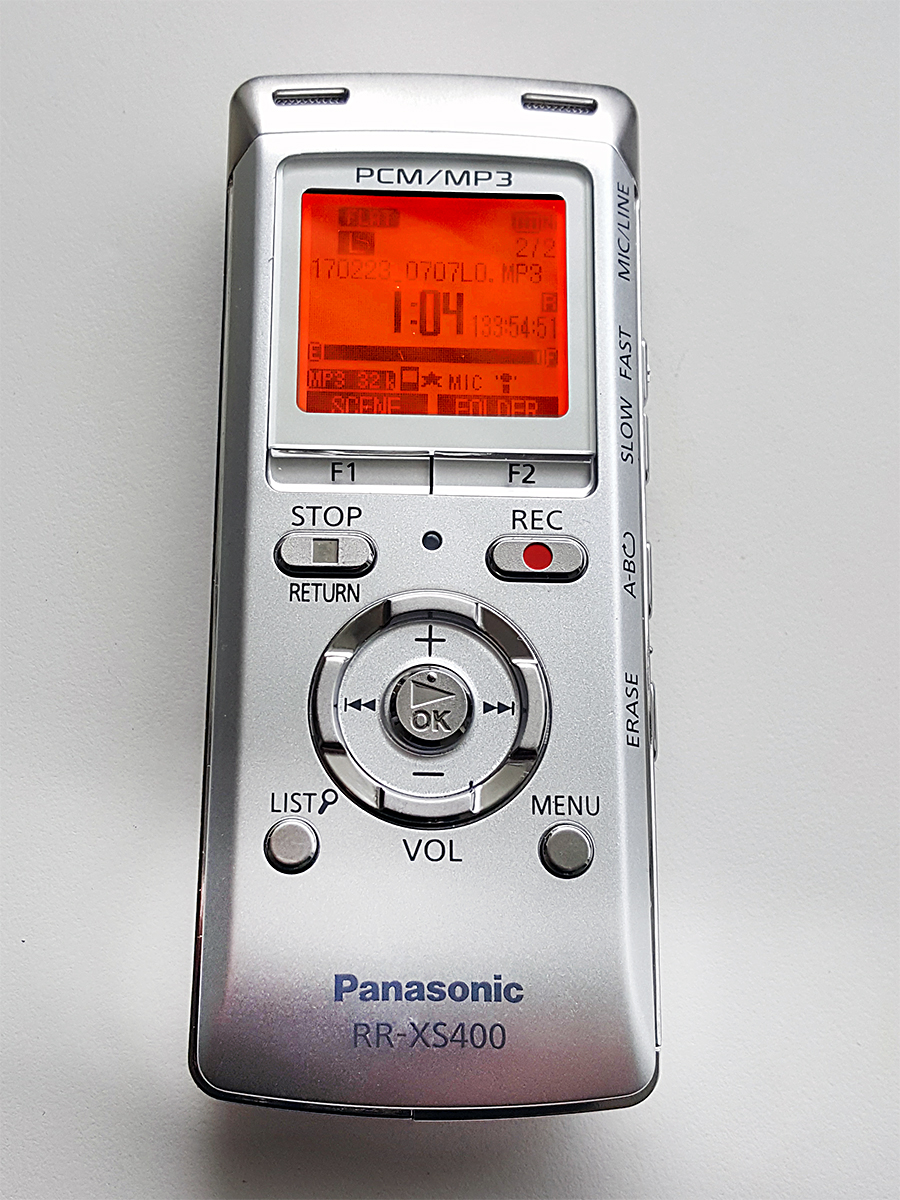
This photo shows what I’m able to carry in the Maxpedition M-2 bag; a coffee mug is shown for size comparison. Contents of the “kit” include:

  • The Sony ICF-SW100 receiver
  • Zero Audio Carbo Tenore In-Ear Monitors & soft pouch
  • Sony AN-71 reel-up antenna
  • Panasonic RR-XS400 Digital Voice Recorder
  • Short 3.5mm male-to-male stereo audio patch cable
  • Two extra AA batteries for the Sony receiver
  • An extra AAA battery for the Panasonic Digital Voice Recorder

A few comments on the contents. The Zero Audio Carbo Tenore In-Ear Monitors (IEMs) provide excellent audio quality for their price. They are among a handful of IEMs regularly recommended by budget-minded audiophiles on the popular Head-fi.org site. I like these IEMs not only for the audio quality, but also their small size (in the cloth bag) which barely fits into the M-2’s main compartment along with the ICF-SW100. Larger earbuds or IEMs might not fit the M-2 without being mangled by the hefty YKK zippers. One caution: the similar Carbo Basso model by Zero Audio is deemed by many to be overly heavy on the bass frequencies. I find the Carbo Tenore to be more than sufficient for bass heavy genres like Electronica.

The Panasonic RR-XS400 digital voice recorder has been out of production a few years, but is a highly capable and compact recorder. It contains a hidden USB plug for charging and data transfer, has a fully featured and backlit LCD display, built-in stereo microphones, switchable LINE/MIC inputs, and other useful features. In excellent used condition the RR-XS400 is worth about $50 USD in 2017, despite some Amazon sellers trying to move them at the original $280 price.

The extra AAA battery for the recorder slips into the front pouch of the M-2 bag along with the Sony AN-71 antenna. The additional AA batteries for the radio, however, are held in the two “pen loops” on the left and right of the M-2. Despite these loops being open-bottomed tubes, the fit is tight enough to hold the batteries securely.

Like every portion of the Maxpedition M-2 bag, the belt loop is proportioned perfectly and sewn with precision. With the Sony ICF-SW100 EDC “kit” secured to my belt on a hike, I’m assured of quick access to a DXing opportunity, such as when hiking the Naches Loop Trail near beautiful Mt. Rainier:

Guy Atkins is a Sr. Graphic Designer for T-Mobile and lives near Seattle, Washington.  He’s a regular contributor to the SWLing Post.

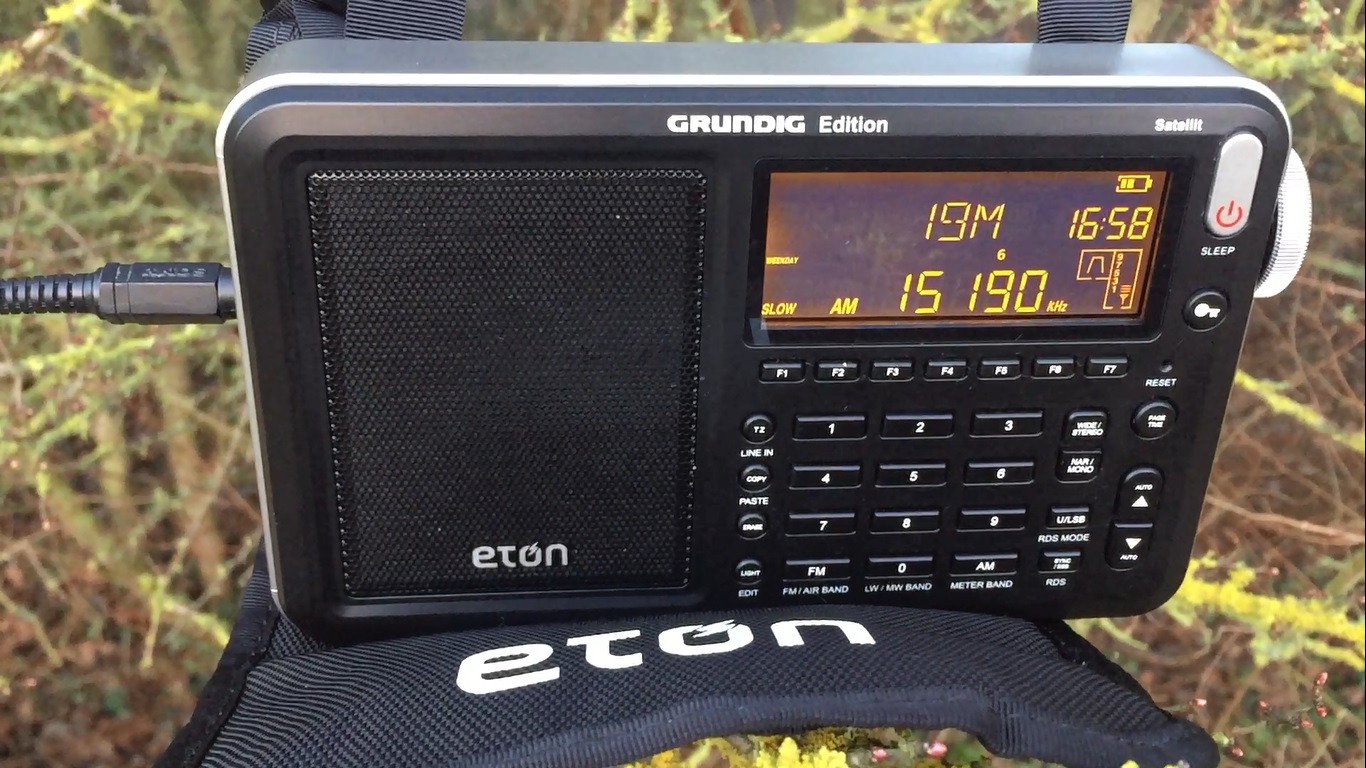
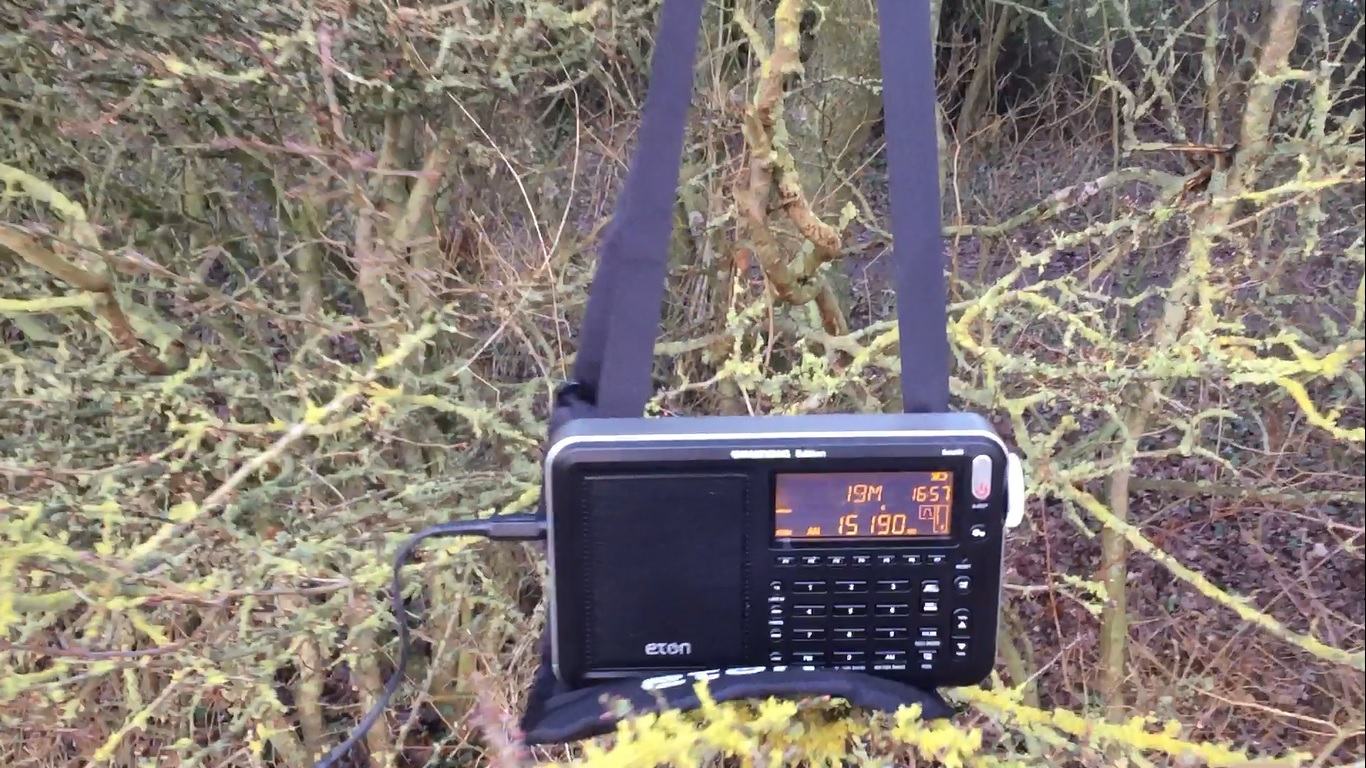
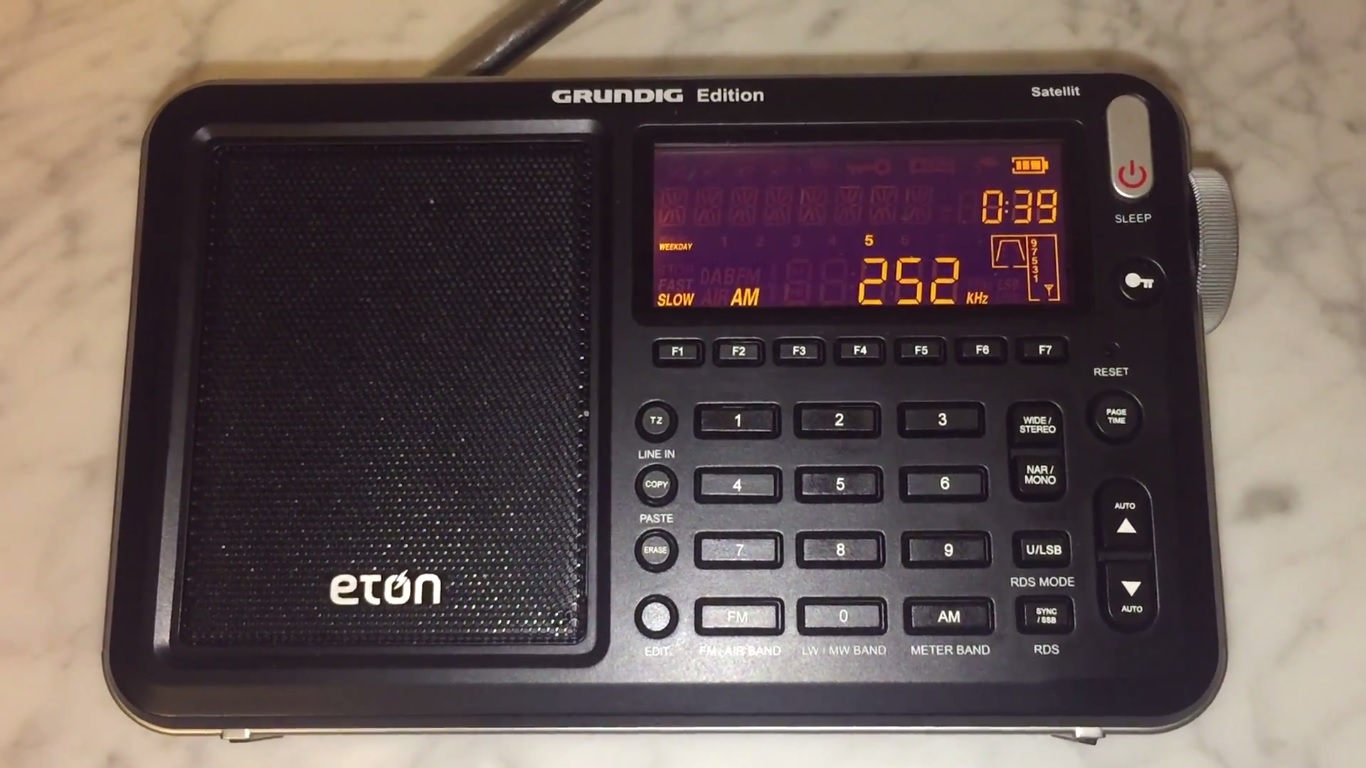
The Eton Satellit: my thoughts after 3 weeks of DXing and some recent catches…

Hi there, it’s been about three weeks now since I started DXing with the Eton Satellit and I thought it time to post an updated review, based on my experiences thus far, along with some recent catches. Noting that other radio hobbyists with a strong presence online have been posting neutral to negative reviews on this receiver, I would just like to point out, perhaps rather obviously, that no receiver is perfect and just as importantly, the criteria on which a portable radio is judged will be different from user to user, based on their listening habits. I am almost exclusively engaged in DXing with the Satellit, whilst others will be listening on the broadcast bands on a more casual basis. I know that for some, the ultimate quality and finish of a product is as important as performance and they would make their physical assessment in a very detailed manner. I on the other hand focus mainly on performance and as regards quality, I’m reasonably satisfied if it doesn’t fall apart in my hands, straight out of the box! That actually happened – and it’s sort of where I draw the line 🙂 I guess the point is, I try to respect everyone’s opinion, irrespective as to whether we are in agreement or not and I believe that’s healthy for the future of our hobby.

Ok, back to the Satellit. Firstly, I am able to confirm that in terms of ultimate sensitivity, this portable is very close to my Sony ICF-2001D – one of the most highly regarded portables ever made. The delta in performance between the two is most perceptible on the weakest of fading signals that intermittently deliver audio with the Sony, but can’t be heard on the Eton. On stronger signals, my experience is that either radio might provide the strongest and or highest fidelity audio. I have a series of comparison videos already in the can, which will be uploaded to the Oxford Shortwave Log YouTube channel soon.

In terms of selectivity, the digital bandwidth filters work very well, although I note that even on the narrowest setting (2 kHz) when operating in a crowded band, adjacent channel QRM can occasionally still sound quite pronounced, as compared to my Sony ICF-SW55 or ICF-2001D receivers. As regards synchronous detection, this is more of a hit-and-miss affair. Subscribers to my channel might notice that in nearly all of my reception videos featuring the Eton Satellit, I have not engaged the SYNC. That isn’t to say it doesn’t work, however, even with selectable sidebands, the SYNC mode often appears to increase the overall signal amplitude and noise floor, without positively influencing the SNR. However, it’s interesting to note that signals on the Satellit in AM mode often almost match the ICF-2001D in SYNC mode, in terms of overall SNR. More on that to come.

There are a number of ways to tune the radio; manually using the tuning knob (and this has a decent feel/ resistance to it), direct frequency input which requires pressing the ‘AM’ button to engage, automatic search and access to 700 memory locations, via 100 screen pages. In the real world – and by that I mean ‘my world’ which is most often in the middle of a field, or the woods, all of the above tuning options are as ergonomic as most of my other portables. With regard to SSB reception, there are fast, slow and fine tuning options with a maximum resolution of 10 Hz and this works very well to reproduce natural sounding speech in LSB and USB modes. The tuning speed/fine options are engaged by pressing the tuning knob inwards towards the set – quite a neat idea. With SSB and SYNC there’s always a little pause whilst the electronics engage – a set of chevrons appear on the screen to indicate the receiver is actually doing something. It’s similar to the Sony ICF-SW77 where you effectively toggle between SYNC USB and LSB and wait for lock. Not an issue for me, but it might annoy some, particularly those who have experience with the ICF-2001D, where SYNC engagement is instantaneous, if the signal is of sufficient strength. A small point, but worth making.


So, overall, a brilliant little radio that in my opinion is completely worthy of the ‘Satellit’ branding, at least in terms of ultimate performance. As I mentioned previously, one of the most experienced DXers I know, with more than 3 decades of listening to the HF bands and an owner of a number of vintage Satellit receivers noted that the Eton Satellit outperformed them – and by some margin. To further demonstrate this, I have included links to recent reception videos. In particular, I copied three of the regional AIR stations with signal strength and clarity that had never previously been obtained. I also copied HM01, the Cuban Numbers Station for the first time on the 11 metre broadcast band, Sudan and Guinea on the 31 metre broadcast band (a whopping signal from Guinea) and Polski Radio 1 on longwave. I hope you find them interesting. Since featuring the Satellit on my channel, one of two of my subscribers have purchased this radio and thus far have been very happy indeed with it’s performance.

Ultimately, I have to strongly recommend this portable to anyone interested in DXing and in particular those that embark on DXpeditions. I just hope that should you decide to buy one, you receive an example that performs was well as mine. Embedded reception videos and text links follow below, In the mean time and until my next post, I wish you all great DX!


Click here to watch on YouTube

Click here to view on YouTube

Click here to view on YouTube

Click here to view on YouTube

Click here to view on YouTube

Click here to view on YouTube

Click here to view on YouTube

Click here to view on YouTube

Clint Gouveia is the author of this post and a regular contributor to the SWLing Post. Clint actively publishes videos of his shortwave radio excursions on his YouTube channel: Oxford Shortwave Log. Clint is based in Oxfordshire, England.

A quick view of my shack in Oxford, UK & recent transatlantic medium wave DX

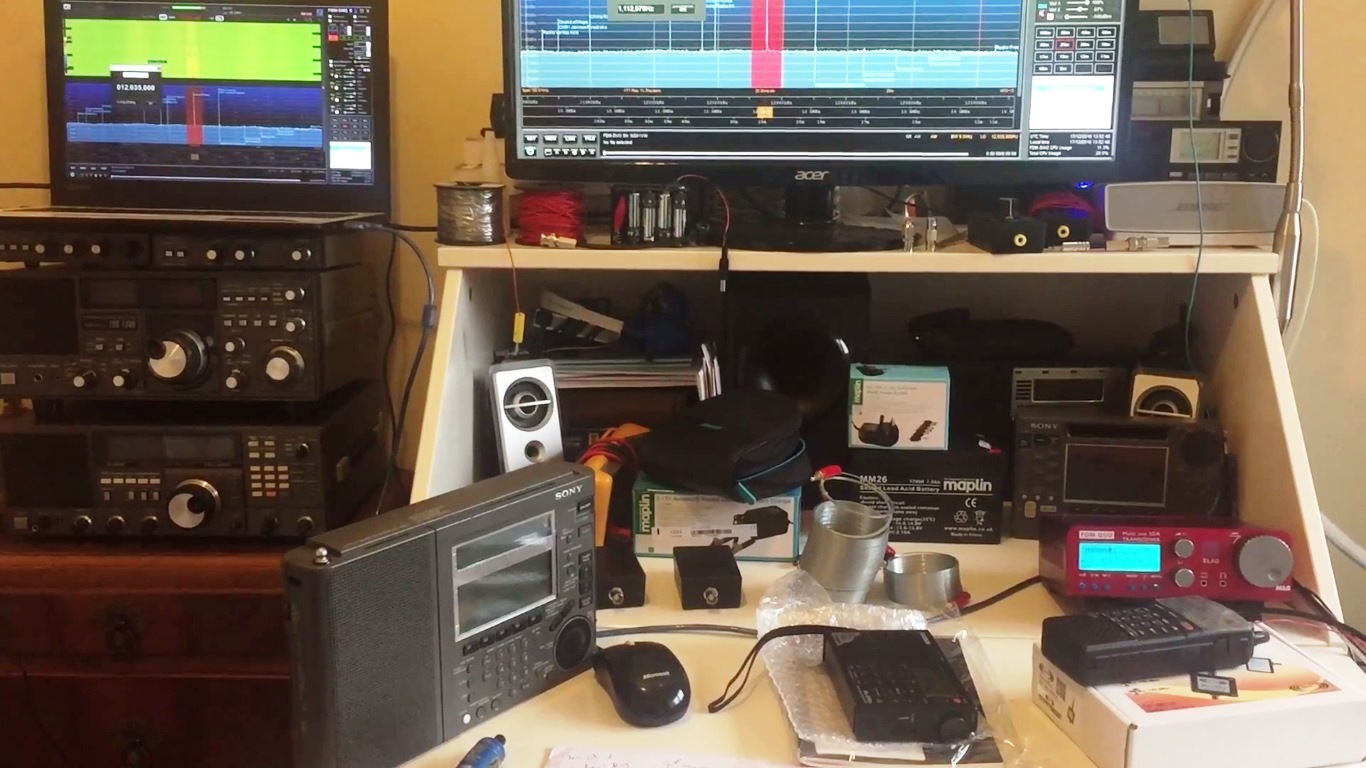
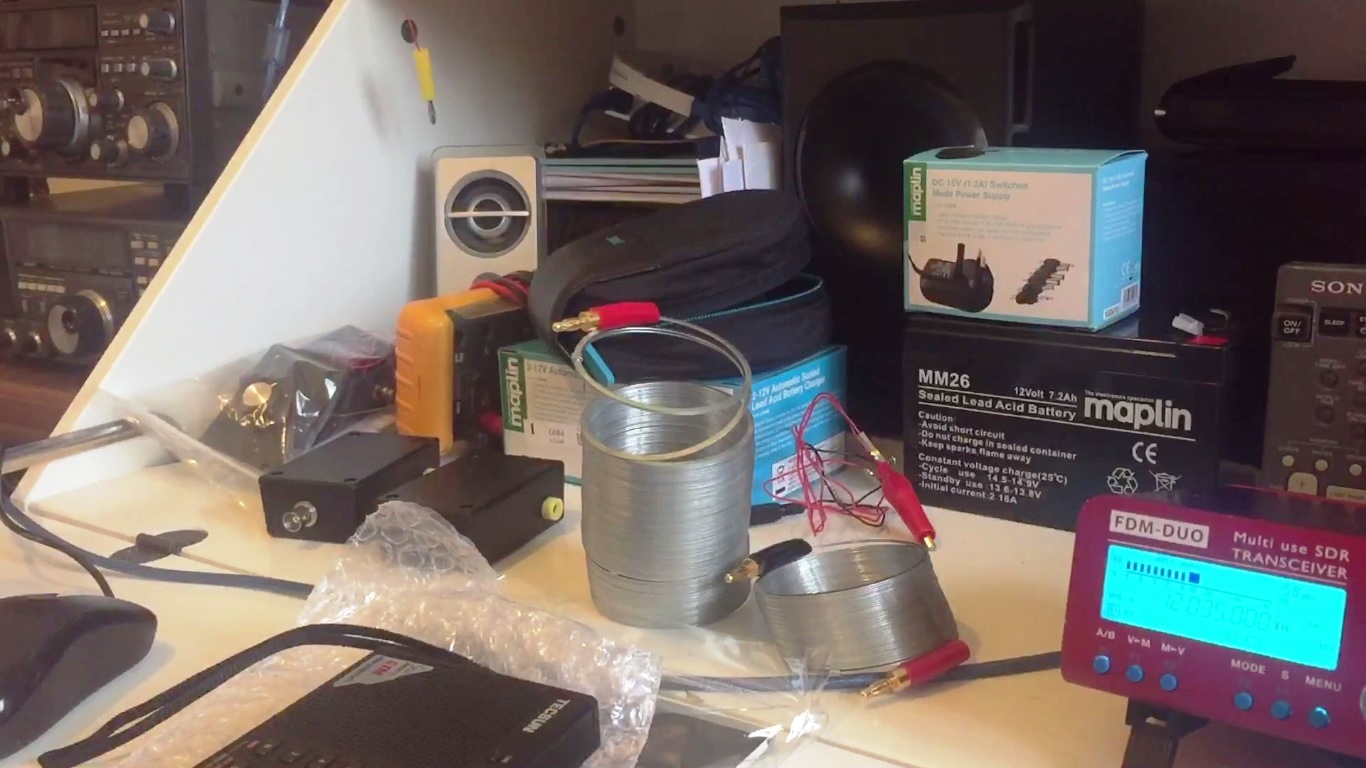
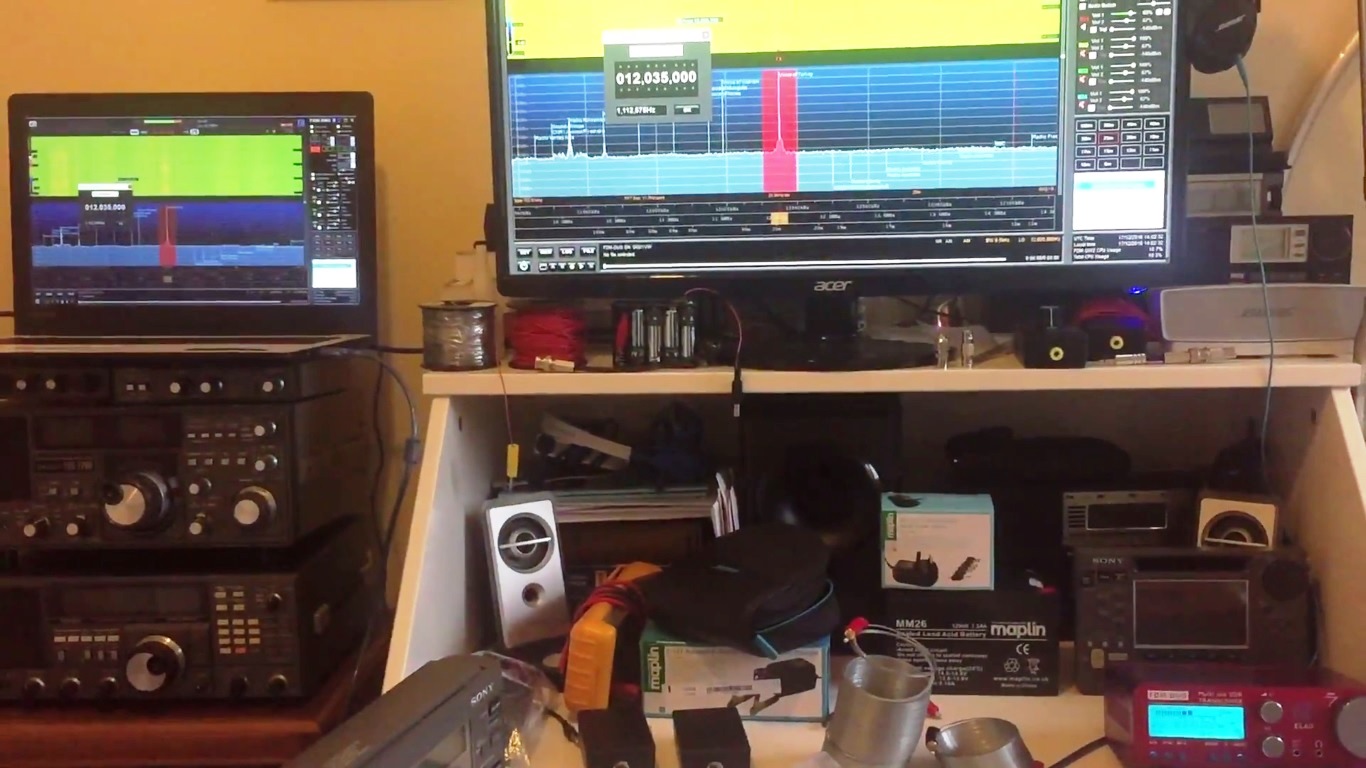
Someone recently described my shack in Oxford as ‘an impressive mess’…. and that really is just about the most positive comment I’ve ever received regarding my listening post! So, my apologies for displaying the mess in public, but in response to having been asked many times by subscribers to Oxford Shortwave Log to ‘share my shack’, here it is, well most of it at least, in all it’s unadulterated glory.


The primary reason however for this post is to share my most recent transatlantic medium wave catches using the brilliant Elad FDM DUO and Wellbrook ALA1530 magnetic loop antenna. This excellent combination continues to pull in really nice DX, although not so much very recently as propagation has been fairly rubbish. However, since early to mid December, the dynamic duo have managed to pull in a number of transatlantic medium wave signals, including Radio Rebelde, Cuba on (670 and 710 kHz), KVNS Texas, CHIN Radio, Toronto, WFED Washington DC, WWNN Health and Wealth Radio, Pompano Beach, Florida, and huge signals from WMEX Boston and WWKB Buffalo, New York. Embedded reception videos and text links follow below and in the mean time, I wish you all great DX!


Click to watch on YouTube

Click to watch on YouTube

Click to watch on YouTube

Click to watch on YouTube

Click to watch on YouTube

Click to watch on YouTube

Click to watch on YouTube

Click to watch on YouTube


Clint Gouveia is the author of this post and a regular contributor to the SWLing Post. Clint actively publishes videos of his shortwave radio excursions on his YouTube channel: Oxford Shortwave Log. Clint is based in Oxfordshire, England.


Video: Ivan’s Airborne TV DX catches

Many thanks to SWLing Post contributor, Ivan Cholakov (NO2CW), who writes:

A while back I shared a short story about FM reception from commercial jetliners. I do that regularly on my flights but I also gave “Airborne TV DX” a try.

My equipment is as follows:

  1. Windows laptop
  2. Hauppauge USB dongle receiver WinTV-HVR-955Q
  3. 3-inch stick antenna

The receiver comes with its own WinTV software for tuning, scanning, watching and recording TV programs. It is one of the few USB dongle size receivers for North America’s ATSC digital TV standard. A have posted a video of my reception recordings from a roundtrip flight Miami to St Louis.

The video is located here:

Click here to view on YouTube.

My notes regarding this activity:

Reception from commercial airplanes is possible as far as 400 miles with the simple unobtrusive “stick” antenna.

Channel scanning is pretty slow and it is possible that by the time you detect a signal, save it, and tune to it you are 50 miles away from the point where you detected it.

Many times signals are detected but no video can be shown due to weak signal. Users in Europe may have a different experience as the availability of DVB-T USB dongles and software is much wider.

TV DX can make a coast to coast flight a much more interesting experience!

No doubt, Ivan! Thanks so much for sharing.

Ivan is quiet adept at logging and recording FM and TV DX while in the air and at sea. Click here to view his previous posts.