Category Archives: Portable Radio

What Would YOU Pay for a New, Sealed Box Sony ICF-2010?

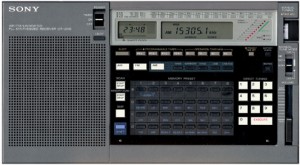
Every radio enthusiast knows that the Sony ICF-2010/2001D was a desirable, high performing portable receiver throughout its long production history. Manufactured from 1985 through 2003, few receivers were as consistently high on DXers’ “must have” list as the ICF-2010.sony2010

These Sony portables still command high prices on the used market, but what would you pay for a brand new, still in the sealed factory carton ICF-2010? Well, someone just won the high bid on this new, unopened 2010 for the princely sum of $982.00 USD plus shipping:

http://www.ebay.com/itm/SONY-ICF-2010-RECEIVER-BRAND-NEW-STILL-IN-FACTORY-SEALED-BOX-/111948598883

What’s your opinion? Outrageous, foolhardy purchase or a savvy investment for the future? Please comment below with your thoughts.

Guy Atkins is a Sr. Graphic Designer for T-Mobile and lives near Seattle, Washington.  He’s a regular contributor to the SWLing Post.

London Shortwave says farewell to Radio Belarus

london shortwave belarus

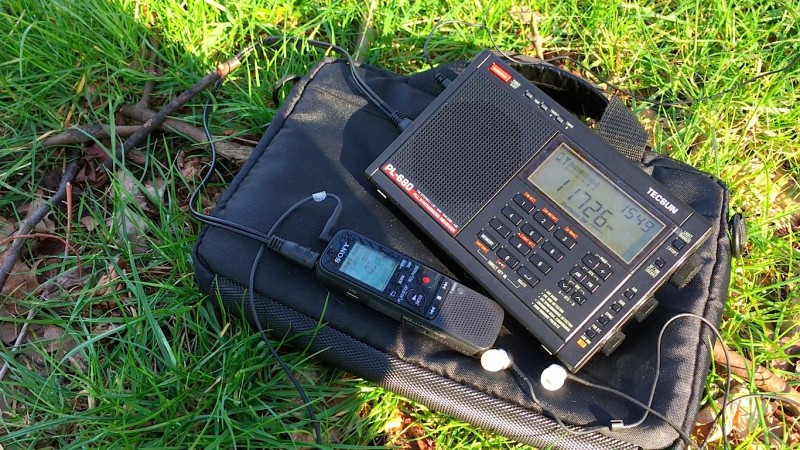
SWLing Post contributor, London Shortwave, hit his local park today with his Tecsun PL-680 and Zoom H1 in tow, then recorded the final broadcasts of Radio Belarus. He has published a post on his blog with details and two recordings of Radio Belarus.

Click here to read his post.

Many thanks to London Shortwave for also going out of his way to post both recordings on the Shortwave Radio Audio Archive! If you have a recording of Radio Belarus, we can add it as well.

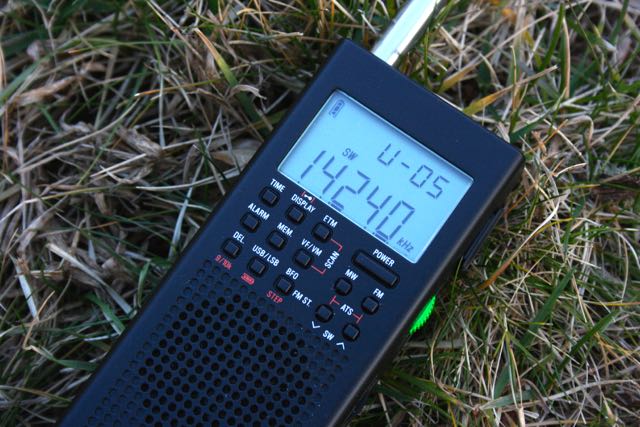
The CountyComm GP5/SSB: my go-to shortwave radio for hiking

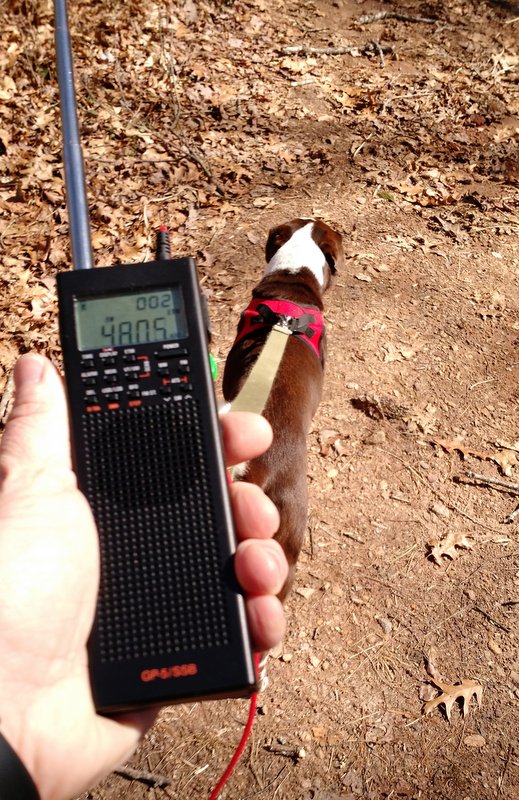
CountyComm GP5/SSB while hiking

My two hiking companions: the CountyComm GP5/SSB and Hazel the dog.

Posting the Blinq deal a few moments ago reminded me that my favorite shortwave radio to use while hiking/walking is the CountyComm GP5/SSB.

I have CountyComm’s custom GP5 case which I clip to my belt or backpack. While hiking, I find it handy to open the case from the top, pull the radio out and operate/tune it with only one hand. Indeed, the vertical form factor of the GP5/SSB is ergonomically-ideal; I can control almost all of the radio functions without having to use two hands. A huge bonus while hiking on uneven terrain!

Typically, when I start a hike, I enable an EMT scan and within a minute or so, the GP5/SSB populates temporary memory positions with all of the signals it can easily receive. When you’re in the middle of the woods–far from sources of radio interference–you’ll be amazed by what you can hear.

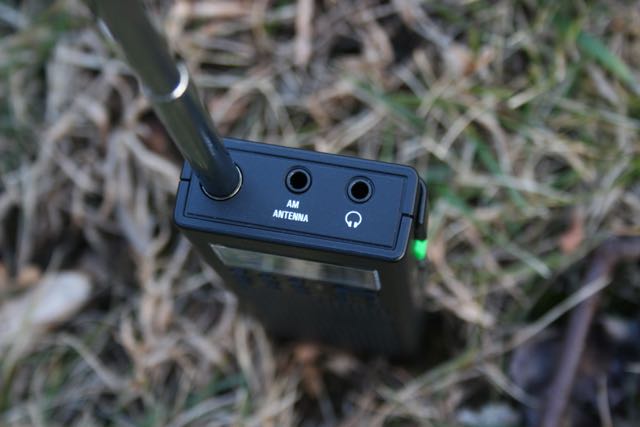
GP5SSB-Top

Of course, with the antenna fully extended, one does have to watch out for low-hanging branches, etc.

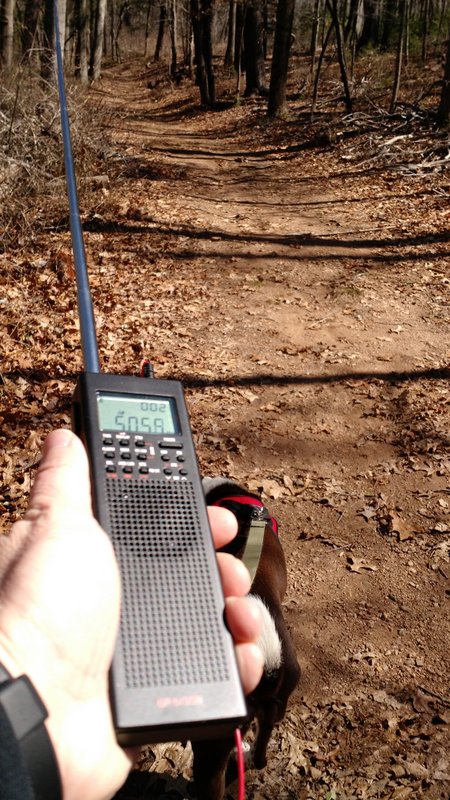
CountyComm GP5/SSB while hiking

Since the telescoping antenna doesn’t swivel, it’s much easier to hold the radio in a way that the antenna points forward while you hike (bonus: it’ll catch all of the spider webs across the trail before your face does!).

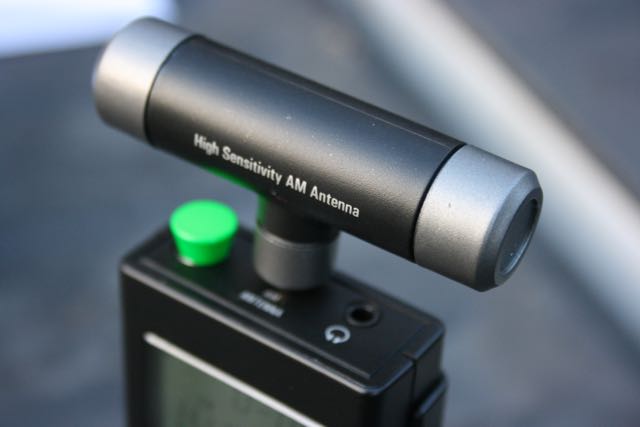
GP5SSB-MW-Antenna

So far, I’ve never used the external mediumwave ferrite bar antenna while hiking–I worry that I could drop the radio and damage either the antenna or the 1/8″ antenna jack.

I typically listen to the GP5 with headphones unless I’m walking a trail during the time of year when black bears are active (in which case the speaker helps alert bears that I’m in the neighborhood).

GP5SSB-Front

Of course, there are a few other radio models with an identical vertical form-factor–most notably, the:

If you’re not familiar with the CountyComm GP5/SSB, click here to read previous posts. I also featured the CountyComm GP5/DSP (Tecsun PL-360) in an ultra portable shoot out in 2014–click here to read.

Do you have a favorite shortwave portable for hiking, biking or cycling? Please comment!

Guest Post: Jerry’s Mediumwave DXing Powerhouse Mini FSL Antenna

Many thanks to SWLing Post contributor, Jerry Popiel, for the following guest post:


PowerhouseFSLAntenna-1

A MW DXing Powerhouse Mini FSL Antenna

by Jerry Popiel

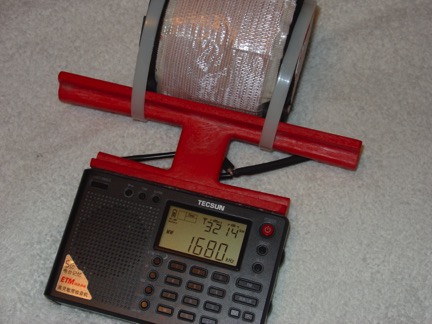
In late February 2016 I completed construction of a modified version of Gary DeBock’s excellent 3 inch Mini FSL design (click here to view).

This new antenna is nothing short of a AM DXing powerhouse with unbelievable sensitivity for receiving stations across the entire AM Bandwidth both day and night. The tuning of stations is razor sharp and it has stunning nulling qualities. Consultation assistance was provided from DXing experts Steve Ratzlaff and Gary DeBock on the project.

Construction Details:

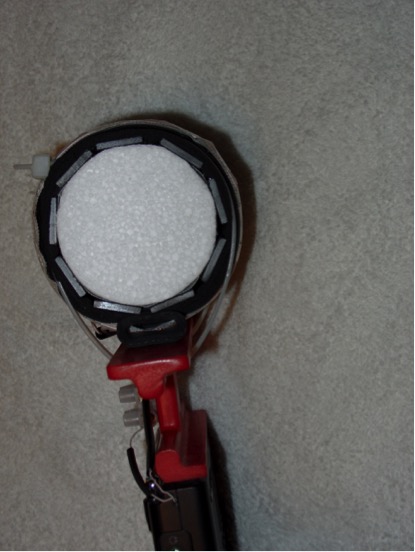
The Antenna was constructed using 9 – 100 mm Ferrite Bars wound on a 2.75 inch diameter x 4 inch styrofoam cake dummy form custom made by in Vancouver, B.C. Canada – ([email protected]) for $3.50 plus shipping.

The Coil wire consisted of 38 turns of high gain 660/46 Litz Wire. (Note: As can be seen 38 turns of the thicker Litz Wire left only 5/8” of room on each side of the Styrofoam Form to wire wrap the coil to the ruler frame. A longer Form ie 5” long would work much better for this build).

The insulation spacer used was 2 layers of 1/8 inch Aerotape self adhesive tape which also helped hold the 100 mm Ferrite Bars onto the Styrofoam Coil Form. Inductance measured 356 uH using a DM 4070 Meter which is well within the requirement of over 300 uH for AM Band Reception.

Side View Of 9-Bar FSL Antenna with 2.75” Diameter Styrofoam Cake Dummy.

Side View Of 9-Bar FSL Antenna with 2.75” Diameter Styrofoam Cake Dummy.

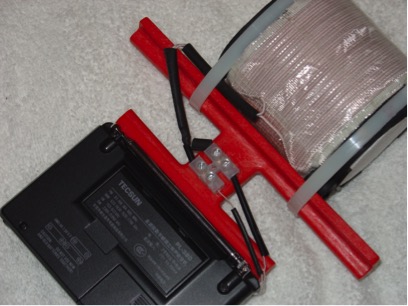
Because of the extra thickness of high gain 660/46 Litz Wire which is a bit too big to solder to the inside terminals of the Tecsun PL-380 Radio, a 2 Position Terminal Block was superglued to the outside of the Ruler Frame to act as an interface connection point.

Position Terminal Block Superglued To Back Of Antenna Frame

2 Position Terminal Block Superglued To Back Of Antenna Frame

Testing Results:

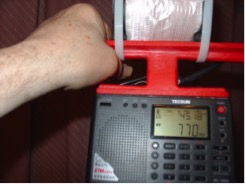
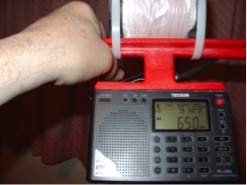
Both daytime and evening AM station captures have been spectacular. Stations as far away as KKOB / 770 kHz Alberquerque, New Mexico 1130 Miles from here in Winnipeg, Manitoba, Canada have been received. Country music station WSM / 650 kHz in Nashville, Tennessee 1082 miles distant is a daily evening pickup.

Station KKOB / 770 kHz Alberquerque, New Mexico 1130 Miles distance.

Station KKOB / 770 kHz Alberquerque, New Mexico 1130 Miles distance.

Station WSM / 650 kHz in Nashville, Tennessee 1082 miles distance.

Station WSM / 650 kHz in Nashville, Tennessee 1082 miles distance.

Two Stations Received At 600 kHz 90 Degrees apart at the same time:

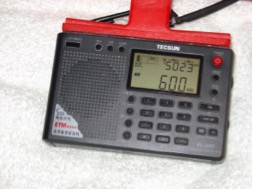
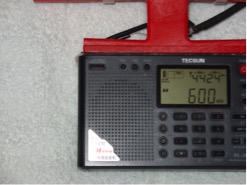
The amazing Nulling and Razor Sharp Tuning quality of this FSL was demonstrated when 2 stations at 600 kHz were received at the same time by rotating the Radio with attached FSL 90 degrees. In the North / South direction Station KSJB / Jamestown, North Dakota (219 miles distant) was received with a strong signal strength of 50 / 23. Then by rotating the Radio 90 degrees to the East / West direction Saskatoon, Saskatchewan station CJWW (442 miles distance) was captured with a similar strong signal strength of 44 / 24.

600 kHz Station KSJB / Jamestown, North Dakota.

600 kHz Station KSJB / Jamestown, North Dakota.

600 kHz Station CJWW / Saskatoon, Saskatchewan.

600 kHz Station CJWW / Saskatoon, Saskatchewan.

Daytime Reception of 600 Watt Station 137 Miles Distant:

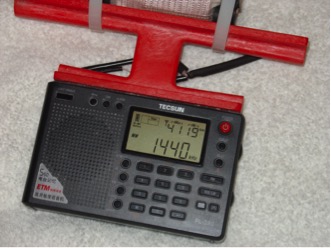
A major daily AM reception capture during the afternoon illustrating the amazing sensitivity of this antenna is 600 Watt station KKXL Sports Radio 1440 kHz (137 miles).

PowerhouseFSLAntenna-8

All Indoor Reception – For Now!

Due to winter conditions here in Winnipeg, all of the amazing station reception captures in this report were done inside the House facing towards the South window. Fortunately the red ruler platform sides can he used as handles when pointing the radio in the direction of best reception. Exciting times are ahead to see how well this mini 3” FSL will perform outdoors for likely even better AM DXing.

Summarizing:

The design of this new FSL Antenna attached to the Tecsun PL-380 Ultralite radio by Gary DeBock is a major breakthrough in AM DXing since the Radio is attached to the FSL. This new FSL Antenna needs to be constructed to be really appreciated. The application described here requires a bit more skill to construct and is also heavier than the original construction – but at least it is portable. For beginners Gary’s original 3” FSL Heathkit Design is highly recommended and can be reviewed in his You Tube Video posted at: https://www.youtube.com/watch?v=VY9u8MReGjk

Thanks,
Jerry Popiel
Winnipeg, Manitoba, Canada


Thank you, Jerry! It’s amazing what performance you and Gary DeBock have gotten out of these homebrew FSL antennas! Thank you so much for taking the time to share your construction details and performance notes!

Mark’s Icom IC-7100 go kit

Click to enlarge

Click to enlarge

Many thanks to SWLing Post reader, Mark Hirst, who writes:

Thomas,

I have been very impressed by the shacks featured on SWLing !

I don’t really have the room to accommodate such large collections, or to dedicate a special area to just radio.

I tend to perch a radio on a spare surface in the front bedroom, and then cycle through my small collection on a weekly or bi-weekly basis, returning the previous radio to storage to await its turn in a month’s time.

Since newer houses and gardens are typically quite small in the UK, I’ve always been thinking in terms of radio on safari, so with the weather starting to improve, I present to you my ‘shack’ consisting of a recently acquired IC-7100 inside a fortuitously sized toolbox. The radio runs in the bedroom like this too, usually connected to a Wellbrook loop when not transmitting.

20160312_121757332_iOS (1)

The picture [above is of the] head unit in stowed configuration, as the lid of the box doesn’t quite clear the unit when sitting on the base. The space on top of the radio is then filled by the SOTA Beams antenna bag and other sundries. The battery travels separately in the backpack.

My plan was to never have to connect/disconnect the ethernet style cable between the two halves, looks like the plan worked !

You can see it in action here:

This is a brilliant kit, Mark–a great way to escape urban radio interference! The Icom IC-7100 is uniquely qualified for the deep case, too, since the control head can sit on top of the body while in use. The angle of operation is also ideal. Very cool–thanks for sharing!

Ashok is impressed with the GP5/SSB

GP5SSB-5

Many thanks to SWLing Post reader (and contest winner) Ashok Shankar Das, who writes:

The GP5/SSB receiver I got as prize from your SWLIing Post Virtual Radio Challenge is great. My friends envy the cute Monster 🙂

Well with this radio I am monitoring 40m and 20m HAM bands regularly. Since January till date I have received several stations. Most interesting stations till date are VK6HCF/portable, RW9JZ and EA3JE (from India).

Here’s a screen shot of the log book if you like to see. 🙂

Screenshot from 2016-02-23 23_04_33

This is excellent news, Ashok! Many thanks again to CountyComm who sponsored our Virtual Radio Challenge IV.

I hope to have another sponsored challenge posted within the next month or two. Frankly, I have multiple projects on my table, so free time has been almost non-existent the past few weeks. Indeed, I’m still catching up on a back log of correspondence I received during my travels last month! (I appreciate your patience and understanding!)

Happy listening, Ashok!

Update: Check out Ashok’s radio blog:

http://swldas.blogspot.in/2016/03/my-experience-with-gp-5ssb.html

How Danny removed the sticky residue from his Grundig G6

SWL Travel Gear - Grundig G6Many thanks to SWLing Post reader, Danny Garris (KJ4FH), for the following guest post which originally appeared on his blog, Up In This Brain:


How I cleaned the sticky coating off of my Grundig G6 radio with guidance from KJ4FH

A few weeks ago, I reached out to Danny Garris, KJ4FH, for help on getting the sticky coating off of my Eton E5 radio. I noticed on eBay that he was selling Eton radios with the gunk cleaned off and I was wondering how he did it.

Where does the sticky gunk come from? Well, for some reason the “geniuses” up at Eton/Grundig put a rubberized, chemical coating on a series of radios they released. They looked great new but over time, them coating seems to get adhesive-like properties, almost like it is melting off. It apparently has something to do with humidity and over time it makes everything stick to the radios – dust, dirt, you name it. It’s terribly annoying and just plain nasty. Shame on Eton/Grundig for doing this because a whole generation of good radios are impacted.

This leads me back to Danny and the instructions I have posted below in my Dropbox with his permission.

Click here for Danny’s instructions: 100%Perfected Way To BEST Clean The Sticky Coating Off The Eton E1XM / E1 / E10 /E100 Series Radios

I used rubbing alcohol at first on my Eton E5 based on some back and forth emails I had with Danny and it did remove a ton of the gunk but I also ended up with places in the finish where the paint was removed, as he warned. Still, my concern was getting rid of the gunk more than appearances since my Eton E5 is a radio I use almost daily that I have no intention of selling. In fact, I am keeping an eye on eBay for a spare unit to purchase just in case because the E5(also Grundig G5) is an amazing radio.

Not long after getting his full instructions with oven cleaner as a new ingredient to try, I noticed a Grundig G6 for sale on eBay for just $19.99 as a buy it now price. I briefly had a G6 years ago and I have always missed it but good units are typically somewhat expensive and rare. This G6 was advertised as working perfectly but completely sticky. The seller posted pictures showing it was one of the stickiest and nastiest radios I had ever seen. But, armed with Danny’s method for cleaning the radios, I grabbed it, knowing I probably would not get another chance at a G6 for such a cheap price.

Below are before and after pictures. The before pictures are from the eBay auction and the radio did in fact arrive that nasty but it does work perfectly! In fact, it is a fantastic performer for the size. I love the tuning knob and the tuning method alone makes it much easier and more fun to use than my Tecsun radios and my recently purchased Eton Traveller III. The G6 is a worthy companion for my Eton E5 and I am very pleased with this purchase.

The after pictures are from the hour of work I did cleaning the radio last night. So far I have cleaned the radio with oven cleaner only. I took about 45 minutes using the Q-tip method and then about 15 minutes “polishing” with a clean white cloth dipped in oven cleaner as I went. I still have some additional detail cleaning to do but the results so far are like night and day.

I owe Danny a big thank you as you can see in the images below and, keep in mind, I still have a bit more work to do so this radio is going to look even better shortly!

front_before

Here is the front as shown in the auction. Gross! According to the description, the seller bought it at an estate sale.

front_after

What a difference some over cleaner makes! I need to blow out the speaker with compressed air to get the Q-tip remnants out and do some minor detail work but the front is almost in new condition now.

As shown in the auction listing, yuk!

As shown in the auction listing, yuk!

I may do a little work with rubbing alcohol or WD-40 to get the shine back on this side but wow - what a difference!

I may do a little work with rubbing alcohol or WD-40 to get the shine back on this side but wow – what a difference!

I wonder if this radio was laying in the grass or something. It was nasty to even pick up and touch!

I wonder if this radio was laying in the grass or something. It was nasty to even pick up and touch!

After oven cleaner, it's like new again. I need to do a little more detail work but that's it!

After oven cleaner, it’s like new again. I need to do a little more detail work but that’s it!

This picture in the auction made me wonder if I was biting off a bit more than I could chew!

This picture in the auction made me wonder if I was biting off a bit more than I could chew!

I still have a bit of work to do on the back but WOW! What a difference!

I still have a bit of work to do on the back but WOW! What a difference!


What a difference, indeed! Thanks for sharing your experience and results, Danny!

I love my little Grundig G6 and, for some reason, the coating has yet to become properly sticky.  I know it’s only a matter of time, though, so I’ll keep this procedure in mind.

This has actually been a fairly popular topic on the SWLing Post, no doubt because so many SWLs have radios with tacky coatings. Click here to read previous posts with cleaning techniques.

If you’re interested in the now discontinued Grundig G6, check eBay for listings. Perhaps you too can find a “sticky” radio special!