Many thanks to SWLing Post contributor, 13dka, for the following guest post:
Tecsun S-8800 Review
by 13dka
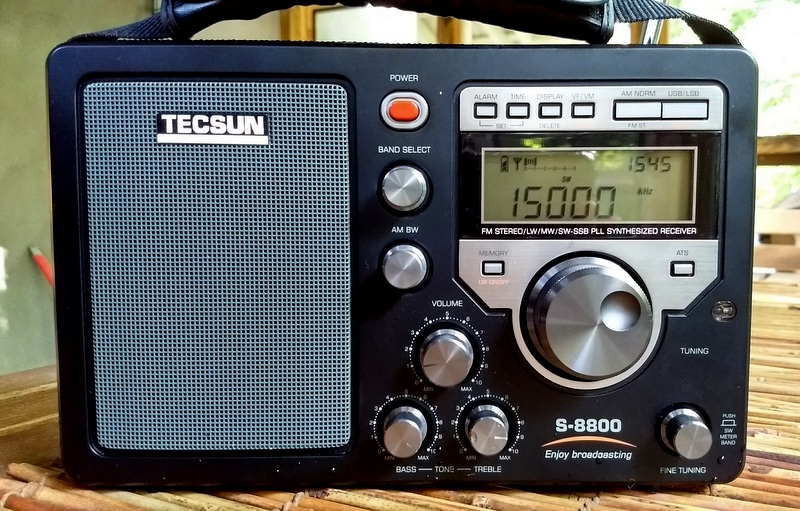
Looking for a new toy again I recently revisited the Tecsun S-8800, which looked like it could replace both my battered old Grundig Satellit and my Tecsun PL-660. Being in production for a few years now, and with the “birdies” situation ironed out long ago, the S-8800 has gathered much acclaim by now but also a few somewhat contradicting reviews. For example, one review reports that the S-8800 can cope with larger antennas, another one states the exact opposite, one praises the MW performance, another one attests only average sensitivity, and only one mentioned an unpleasant detail I’m going to emphasize on in a bit.
All reviews touted the improved SW performance in AM and SSB though, and that was reason enough to make my own experiences. Testing it turned out to be a bit of an emotional rollercoaster though.
I hope I can share more than only redundant bits of information about the radio, and I’ll skip most of the general information you can read in most other reviews.
Off to the 13dka radio test site at the dike!

13dka’s SWL Happy Place
General
Like the technically somewhat similar Tecsun PL-880, the S-8800 is a triple conversion receiver and has 2 conventional IF stages, the third IF stage is using a Si4735 DSP chip again, providing the filters and all that jazz.
Tecsun seems to have thrown a lot more parts into it than in previous radios, plus a pretty big ferrite rod (covering 8-9/10th of the radio’s width) with individual LW and MW coils (most of the smaller receivers have only one coil), a 108mm telescopic whip and of course the “gun metal” knobs. Designing a radio with a rather simple front panel and making a remote control an integral part of the operation concept (like it is reality with TVs for a long time) is a charming oddball approach, in a way reviving an utmost luxurious feature of 1930s high-end radios. So let’s cut to the chase and talk performance:
Longwave and Mediumwave
On LW and MW, I first compared the S-8800 with my old Grundig Satellit 400 at home. The old clunker has similar dimensions, a big old speaker bass/treble controls and it was known to have an average sensitivity on the AMBC band in its time, when all the great, now vintage AM performers were still ubiquitous, so that’s rather a “Jay Allen average” than an “average of the mediocre AM radios of this millenium”. I think Jay Allen might rate it 3 stars.
Longwave

The first station I tuned in was the BBC LW transmitter network on 198kHz and it turned out a tad more noisy on the Satellit. Great! I could also pick up Medi1 and Kalundborg a smidge better than on the Grundig, and in the early evening, out at the beach I was picking up stations on all still populated channels on LW (minus 180kHz where it has one of the remaining birdies). The other new portables I currently own (PL-660, D-808) are far away (PL-660) and far, far, far away (D-808) from that kind of performance.
Mediumwave
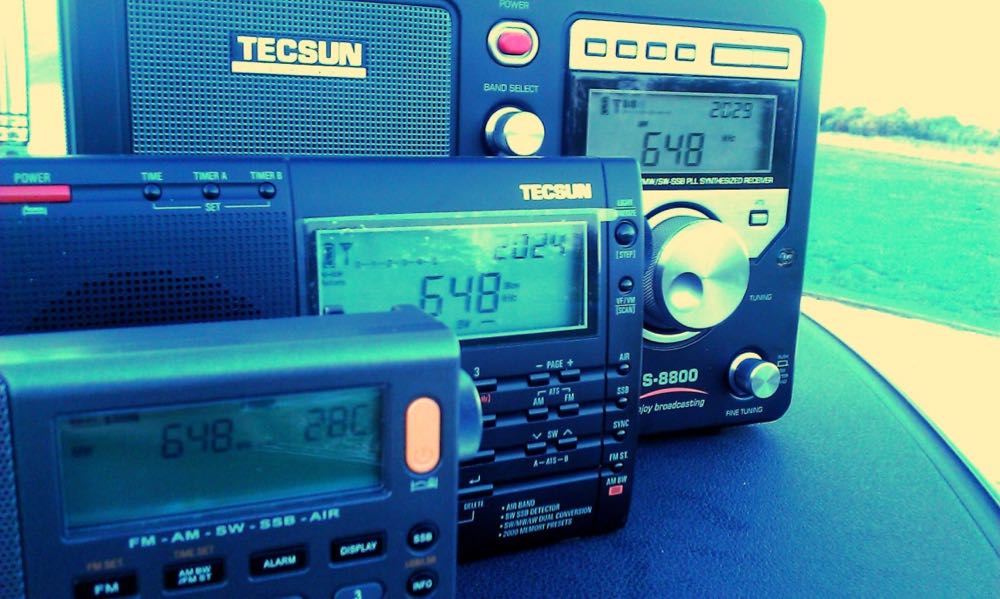
Unfortunately that good impression vanishes gradually when leaving the long wave for the NDB band (still good) and finally medium wave. Before I left the house to test the radios on the electrically quiet beach again, I was checking out one of my favorite border case stations (low power station from The Netherlands on 1602kHz, whatever their name is this week) and that made very clear already that the S-8800 can’t hold a candle to the Satellit, at least not on the top end of the MW band. Despite all the noise indoors, on the Satellit I could easily recognize the song being played while the S-8800 didn’t pick up anything at all.
On the beach it turned out that – despite the ferrite rod being twice the size – I find it only marginally better than the PL-660, and not close enough to the little XHDATA D-808 (if you’ve read my D-808 review you already know that this little radio is almost on par with the Grundig on MW):
Timeline: 0:00: D-808 0:07: S-8800 0:11: D-808
Of course I have read Thomas’ assessment of the AM performance so I was prepared to be underwhelmed. But at least you can connect some high gain MW antenna to make up for the missing sensitivity and be happy again, or can you?
A not so nice surprise
The unpleasant detail I mentioned before is: the Int/Ext Antenna switch does not turn off the internal ferrite bar antenna. Jay Allen mentioned it in his review, it was the only review with that detail and unfortunately I overlooked it. How does that matter?
The main issue is this: if you’re (like me) forced to use outdoor antennas to escape high indoor noise levels, the internal loopstick just won’t let you. The external antenna will just increase the SNR a bit when the station is strong enough anyway. Even in a low noise environment, the internal loopstick will needlessly add noise to the signal received from a high-performance active loop or FSL antenna.
That also explains a paragraph in Thomas’ S-8800 review:
“I also hooked up the S-8800 to my large horizontal loop antenna. This certainly did improve MW reception, but not as dramatically as I hoped. Additionally, it seemed to be very sensitive to RFI in my shack even when hooked up to the external antenna.”
There’s more external antenna idiosyncrasy: only the BNC jack is wired to the “Ext” position of the antenna switch, the “hot” (red) Hi-Z terminal is active when the switch is in the “Int”-position, it just seems to save you an alligator clip on the whip.
The dedicated “AM antenna” terminal was in part what sold the S-8800 to me. The label made me assume this would be specifically wired to the AM circuit but as it turns out it’s just a generic high impedance input and I really didn’t anticipate that the internal loopstick remains always active (or in case of the Hi-Z terminals, the retracted whip). Yes, technically you can connect an external antenna for MW, practically…YMMV.
To conclude this section, the final outcome of this antenna connector issue plus the not so brilliant MW sensitivity was that not even my active ML-200 loop (connected to the BNC-jack) could improve reception on 1602kHz enough to make the S-8800 get at least a bit into the ballpark of the Grundig with its loopstick antenna. The currently mounted small 80cm rigid loop on the ML-200 just couldn’t produce enough signal to lift the station over the noise that much.
Shortwave SSB

As the other reviews reported already, Tecsun has obviously worked on the AGC issues their former products had. I can confirm this so far, the AGC does not show the distorted onset of leveling anymore – unless the signal is very strong. But the leveling happens much faster than e.g. on the PL-880 so the remaining blasts of distortion are quite short:
A more relaxed AGC release time would save us most of those too. I noticed AGC pumping effects from strong signals in the spectrum neighborhood only with a big antenna connected. But unfortunately there is more…
Stuff you have to live with:
In his great review, Thomas mentioned the auto mute sometimes interfering with reception. I noticed this too (with all bandwidths on SSB) and I credited this to very low noise figures. When the bandwidth is narrow (=less noise) or if you have a very low noise floor anyway like when tuning through 25-30MHz, the receiver gets muted over the entire chunk of spectrum, just to intermittently and pretty suddenly pass the noise again. Sounds like a broken antenna cable and has some potential to confuse people:
Then I made some experiments with ECSS, destroying my “noise floor” theory. It doesn’t always happen but under circumstances that may sound like this:
Too bad that setting auto mute to ’00’ doesn’t actually turn it off in SSB mode so there’s likely no remedy for that.
On my example, there is absolutely no difference between the 3kHz and 4kHz SSB filters. A working 4kHz filter would have been a good choice for ECSS reception.
Another remaining quirk at least on my specimen of the S-8800 is a slight FM modulation of an oscillator in SSB, particularly with strong signals. You can hear it best if you create a heterodyne or listen to CW, the tone sounds a bit hoarse, so do voices and I’m not sure whether or not this could affect narrow-bandwidth digimiode decoding. The front panel (namely the bandwidth knob area) is quite susceptible for “hand capacity”, the frequency varies a bit when you move your hand in front of the S-8800. This is not uncommon with portables of course, but my D-808 for example has its “Theremin playing area” on the back of the radio.
In this clip you can hear both the “hoarse” modulation and my hand waving to you.
This leads me to calibration and frequency drift. The S-8800 can be calibrated on SSB (see the “Hidden features” section below), however this turned out to be a (too) fast moving target. I don’t know if it’s the VFO or the BFO but it is so temperature-dependent that 6°C temperature difference equates to a quite substantial (for SSB) drift of 150Hz. Whatever oscillator it is, it seems to lack any temperature compensation measures, with all the implications that may have on relaxed SSB listening, digimode decoding and ECSS reception when the temperature isn’t quite stable where you want to use it. After calibrating it, it’s often slightly off again within the same minute. My cheap little D-808 won’t drift even when I take it from an overheated apartment into a -5°C cold winter storm.
The good stuff
Now to the fun part! When I compared the SSB performance of the S-8800 with my PL-660 the first time, I found them very close for some reason. I could find only one weak station that came in noticeably better on the S-8800 and while I was happy that it wasn’t worse than the PL-660 I was also a bit disappointed.
Timeline: 0:00: PL-660, 0:10: S-8800 receiving the “Gander Radio” VOLMET.
Then I repeated the test a few days later, this time a bit more into the evening and the outcome was very, very different. The S-8800 won every single weak signal comparison with ease and sometimes in a way that made me think my PL-660 must be broken.
But then I could help the PL getting a lot closer by simply holding it in my hand, the difference was that I had placed the PL-660 differently so I could record both radios easier. The factor I forgot to put in the equation was that the S-8800 is absolutely not depending on anyone holding it to give it some counterpoise – that and the long whip is certainly a part of its advantage, and the receivers would be much closer when used with the same external antenna. With the radios just standing there tho (and that’s what most people will do with their radio instead of holding it in their hand), the difference is remarkable nonetheless and I also learned that you should always look and listen twice when testing radios!
Timeline: 0:00 D-808, 0:03: S-8800, 0:08: D-808, 0:10: S-8800
Timeline: 0:00: PL-660, 0:05: S-8800, 0:10: PL-660, 0:16: S-8800
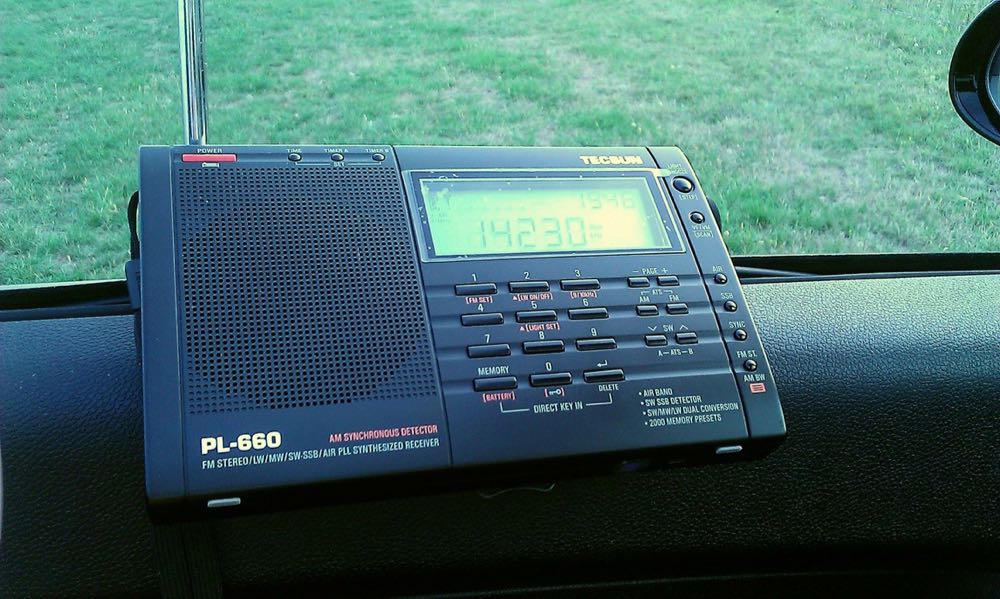
When I repeated the test yet again but granted the PL-660/D-808 the litte bit of counterpoise they seem to need (I let them rest on the car door instead of holding them), the results were not that unequivocal anymore. However, the receivers were 50% on par, the S-8800 was clearly better the other 50% and overall the other two receivers could not score a single point for them. I think that shows that the S-8800 really is a hair or three better. Beyond the increased sensitivity and minus the frequency drift, SSB reception feels more mature, the the S-8800 behaves more like a regular communications receiver now and the big speaker is a big plus. Of course that means there should be also an improved reception of…
Shortwave Broadcasts

I know that the S-8800 has inherited the “Enjoy broadcasting” and “BCL RECEIVER” lettering from the cheap S350, but after stepping the PL-660 and the S-8800 through all shortwave broadcast bands, I felt that’s exactly hat it was made for, and it shows!
There is no doubt that a big speaker can create the illusion of better reception, but I think I don’t fall for that easily and rather listen to the background noise and how intelligible the “content” is. While the comparison with the PL-660 often ended up in a tie when I subtracted the impact of the speaker in my mind, there were indeed some stations where the S-8800 had remarkably less noise than the PL-660. But of course the big speaker is giving the S-8800 a permanent edge on all reception cases, and it’s a real joy to listen! Combined with lower noise and a generally more stable signal (through better AGC) this made quite a difference between the two.
Bottom line is that when listening to shortwave broadcasts, the S-8800 gives you the warm and lush sound of yesterday’s famous receivers while it technically delivers the best performance of all Tecsun portables so far. If you fancy music programs on shortwave and if you don’t mind the price for the luxury and performance, you’ll enjoy this radio a lot.
FM

Short story: my specimen of the S-8800 lacks the very good FM band sensitivity of the PL-660 or the XHDATA D-808. While the latter radios present my favorite marginal case station 100km away fairly with some noise at sea level, the S-8800 just doesn’t receive that station at all, no matter how I position the whip. It’s not exactly worlds between them but considering that (assumedly) most of the FM receiver is in the Si4735 chip that it shares with a couple of great FM performers from the same company, this is a bit surprising.
Signal handling capabilities
The S-8800 is said to have a pretty robust frontend, which I found true but I want to put that a bit into relation. My “lonely beach/dike listening post” sports 2 abandoned steel flag poles of 6 and 8m height. They can serve as support for wire antennas, or easily be used as an antenna themselves by inductively coupling them to the receiver – IOW by winding a wire 2-4 times around the pole (you could use the Eiffel tower as an antenna this way) and connecting the other end to the radio.

For some reason this contraption produces quite massive output voltages, but I could always use it for a quick and thorough (and due to the location QRM-free!) reception improvement with my PL-660 anyway. Why?
The PL-660/880 have a 3-position (DX, Normal, Local) switch. I think it turns off the input preamp in the “Normal” postion and adds a simple attenuator circuit in the “Local” setting. The latter is sufficient to tame the output of all sorts of antennas (including the flag pole) enough to make my PL-660 work just fine with that on all bands.
The S-8800’s sensitivity switch on the other hand has only 2 positions and telling from the results it really only turns off the preamp. Now it actually acts up much less on the flag pole than the PL-660 in its comparable “DX” and “Normal” positions, so obviously Tecsun has put some effort into making the frontend more robust indeed. But it seems they thought “that should do, let’s ditch the 3rd (attenuator) position and save 3 resistors” and that left me with many (but tolerable) images across the entire shortwave above 3 MHz, and a heavily image-infested 160m band. BTW, a few soft images from (I guess) 49/41m blowtorches could be heard around 29MHz with only the whip.
A word on the audio
I believe that the “legendary” status of the Grundig and Zenith lines of world band receivers is partly owed to their big sound. They had their music loving and program listening audience in mind, and Tecsun’s choice of casing, big speaker, the bass and treble controls are certainly taking the same line.
Compared to my Satellit 400 (80s model, but still has much of that “legendary” sound), the Tecsun sounds a bit more boomy in the lower mids while having a less super-deep bass response than the Grundig, which also sounds more neutral. Besides these very unimportant distinctions, the S-8800 does sound big and that also helps reception – lacking low mid/bass content can impair intelligibility as well, and it causes more fatique on long DXing sessions.
The bass/treble shelving EQ is certainly more sophisticated than the Grundig’s, it has quite sharp cutoffs at very sensibly chosen frequencies, so turning the knobs down will leave the main chunk of the mid range completely unaffected and just helps removing rumble or the 5kHz beat frequency from a band neighbor, or add some nice hifi-highs and beefy low end when you turn them all the way up. In other words you can continuously blend the speaker sound from perfect “voice communications” style to “dad’s big old radio”.
Hidden functions
Of course the S-8800 has some unofficial “power off” and “power on” extra functions assigned to the number keypad on the remote (they all work by pressing and holding a number key for up to 10 seconds). Some are identical to the PL-880, some are different:
0.) I found calibrating the S-8800 on SSB works with the same method used on the PL-880: Tune to a station with a known frequency, switch to USB or LSB and use the fine tuning knob to tune for best audio/music playback. An alternative way of doing this is downloading a free spectrum analyzer app for your smartphone (“SpecScope”), tuning the radio 1kHz off frequency so you get a nice heterodyne tone on USB or LSB, then using the fine tuning knob to tune the tone to hit exactly the 1kHz mark on the analyzer display. Your last 2 (Hz) frequency digits will now show an offset frequency.
1.) Then press and hold the ‘0’ button until a ’00’ appears in the top right corner of the display and the last 2 digits of the frequency readout start flashing. Release the button and quickly use the fine tuning knob to reset the last frequency digits to ’00’ (the number on the top right corner should be changing while doing that), then immediately hold the ‘0’ key again to confirm – tadaa, the offset should be gone while the last 2 frequency digits show ’00’ now. This all needs to happen pretty quickly and with the right timing, so it may take a few attempts to get it right.
2.) With the radio off, button ‘2’ turns the LW band on/off.
3.) Press and hold the ‘3’ button while the radio is off to toggle between permanent and “intelligent” display illumination.
4.) When the radio is turned on, this button enables access to the extra functions of the number 6 and number 9 keys. The display will read “On” when you perform this the first time, doing it again will turn it off again.
5.) Radio on, set to FM band: this toggles between 75 (US) and 50 (anywhere else) microseconds deemphasis on FM.
6.) Radio on: When enabled using the ‘4’-button as described before, holding the ‘6’ will toggle the (annoying) dynamic bandwidth feature off and on. You can set this independently for AM and SSB. Ideally to zero, because it automatically resets your bandwidth setting and since this is happening in steps, it sounds quite strange. The PL-660 uses a stepless dynamic envelope following low pass filter (which is I believe what they called “DNR).
7.) This is still a mystery to me. On the PL-880, this button apparently controls the line out level on FM. On the S-8800 it (ostensibly) seems to control the S-meter bias with numbers running from ’00’ to ‘+99’ and ‘-99′ for all bands. Positive values reduces the S-meter display which made me curious if it rather controls AGC level or gain at some stage, but it really seems to affect the S-meter display only.
8.) Radio off: Toggles the seconds display on the main clock (when the clock is displayed instead of frequency).
9.) Another important one: this controls the threshold of auto squelch/soft mute. If you want to turn that off, turn it down to ’00’ with the main tuning knob, then hit the ‘9’ key again. You need to do this for AM, FM and SSB separately.
Random stuff
- The S-meter was indicating a permanent base level of 2 bars even at my remote beach listening post. But even though it can apparently be “calibrated”, a 5-bar indicator is quite a step backwards from the 99-step RSSI meter of the PL-880.
- After an initial discharge and recharge cycle, the 2x2000mAh “18650” batteries gave me a continuous runtime of 21 hours. When you connect the charger and then turn on the radio, it stops charging unless – and this seems odd – you are in FM mode. A full charge while listening to FM radio took 4:41.
Verdict
I had a pretty hard time making my mind up about this radio. It has so elaborate details, so much design improvement and costly parts went into it but I feel like it doesn’t quite meet the expectations Tecsun created with this radio. Sadly, it has a few things that were started ambitious and ended underwhelming.
It got a huge 2-coil loopstick and somehow they managed to make it perform slightly worse than a 70€-radio with not even half of that loopstick size, they gave it 2 external antenna ports but they disappoint MW enthusiasts right again by keeping the loopstick always active, and how FM could turn out less sensitive than many radios with the same Silicon Labs chip (including their own models) is beyond me.
They improved the front end but then they dropped the attenuator, which costs the overall flexibility and better overloading-resilience their other radios have, they fixed the SSB issues of the predecessors and introduced a free-floating BFO with a mind of its own.
The price tag is making these downers certainly weigh heavier, and I think without them this radio may have turned out to be a real classic.
On the plus side I found a radio that really excels on shortwave. Shortwave program listeners can feast on a most sensitive, selective, luxurious and well-behaved portable with a big sound and I think there’s probably no current portable that could compete with that.
Ham radio aficionados get improved SSB reception and if there wouldn’t be this “cheap 70s receiver trademark” unstable oscillator, it would come close to communications receiver performance levels (minus the frontend needed for big antenna voltages).
That the price reaches into the ballpark of pre-loved high-end(-ish) JRC/Icom/Yaesu communication receivers or buys you a mint-condition ICF-2010/2001D may seem like a problem too. But then again, none of those radios is perfect either, and only the Sony is a portable.
Despite the quirks, the S-8800 is still a great, valuable radio that revives an out-of-fashion style of radios in a pretty unique and modern way.
What a brilliant, critical review of the Tecsun S-8800! Thank you so much for taking the time to properly test and compare the S-8800 with the venerable PL-660 and the XHDATA D-808 (readers, also check out his review of the D-808).
You’re right, too, in that I’ve noticed some contradictions in reviews–I do wonder if part of this might be variations between US and EU versions of the radio, or perhaps small quirks in production runs.
No doubt, however, that the Tecsun S-8800 is a champion of the shortwave broadcast bands and its audio fidelity is in a class of its own.
Click here to view the Tecsun S-8800 at Anon-Co or here to search eBay.
Do you enjoy the SWLing Post?
Consider supporting us via Patreon or our Coffee Fund! Thank you!