Contest Reminder: Your “dream radio”

dial_closeup_1

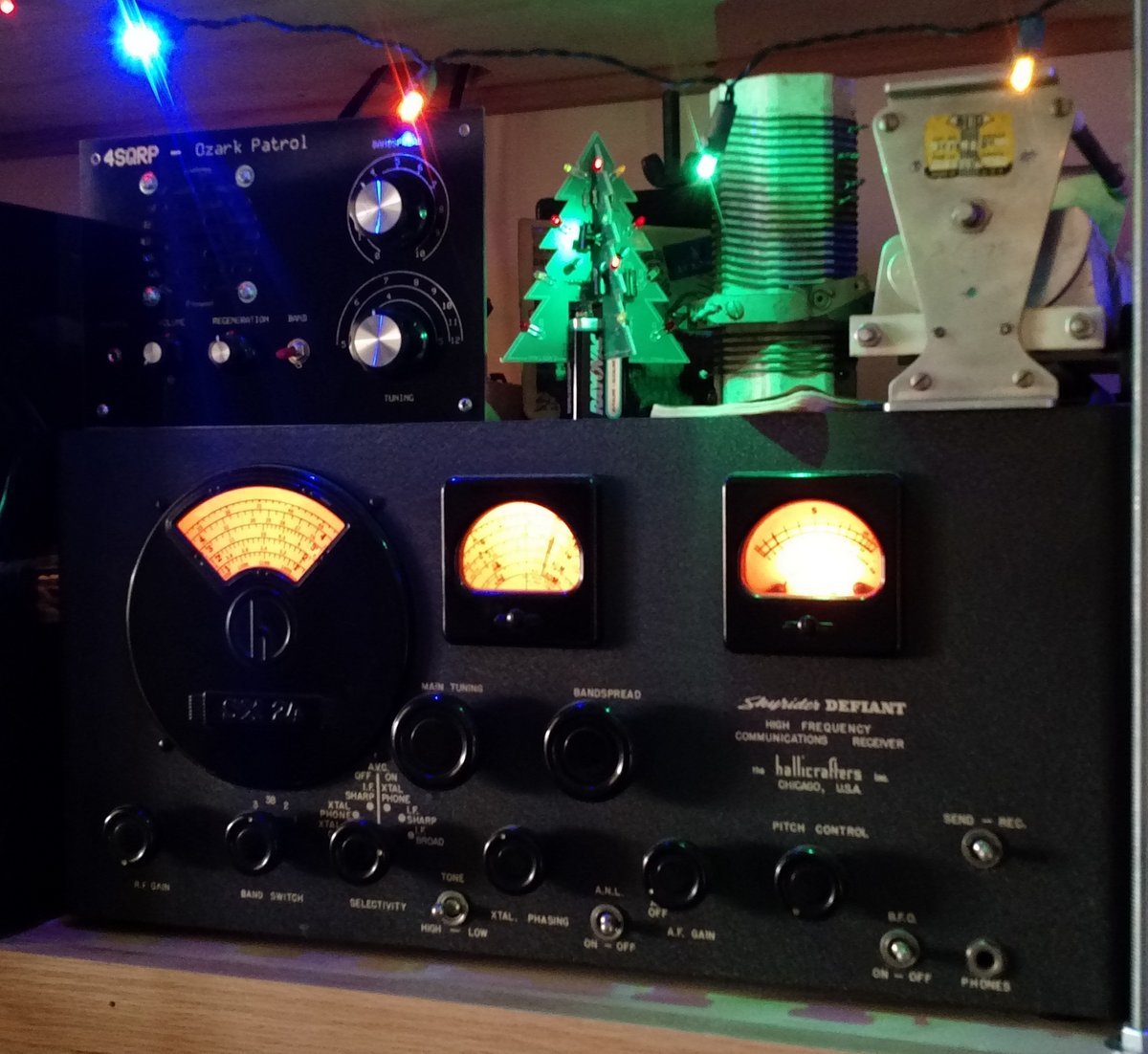
Think back to your first days in radio…What was your “dream” receiver?  And why?

Or–if you’re new to shortwave radio–what is your “dream” receiver currently, and why?

Many of us had a radio they dreamed of in their youth, or when they first began to hanker after the radio experience. What was yours?  For newer hobbyists, what is yours? And just what made–or makes–this radio so special? Did you ever obtain one?  And if so, did it live up to your expectations?

Share your experiences with the Post for a chance to win a prize from Universal Radio!

The winners of this contest will be chosen at random, using a randomizer application; an independent non-entrant will make these selections.

Thanks to Universal Radio and Fred Osterman’s generosity, there will be two winners of this simple contest–a US winner and an international winner.

The US prize will be a copy of Shortwave Receivers Past and Present by none other than Fred Osterman. I reviewed this book a couple years ago: it is an invaluable reference tool and also a fun “dream” book.  With sincere apologies to my international friends, this prize must be limited to the US simply because shipping this weighty volume internationally would cost more than the book itself.

ShortwaveReceiversPastAndPresent

The international winner may select between the following (less weighty!) books, also very good references: Joe Carr’s Loop Antenna Book or Buying A Used Shortwave Receiver: A Market Guide To Modern Shortwave Radios.

Entering the contest is easy. Simply go to our entry form (below or click here) and fill in the required fields.  Be descriptive! This will make the contest fun. Let us know in detail why that radio was (or is) so significant to you.

Your entry will be recorded, and the winners chosen at random on Sunday October 16, 2016. We’ll publish the responses once the contest concludes, sharing only the name you provide.

Radio Maubere: clandestine radio in occupied East Timor

Radio-Dial-Blurred-Dark

Many thanks to SWLing Post contributor, Phil Brennan, who writes:

Your readers may be interested in this article detailing a clandestine radio station that was set up between the Fretlin rebels in East Timor (now Timor Leste) and supporters based in Darwin where I live. The Fretlin rebels fought against the Indonesian occupation until the country’s independence in 2002. In the 1970s this was the only method of obtaining information on the brutal repression of the Timorese people by the Indonesian dictatorship

The man featured in the article, Brian Manning Snr., who died a couple years ago was a well known activist and trade unionist in the Northern Territory. He was also very involved in the campaign for Aboriginal workers to receive equal pay and conditions in the 1960s. This campaign was instrumental in raising the profile of the Aboriginal land rights movement in Australia. Brian Manning Jr. Is a good friend of mine.

(Source: ABC News)

If someone was to make an Australian version of Forrest Gump, they might look to Brian Manning’s life story for inspiration.

In 1966, he helped the Gurindji strikers in the Wave Hill walk-off. When Cyclone Tracy hit his hometown of Darwin, police commandeered his truck to collect dead bodies. Months later, he became involved in possibly the most important mission of his life.

That mission was Radio Maubere: an underground radio link that operated between Darwin and occupied East Timor during the 70s and 80s.

For many years, it was the only link the Timorese had with the outside world.

“Dad felt very strongly that these people needed to be supported in their struggle,” his son, Brian Manning Jr, said.

“So with a few other people, they got together and formed this radio operation.

“It was vital. There’s no doubt that the Indonesians were in there to systematically reduce the population by any means necessary.

“So these people were just killing people, and these stories had to get out.”

[…]As the years went on, and the list of confiscated radio transmitters grew longer and Manning’s tricks became more and more creative.

“They had a few decoy vehicles. And they had a few decoy radios. And they had people rendezvous with them in the bush in certain areas,” Brian Manning Jr said.

Often one person would set up the transmitter, another would come along and use it, and a third would arrive to pack it up and transport it out of danger.

[…]The broadcasters even devised their own coded language to communicate top secret information, remembers one of the group’s members, Robert Wesley-Smith.

“They each had a book, and the code would direct them to a page or something. It was very slow … but it was a great adventure,” Mr Wesley-Smith said.

Whatever problems Manning and his crew had in Australia were nothing compared to the dangers faced by those operating on the other end, where gunshots could sometimes be heard in the background.

There was a constant need to get new transmitters into the country, and an engineer from Sydney came up with an ingenious method for avoiding detection.

“It now fell to the resourcefulness of Andrew, who created a transmitter out of a ghetto blaster,” Manning wrote in his book.[…]

Click here to read the full article.

From the Isle of Music Preview for October 17/18

promoftiomoct0182016small-copy

A potpourri of styles of Cuban music…

Our October 18 (October 17 in the Americas on WBCQ) program offers a potpourri of reissues of Cuban music from prior decades and some more Cubadisco 2016 nominees – a mixture of traditional and contemporary.

Two options for listening on shortwave:
WBCQ, 7490 KHz, Tuesdays 0000-0100 UTC
(8pm-9pm EDT Mondays in the Americas)
Channel 292, 6070 KHz, Tuesdays 1900-2000 UTC
(2100-2200 CEST)
See the NOTES section of our Facebook page for more information. 

Dave warns of fake “Sony SW-33” receivers

fake-sony-shortwave

Fake “Sony SW-33”

Many thanks to SWLing Post contributor, Dave Zantow (N9EWO), who writes:

Here is an interesting one [I saw] on eBay this morning. A SONY marked SW33 SW portable, but of course it’s NOT the ICF-SW33 model you (or I ) are thinking of.

Click here to view on eBay.

Looks to be a Kchibo made radio (a model I tested for Passport years ago) ? Humm….but Kchibo’s are made by TOWADA Audio (in China and Vietnam plants). As you may already know TOWADA Audio also made all of Sony’s SW sets for decades going back into the 70’s (but at the Japanese Plant of course). So is this some unofficial model (but poorly marked) or just a total fake from a few years ago ??

Have more information on TOWADA and Sony on the bottom of my Sony Page : http://webpages.charter.net/n9ewo2/sony.html

But that is a weird one.

The real Sony ICF-SW33 (Image: Universal Radio)

The real Sony ICF-SW33 (Image: Universal Radio)

Thank you, Dave! Yes, obviously this “SW-33” is not the real item (see authentic ICF-SW33 above).

I’m guessing the seller has no idea this is a fake radio. Dave makes a good point: if it doesn’t look like a Sony, it probably isn’t! Buyer beware.

Update: RTÉ RADIO plans to axe longwave service in 2017

SX-99-Dial-Nar

Contrary to a news item we recently shared from The Independent, SWLing Post contributor, Mike Barraclough, notes the following news from the Irish Post:

RTÉ RADIO will proceed with plans to axe its longwave 252 service next year, it has been confirmed.

[…]RTÉ has consistently argued that better use could be made of the money and that listeners should consider other options, such as internet and satellite receivers, to tune in to their favourite shows.

Despite undertaking a survey of almost 3,000 longwave 252 listeners in Britain last year, in conjunction with Middlesex University London and the Irish in Britain charity, the broadcaster will now go ahead with the move.

The survey had revealed that the service was a vital “lifeline” for many elderly listeners, and an important link to their homeland.

[…]The Irish in Britain organisation, which helped facilitate the RTÉ survey, today said that they would be meeting with the consultative steering group in the next few weeks to discuss the next steps for the campaign to save longwave.

Chief Executive Peter McNulty told The Irish Post: “We will be sitting down with the consultative group to review the situation and discuss the research to see how we can move forward.

“The research is very clear that there is a demand for this type of service from the Irish community here in Britain. That link with home is very important.”

RTÉ would not reveal when in 2017 they plan to close the longwave service.

Read the full news item on the Irish Post.

Tecsun PL-680 Beats Expectations


I have been procrastinating over investing in another portable shortwave radio to replace my ageing (but still going strong) Sangean ATS909. Also known in the U.S. as the rebadged Radio Shack DX–398, the Sangean has been a most reliable rig for in-the-field DXpeditions. My unit is one of the early first generation versions that I purchased on the second-hand market, so I’m guessing it has to be at least 16 years old now. It continues to provide a full rich tone quality on AM/FM and is very sensitive on shortwave providing you use an external antenna of 5 metres (16 feet) or more. The radio received some bad press because of its poor SW reception using just the telescopic rod antenna, which frankly was justified. The in-built whip is useless! But all of my work has been with an external antenna, and the results have been most successful over the years.

But the old ATS909 has lived a hard life, having been bounced around in the car on rough dirt tracks, dropped a few times, and thanks to a recent home renovation project it now has paint splattered all over it. On one occasion, I’d even left it outside on the ground after a spot of gardening, subjecting it to half an hour of heavy rain, before realising my forgetfulness. The radio was soaked but still going strong when I picked it up. However, the digital readout was all messed up. After 24 hours of drying, and it fired up beautifully again, and has been fine ever since! That’s some impressive build quality there! Thanks Sangean!

Anyway, a few months ago I decided to “pull the trigger” and purchased a new Tecsun PL-680 AM/FM/SSB/Air Band radio. This rig has been on the market since around February 2015. So far, it has performed very well for me.

Interestingly, on the built-in telescopic antenna reception is only marginally better than the Sangean, but the Tecsun is really quite sensitive with an external long wire antenna. In fact, I’ve had it hooked up to my three double bazooka (coax) dipoles for 80, 40 and 20 meters, and the performance has been excellent. The tone quality is not quite a good as the Sangean, lacking richness and depth on MW, FM and SW. But for DXing, the audio appears just right for digging out clear audio from the noisy shortwave bands.

pl680-at-the-beach

Recently, I hooked up both portables for a side-by-side comparison using four different external antennas outside the shack with switches between the two radios. I was eager to check how they measured up in terms of sensitivity and selectivity. The results for the Tecsun were impressive, picking up all of the weaker signals that the Sangean could hear.

Indeed, on several shortwave broadcast bands, the Tecsun appeared to be just a touch more sensitive at digging out some of the weakest signals. The audio also appeared a little clearer for those weak signals, perhaps because it has a narrower audio response than the Sangean. And selectivity for the PL-680 was about the same as the ATS909, generally very good.

On the ham bands, however, the SSB audio quality of the ATS909 sounds more pleasant to my ears than the PL680. But the Sangean’s tuning process in SSB is somewhat more cumbersome than for the Tecsun.

The PL-680’s synchronous detector effectively reduces adjacent signal interference. It’s easy to use and is a strong feature in its favor. However, occasionally it can fail to lock on to a weaker signal or when the signal is subject to deep fading. One other characteristic of the Tecsun is that it has a rather overly generous S-meter, hitting S4 or 5 for all but the weakest signals. This is a meter not to be taken too seriously!

But the PL-680 is not without its faults!

Click here to continue reading the full story.

Rob Wagner, VK3BVW, is the author of this post and a regular contributor to the SWLing Post. He also blogs at the Mount Evelyn DX Report.

Matt’s review of the BST-1

BST-1-Receiver-Label-AltMany thanks to SWLing Post contributor, Matt, who shared this review of the BST-1 car shortwave receiver:

Overall: a good sensitive receiver, with a very inventive interface. I am looking forward to my long commutes for a change.

Using the FM RDS info on the car radio is a stroke of genius.BSTFM2

Performance: Miles ahead of my old MFJ 3 band heterodyne converter. I could hear 2 or 3 stations in the day, maybe 6 or 8 at night. With this new receiver during my morning and evening commutes in the NE US, I can hear dozens of stations day or night. Performance is roughly on par with a decent shortwave portable using the built in whip. I get 6070 Canada listenable 2 out of 3 days, 9580 Australia one out of 4 days in the morning, Radio Romania is an S5-8 beacon in the evenings.

Quirks: when the receiver is powered down, it does not save the music/speech bandwidth setting. It always comes up in the speech mode.

Also, when you are in tune mode and wrap around from 0 kHz to 33 MHz or vice versa, there is a glitch. Instead of scanning on the even 5 kHz intervals, it changes to scanning on the 3 and 8 kHz or 2 and 7kHz intervals: 32.003, 32.008, 32.013, 32.018, etc. instead of 32.000, 32.005, 32.010, etc. If you go back to preset frequencies, scan, and then go back to tune mode, it is back to normal.

I have only seen spurious signals around 2 MHz or so. I think it is some 15 MHz broadcasters bleeding through – only one or two usually. No other spurious signals apart from this seen yet.

Suggestions: restrict the tune mode to the shortwave bands to save time slogging through all that dead space between broadcasting segments (toggle all or band only tune?)

Make it so you can switch the AM broadcast filter in and out, maybe with an attenuator. I live over 50 miles from the nearest high powered AM station, and it would be nice to be able to BC/LW DX. The receiver is quite sensitive down there. On 1700khz where the filter doesn’t have much of an effect I can hear an AM station 80 miles away. Instructions on putting in a manual switch to do the same would be good as an alternative to this.

Thanks for sharing your review, Matt! I agree that the BST-1 is surprisingly sensitive, especially for a mobile receiver.

Click here to view the BST-1 order/information page.

Click here to view our review of the BST-1.