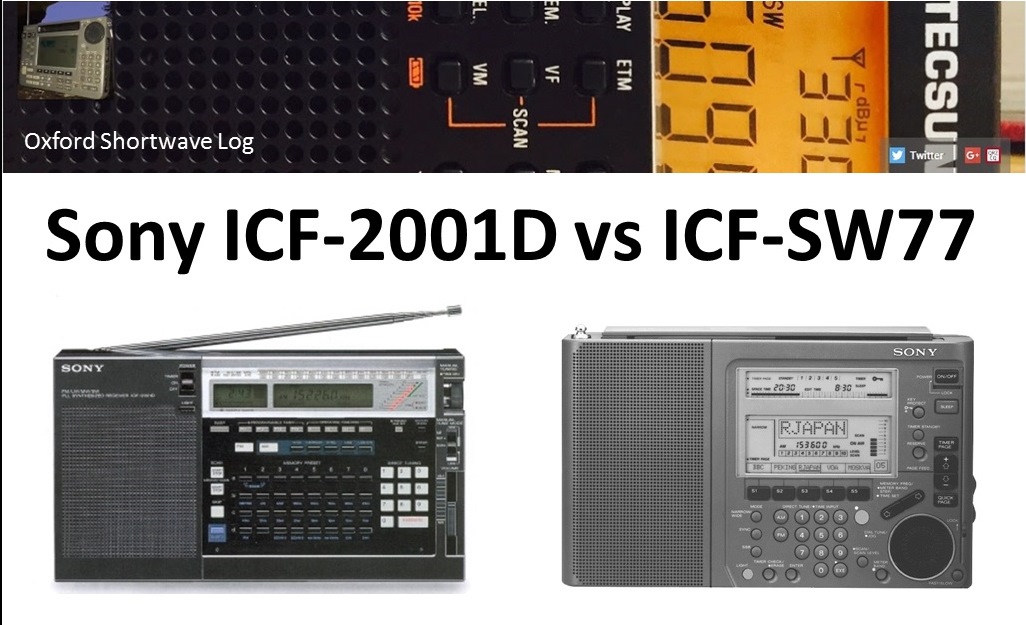
Hi there, after the first set of recordings were analysed, the score was 4-3 to the ICF-2001D, demonstrating how similar these two great receivers are in overall performance. There were a copule of notable differences however. The synchronous detection circuit on the ICF-2001D allows the user to effectively tune through a signal in 01. kHz steps, whilst the receiver automatically locks onto either the upper or lower sideband, depending on the frequency offset. The ICF-SW77 synchronous detection system differs in that the user must tune the signal and select the sideband. The results of this test confirmed that whilst the ICF-2001D almost always retained SYNC lock, the ICF-SW77 was very prone to losing lock, which of course affected the audio quality in many cases. The other issue was with the ICF-SW77 in that the narrow audio bandwidth filter often seemed to deliver ‘muddy’ audio. Whilst this feature proved to be excellent in terms of mitigating adjacent channel QRM, it also reduced signal clarity/ audio discernibility a little too much in my opinion. However, overall, sensitivity and selectivity was very similar between both radios – in fact, one recording had to be judged a draw (Radio Bandeirantes, Sao Paolo on 9645.4 kHz) – I simply couldn’t split them. Part two of the reception testing follows, using signals from Canda, DR Congo, Brazil, Cuba and Peru.
I hope you enjoy the recordings – text links and embedded videos follow below:
- Which is the best? Sony ICF-SW77 or ICF-2001D? Test #9 CFRX Toronto 6070 kHz
- Which is the best? Sony ICF-SW77 or ICF-2001D? Test #10 Radio CANDIP 5066.4 kHz
- Which is the best? Sony ICF-SW77 or ICF-2001D? Test #11 : Radio Alvorada 4965 kHz
- Which is the best? Sony ICF-SW77 or ICF-2001D? Test #12 Radio Verdes Florestas 4865 kHz
- Which is the best? Sony ICF-SW77 or ICF-2001D? Test #13 Radio Rebelde 1620 kHz Cuba
- Which is the best? Sony ICF-SW77 or ICF-2001D? Test #14 Radio Cultural Amauta 4955 kHz
Clint Gouveia is the author of this post and a regular contributor to the SWLing Post. Clint actively publishes videos of his shortwave radio excursions on his YouTube channel: Oxford Shortwave Log. Clint is based in Oxfordshire, England.
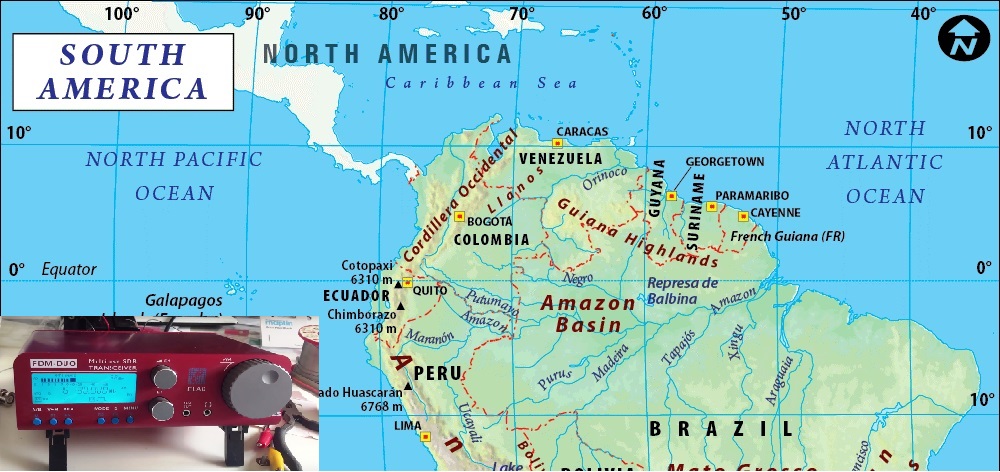

 Hi there, I thought I would share some Brazilian shortwave catches with you, obtained using my Sony ICF-2001D receiver and 200 metre experimental longwire. The first is Radio Bandeirantes, Sao Paolo on 9645.4 kHz. This is a station that I’ve only heard once or twice previously, but was received with excellent signal clarity and strength recently, using my deployable longwire antenna. I would rate this station as moderately difficult to receive with reasonable discernibility. The second is Radio Novo Tempo from Campo Grande, on 4894.9 kHz. This station I would rate as difficult to hear with discernible audio. The key is always signal-to-noise, thus moving yourself out of the ubiquitous blanket of QRM most modern environments endure will usually achieve this and of course coupled with sufficient space outdoors to erect a larger antenna will hopefully also improve signal strength. My final video on this post is Radio Nacional Brazilia on 6180 kHz. I would regard this station as quite easy to hear well; their effective TX power towards Europe is around 2 MW, however, outdoors, this station can literally boom in, with what might be perceived as local-AM signal strength. I hope you enjoy watching the videos and seeing/ hearing what’s possible with a modest set-up. As for the Sony ICF-2001D? Well the design is more than 30 years old, but in my opinion at least, still one of the very best portable shortwave receivers ever manufactured. Thanks and 73.