Shortwave listening and everything radio including reviews, broadcasting, ham radio, field operation, DXing, maker kits, travel, emergency gear, events, and more
Many thanks to SWLing Post contributor, Dan Robinson, who shares the following guest post:
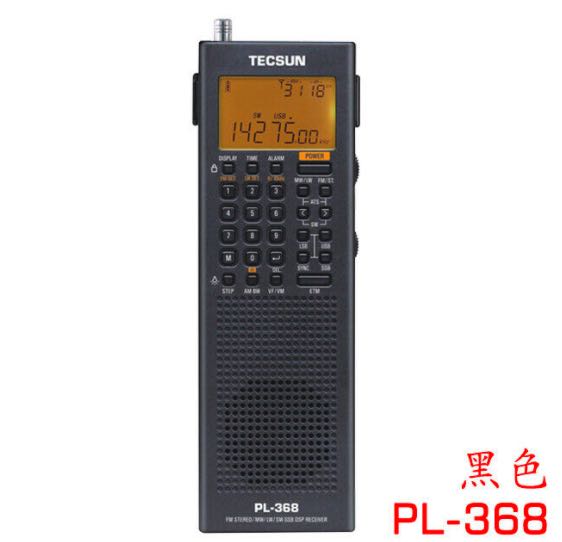
Revisiting the Tecsun PL-368: Assessing a Later Firmware Unit
by Dan Robinson
This past April, I reviewed Tecsun’s PL-368, the update of the PL-365 (also sold by CountyComm as the GP5). There were some major changes: Tecsun shifted from AA batteries to a flat BL-5C cellphone type battery, and of course the marquee design change was the addition of a keypad.
The keypad is a night and day change – whereas before the PL-365 was a handy receiver but hobbled by archaic tuning limited to memory access and the side thumb wheel, the 368 provides easy instant frequency selection.
In my previous review, I mentioned the well-known characteristic of the 360 and 365 models which exhibited over-sensitivity to the touch. When removing your hand, signal levels plummeted – usually, a full grip was necessary and any variation caused reduced sensitivity – noticed mostly in shortwave mode.
The PL-368 I reviewed was from among the first versions of the receiver. It had a firmware of 3681, from a 2020 production run. Recently, I received from Anon-Co – the most reliable supplier of Tecsun receivers – an updated unit, with firmware 3684.
Please see my previous review for comments on various aspects of the 368: the longer but less robust telescopic antenna, addition of detents on the volume wheel, and the welcome addition of adjustable bandwidths, synchronous detection, and ability to tune in 10 hz increments, and other changes.
PROBLEMS
SYNCHRONOUS DETECTION: As with the 909x and H-501, the upgraded 368 now has Synchronous Detection. I did not expect any change in the 3684 firmware – SYNC still has some distortion and loss of lock.
As with the 330, 990x, and 501x successful use of this mode requires a delicate dance involving careful selection of various bandwidths while in SYNC mode and fine tuning.
However, whereas on the previous 3681 unit there was significant “warbling” when in SSB and SYNC, and phonics when touching the keypad, the 3684 unit has little to no such warbling and the phonics appear to be gone, or minimized.
It’s not known what Tecsun may have done to address these issues – my review of a previous 3681 firmware unit was published in April, so it’s hard to think that Tecsun made any major physical changes to the PCB/keypad and radio body. But there does seem to be some improvement.
I had no expectation that a firmware change would result in any improvement in the other major issue common to the 360 series – reduction of sensitivity when the receiver is not being held in the hand.
The 368 still shows a noticeable reduction in signal strength, visible on the display, when left standing on its own versus being fully gripped. But the problem does not seem to be as serious as it was with the PL-360/365.
And since my first review of the 368, I have done some additional comparisons with older portables which were constructed with more robust cabinets. Some of those also exhibited reduced sensitivity when not being held.
For the PL-368 with firmware 3684, the headline really has to be the apparent disappearance of the “phonics” when tapping the keypad and cabinet top surface. This was the elephant in the room on the first very early sample of the PL-368.
While there is still distortion using SYNC mode, this issue seems to have been slightly reduced with the latest firmware. Without confirmation by Tecsun, there is no way to know what specifically may have been done to impact the SYNC issue in a positive direction.
A major disappointment is confirmation from Anon-Co via Tecsun that the re-calibration function seen in the PL-330, 990x and H-501x is absent from the PL-368.
That leaves a user with only the fine tuning option in SSB. This is a real puzzler, since surely Tecsun could have enabled re-calibration on the 368 in the same way it did with the other receivers.
SUMMARY
I stated in my first review of the 368 that this receiver would be an automatic must-buy in my book, were it not for the earlier issues of cabinet phonics and signal level reduction when the radio isn’t being fully gripped in hand.
One hopes that the phonics issue has been fully addressed by Tecsun. It’s possible that my initial early unit of the 368 had some weakness in the PCB for the keypad, and LCD display that has been recognized and corrected.
Without confirmation from Tecsun, it’s also difficult to declare that the 3684 firmware has truly brought about a measurable improvement in SYNC and SSB. But based on my testing of this particular 3684 firmware unit, the radio is more usable and tolerable in SYNC and SSB.
And of course, addition of the keypad along with multi-bandwidth options moves the 368 firmly into the same zone as Tecsun’s other portables, albeit perhaps more in the “prepper” category.
There are so many offerings now from Tecsun in portables that it’s hard for me to place the PL-368 in the “must-buy” category, especially since the PL-330, 990x and H-501x bring so many superb features to the game.
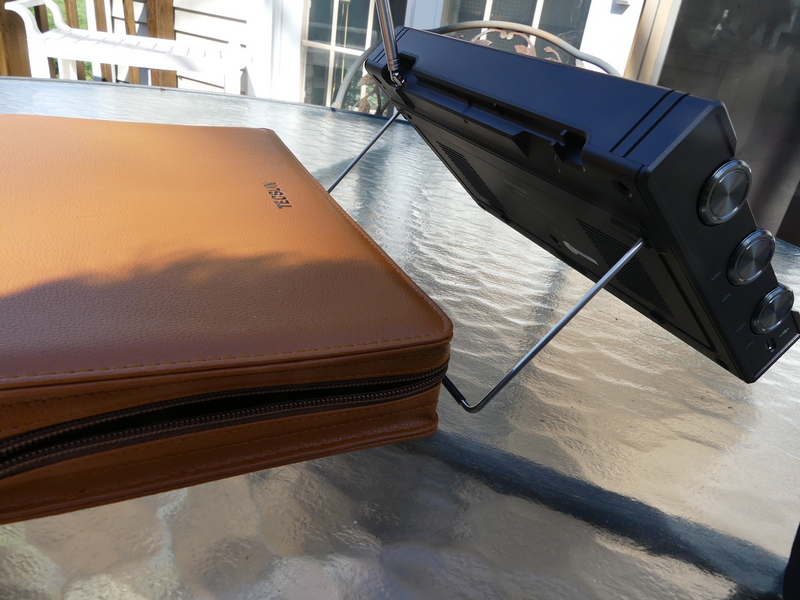
But the PL-368 has a certain appeal – its walkie-talkie style design makes it an easy quick-grab for trips, similar to the PL-330, though the 368 can not really be safely balanced on a flat surface and is best used with some kind of stand.
In terms of raw performance, one has to observe that the wonderful Belka DX has to be considered as a top choice and major competition when it comes to extreme portability and top performance, especially with the available speaker/battery backs.
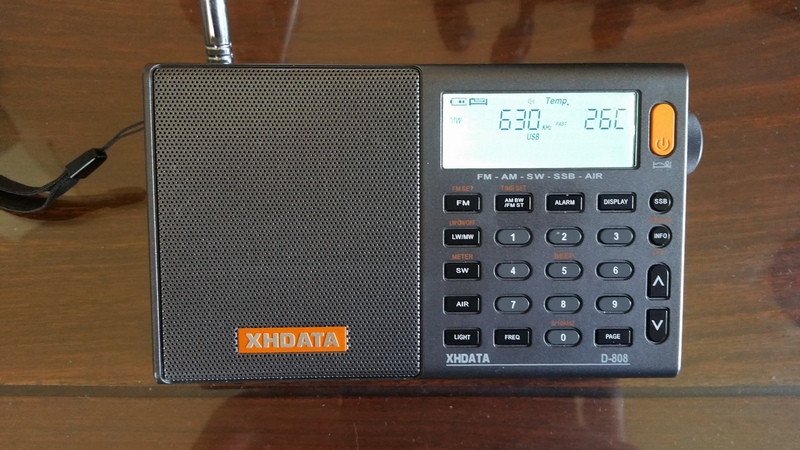
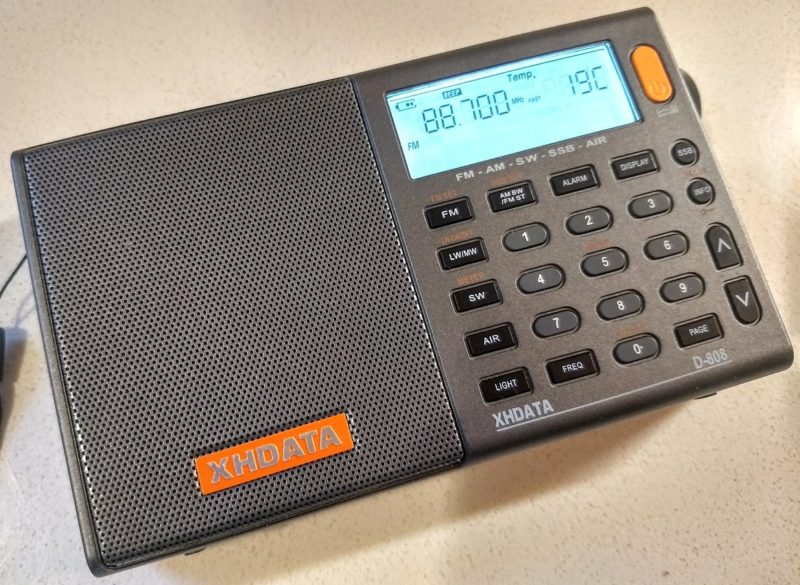
And the PL-368 still has major competition from the XHDATA D-808 (now appearing under the RADIWOW SIHUADON label) with excellent AIR band capability and multiple bandwidths, though no synchronous detection.
To “save” the PL-36xx series, Tecsun will have to ensure steady QC (quality control) in manufacturing and when possible, further firmware updates of the 368, as with all Tecsun receivers.
Switch between internal ferrite rod and whip on AM (MW & LW)
1. Select the MW or LW band.
2. Press and hold key ‘3’ for about 2 seconds.
When the display briefly shows “CH-5” this means that the device is set to MW/LW reception using the telescopic antenna. The display shows MW (or LW) and SW on the left side of the screen.
When the display briefly shows “CH-A” this means that the device is set to MW/LW reception using the internal ferrite antenna. The display shows only MW (or LW) on the left side of the screen.
Adjusting the maximum volume level
Select the frequency band, then press and hold key ‘7’ for 2 seconds until a number is displayed. At this moment, rotate the [ TUNING ] knob to adjust and press the key ‘7’ again to save and exit.
Firmware Version
In power-off mode, press and hold [ VF/VM ] for 0.5 seconds until all characters on the display are shown, then wait a few seconds until the firmware version is briefly displayed at upper right of the display.
Extend SW-range for European setting (1621-29999 kHz)
1. In power-off mode, press and hold the [ 3 ] key to set the MW tuning steps to 9kHz.
2. Select the SW band, and then press and hold the [ 5 ] key for 10 seconds to enable/disable the SW frequency extension.
The starting point of the SW frequency range will become 1621 or 1711 kHz.
Many thanks to SWLing Post contributor, 13dka, who shares the following guest post:
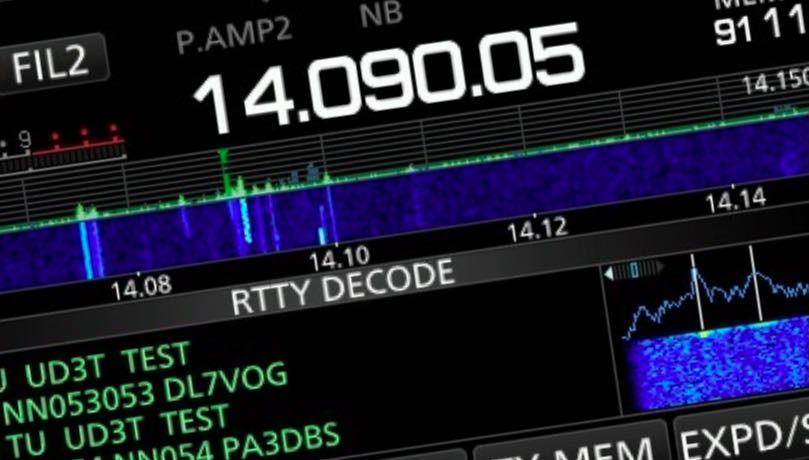
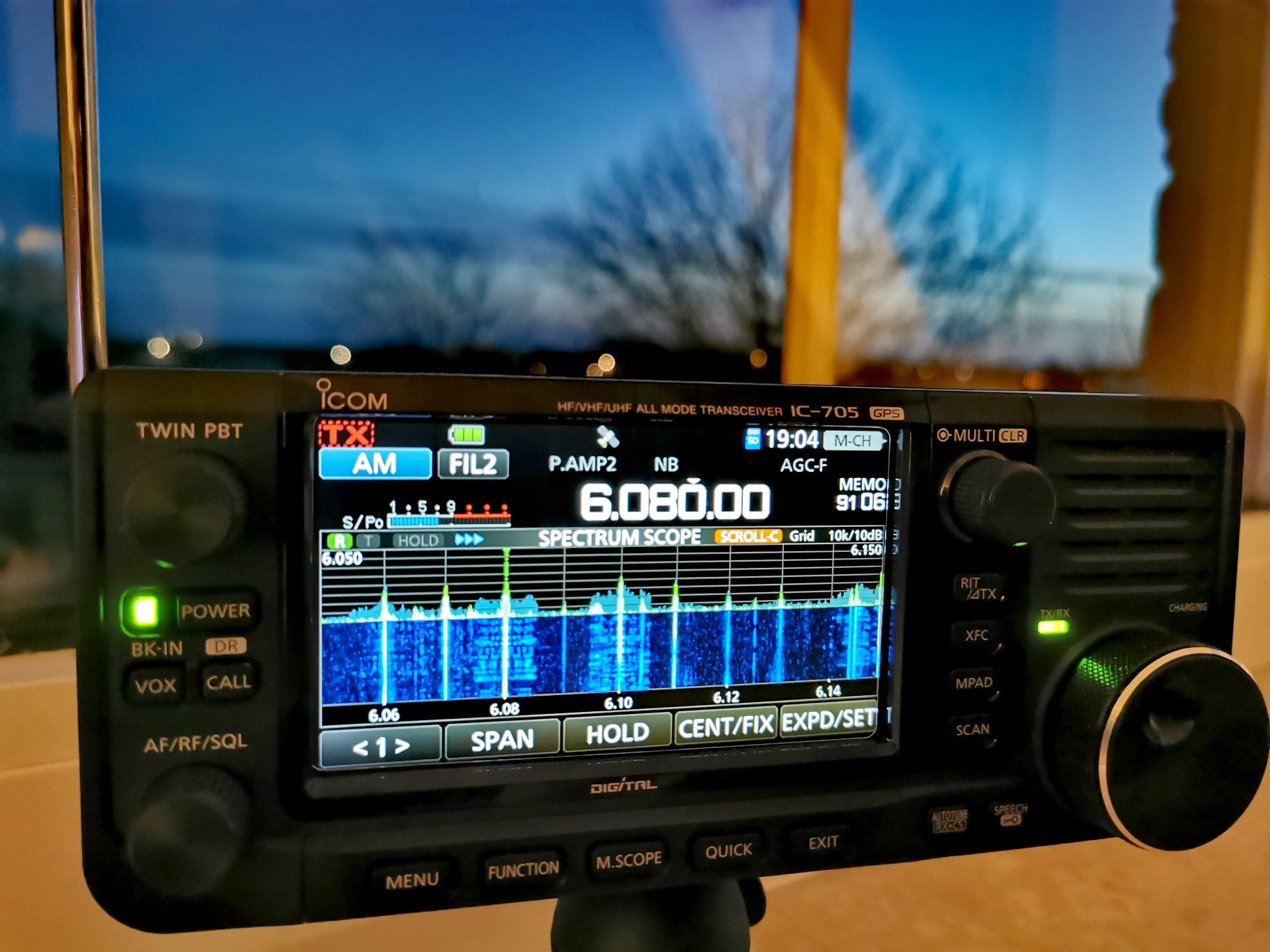
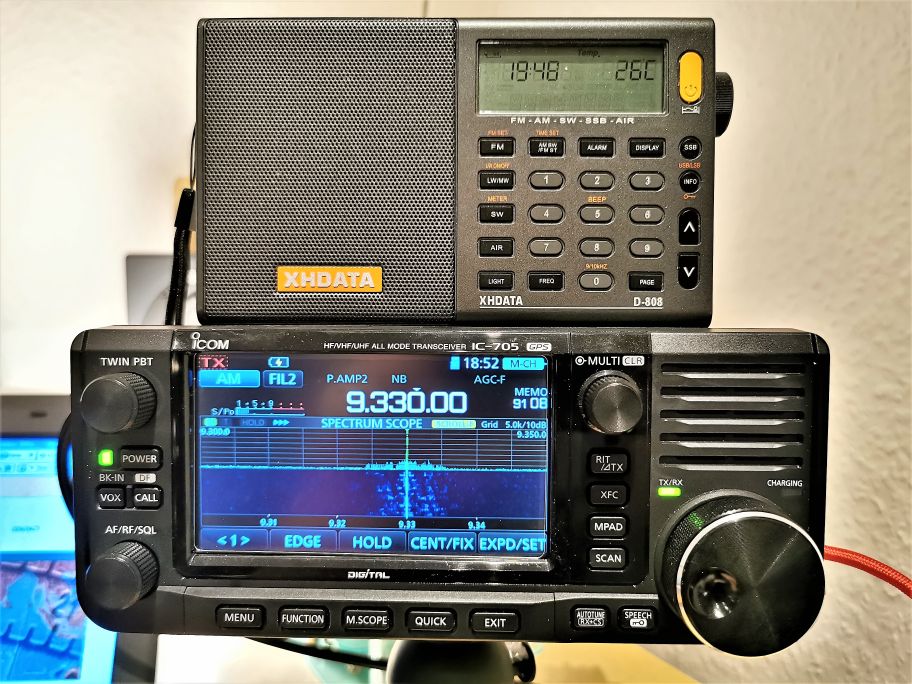
The Icom IC-705: Is this really a new holy grail SWL/BCL receiver?
by 13dka
When Thomas got wind of its development in 2019 he immediately asked “could the Icom IC-705 be a shortwave listeners holy grail receiver?”. I usually wince a little when I hear “holy grail” because it means very different things to different people, it’s also a moving target with many people aiming at the spot where it was decades ago. But Thomas certainly had a very level-headed assembly of technical performance, quality and practicality requirements in mind when he used that term, and I thought he might be onto something!
There are some excellent, trustworthy reviews of the IC-705 out there. The following is not one of them, I just want to share an opinionated breakdown on why I think this is an interesting radio for SWLs/BCLs indeed, also deliberately ignoring that it’s actually a transceiver.
Jumping shop
While the era of superhet/DSP-supported tabletop holy grails ended with the discontinuation and sell-off of the last survivors more than a decade ago, powerful PC-based SDR black boxes were taking over the mid-range segment and it became very slim pickings for standalone SWL receivers: Thomas just recently summed up the remaining options here.
Between the steady supply of inexpensive yet serviceable Chinese portables, upgraded with a least-cost version of DSP technology, and the remnants of the high end sector there’s very little left to put on the wish list for Santa – that doesn’t need to be paired with a computer that is.
No surprise that SWLs/BCLs in search of new quality toys with tangible controls are taking a squint over the fence to the ham transceiver market: Hams are still being served the best and the latest in radio technology in all shapes and sizes, and even entry-level rigs usually come with feature-rich general coverage receivers. But transceivers never had SWLs much in their focus in the past decades, and particularly not BCLs: Frontend adaptation, additional AM filters, switches and functions would’ve meant increasing costs and so transceivers were never perfected for that purpose. DSP and SDR technology allowed for improvements on that without actually adding (much) hardware and so some interesting alternatives surfaced in the past years, but most of them still come with little downers, at least for BCLs.
Many thanks to SWLing Post contributor, Marwan Baayoun, who writes:
Hello Thomas,
I hope this email finds you and yours well and in good health.
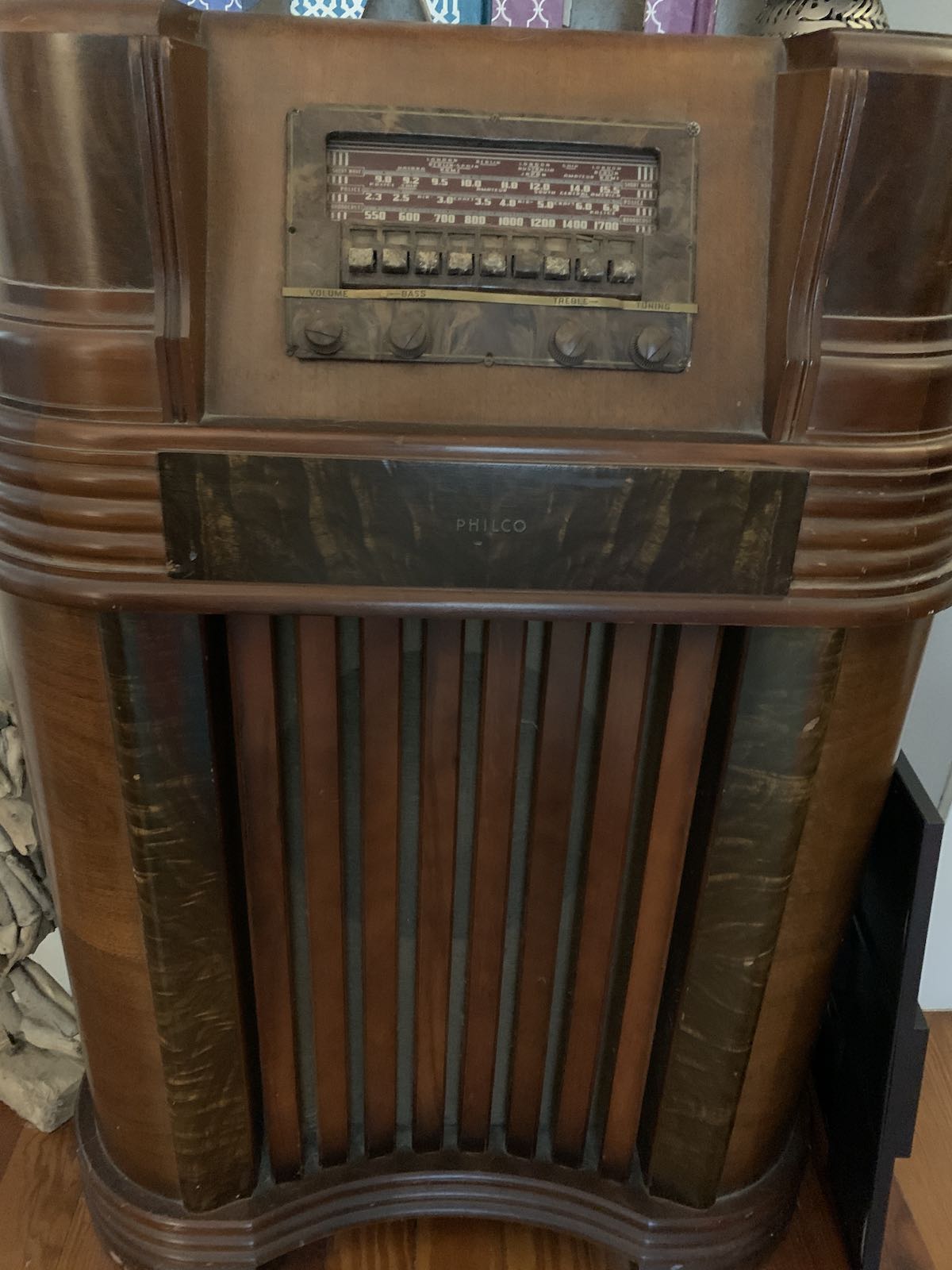
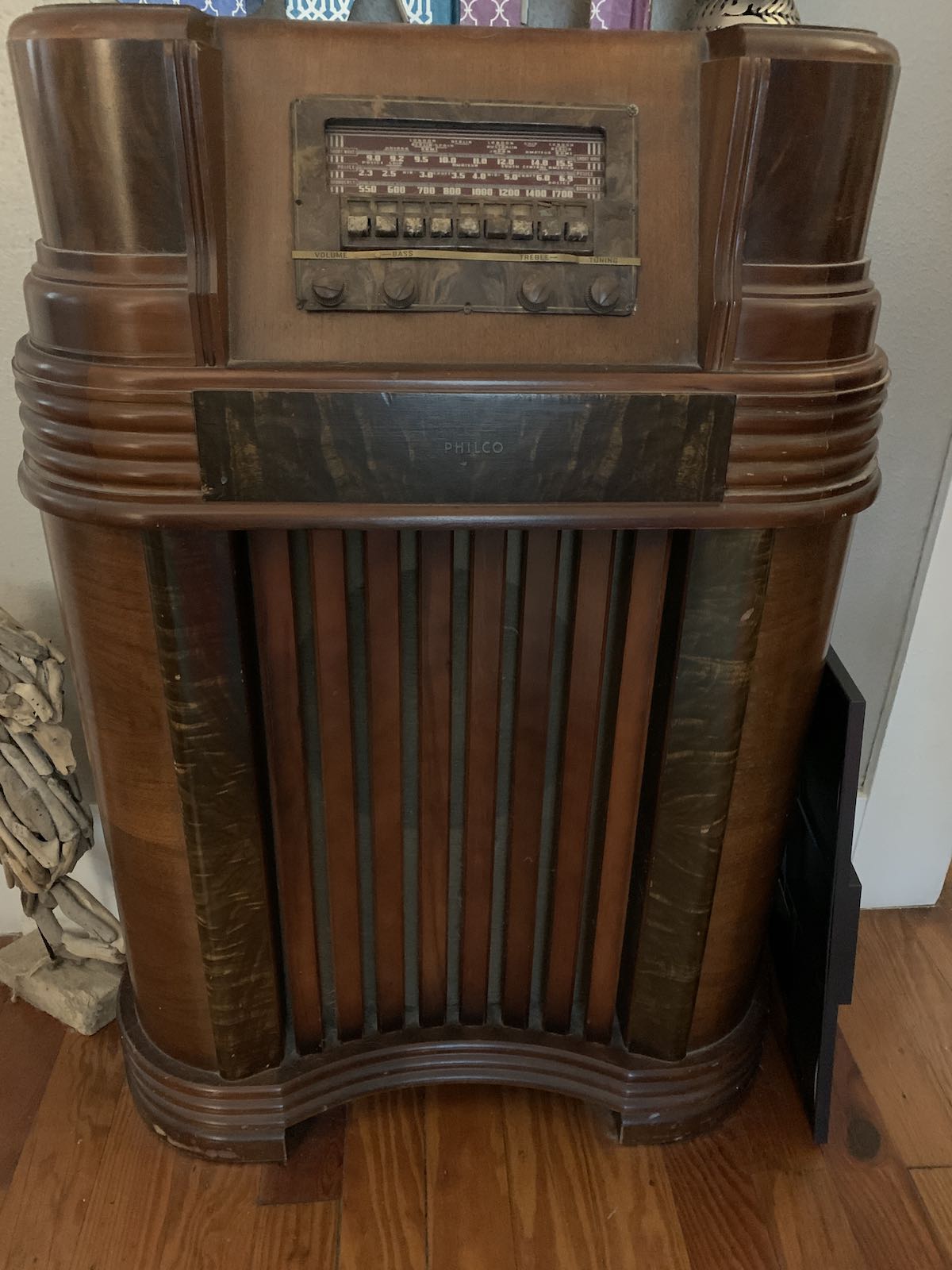
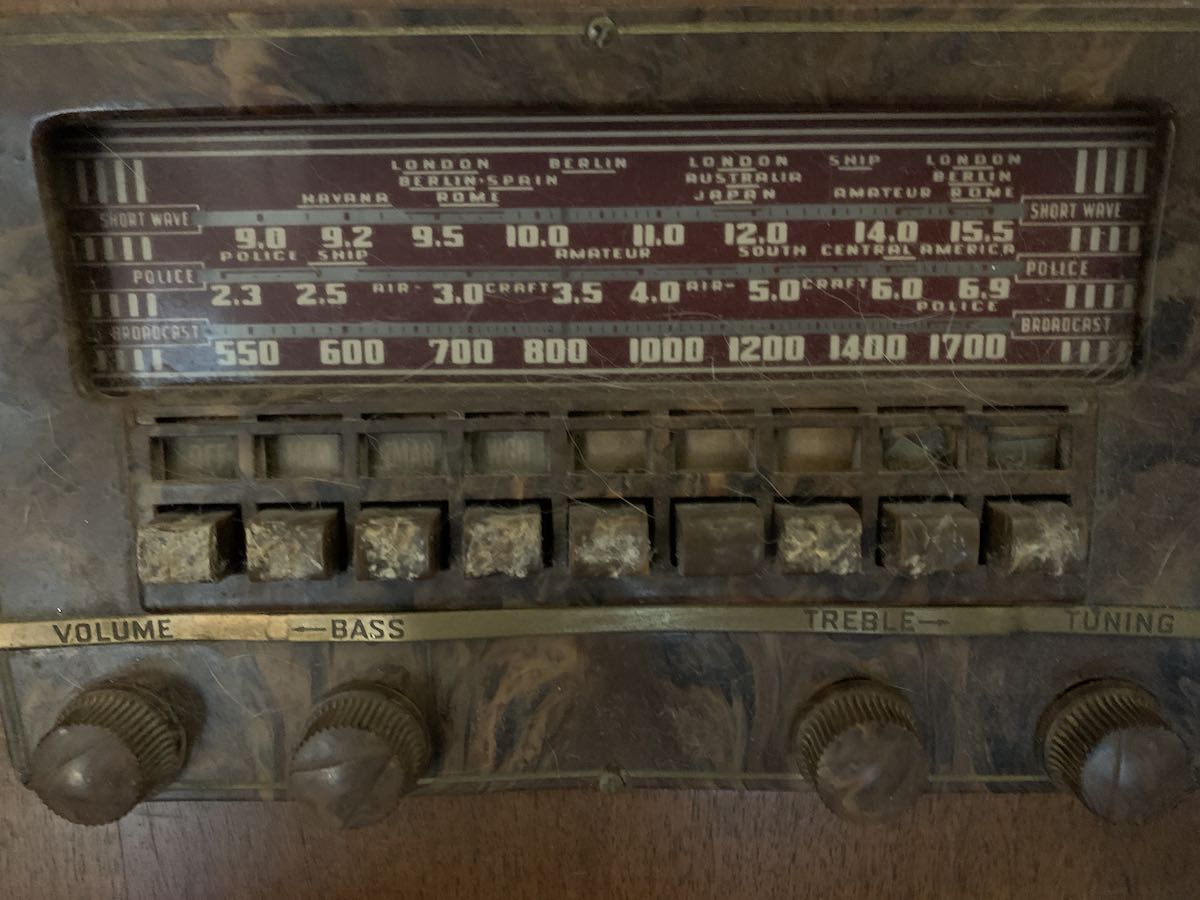
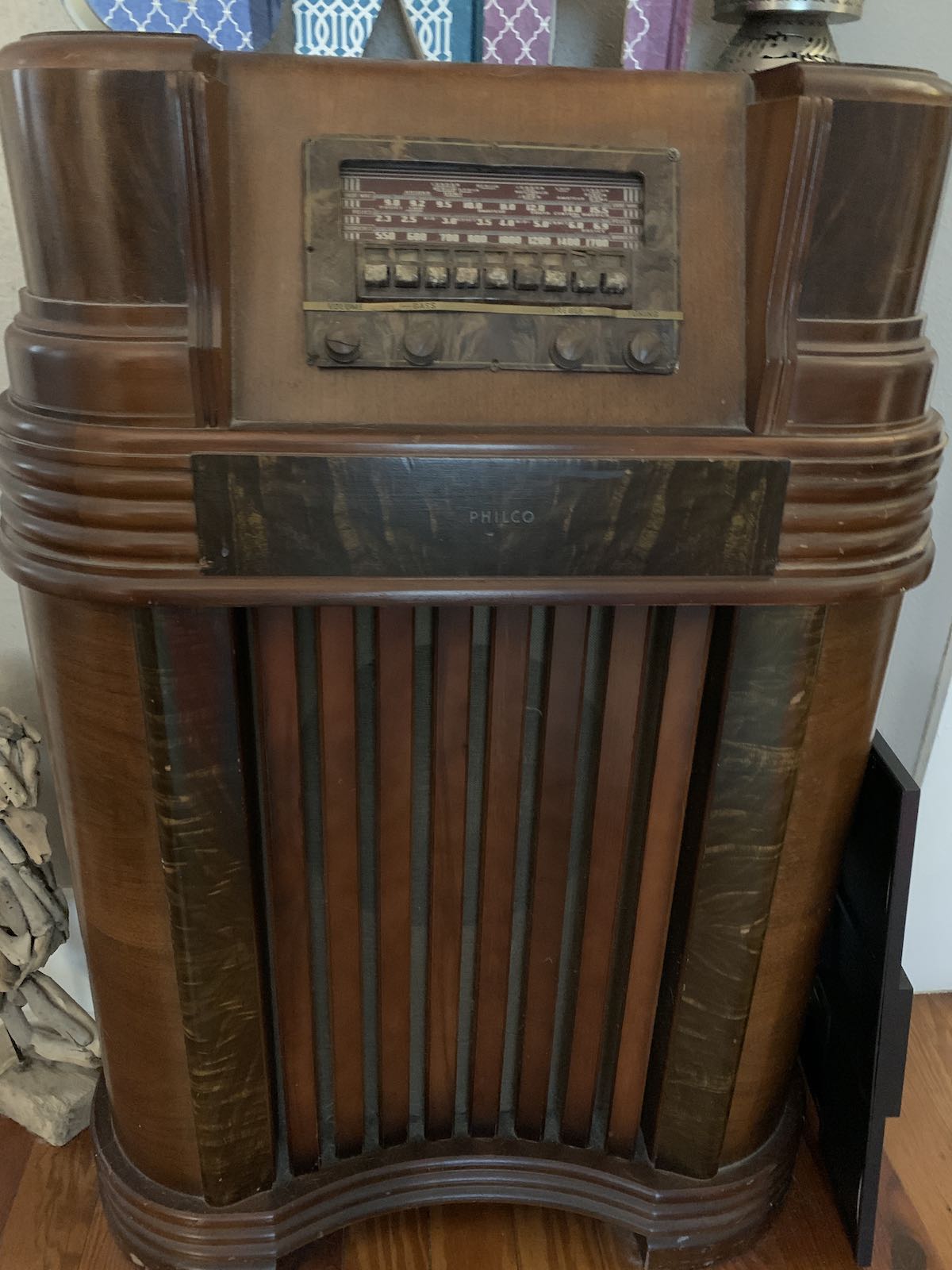
Before our trip to Turkey next Sunday, my wife and I went to see our three month and only grand kid we have. In her play room I noticed that our son in law has an antique radio that his father gave it to him. Upon close look up, I noticed it has shortwave and police bands on line-up. I thought I’d take a few photos and share them with you all. The radio was working but recently some of the tubes inside went out and they need to be replaced.
Below are the pictures I took. Oh, and I decided to take with me my Tecsun PL-880. I so want to take either my Sony SW-2010 or the ICF-SW77, but I don’t want to risk not seeing them in case they get confiscated. The next top model that I have and that I can alway replace is the 880 and I figured it is the one that’s going to accompany me on out trip.
Cheers and I hope the photos are of interest.
Marwan
Thank you for sharing this, Marwan! Those Philco console radios are simply stunning–I love the craftsmanship of the body. I’m not familiar enough with Philcos of this era to identify it, but perhaps someone here in the SWLing Post community can! I certainly hope your son-in-law can have it repaired–this radio would have amazing audio.
And, yes! I think the PL-880 would make for a great travel companion on your upcoming trip!
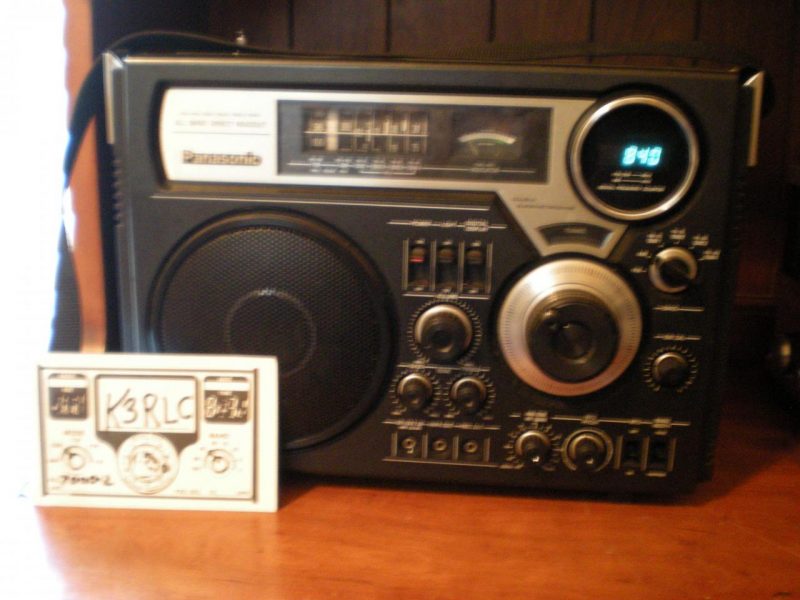
A nice condition looking and playing radio that has no damage or smoke smell etc. The only item not working is the dial lamp went south, an easy replacement. Battery box is clean and runs off ac power as well.(cord included) I am asking $110.00 and will help some on the shipping costs, Pay Pal is ok I will eat the fee. Tnx & 73
That is not a bad deal for a working RF-2600. Of course, you’d need to assume if the capacitors have never been replaced, that might need to be done in the near future. Recapped? This would be a superb receiver. I know Vlado has re-capped and restored these before.
Speaking of Vlado, the second tip is that he is selling a number of used radios from his own collection. All are in good working condition–he would provide photos with cosmetic condition. He claims on the site that they’re for local pickup only, but I’m betting he would quote a shipping price if you ask nicely.
Here’s the list at time of posting:
ICOM IC-746PRO in a box, with microphone.
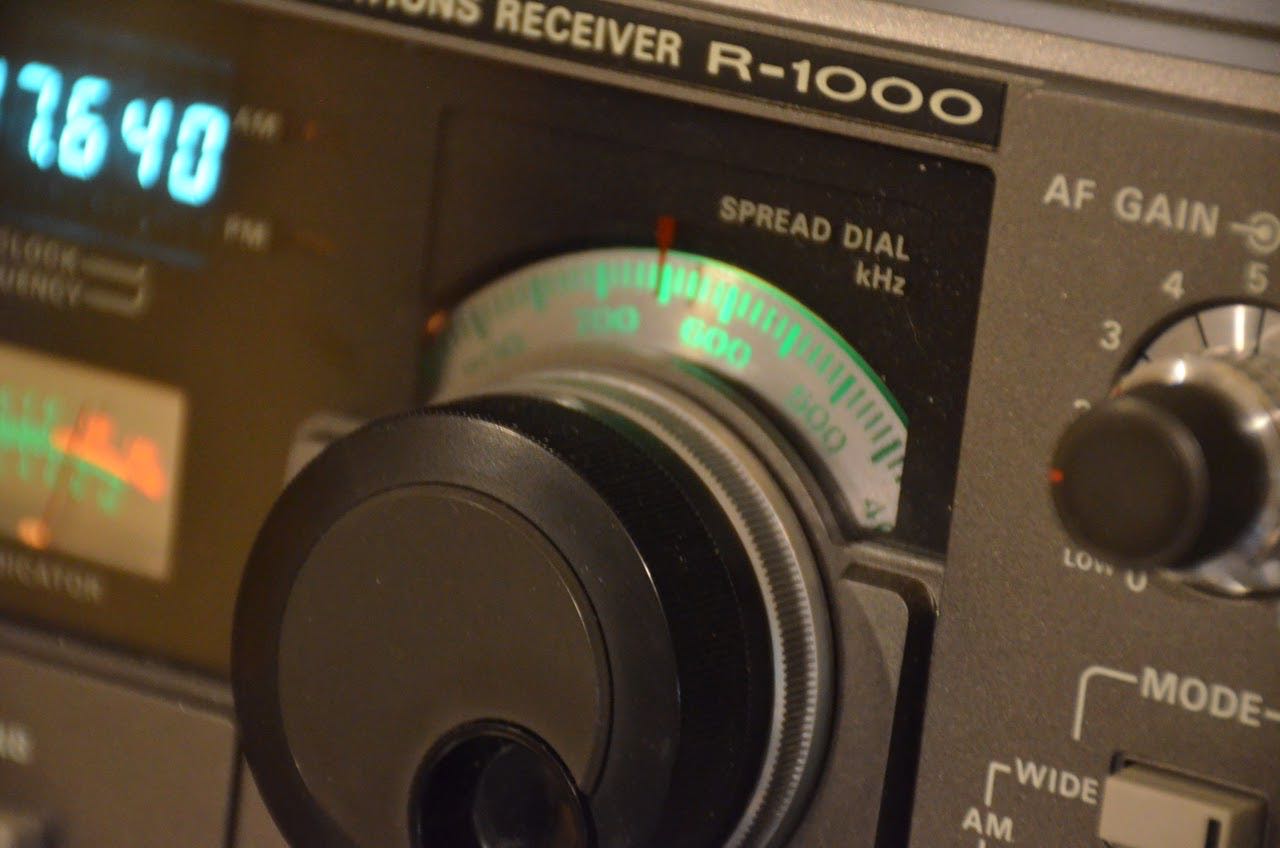
Kenwood R-1000 Shortwave receiver with power cord.
Kenwood TS-50 HF transceiver with DC power cord and mic.
ICOM IC-271H with built in power supply, microphone included.
Kenwood TS-870S with microphone and DC power cord.
Kenwood HF Transceiver TS-850S with 2 CW filters (455KHz/8.8MHz IF filters), desk microphone MC-50, DC power cord, voice recording unit, remote memory control unit RM-1. Great condition. Note: My DX companion since the days of ZS6MG.
ICOM IC-7000 with microphone and DC power cord (Note: Minor issue with the Band Down button cover missing, otherwise great condition).
Sony ICF 2010 AM/FM/SSB Medium wave, SW, FM and Airband receiver with AC/DC adapter. Few available.
Sony ICF SW-100, Shortwave and FM pocket receiver, AM, FM, SSB. Few available.
Kenwood TS-2000X transceiver, HF/VHF/UHF and 1.2GHz, DRU-3 digital voice recording unit, VS-3 voice synthesizer unit, microphone and DC power cord.
ICOM IC-745 with FM unit, fully loaded with filters, keyer board, microphone and DC power cord.
He hasn’t listed prices on these, but if you’re interested, just inquire. His email is vlado -at- hamradio.repair. Click here to view his rigs for sale. If you buy from Vlado, you’ll know that the radio will work as it should.
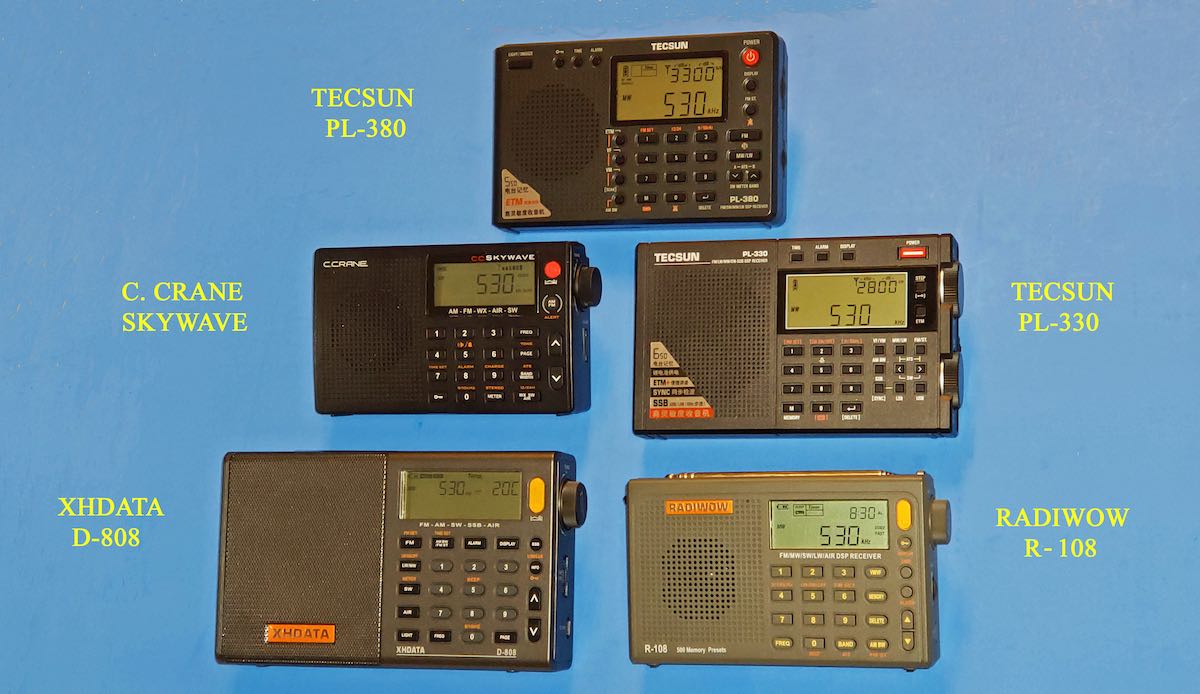
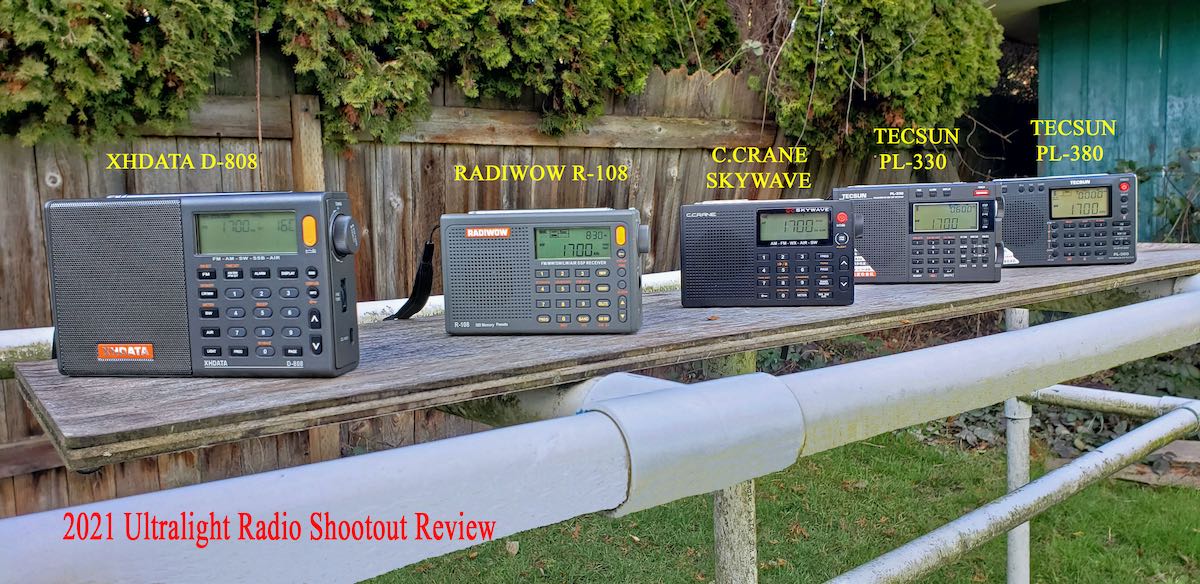
Many thanks to SWLing Post contributor, Gary DeBock, who shares his extensive 2021 Ultralight Radio Shootout.
This is truly a deep dive featuring five popular ultralight portable radios and examining mediumwave, shortwave, FM, and AIR Band performance.
The review is an amazing 40 pages long! In order to display the entire review, click on the “Continue reading” link below.
2021 Ultralight Radio Shootout
Five Hot Little Portables Brighten Up the Pandemic
By Gary DeBock, Puyallup, WA, USA April 2021
Introduction The challenges and thrills of DXing with pocket radios have not only survived but thrived since the Ultralight Radio Boom in early 2008, resulting in a worldwide spread of the hobby niche group. Based upon the essential concepts of DXing skill, propagation knowledge and perseverance, the human factor is critical for success in pocket radio DXing, unlike with computer-controlled listening. The hobbyist either sinks or swims according to his own personal choices of DXing times, frequencies and recording decisions during limited propagation openings—all with the added challenge of depending on very basic equipment. DXing success or failure has never been more personal… but on the rare occasions when legendary DX is tracked down despite all of the multiple challenges, the thrill of success is truly exceptional—and based entirely upon one’s own DXing skill.
Ultralight Radio DXing has inspired spinoff fascination not only with portable antennas like the new Ferrite Sleeve Loops (FSL’s) but also with overseas travel DXing, enhanced transoceanic propagation at challenging sites like ocean side cliffs and Alaskan snowfields, as well as at isolated islands far out into the ocean. The extreme portability of advanced pocket radios and FSL antennas has truly allowed hobbyists to “go where no DXer has gone before,” experiencing breakthrough radio propagation, astonishing antenna performance and unforgettable hobby thrills. Among the radio hobby groups of 2021 it is continuing to be one of the most innovative and vibrant segments of the entire community.
The portable radio manufacturing industry has changed pretty dramatically over the past few years as much of the advanced technology used by foreign companies in their radio factories in China has been “appropriated” (to use a generous term) by new Chinese competitors. Without getting into the political ramifications of such behavior the obvious fact in the 2021 portable radio market is that all of the top competitors in this Shootout come from factories in China, and four of the five have Chinese name brands. For those who feel uneasy about this rampant copying of foreign technology the American-designed C. Crane Skywave is still available, although even it is still manufactured in Shenzhen, China—the nerve center of such copying.
Prior to purchasing any of these portables a DXer should assess his own hobby goals, especially whether transoceanic DXing will be part of the mission– in which case a full range of DSP filtering options is essential. Two of the China-brand models use only rechargeable 3.7v lithium type batteries with limited run time, which may not be a good choice for DXers who need long endurance out in the field. A hobbyist should also decide whether a strong manufacturer’s warranty is important. Quality control in some Chinese factories has been lacking, and some of the China-brand radio sellers offer only exchanges—after you pay to ship the defective model back to China. Purchasers should not assume that Western concepts of reliability and refunds apply in China, because in many cases they do not. When purchasing these radios a DXer should try to purchase through a reputable seller offering a meaningful warranty—preferably in their own home country.
One of the unique advantages of Ultralight Radio DXing is the opportunity to sample the latest in innovative technology at a very reasonable cost—and the five pocket radio models chosen for this review include some second-generation DSP chip models with astonishing capabilities. Whether your interest is in domestic or split-frequency AM-DXing, FM, Longwave or Shortwave, the pocket radio manufacturers have designed a breakthrough model for you—and you can try out any (or all) of them at a cost far less than that of a single table receiver. So get ready for some exciting introductions… and an even more exciting four band DXing competition!
Many thanks to SWLing Post contributor, Dan Robinson, who shares the following guest post:
Revisiting the XHDATA: What Sangean Should Have Learned from the D-808
by Dan Robinson
Recent additions to the shortwave portable receiver market have been quite impressive, especially considering the continuing decline in the use of shortwave as a transmission method by broadcasters.
In what could be the final models from Tecsun, we saw the PL-330, PL-990x and H-501x all of which bring impressive features and capabilities to the game. Sangean finally introduced its upgraded ATS-909×2 including an early firmware upgrade that was supposed to correct some issues with this receiver.
As I have observed in some recent reviews, the very fact that the listening community still sees any new receivers is reason for gratitude, though we also have opportunities to acquire numerous classic receivers and can still do an excellent job in today’s listening environment.
One receiver that emerged a few years ago and which took the listening hobby by storm was the XHDATA D-808. Numerous reviews are online, including ones here on the SWLing Post, and excellent reviews by Gilles Letourneau here and here.
The 808 was and still is compared to the CCrane Skywave SSB, a much smaller and compact receiver. Unfortunately, in my experience both suffer from soft muting.
I obtained a D-808 shortly after it appeared based on early positive reviews. I used it once, at the beach in Florida where reception conditions were superior – comparing it to some older portables in my collection such as the SONY ICF-SW07, ICF-SW55, and the Panasonic RF-B65.
I was impressed with the sensitivity of the 808, large speaker, and inclusion of AIR band, though I noticed some digital artifacts and agree with negatives such as slight soft muting and chuffing, and slowness of the processor.
I boxed the D-808 up and stored it away where it sat until recently when I took it back out after my experience using Sangean’s ATS-909×2 – thus the title of this brief commentary.
Sangean made some basic decisions with the 909×2. Many of them are quite positive over the old 909x. For many users the 909×2 has more than enough features to justify the higher price of the receiver.
I came to a different conclusion after returning my ATS-909×2, and I started thinking about how the D-808 could have informed engineers at Sangean as they considered which features to put in the 909×2. To what extent Sangean designers looked at various other portables, including the D-808, we will probably never know.
D-808 DEMONSTRATES IMPORTANCE AND IMPACT OF BANDWIDTH FILTER CAPABILITY IN SSB
AM bandwidth control on the ATS-909×2 is quite nice. However, what leaps out is the absence of multi-bandwidth capability in SSB mode. It’s baffling that Sangean seems not to have recognized this as a must-have feature.
Tecsun started providing this on small receivers years ago, and in the PL-880, the excellent though flawed portable that also took the listening world by storm, and in the recent 330, 990x and 501x.
Using the D-808 again after a few years reminded me that this little China-made receiver offers no less than SEVEN bandwidths, in AM mode. Let me say that again: SEVEN (7) bandwidths.
You don’t find that kind of selectivity capability even in a Drake R8B. After that, you’re getting into continuously variable bandwidth control found in premium DSP receivers.
So, in AM mode you have: 6 kHz, 4 kHz, 3 kHz, 2.5 kHz, 2.0 kHz, 1.8 kHz, and 1.00 kHz
The D-808 also has fine tuning capability. This is not the same as the Tecsuns which actually enable you to re-calibrate, and with adjustment that remains set for both USB and LSB. On the D-808 you fine tune to zero beat, but have to repeat the correction for LSB and USB on the frequency you’re on – it’s a bit more twiddly, but on my 808 the fine tuning is nonetheless very smooth.
Nevertheless, combined with SIX bandwidth options when in SSB, the fine tuning option on the 808 is a superb feature, not to mention that on my particular D-808 there is little to no “warbling” when carrying out the fine tune operation.
So, in SSB on on the D-808 you have: 4.0 kHz, 3.0 kHz, 2.2 kHz, 1.2 kHz, 1.0 kHz, and an amazing .5 kHz ! Imagine that: .5 kHz
I usually remember stuff like this, but when I first tried the D-808 in Florida back in 2018 I was more focused on assessing sensitivity, audio, and issues such as its pretty slow DSP response when changing modes.
So, now you have to pick me up off the floor as I re-visit the D-808 and realize what an amazingly capable little radio it really is – again, see the excellent reviews by Gilles in which he pays a lot of attention to this fact.
Additional years ago, I used receivers such as SONY SW-55s and Panasonic RF-B65s in ocean side DXing. These are fine receivers, but the 55 is limited to two bandwidths, NARROW and WIDE – similar to the SONY 2010 and SW-77, both of which also had effective synchronous detection.
One of my best DX catches at that time was Radio Rwanda on 6,055 kHz just before it’s sign off in the late afternoon eastern timed. Using a Panasonic RF-B65 which had NO bandwidth options, I was able to hear and record a full sign off and ID.
However, had a D-808 existed at that time this would have been much easier because of the multiple bandwidths in both AM and SSB. I imagine a SONY ICF-SW7600GR would have done a good job as well, but it too does not have the multiple bandwidth options that a D-808 has.
These days, with the number of stations on the air reduced even further, examples like this may be fewer and farther between. But one has to observe that for AMATEUR radio listening, the amazing bandwidth capability of a D-808 really sets it apart from the pack.
Am I glad I re-discovered the D-808? You bet. It was on my list of TO SELL receivers. Now, it has a reprieve and is firmly back on my keeper list.
I have to think that it is highly unlikely that there will be a new version of the D-808, unless someone out there has heard something in the receiver rumor mill that I have not. Perhaps the folks at XHDATA/RadioWOW will take this hint.
If XHDATA were to re-design the 808, the most improvements one would hope for are obvious: a newer and faster DSP chip to speed up mode changes, a jack for external recording. A real long shot would be to hope for the same sort of calibration adjustment seen in the Tecsun receivers.
When I really get to dreaming, I think of XHDATA or some other maker designing a portable like the 808 – why not call it the 1000 Super DSP – that actually has continuously adjustable bandwidth control. This will never happen.
It’s doubtful that XHDATA or some other manufacturer will consider competing directly with Tecsun and Sangean. But the D-808 carved out a place for itself in the small portable category, at an extremely competitive price point.
As this was not an exhaustive retro review of the D-808, I have not gone into the various negatives that every D-808 owner knows to exist.
Lack of a RECORD OUT jack is one. A D-808x might implement Bluetooth capability as Tecsun has, and MicroSD recording capability (though that gets into issues that appear to have prevented Tecsun from doing the same). And surely, get rid of the soft muting.
In conclusion, I go back to a question that occurred to me as I used the Sangean ATS-909×2: what Sangean could or should have learned from the D-808.
Here was a small, well-designed DSP radio that burst upon the scene with outstanding capabilities and which even today is prized among those who own it. Need I repeat? SEVEN bandwidths in AM mode, and MW, and SIX in SSB and LW.
Every company that’s still manufacturing receivers makes its own decisions. It’s as important that we voice our gratitude to Sangean for its latest (possibly last) effort to revise the 909xxxx series as it is to Tecsun for offering no fewer than THREE superb world band receivers.
Sangean has received feedback from me and other reviewers about the x2. All of that is aimed at helping the company possibly correct shortcomings in the new receiver. I hope that this commentary is another step in that direction.
Many thanks to SWLing Post contributor, Dan Robinson, for the following guest post and review:
The H-501: Jewel in the Tecsun Crown, With Some Attractive Features
by Dan Robinson
Since 2020, there has been one Tecsun receiver I have been most looking forward to reviewing, and that is Tecsun’s H-501.
Videos showing the pre-production and mainland China versions of the 501 started appearing online at least a year ago. There are also numerous videos showing comparisons between the H-501 and PL-990x as well as the PL-330.
What I will do here is provide an assessment of the 501 informed by my use of a H-501 just received, the other two Tecsun receivers, and my decades of experience using a wide range of portable receivers. This review is based on initial tests of a H-501x, among the first production units.
Video: Unboxing
HOMAGE TO RECEIVERS OF THE PAST
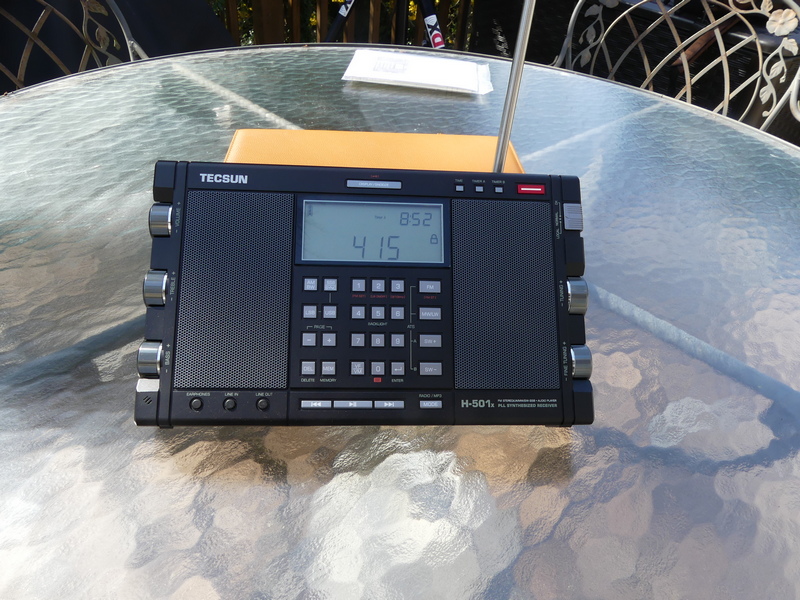
The elephant in the room with the 501 is, of course, its two large left and right speakers. This reminds one of another Tecsun DSP portable, the PL-398BT with a similar left-right speaker arrangement.
On the left of the H-501, from the top, are the Volume, Treble, and Bass knobs which like the PL-880 and 990x has obvious lineage back to the famous Grundig portables of the 1990’s – the Satellit 500 and 700. Both of those were limited to two bandwidths. Only the 700 had anything approaching usable synchronous detection.
Each of the left hand control knobs on the 501 contains a dot to indicate where you are in the Maximum/Minimum range. At the bottom of the left side is a micro-USB port for when the receiver is used as a computer speaker – quite a nice feature!
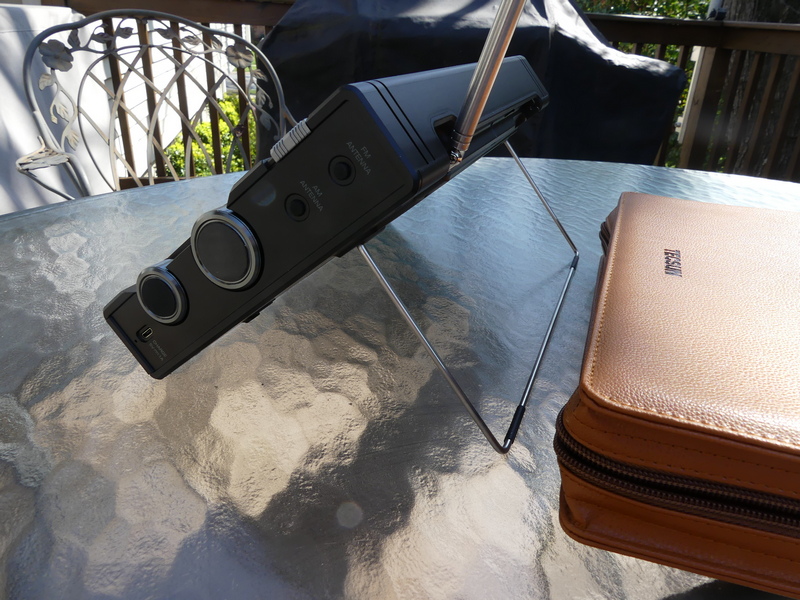
On the right side of the 501 you find ports for AM and FM antennas, each with a rubber traction cap, similar to what is found on the PL-990x. There is also a three position sensitivity sliding switch for Local, Normal, and DX modes – that’s one more than usually found.
Knobs on the right side are the Main tuning and Fine tuning, again similar to the PL-990x. At the very bottom of the right side is the 5v 1.0 amp micro-USB charging port.
ERGONOMICS
NEGATIVE: Here I discuss one of two major negatives with the 501. The tuning knobs are embedded quite far into the radio body. Each has a round piece of rubber covering on the knob end surface designed obviously to provide traction, possibly also as a protective measure.
The reality is that on the 501, more seriously on the PL-330, embedding of the knobs so far into the cabinet makes it virtually impossible to undertake rapid tuning using those knobs if you are just placing your finger on the top barrel part of the knob itself!
As you will see in photos and video accompanying this review, holding a finger against the rubber on the end of each knob, or closer to the center, to achieve more rapid tuning. But it’s kind of annoying. On the PL-990x the knobs are somewhat different – extending a bit farther out of the cabinet, but also with the rubber coverings.
So, this is a design point for Tecsun to consider. Surely, it should be possible to come up with slightly different knobs for the 501 that make it more comfortable to achieve rapid tuning. As it is, the knobs on the 501 barely extend beyond the cabinet edge, including the end and rubber cap.
The same goes for the PL-330 – which has knobs that only one half inch in depth, and extending only about 1/16 of an inch beyond the cabinet edge. Part of the attractiveness of the 330 is its compact size and I doubt Tecsun will be moving to put slightly larger knobs on that radio anytime soon. But as it is, using the main and fine tuning controls on the 330 gets you maybe 10 kHz in tuning range.
[UPDATE] I realized after further use of the 501x that Tecsun clearly intended for the rubber knob cap covers to act as traction for tuning. The problems I see: after significant use over time, those rubber covers will lose their stickiness and thus their ability to help tuning will be reduced. Also, the fine tuning knob is smaller — and even using the rubber cover on the knob for more traction, it is somewhat difficult to achieve rapid tuning in 1 kHz mode. Tecsun could help 501x owners on the issue with the tuning knobs by including spare rubber knob caps. But it’s uncertain how the existing rubber knob covers are attached to the original knobs and how easy it would be to replace them when they lose their stickiness.
H-501 IMPRESSIVE FRONT PANEL
At the top of the H-501 radio above the LCD display can be found the Display/Snooze/Lock button. On an older Tecsun radio, the PL-880, this button doubled as the calibration adjust control. On the PL-990x this triple function button is located on the top of the radio.
LCD DISPLAY
POSITIVE: One of the big positives of the 501 is the large LCD display. The number digits are absolutely huge and make it easy to read frequencies.
Thanks Tecsun! The display contains numerous bits of information about receiver operation, the signal strength meter, etc.
Below the display is the keypad, with special dual keys for 9/10 kHz mediumwave, Longwave activation, and FM range adjustment. Backlight activation is on the 5 key. At the bottom you have the VF/VM key to select between frequency tuning and memories. To the right are the FM, MW/LW, and SW + and – buttons. These put the radio into shortwave mode and as is the case with the PL-990 and other receivers, activate ATS/ETM tuning.
At the very bottom of the front panel can be found PLAY/PAUSE, RR, and FF buttons for control of SD card audio when using the microSD card, which like on the 990x is located on the bottom of the receiver. According to the manual, by the way, the microSD slot accepts cards of up to 128 GB. Included in the box is a 16 GB SanDisk Ultra card. A reset hole is also on the bottom of the radio.
Finally, at the bottom of the 501 face are rubber covered input ports for Earphones, Line In, and Line Out.
METAL TILT BAIL
POSITIVE AND NEGATIVE: On the back of the receiver, you find the metal tilt bail which folds down and locks into two plastic tabs and can be lifted easily with a finger from an indentation in the cabinet.
This was a good design move by Tecsun, with the following observations: there are no incremental positions on the metal bail as you find on, say, a Microsoft Surface or similar tablet type PC. The only fully stable position is to have the metal bail fully extended back. That places the 501 in a great position if you’re standing or even sitting to a degree. But if you try to place the bail in any middle position you’re in danger of having the radio become unstable. Tecsun should definitely give some thought to a re-design, though the bail is better than the flimsy plastic stands found on the PL-990 and PL-880 and some older portables.
Still on the back of the radio, intelligently, Tecsun marks a screw hole which can be used to remove the telescopic antenna (marked as ANT SCREW). The other screw holes for removal of the back of the radio are also clearly marked. Thanks Tecsun!
However, one additional partial negative – there are no rubber pads on the bottom back edge of the 501x which will be contacting whatever surface the radio is sitting on while the metal bail is in use. So, if you don’t want that bottom back edge to be scratched, place the radio on something to cushion it.
BATTERY CHARGING
POSITIVE: Another interesting feature not found on other radios: Tecsun has created a dual charging system for the 501 which uses two 18650 batteries.
In viewing numerous videos, I have not seen this discussed much. Basically, this enables you to use the receiver’s internal charging capability to choose which battery you are charging. The manual states that the battery contains space for a “spare” battery. The charging indicator on the LCD display will flash while charging is underway – there does not appear to be a separate display for battery A or B. However, and this is quite a unique capability – while you are using the 501x, the switch changes which battery the radio is using.
It’s not clear to me whether the receiver while powered on is taking energy from one or both batteries simultaneously. As I note in my reviews, and this is amplified in the manual, do not expect to be able to charge a battery internally and listen to the radio at the same time because there WILL be noise.
HUGE WORLD MAP AND RADIO DIAGRAM INCLUDED
Tecsun includes a huge – and I mean HUGE – World Amateur Radio map in a plastic pouch with the manual. On the back of this is a large photo of the 501 with clear English guide points to each and every feature of the radio. In this, Tecsun is really going out of its way to make owning the 501 a special experience.
In the box (see photos) Tecsun includes 2 18650 lithium batteries, a 5 volt double USB A charging cube, a mini to mini cord, a USB charging cable, and to boot, a pair of fairly high quality wired earphones complete with spare ear tips.
PERFORMANCE
Anon-co advises that the H-501x uses a different IC than the PL-990x. No further details were available as of the time of this writing.
This is clearly a sensitive radio, as is the PL-990X. In these days of declining use of shortwave, almost any receiver is going to be able to hear “stuff” all over the bands and the 501x and 990x as well as the 330 are all quite capable in this regard.
In the video, I tune some familiar stations, including Voice of Greece and BBC
and move through the excellent bandwidth options. This is where the 501, with its large dual speakers, excels because if you’re on a strong station – Greece is a great example because of its great music programs – and you have that wider option, it’s really pleasant to listen to.
NEGATIVE: However, one has to puzzle over the decision to limit bandwidth to 6 kHz when in shortwave mode. On mediumwave (AM) you have a 9 kHz option which provides some fine listening. Perhaps Tecsun felt that there are few stations using shortwave these days that would benefit from having a significantly wider option? I would urge Tecsun to make 9 kHz available in shortwave.
SYNCHRONOUS DETECTION
NEGATIVE: I really had some hope that Tecsun would go farther toward
solving the problem of unstable/distorted SYNC mode with all of these recent radios. Unfortunately, it was not to be.
Using SYNC on these radios – though this was not the case with the PL-660 and 680 – involves a delicate dance, requiring using a combination of bandwidth filters and LSB/USB. SYNC works fairly well with some stations, but it really depends on signal level, and to an extent signal level of any station close to the frequency you are on.
There is a 1 kHz fine tune spread when using SYNC after which lock is lost. And still, lock is often lost even when you’re on center frequency and not using
fine tune in SYNC – the signal just becomes distorted. Not fun. The PL-990x has the same issues.
Now, Tecsun has definitely made progress since the horrendous implementation of SYNC on the PL-880, which wasn’t even an official feature. But it’s disappointing that given the design features in the 501, especially the wonderful dual speakers, a way has not been found to resolve this issue which obviously involves the DSP chip that is the brain of the receiver.
Video: Detailed testing of Tecsun H-501x
ANTENNA
NEGATIVE: One of the things the folks at SONY, Panasonic and some other manufacturers did so well was design radios with antennas that nested inside the radio and could be pulled up and out of the cabinet, and because of this, there was clearance from the top of the radio so the antenna can achieve vertical position. Tecsun has not done the same. Antennas on the H-501x, PL-990x, PL-330 swivel but cannot take up vertical position, and of course they are nested on the top of the radio. One would have thought that after years of producing portables, and coming to dominate the portable market, someone at Tecsun would have recognized the importance of antenna re-design. NOTE: the antenna on the 501x is sufficiently long, but on the PL-330 for example, seems to be not long enough.
BLUETOOTH
POSITIVE: Hooray for Tecsun in integrating BT capability into the 501x and 990x. This was such an obvious move and thanks to Tecsun for really hitting it out of the park. Unfortunately, we don’t get the ability to record audio from the radio on to microSD cards – that would truly have been a major step forward
CALIBRATION
The H-501 has the same re-calibration adjustment feature as is seen in the PL-909x and the PL-330. This involves going into LSB or USB mode, holding down the USB or LSB keys until a flash appears, then using the Fine Tuning knob to achieve zero beat on WWV or strong station that is known to be on frequency, then holding down USB or LSB again to have the radio re-zero itself. This is a fine feature that we have seen since the PL-880.
When I first received the H-501 it appeared that the receiver was fairly on zero beat from mediumwave up through 25 meters shortwave. Further testing revealed that re-calibration was necessary, but the degree of error from mediumwave up through 19 meters was not as significant as I have seen on the PL-990x. Re-calibrating at a mid-point of 25 meters appears to be a good mid-point choice, but inevitably, doing re-calibration on shortwave will throw the receiver off by a bit down on mediumwave.
A cautionary note: when undertaking this calibration function be sure to give the radio time to confirm it’s in calibration mode with the FLASHing LCD. Sometimes, the readout will jump a full 1 kHz above or below the frequency you’re zeroing on – if that happens use the MAIN TUNING knob to get yourself back (i.e. 9,704 to 9,705.00) and complete the zero beat operation with the FINE TUNING knob, then hold down LSB or USB to complete.
All of this may be overkill for most people – I am just among those who obsess over having receivers as exactly on zero beat as possible. That’s more difficult or impossible to achieve with older receivers that have no calibration function, such as the ICF-2010 or SW-55 without literally taking those radios apart to access internal points of adjustment. The fact that Tecsun provides this capability in these portables is something we should all be very grateful for.
CIRCUIT LOCKUP
All of the Tecsun radios have a “reset” hole to be used if the receiver is not functioning properly. I had one occasion of lockup with this sample of the H-501x. Rather than using the reset hole, I decided to remove one of the two 18650 batteries, which of course reset the receiver. I have alerted Anon-co to this issue, but it’s hard to tell whether it’s a major problem without having other H-501 units to compare to.
CARRYING CASE
POSITIVE: The H-501 that I received for review from Anon-co came with a beautiful faux leather case complete with a convenient carrying handle. My understanding is that this matches mainland China versions that have been widely seen in videos online.
Anon-co advises that the first batch of 501x to be carried by them will come in a gift box with this PU leather case, possibly to be followed at some later point by a hardcover carrying case. Indeed, a photo can be found online showing the H-501 in a hardcover carrying case similar to the cases for the PL-880 and PL-990x kits.
As of early April, Anon-co advises that while the price for 501x is not set yet, it’s expected to be somewhere in the $310 – 330 range including shipping to the U.S.
AM/MEDIUMWAVE AND FM PERFORMANCE
Not much to say here – I find FM performance on the 501x to be superb, and mediumwave reception is more than satisfactory.
CONCLUDING THOUGHTS
As I noted earlier, these days amid declining use of shortwave by remaining broadcasters, almost any DSP or older portable receivers are capable of producing excellent results for shortwave listening.
Facebook groups devoted to shortwave (they have become the new gathering place and information exchanges for those of us who still love the hobby) are
full of newcomers inquiring about which Tecsun, Degen, or other portables are best.
Often, my advice is to consider older portables that are still quite competitive, especially considering the reduction in the number of stations still on shortwave. These would include such classics as the Grundig Satellit 700/500, the SONY
ICF-2010(2001D), SONY ICF-SW77, and ICF-SW55, along with the venerable Panasonic RF-B65 and SONY ICF-SW100S in the smaller category.
What Tecsun has done with what we have to assume may be the final group of DSP receivers it produces is come up with small (PL-330), medium (PL-990x), and large (H-501) radios that combine extremely attractive features and excellent audio. The H-501x, in effect, is a Grundig Satellit 700 re-born for the 21st century and the path to it was paved by the PL-880.
Though implementation of SYNC in each of these receivers still leaves much to be desired, having this feature is enough to push prospective buyers to choose one or more of these Tecsun units over older portables.
Note that Sangean, which is now producing its ATS-909×2 (though the radio has growing pains and is having its firmware updated by Sangean) seems to have taken note of Tecsun’s dominance of the market and provided multi-bandwith capability, and an improved and enlarged LCD display on the 909×2 along with finer frequency resolution.
In a strange but perhaps understandable decision, Sangean left SYNC mode off of its new flagship receiver. Whether this had more to do with production costs or a decision that synchronous detection really brings little to the game these days, or both, along with other factors, remains a puzzle. It does appear, from early reviews, that Sangean may have improved sensitivity on the 909×2, though this too remains unconfirmed.
But again, even with the negatives I noted here about the H-501x, what Tecsun has accomplished is significant. It has given remaining potential buyers of multi-band portables three superb receiver choices. There are others in the Tecsun line such as the S-8800 and S2000, but of these only the S8800 is something I would recommend.
As I noted in a recent review of the PL-330, had we enjoyed a situation back in the golden days of shortwave in the 1960’s/1970’s/1980’s where a portable provided multiple bandwidths, advanced memory operations, and synchronous detection, DXing would have been even more of an enjoyment than it was. Certainly those Country Heard/Country Verified totals would have been higher!
The H-501x could easily be considered the crown jewel in the Tecsun group with its killer looks, large speakers, and performance equaling the PL-990x. Each of these receivers is arguably an easy choice as a “daily driver” for traveling, though where air travel and TSA issues are concerned, the PL-330 would be a better choice.
RECOMMENDATION: Of the negatives I discuss in this article, only one I would consider fairly huge, and that is the ongoing issue with synchronous detection. If the 501x, like the 990x and 330, were to have this issue resolved that would make it easy to recommend any of the three radios. As it is, the attractiveness of the 501x lies with its beautiful two speaker design. Even with the annoying SYNC issue, I would recommend the radio to anyone who understands the SYNC issue and doesn’t mind and who wants a nice, larger version of the 909x.

 Many thanks to SWLing Post contributor, Dan Robinson, who shares the following guest post: