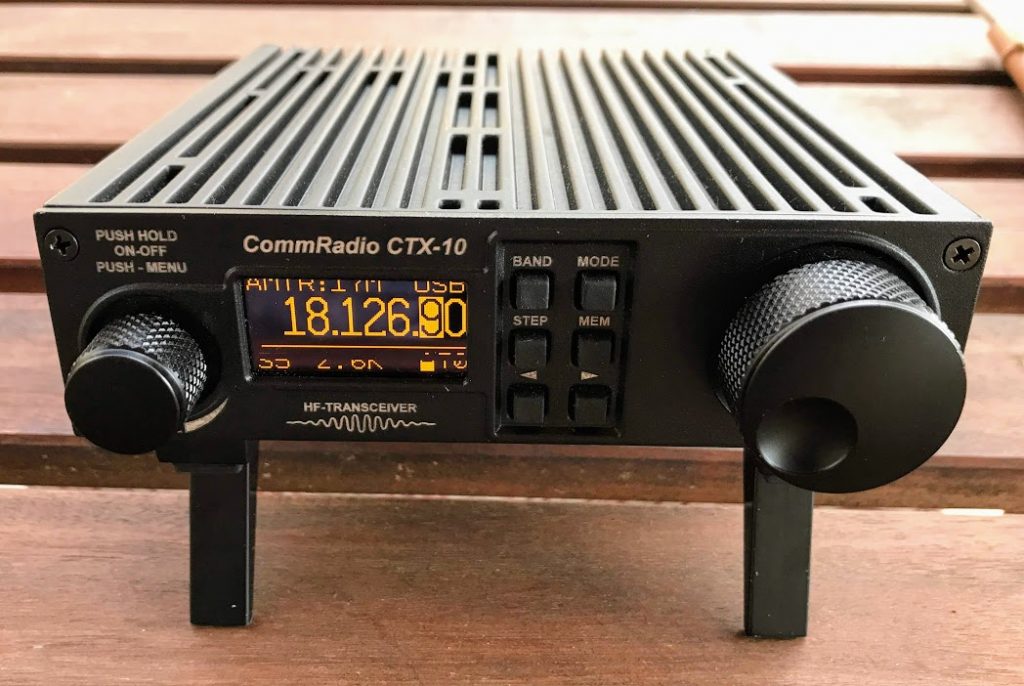
[Update: Please note that we’ve now posted a final review of the CTX-10 which builds upon the review below. Think of of the final review as the second installment, or “Part 2? of this review. If you’re considering the purchase of a CTX-10 please read this initial review first.]
In the past two years few QRP transceivers have generated the interest of the CommRadio CTX-10. I’ve gotten no fewer than two dozen emails from readers asking about the CTX-10 after learning I had one here at SWLing Post HQ. And, I’ll freely admit, I was among those people who couldn’t wait to give this promising little radio some on-air time––and, as a result, a proper evaluation.
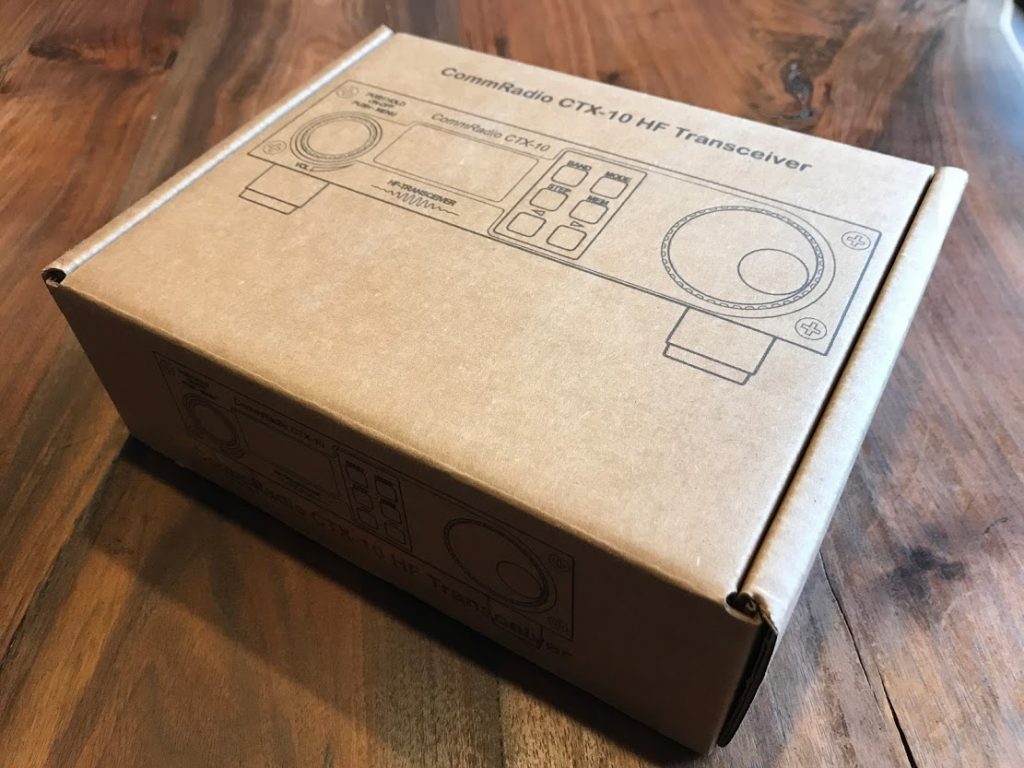
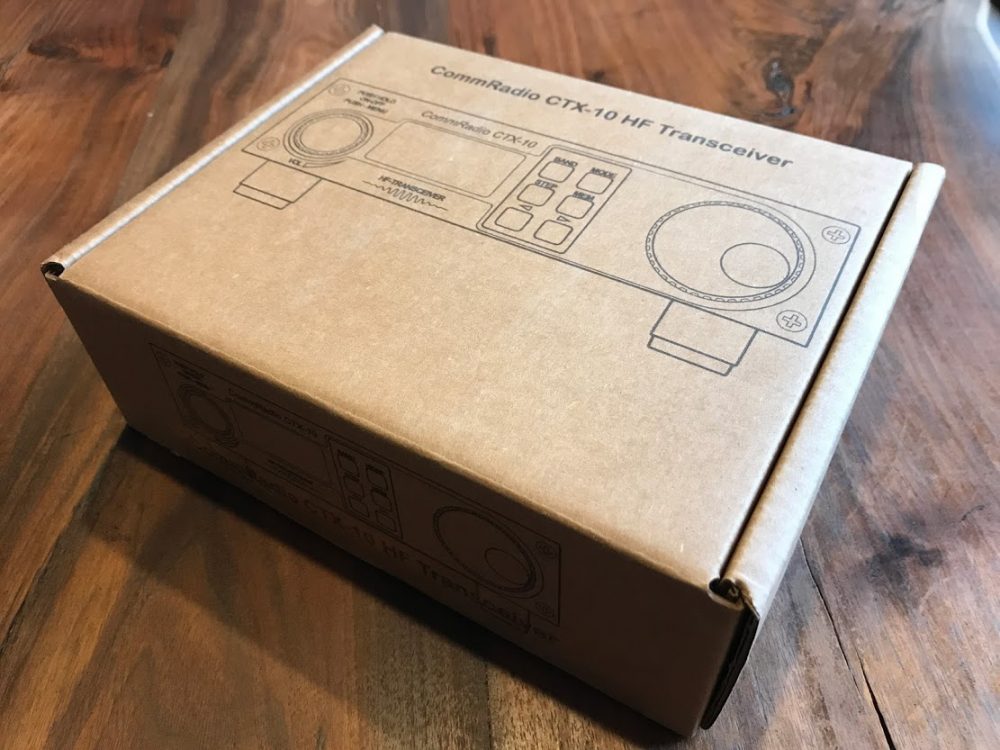
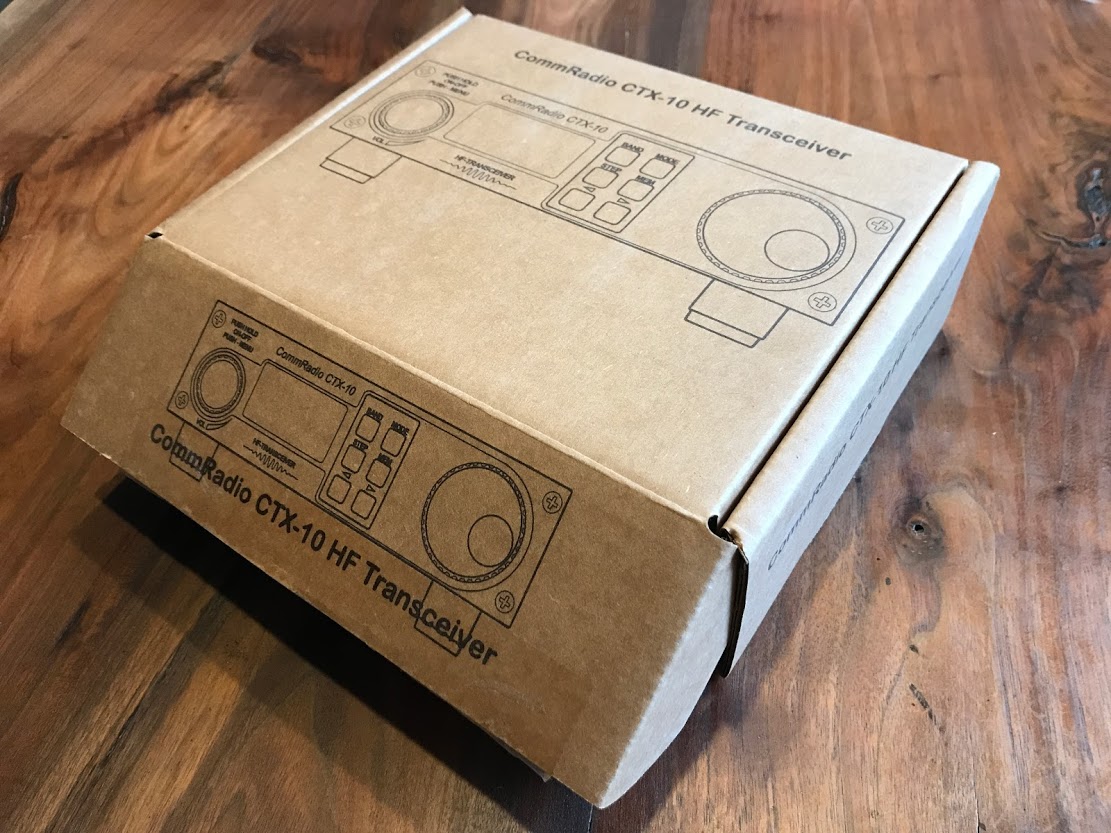
The CTX-10 arrives in this simple box.
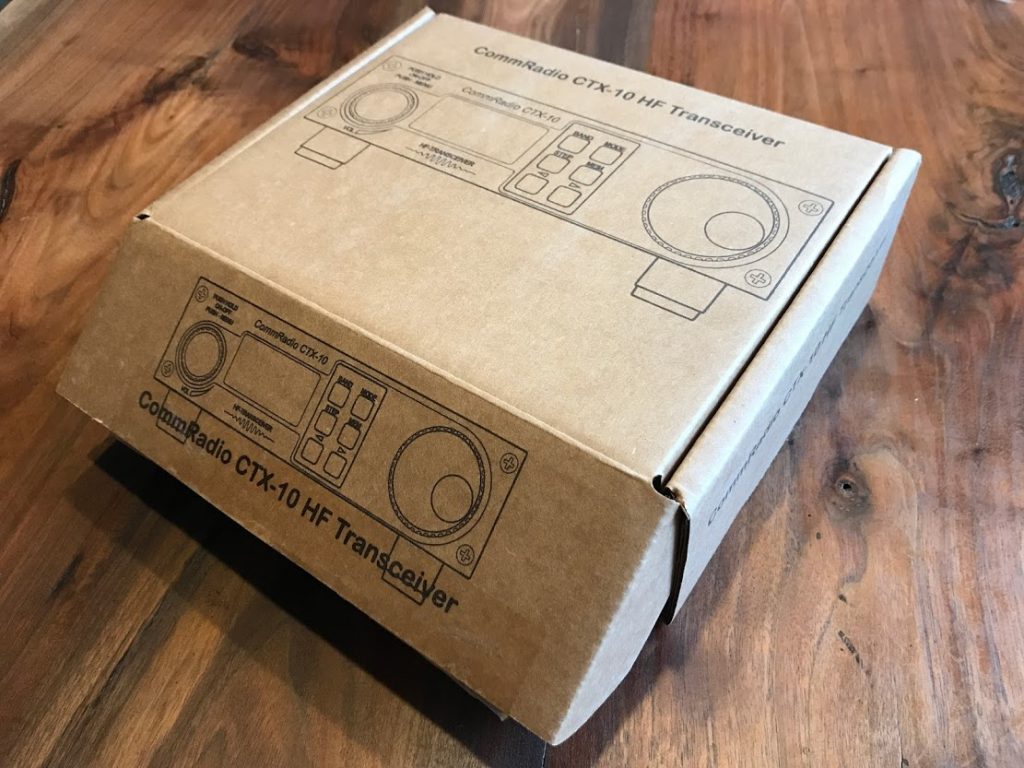
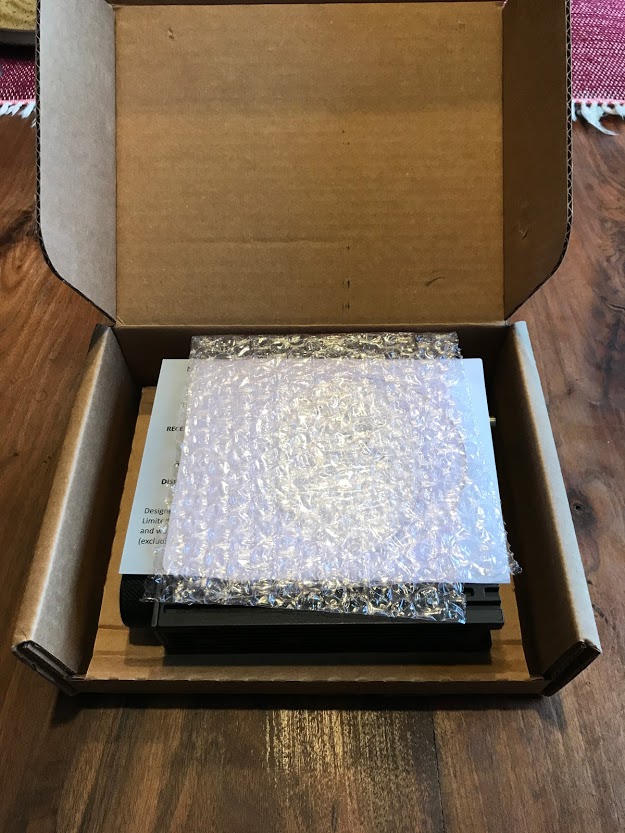
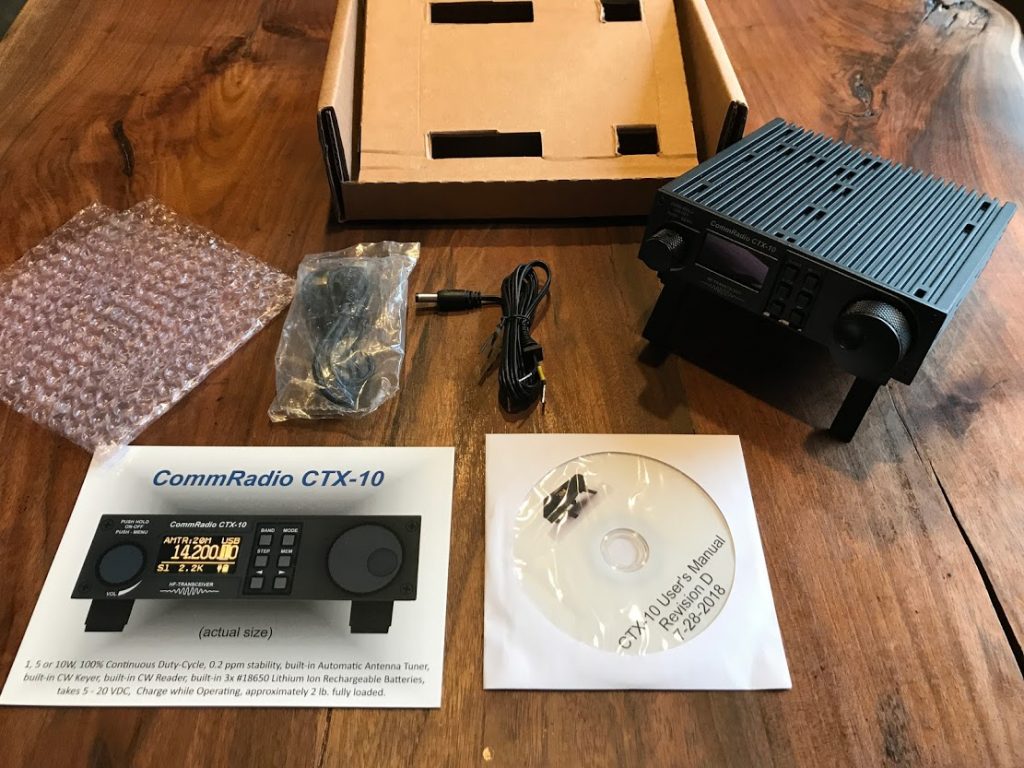
Everything included in the CTX-10 box.
There are a few reasons why the CTX-10 has stirred up so much excitement. Firstly, the CTX-10 transceiver is based on the excellent and well-regarded CommRadio CR-1/CR-1A receiver. Click here to read our review in a new window.
Fans of the US-made CR-1 and CR-1A appreciated the approach to the CommRadio design: simple operation, clever engineering, near-mil spec components and construction, superb receiver characteristics, as well as excellent audio. The classic CR-1 has all the essentials––multiple modes, filters, and the like––yet offers relatively few features when compared with other tabletop radios in its price class. It’s a simple get-on-the-air rig that feels like it’s engineered to last forever. Indeed, its design approach reminds me of the Lowe receivers of days gone by.
Another reason for the unusual level of interest is that the CTX-10 has been in the works for a long time. It was first announced over two years ago in October, 2016, and only started shipping in July/August 2018.
Since then, there have been very few CTX-10 reviews posted…hence all of the email questions.
In early October 2018 Don Moore, President of CommRadio, sent me a loaner CTX-10 which I’ve been using regularly since, testing all aspects of this little 10-watt transceiver.
Even though I’ve had the radio for a while, I plan to post a final CTX-10 review in the SWLing Post in coming months. As you may know, I typically only keep a review unit two months before publishing an evaluation, so why the delay? In short: I feel like the CTX-10 has some important updates/upgrades that need to come down the line, and I’m allowing time for these to be developed and tested before I issue a full and final review. So, if this is a rig that interests you, you’ll want to stay tuned for that.
In fact, due to a couple of quirks that only affected the first twenty production units, CommRadio has already replaced my initial review unit. I’ll detail these quirks below.
In the meantime, what follows is an initial review of the CommRadio CTX-10 with the most current firmware as of time of posting (1311). This review format is a departure from previous reviews as I’m only focusing on the pros and cons that might help future CTX-10 owners make a purchase decision.
Consider this initial review just a taste of the CommRadio CTX-10, not the full course.
CTX-10: The Pros
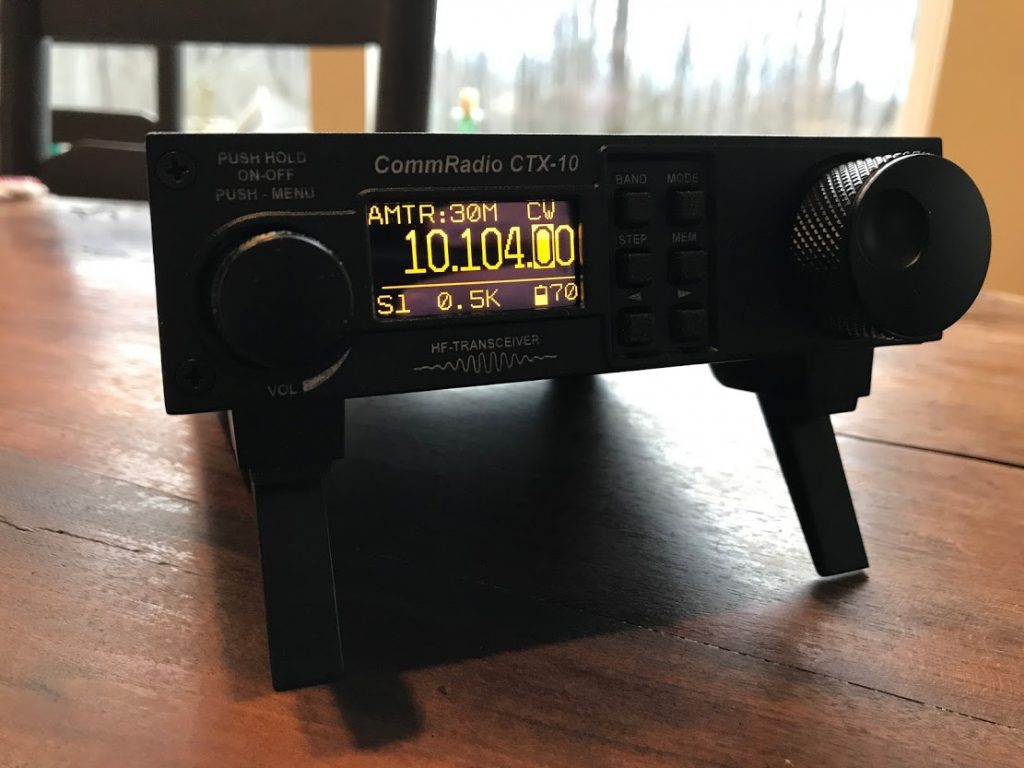
First of all, much like the CR-1 and CR-1A, the CTX-10 is an all-in-one unit that takes fewer than five seconds to get on the air if you have an antenna at the ready. Seriously. Other than a key, and/or microphone and antenna, there are no other external attachments needed. It’s field-ready from the moment you remove it from the package.
True story: it took me all of thirty seconds to remove the CTX-10 from the box, plug in a key, an antenna, and have it on the air. This is a major pro, in my radio world.
ATU
The CTX-10 has a built-in automatic antenna tuner that seems to do a great job making 1:1 matches on near-resonant multi-band antennas. I have a large horizontal multi-band delta loop here at the QTH, and the CTX-10 does a fine job finding a match on most ham bands.
Can it match the performance of the Elecraft KX-series ATU? I haven’t done an A/B comparison yet, but I don’t expect so—not on random wire antennas, at least. I do think, however, it will easily match any proper field antenna you pack in your go-kit.
Another minor plus worth mentioning? The ATU is very quiet in operation.
Internal batteries
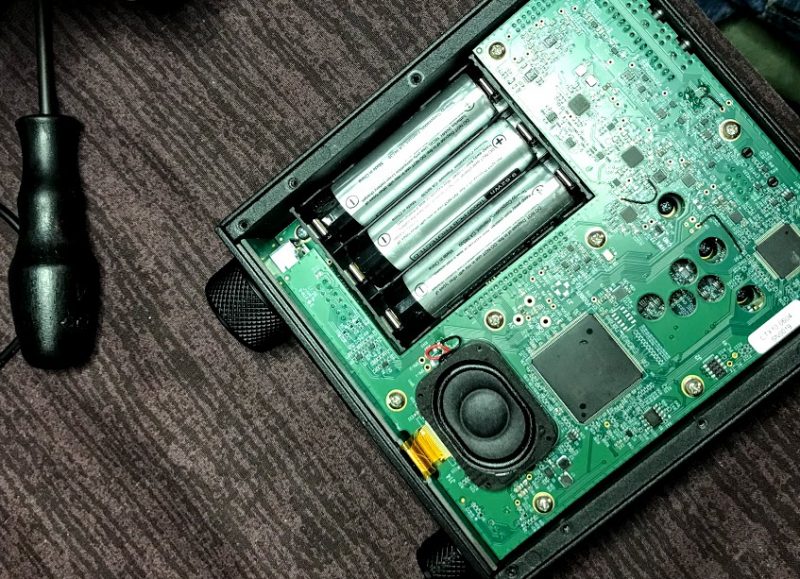
The CTX-10 ships with three built-in #18650 3.7V 2600 mAh rechargeable Li-ion batteries that are user-replaceable. These are high-capacity cells—in fact, the same type of cells used in the Tesla Model S.
But how do they work? In short: brilliantly. They power the CTX-10 for a much longer period of time than the battery pack in my Elecraft KX2.
After a full charge, these cells will support casual operation for up to eight hours. If you’re using the CTX-10 in a contest or on Field Day where operation is intense––that is to say, near-constant transmitting––it should last the better part of an hour. Don Moore actually produced a video early on of the CTX-10 running a full 10 watts and transmitting dits in CW for forty solid minutes before the batteries depleted to the point of shutting down. That’s certainly a new benchmark for portable rigs with internal batteries.
The CTX-10 has an intelligent charger that will recharge the internal cells when any voltage over 5 VDC is applied. This means, in a pinch, even a typical USB charger will work. If the power supply can deliver up to ten watts, it’ll charge the batteries rapidly––anything below that will take a longer.
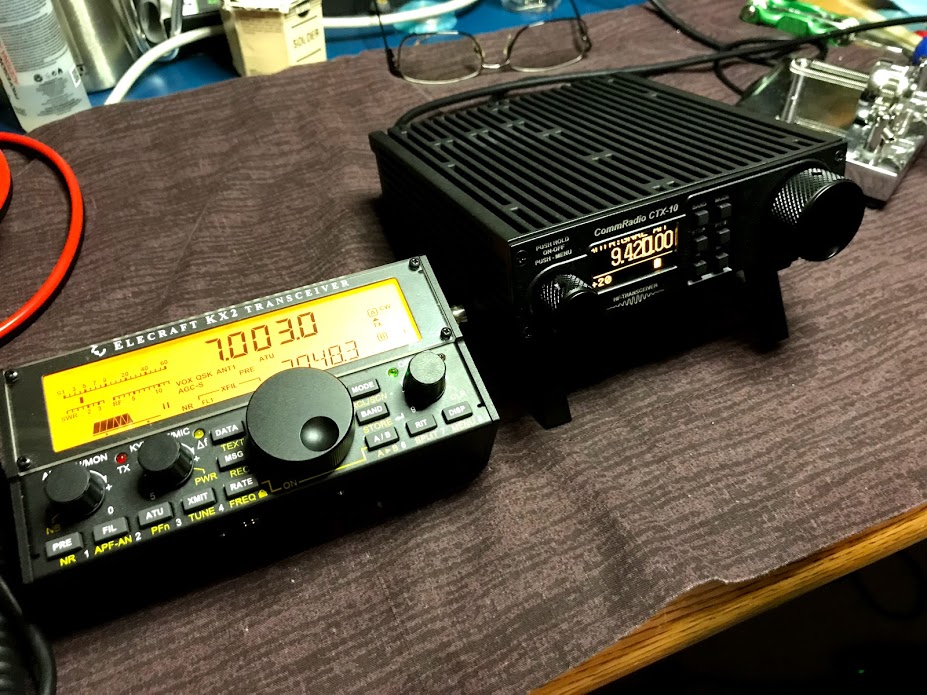
Elecraft KX2 (left) and the CommRadio CTX-10 (right)
I also own the Elecraft KX2 and have used it in the field more than any other portable transceiver I’ve owned up to this point.
The KX2’s battery charging routine is more involved than that of the CTX-10. The KX2’s pack must be removed from the radio (by opening the bottom plate of the chassis with two thumb screws, and unplugging the coaxial connector), then it must be hooked up to an external battery charger, charged, and then re-inserted in the KX2.
In contrast, the CTX-10 only requires plugging it into a power source that can provide anything from 5 – 20 VDC––in other words, pretty much any power source. All of the intelligent charging is built into the CTX-10.
Without a doubt, the CTX-10 has the most robust and well-designed internal battery charging system I’ve ever found in a portable radio. Period.
Best-in-class duty cycle
If you’re a fan of FT-8 and other high-duty cycle digital modes, you’ll be very pleased with he CTX-10.
Like many other hams, I was bitten by the FT-8 bug. FT-8 is an amazingly efficient digital mode that somehow manages to defy propagation—even when transmitting at low power. In the past, I’ve worked all time new countries on five watts!
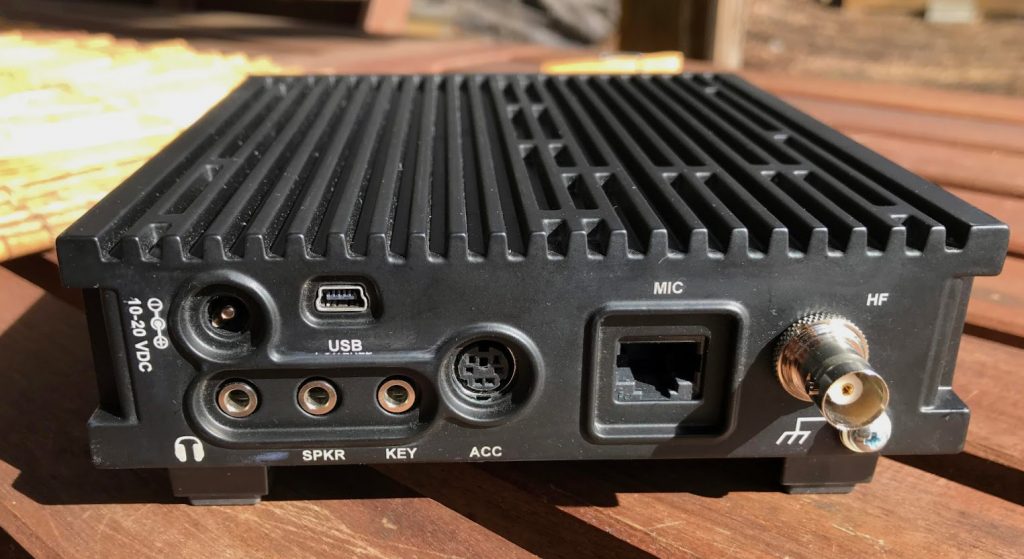
The CTX-10 back panel.
At home, I designated the Elecraft KX3 as my primary FT-8 rig. First time putting it on the air, I found to be fairly effortless. However, after operating perhaps 15-20 minutes, I found that power levels decreased significantly. This is because taxing the finals with FT-8 produces a lot of heat, and the KX3 protects the finals by lowering the output power. KX3 owners wishing to play FT-8 for extended periods at 10 watts or higher know how important it is to purchase an aftermarket heatsink to give the KX3 more transmitting time.
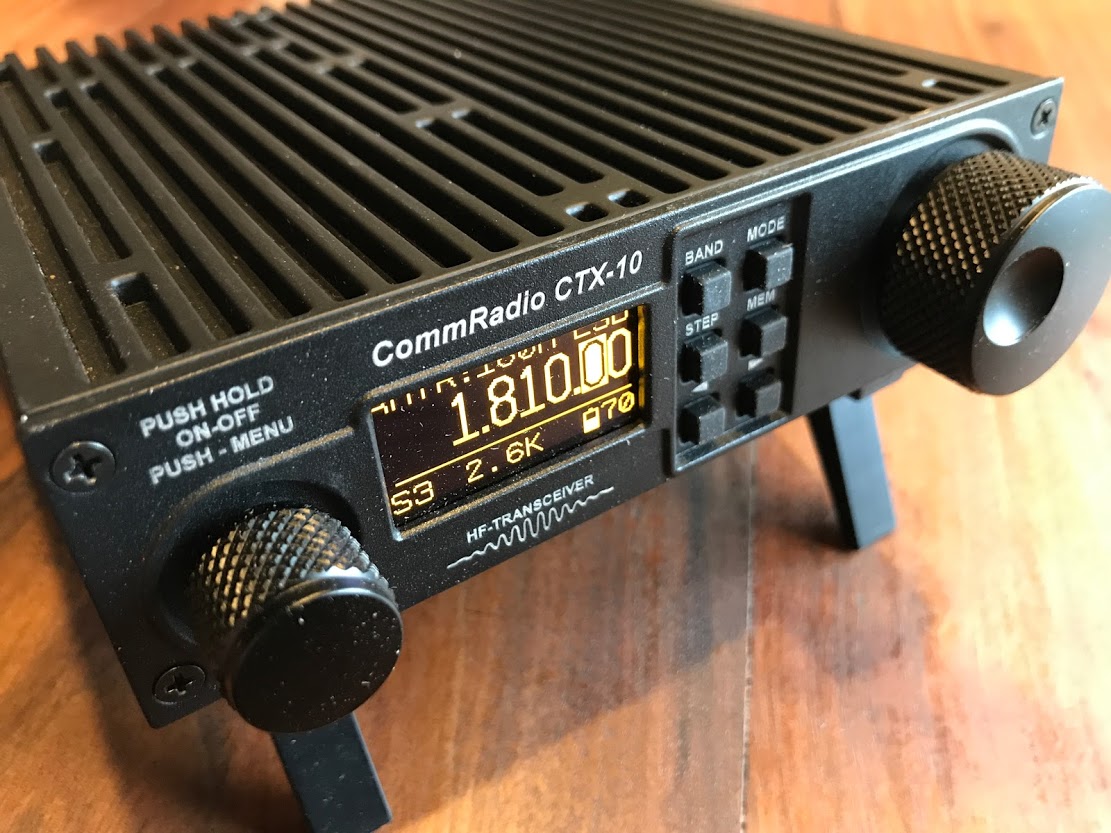
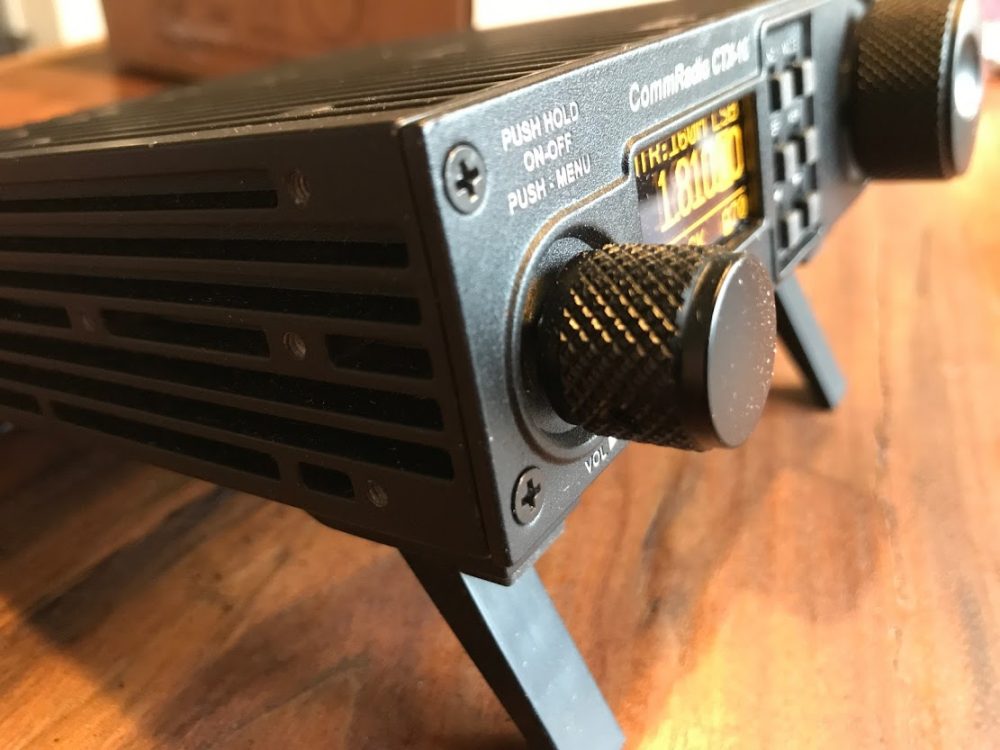
The CTX-10, in contrast, needs no aftermarket additions—if anything, it’s over-engineered. The entire chassis of the radio is essentially a heat sink, and because of this, it requires neither additions nor a fan to cool the finals, leading to comparatively effortless operation. Plus, as a result, operation is completely quiet.
In short? No overheating finals with the CTX-10: it’s an FT-8 beast!
Receiver performance
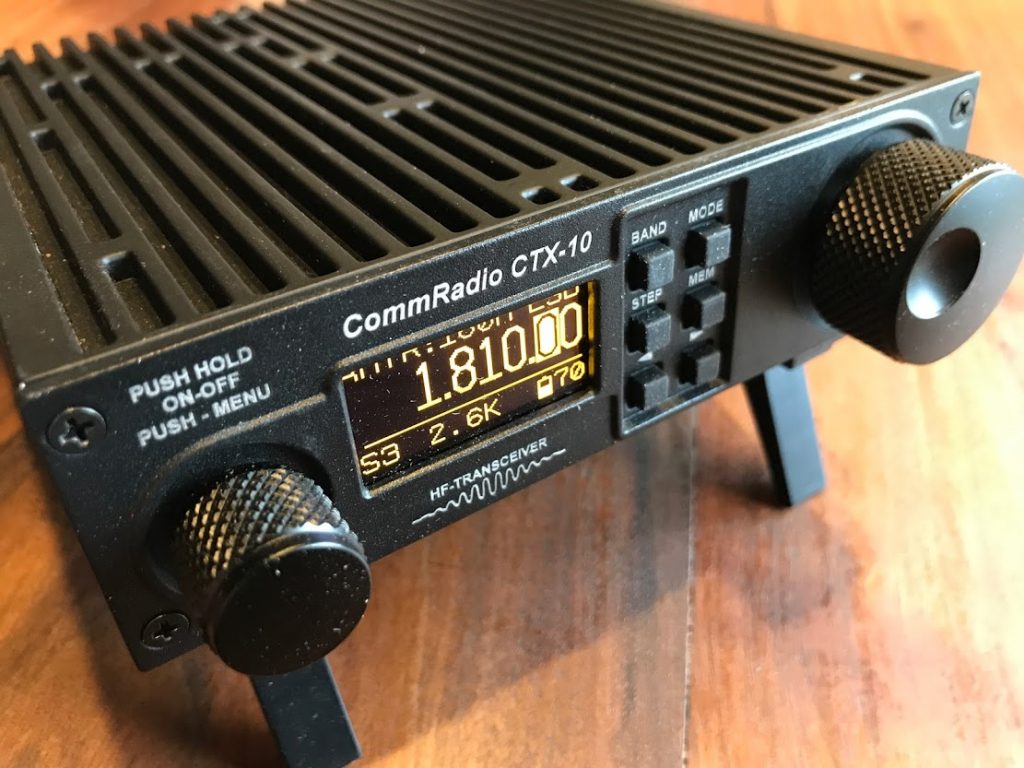
Overall receiver performance is what I expected: nearly identical to the CommRadio CR-1/CR-1a receiver series with the added benefit of an internal ATU that helps tweak the antenna match on the ham bands.
Simple operation
You can tell that CommRadio has a legacy in designing equipment for the military, as well as for commercial and aviation industries. The CTX-10 smacks of a channelized commercial radio. There are relatively few features and adjustments as compared with, say, the Elecraft KX2 or the LnR LD-11. For those who like basic controls, the CTX-10 should please. On the other hand, if you like more granular control of your transceiver, you might prefer more refinements.
Quality engineering and construction
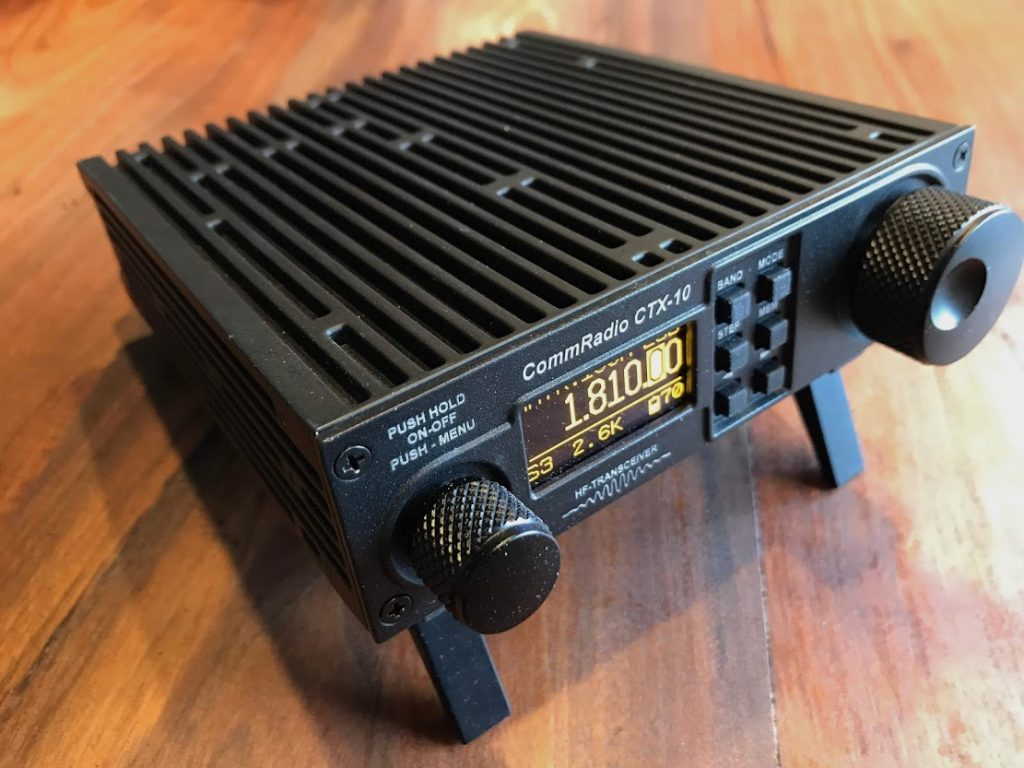
Like the CR-1A, the CTX-10 enclosure is aluminum with machined aluminum knobs. The boards and internal components are near (if not) mil-spec––brilliant quality that is found in few other radios.
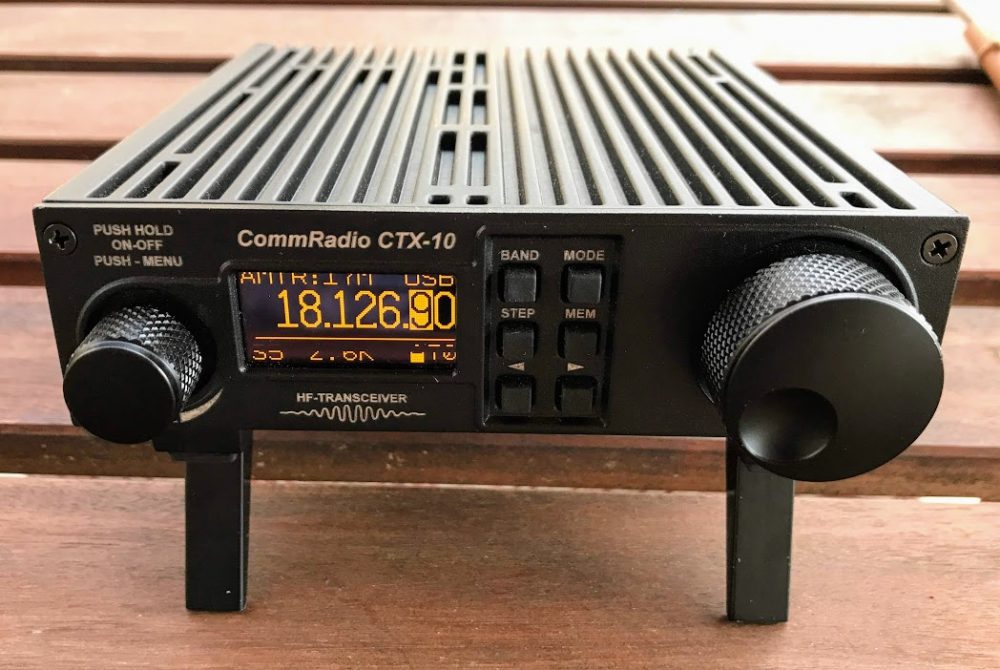
The OLED display is easy to read at any angle and under almost any conditions you might experience at home or in the field––truly best-in-class in this regard. It is a relatively small display, but crisp and high-contrast, so quite easy on the eyes.
The circuit boards inside are of the highest quality, and so are the components. Don Moore sourced them from the same suppliers he uses for commercial-grade equipment.
My good friend, Vlado (N3CZ)––radio engineer and repair technician––took a look inside the CTX-10 chassis; he was sincerely impressed by the quality of the construction and board design. It’s worth noting that Vlado isn’t easily impressed, as he looks at the internals of commercial and military grade communications equipment every day: thus it says something that he remarked on this rig’s quality.
CTX-10: The cons
I’ve covered the obvious positives, so what about the negatives?
What follows are the cons I’ve noted while operating the CTX-10.
Keep in mind, some of these cons may disappear with future CTX-10 firmware updates. Again, I plan to hold off on my full and final CTX-10 review until I feel CommRadio has essentially finished planned upgrades.
At least for now: only one VFO
[Update: A/B VFOs and split operation were added to the CTX-10 via a firmware update in 2019. Please read our final review for details.]
Herein lies my biggest gripe with the CTX-10 and what I would consider a glaring omission on a $1,000 modern SDR transceiver. However, it’s worth noting that CommRadio has committed to address this in an update–see below.
At time of posting, the CTX-10 doesn’t have A/B VFOs like almost all modern transceivers––certainly like all of its direct QRP competitors, like the Elecraft KX2/KX3, LnR LD-11, and Yaesu FT-818/817ND.
So, how does a lack of two VFOs impact operation? First of all, there is no way to operate split on the current version of the CTX-10. Ouch.
The first time I put the CTX-10 on the air it was at the QTH of Vlado (N3CZ). We put the CTX-10 on 40 meters, and one of the first stations we heard was in Vanuatu, due to a brilliant opening into the Pacific. Vlado was positive he would work them with 10 watts on his 40M Steppir Yagi––I was, too. This being the first time either of us attempted DX on the CTX-10, we plugged in Vlado’s Bencher paddles and quickly tried to sort out where the DX station was working his pileup.
It was then we realized that the CTX-10 had no second VFO to work split, and, hence, we couldn’t work the Vanuatu station––because, like pretty much any desirable DX, he was operating split. Frankly, I was in disbelief and quickly downloaded the latest CTX-10 manual to find out how to engage split, but there was no mention of it in the manual.
The only other option was to operate split using a RIT control to shift the receive frequency. Again, we couldn’t locate a RIT control and a search of the manual proved no mention of RIT because, alas, there is no RIT control.
Again, we couldn’t work Vanuatu on the CTX-10 because, like all good DXers, the Vanuatu team were operating split.
Update: CommRadio has informed me they will be adding A/B VFOs as soon as possible, certainly before the 2019 Hamvention in mid-May, but hopefully sooner.
Update 2: Split operation added June 2019. Please read our final review for details.
Features may be too basic for some ham radio operators
It’s no secret: most of us hams like to fiddle with controls to tweak a transceiver’s performance. This is why ham radio transceivers often feature even more controls than their commercial/military counterparts.

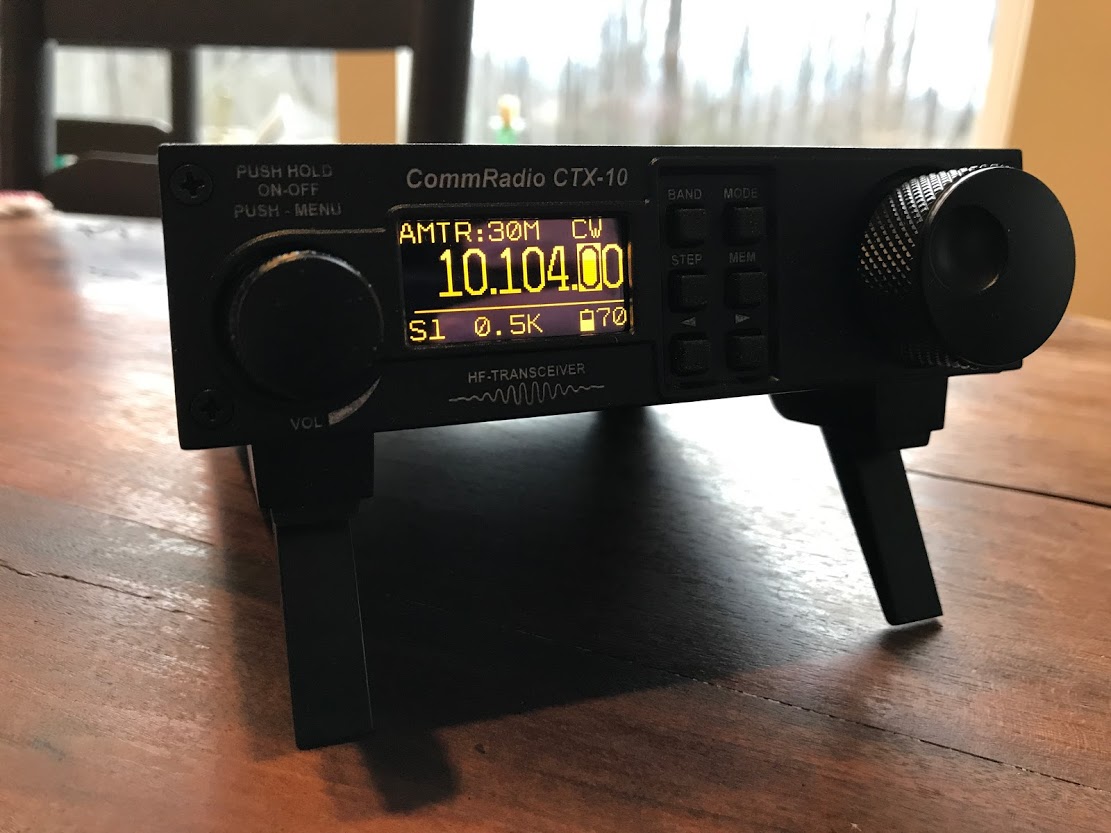
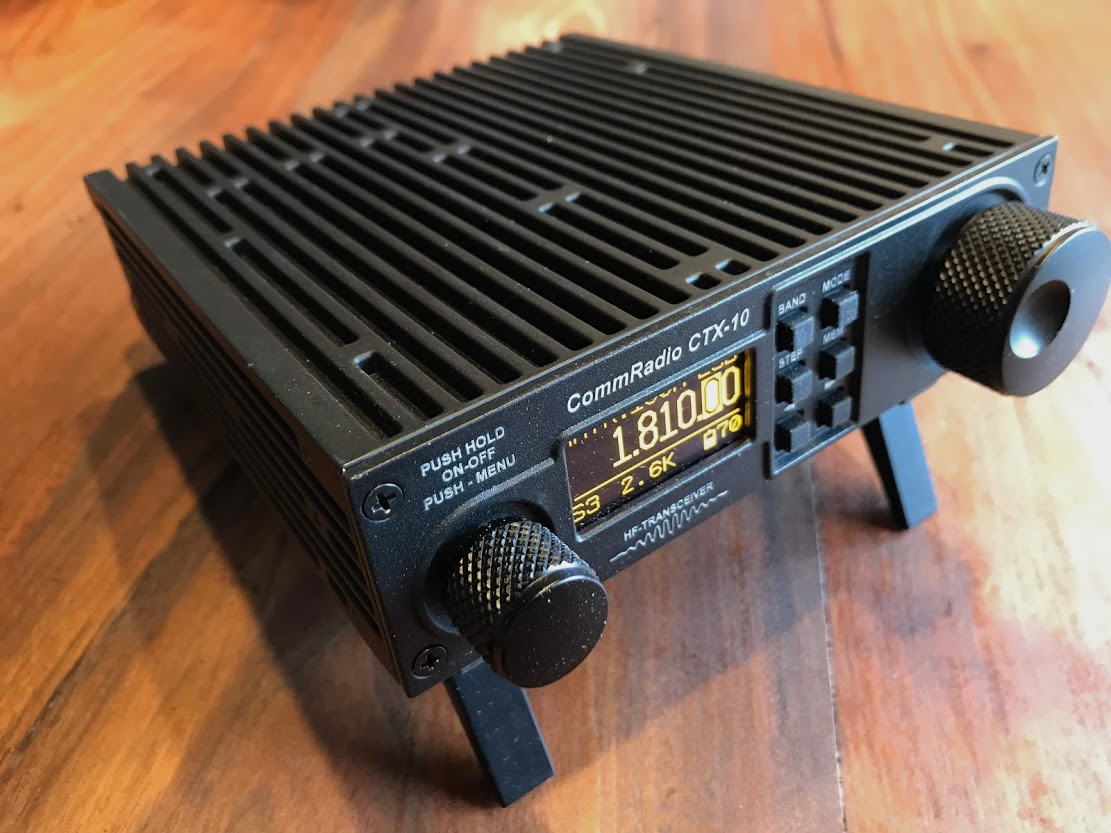
The CTX-10 support feet are easy to flip up. The operating angle is excellent.
Still, some operators do appreciate a simpler rig, as they prefer simply to get on the air and get the job done. I appreciate this, too, especially when engaged in field operations where I’m less inclined to tinker with settings. So there’s some appeal in the CTX-10 approach.
At present, the CTX-10 feature set is very basic. Here’s a list of common controls the CTX-10 lacks––many that I’d typically expect in a radio of this price class:
No RF Gain control. The CTX-10’s RF gain is directly tied to the three AGC settings (slow, medium and fast). I know operators who never reach for the RF gain control, but I do, especially in the summer when it’s such an effective tool to lower QRN levels and help DX pop out of the background.
No microphone gain control. The CTX-10 lacks a mic gain control. The microphone input has a limiting pre-amplifier with built-in compressor and ambient noise gate. Problem is, at present, these settings are fixed and cannot be manually adjusted by the user. The CTX-10 was designed to work with handheld mics positioned closely to one’s mouth. Early feedback from users indicated that the CTX-10 was a little too aggressive, cutting off speech; a recent update did address this concern. Some users might never notice the lack of a mic gain control if they stick with the suggested modular MFJ-290MY or Yaesu MH-31A8J handheld mic. Personally, though, I like having a little more control of my microphone performance.
Keep in mind, there’s a plus side to the CommRadio ANG (Ambient Noise Gate): extended battery life. If you have the microphone keyed down, yet aren’t speaking for longer than a second or two, the output will be gated OFF, preventing background ambient noise from being transmitted. The on/off gating happens very quickly and isn’t noticeable.
The CTX-10 currently has no passband (PBT) control, notch filter or noise blanker.
Microphone compression is also pre-configured, and there’s currently no way to manually adjust it. This is a design choice typical of commercial communications gear.
No QSK/full break-in operation. The CTX-10, like the LnR LD-11, uses a traditional relay for switching between transmit and receive. Some CW ops like to hear the received audio between the dits and dahs of their sent CW. Elecraft radios, for example, use PIN diode T-R switching to eliminate relays during QSK. The CTX-10 uses a relay, so during CW operations, you’ll hear the relay click when switching from TX to RX and back again. This isn’t a problem for me, as I rarely set my CW rigs for full break-in, but the CW hang time delay on the CTX-10 is not currently adjustable. For high-speed CW ops that prefer a faster relay recovery, I suspect this could be an annoyance.
Limited CW adjustments. The CTX-10 lacks other controls many of us CW operators appreciate. Currently, the CTX-10 lacks a sidetone control––you cannot change the sidetone volume, nor can you turn it off. I believe CommRadio plans to fix this quirk in a future firmware upgrade. Additionally, you (currently) can’t change which side of your paddle sends dits and dahs without re-wiring your paddle. A minor con, for sure. Still, most modern QRP transceivers allow you to change this from the radio––I imagine CommRadio could add this feature in the future if their customers want it.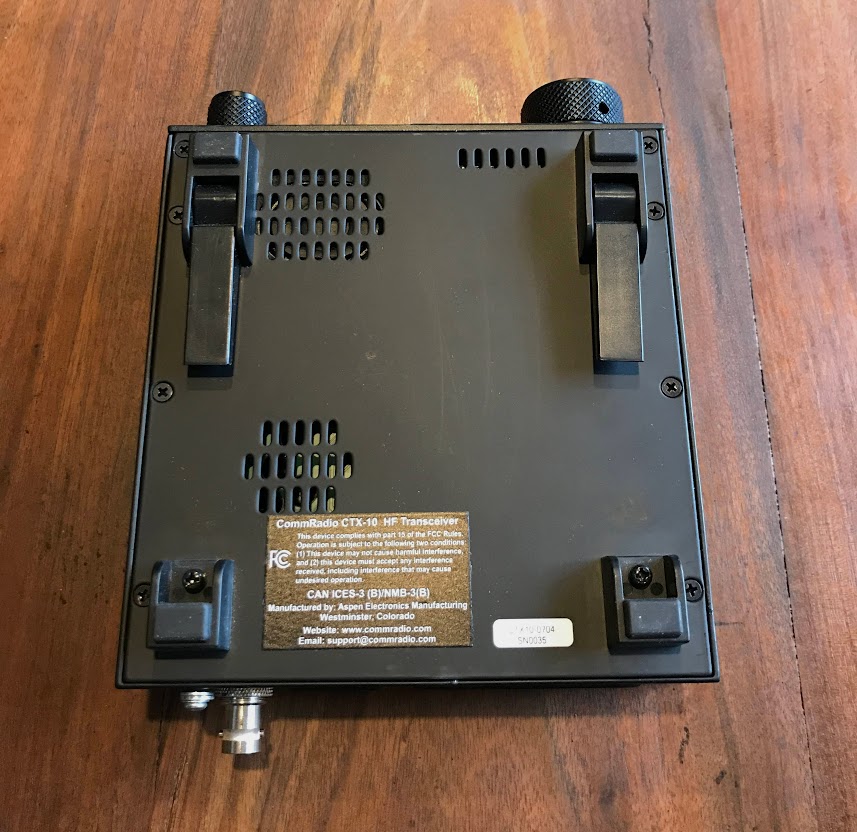
In addition, when operating the built-in CW keyer at speeds north of 25 words per minute, both Vlado and I noticed that immediately following a TX-RX-TX relay recovery, CW keyer timing was a little flaky. We assumed there was a problem with our paddles (perhaps dirty contacts?), but that turned out not to be the problem. Difficult to characterize, but essentially: immediately after a TX-RX-TX relay recovery, it’s hard to form a word correctly. The letter “Y” might come out as a “K” or “X” and a “Q” might come out as a “Z.” Both Vlado and I believe this might have something to do with keyer timing, which is possible. Nonetheless, I’m confident this can be fixed with a firmware update. In addition, we worked my friend Mike (K8RAT) and while he had very positive comments about the CW tone in general, he did notice truncated elements following a TX recovery. He also noticed an occasional slight tone spike on the first element which seems to coincide with an audio pop we hear in the sidetone. Note: CommRadio fixed this issue in a 2019 firmware update. Read our final review for details.
Accident-proof ATU activation. As with the CR-1A receiver, most of the CTX-10’s features and options are controlled by accessing the menu system by pressing the volume control knob. To make ATU activation easy, CommRadio place the ATU function first in the menu––with one knob press, the ATU item appears, and with one more press the ATU activates and tries to find a match. Engaging the ATU, in my opinion, is just a little too easy. With two presses of the volume knob, the ATU engages––great, but I find this happening by accident simply by normal handling of the radio. Instead of two short presses to engage ATU, I feel it might be best when making one short then one long press.
One other minor note: the CTX-10 ATU configuration cannot be adjusted manually like it can on the Elecraft KX series ATU.
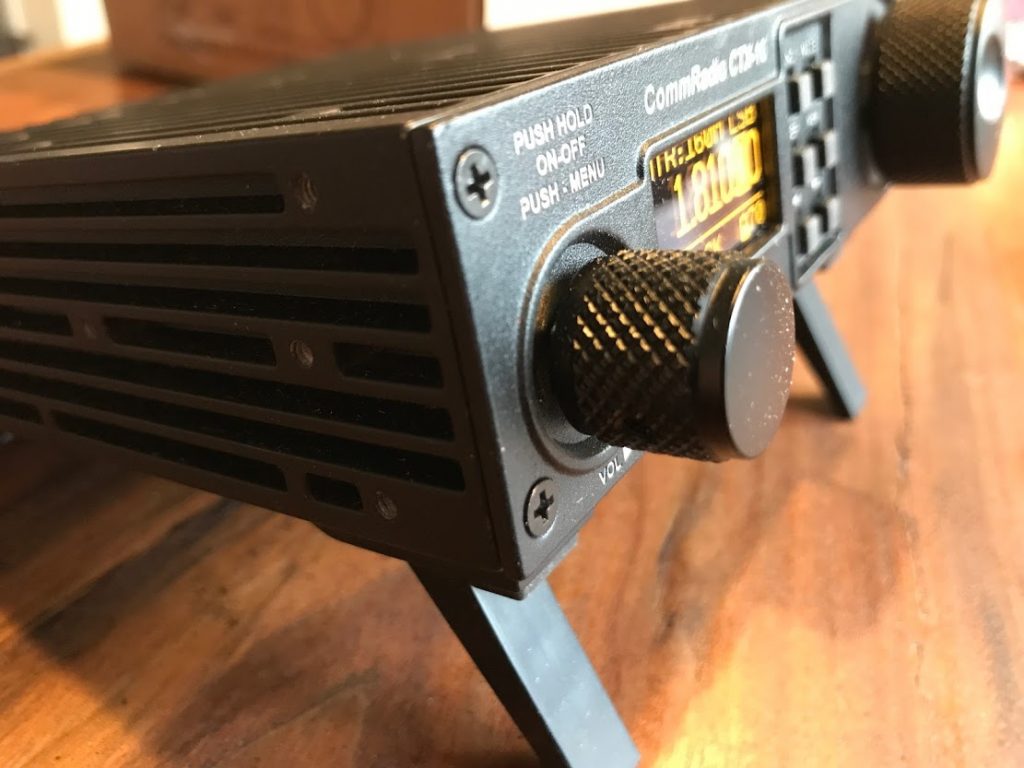
No keylock to prevent powering up and engaging ATU. The CTX-10 does have a keylock to prevent the encoder from shifting during operation (a great feature for FT-8, for example), but it lacks a keylock to prevent the main power button from being pressed and turning on while in transport. Even more worrisome would be turning on the unit and engaging the ATU while in a pack––I’m guessing this could eventually damage the radio’s finals. The current solution for this? CommRadio suggests tying a shielded wire around the post of the volume control. This prevents accidental pressing while in transport and the CTX-10 ships with one of these around the volume knob (to prevent it turning on in shipment). I feel a more elegant solution would be to design it so that, in order to power up the CTX-10, you’d press two buttons simultaneously: for example, the volume control and the STEP buttons. I’ve make this suggestion to CommRadio. Update: Via a 2019 firmware update, CommRadio added a feature that automatically turns off the radio if accidentally turned on during transport. This is not a keylock and will not prevent the ATU from activating of the power button is accidentally pushed twice, but it will prevent the radio from being powered on in a pack until the batteries have been depleted.
Minor concern: no noise reduction control. In truth, this is a very minor con in my opinion. I’m not a big user of DSP noise reduction, but some users expect it on modern transceivers. I feel like the CTX-10’s receiver is well-balanced so I wouldn’t reach for a noise reduction control under normal operating conditions. That said, since there is no manual RF gain control, a variable noise reduction control could come in handy when QRN is heavy.
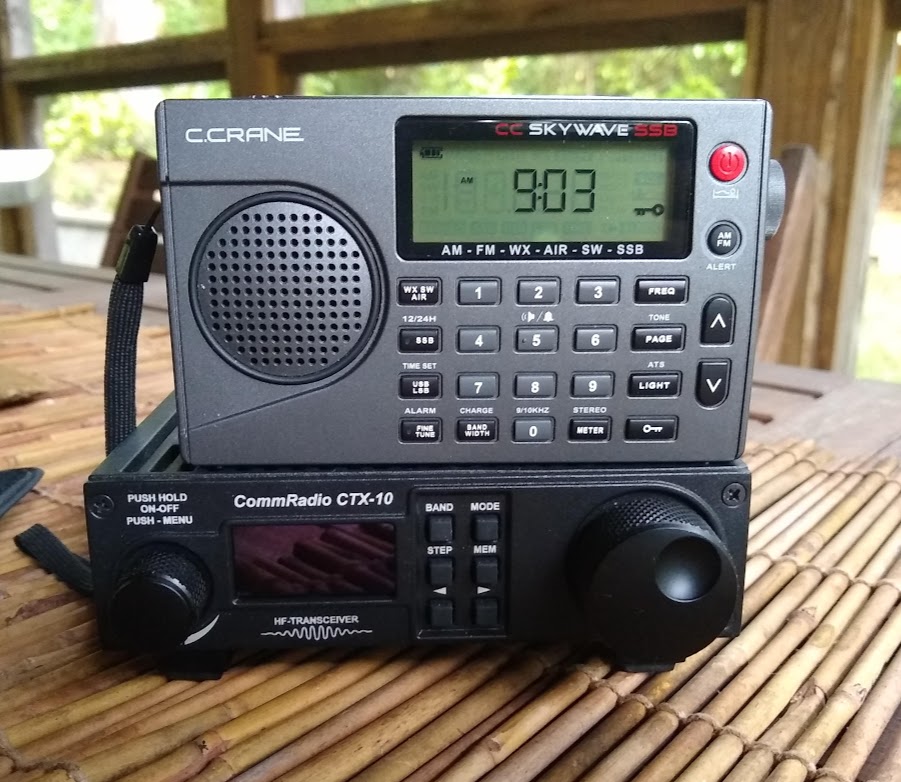
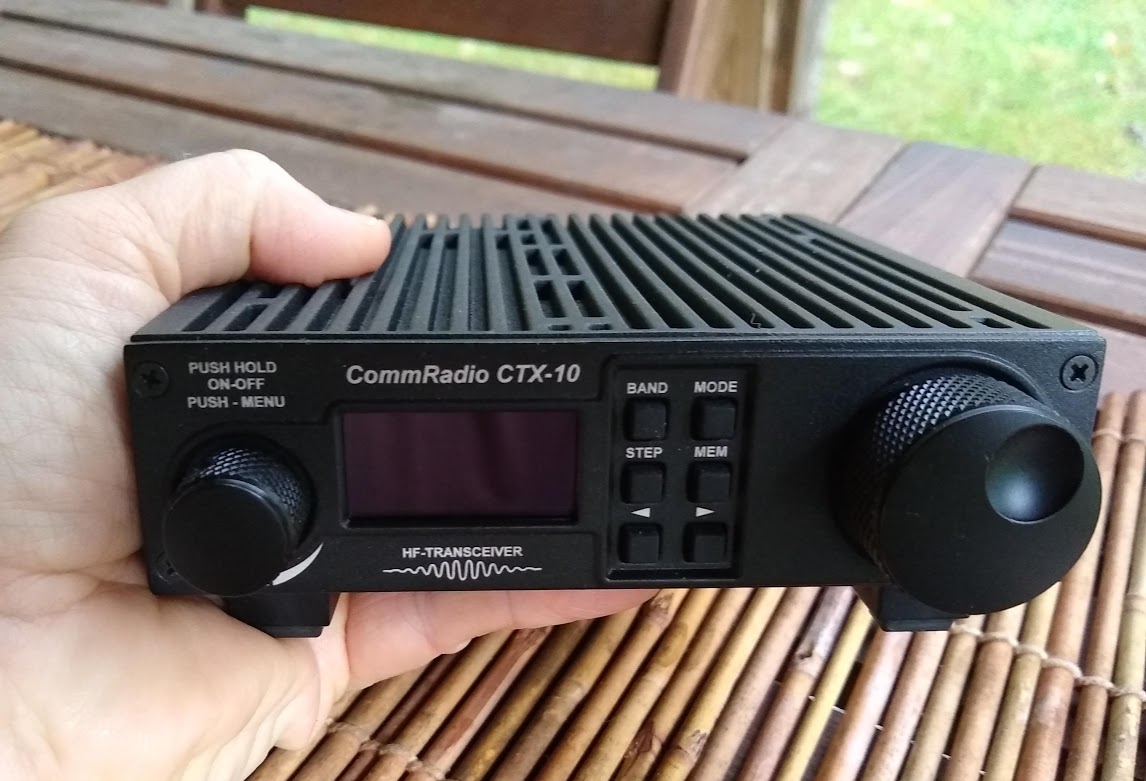
Size comparison: My ultra-compact C. Crane CC Skywave SSB sitting on top of the CommRadio CTX-10.
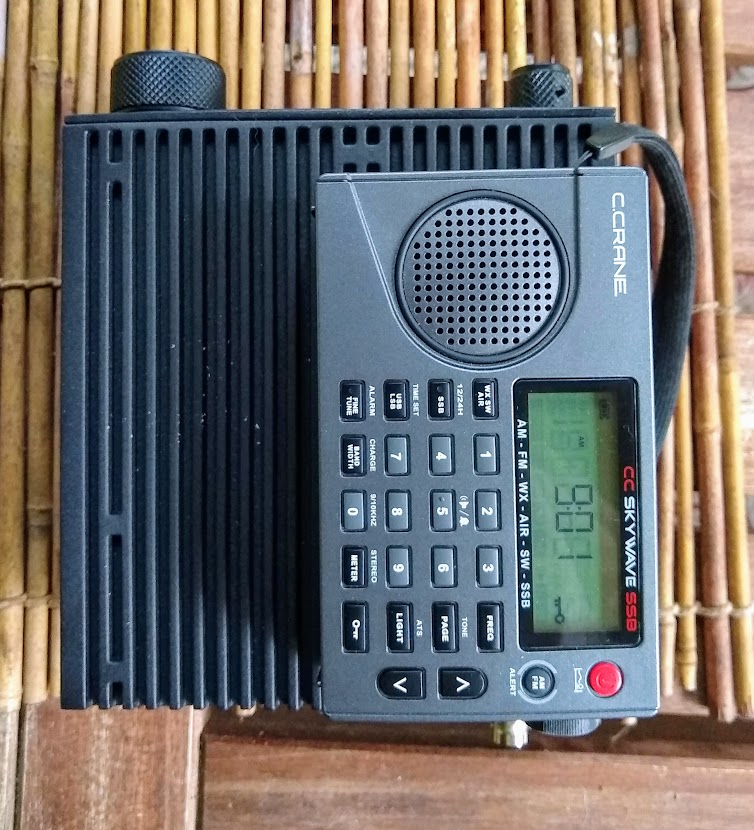
Minor concern: limited power output levels. This is a very minor gripe for me, but again could be important for other ops. At present, the CTX-10 has only three power output levels: 1, 5, and 10 watts. Thus for low-power contests, there is no way to lower the CTX-10 below one watt and no adjustment to zero watts. A couple of years ago my radio club had a DXCC 500 mW challenge to see who could work 100 countries with 500 mW or less. Most other modern QRP transceivers in this class have more nuanced control of power output and can be set to 1/2 watt. At present, the CTX-10 cannot. This is truly a minor complaint––perhaps only important to 10% of CTX-10 owners at best––but I’m willing to bet this could be added via a firmware upgrade.
Early production run quirks now resolved
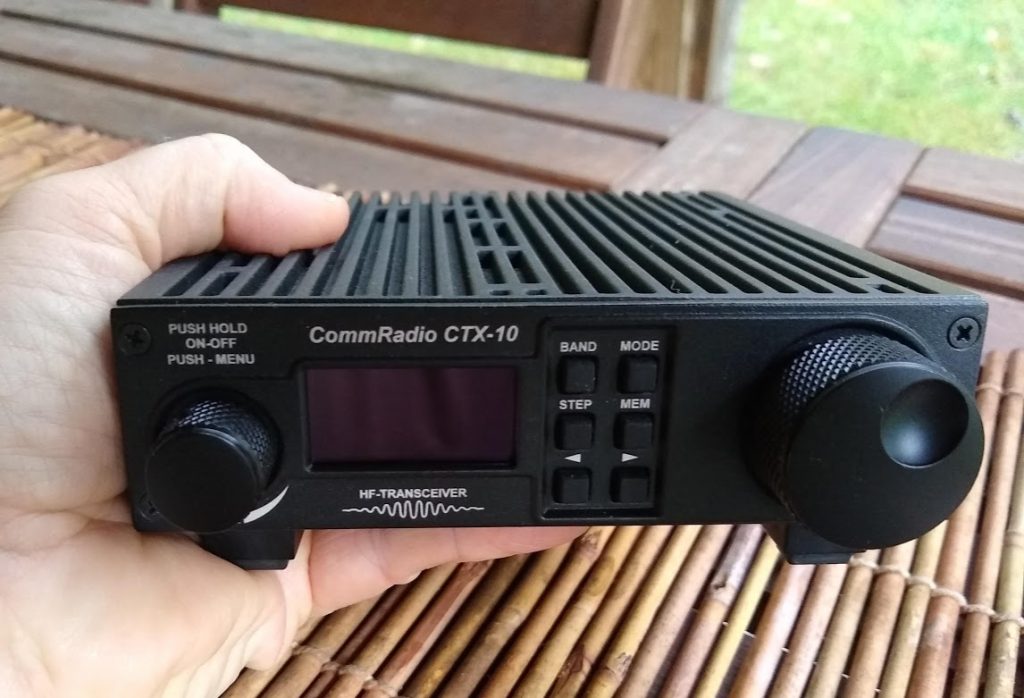
Fortunately, however, the CTX-10 is listening to their market, and has resolved a number of early production run quirks. My initial evaluation loaner unit was serial number #19. Turns out, some of the first production run units (including mine) had a couple of hardware quirks. CommRadio has replaced or fixed these issues when customers report them, and units currently in inventory aren’t affected. I list them here simply to document:
- Resolved: Intelligent charger whine. When charging the internal Li-Ion cells, my evaluation unit produced a high-pitched audible whine. I measured the audio frequency with a simple smartphone app and determined that it hovers around 10.5 kHz. The replacement unit doesn’t have this problem.
- Resolved (or repairable): Internal speaker distortion. The internal speaker on some of the early units was prone to vibrate against the bottom plate of the radio’s chassis. This produced a buzzing distortion on loud sounds or when the volume was increased above, say, 50%. Again, this only affected some of the initial production run units. The fix for this is quite easy, and either CommRadio will do this for you or you can do it yourself and get a warranty extension, so if you find this to be a problem with your early unit, contact CommRadio.
Conclusion
To my knowledge, the CTX-10 is CommRadio’s very first ham radio transceiver. But it’s not the company’s first foray into transceiver equipment, as they’ve a solid history in commercial, aviation, and military electronics.
My biggest criticism of the CTX-10 is that I feel it should have never been released without A/B VFOs. Fortunately, this was addressed in a 2019 firmware update. I trust this company, so I know they will follow through; I’ve even offered input on how split operation might be implemented with the A/B VFOs. Personally I wish the rig sported a little more in the way of CW controls, mic gain, and an RF gain control, too––but that’s my preference, controls I like to use. Again, the CTX-10 feature set might be a little too thin––too simplistic––for some hams.
That said, I never expected the CTX-10 to have the number of features that, say, the KX2 has––the CTX-10 isn’t intended to be a “Swiss Army Knife” radio like the KX2/KX3. In fact, CTX-10 development actually began around the same time the KX2 was introduced to the market, and its introduction didn’t deter CommRadio.
CommRadio firmly believes that the CTX-10 will still have appeal to current KX2/KX3 owners and QRPers who value their design philosophy of simplicity. And, what’s more…they have a point.
So, who is the CTX-10 for?
When I check out a new-to-the-market radio like the CTX-10, I always try to sort out who the customer is––what type of ham radio operator would reach for the CTX-10 over other transceivers.
After having spent the past few months with the CTX-10, I can tell you that the CTX-10 owner is one who values a very simple, straightforward radio––one that appears and functions more like a commercial or military channelized set. Perhaps someone who began operating in a commercial, military, or aviation field, and/or who likes the “get on and get the job done” approach. Someone more interested in making contacts than in radio operations and refinements. Those who want a sturdy, lasting, no-frills, set-it-and-forget-it rig. If that’s you, take a closer look at the CTX-10–it may just suit your needs to a T.
The CTX-10’s overall construction and components are, as I’ve said, near mil-spec. The CTX-10 isn’t weatherized or waterproof––no more than any of its competitors––but the construction is top-shelf, for sure. It should run for decades without need of repair.
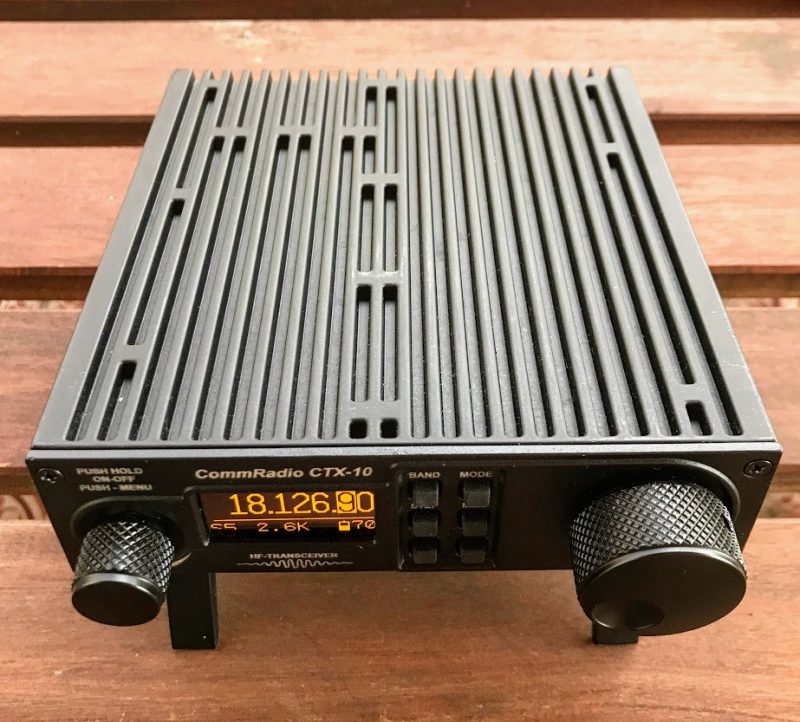
The whole body of the CTX-10 is essentially a heat sink.
I believe the CTX-10 will have strong appeal for radio enthusiasts who value:
- All-in-one-box portability with no extra wired accessory components
- Best-in-class internal battery life
- Best-in-class intelligent battery charging
- HF packs
- A high duty cycle and no cooling fan noise or third-party heat-sink add-ons
- Digital modes like FT-8 and the ability to operate them in the field from internal batteries
- The equivalent of a simple portable military/commercial set
- Robust audio from a radio’s internal speaker or headphones
- A well-balanced receiver with few manual adjustments
- Broadcast listening (the CTX-10 is also superb broadcast receiver)
- Best-in-class hardware
The CTX-10 is built like a tank, and has brilliant receiver characteristics. It’s also designed and manufactured here in the USA, and I find it’s easy to get good support from CommRadio.
I will add that CommRadio has been very receptive to my constructive and frank criticism. A good thing, in my book, as lesser companies might take offense or simply be dismissive.
If you’ve been waiting to purchase the CTX-10, I hope I’ve given you enough information that you can make a decision.
If you have any specific questions, please contact CommRadio or comment, and I’ll do my best to answer. I hope to post a few videos of the CTX-10 in action within the next few weeks when my rather busy schedule permits.
Please click here to read our final review of the CommRadio CTX-10.
Click here to view the CommRadio CTX-10 at CommRadio and at Universal Radio.
For a full list of CTX-10 features and specs, I would encourage potential owners to download and read the CTX-10 Operator’s Manual, available on the CommRadio website.
Do you enjoy the SWLing Post?
Please consider supporting us via Patreon or our Coffee Fund!
Your support makes articles like this one possible. Thank you!