Shortwave listening and everything radio including reviews, broadcasting, ham radio, field operation, DXing, maker kits, travel, emergency gear, events, and more
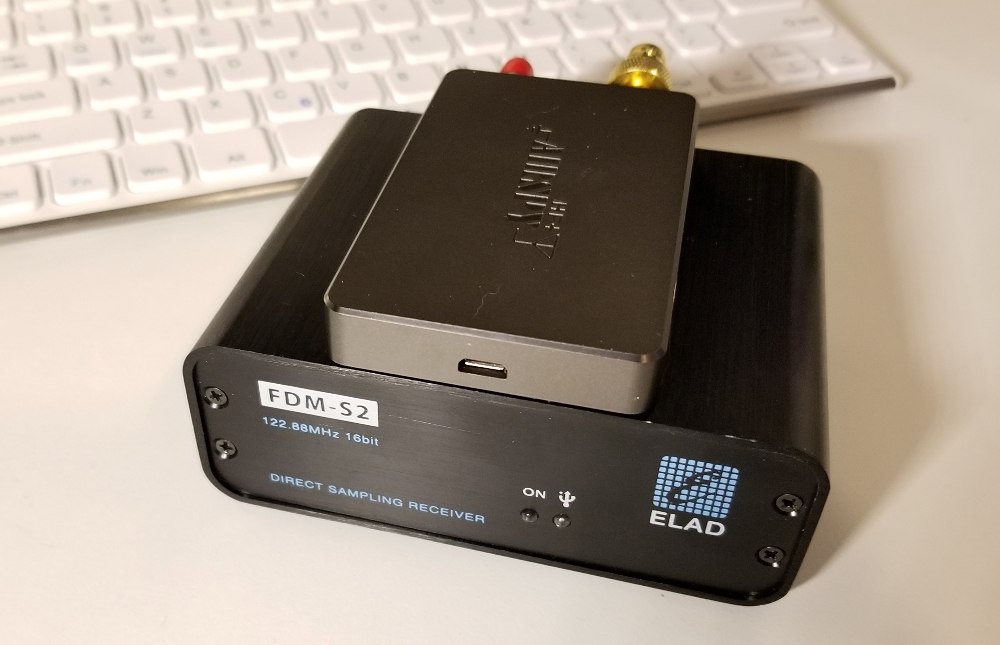
The AirSpy HF+ is the new SDR on the block, but how does it compare to the Elad FDM-S2 which is more than 2-1/2 times its $199 price? My main interest is finding out how they compare in a very RF-quiet DXpedition setting, but today I compared the two briefly from my home in Puyallup, Washington (near Seattle).
The receivers were connected via a two-way antenna splitter to the output of aWellbrook ALA1530S+ loop antenna. I monitored during mid-afternoon local time to ensure that all my MW locals in my suburban location would be at full power, for the best test of the radios’ overload performance. The Wellbrook active antenna is rather “hot” and sometimes overloads receivers during the daytime unless attenuation is added to the signal chain.
I noted there were no truly weak medium wave signals available during the session so comparing sensitivity wasn’t appropriate. However, the band was full of strong daytime MW signals.
It became apparent quickly that the upstart HF+ provides strong competition to the Elad SDR. Clearly, the AirSpy’s trade-off is bandwidth for raw performance at lower cost–approx. 660 kHz alias-free coverage versus about 6 MHz maximum for the Elad.
Using the same center L.O. (local oscillator) frequency, short recordings were made with both receivers on the same receive frequency, same bandwidth, AGC setting, etc. To approximate the 660 kHz coverage of the HF+, I set the FDM-S2 to its 768 kHz sampling rate, the closest available setting to 660 kHz wide coverage.
Here are the results on 1540 kHz, just 10 kHz away from a strong signal on 1550:
AirSpy HF+ – 1540 kHz
Elad FDM-S2 – 1540 kHz
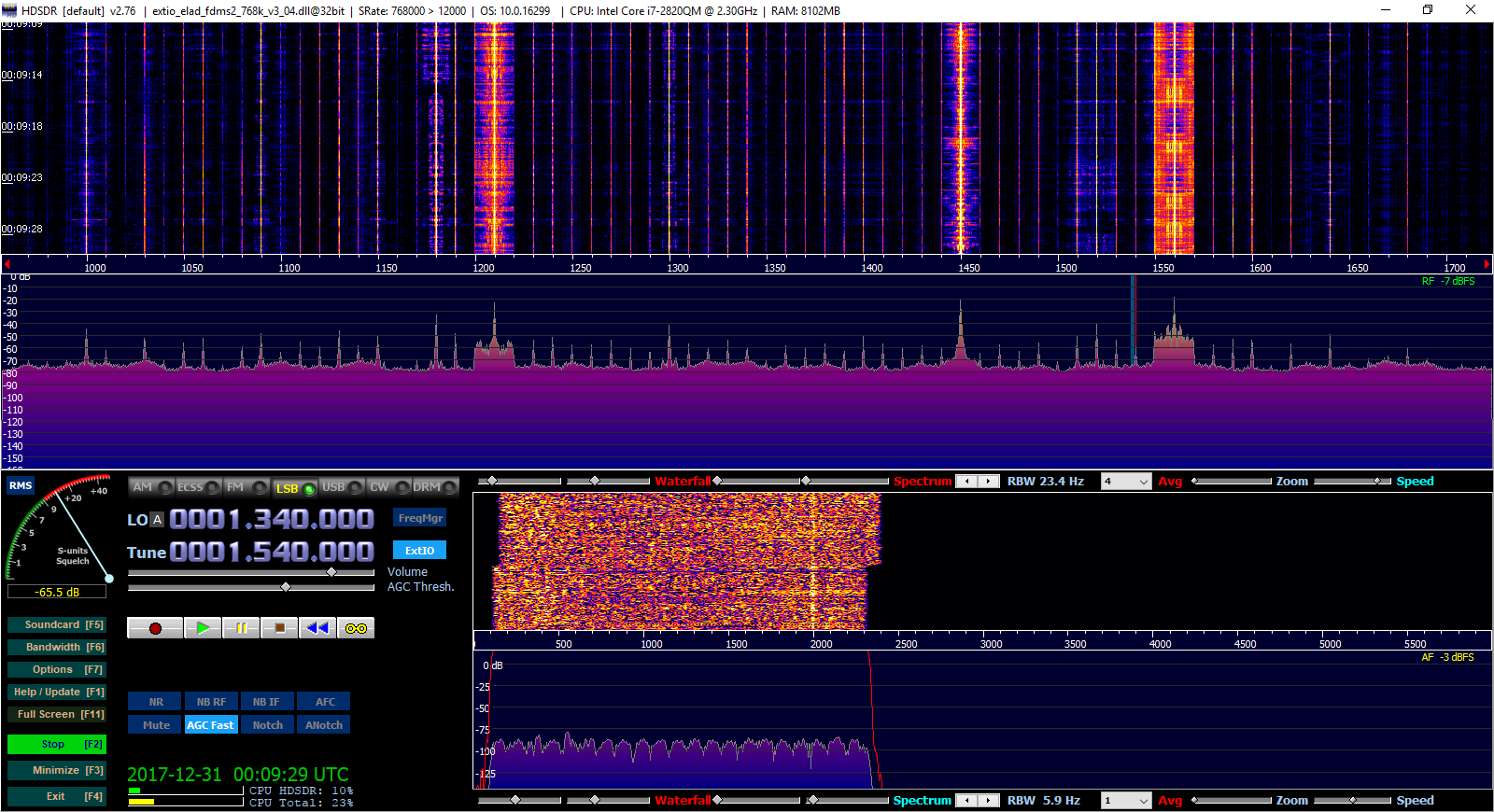
What’s wrong with the above audio picture? The FDM-S2 is clearly overwhelmed by the strong RF on the upper end of the MW band. Visually, the spectrum looked like this with the Elad:
Elad FDM-S2 waterfall/spectrum (1540 kHz)
The noise floor rose by approximately 20 dB due to the overloading. The HF+ showed a normal waterfall and spectrum display while tuning 1540 kHz:
AirSpy HF+ waterfall/spectrum (1540 kHz)
Let’s listen to two more audio clips, this time from 720 kHz which is adjacent to very strong 710 KIRO, the ESPN affiliate in Seattle:
AirSpy HF+ – 720 kHz
Elad FDM-S2 – 720 kHz
This time the difference is subtle, but I think you’ll agree there is a greater amount of “crunchy” background distortion noise on the FDM-S2 recording. I found this to be the case in each instance where I compared receivers on frequencies adjacent to strong locals.
I no longer own a Perseus SDR, but that receiver handles the entire MW band at this location without overload using the same Wellbrook ALA1530S+ loop.
I’d like to emphasize that these were brief, somewhat casual AirSpy HF+ vs. Elad FDM-S2 tests. I expect that in a more forgiving RF environment, both receivers will be equally adept and digging out weak weak and challenging DX signals. I plan to investigate this very scenario in a few weeks at a quiet location on the Oregon coast.
Side note: I have two HF+ units and they can operate concurrently without problems for full medium wave band coverage with HSDSR software, even when both are recording IQ WAV files.
Guy Atkins is a Sr. Graphic Designer for T-Mobile and lives near Seattle, Washington. He’s a regular contributor to the SWLing Post.
Many thanks to SWLing Post contributor, Michael (N9YZM), who writes:
Hi Thomas,
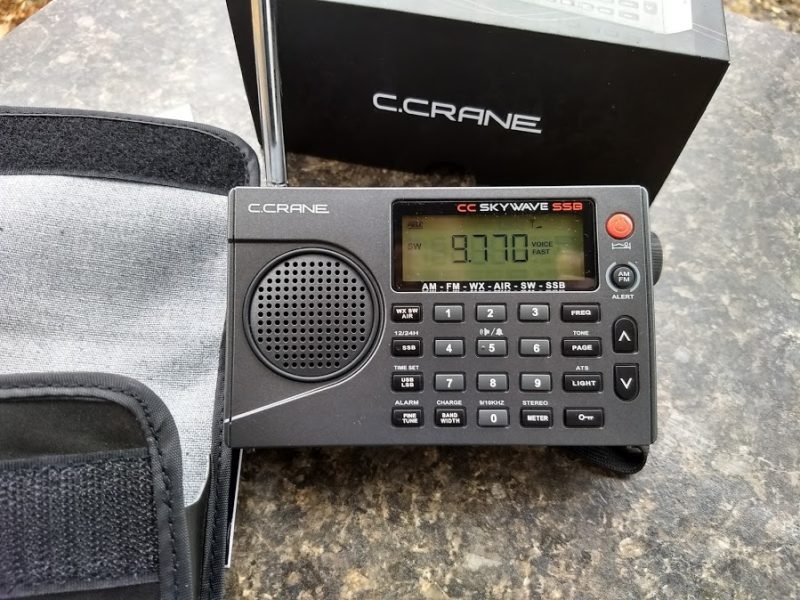
I took the plunge and purchased the Skywave SSB. It was under the tree on Christmas morning.
It was with some trepidation that I unwrapped it and installed a pair of AA batteries. I had read all the reviews regarding whistles and whines and had decided to give it a go anyway, particularly with the knowledge of the manufacturer’s excellent reputation for product support.
I am pleased to report no whistles or whines so far!
This morning I was listening to the breakfast club net on 3973 kHz. Reception, with just the whip, was not quite as good as my Commradio CR1-a with the W6LVP loop, but still very readable, and good enough to put a smile on my face and remove any thoughts of returning the radio to the manufacturer.
Air band, Weather Channel, FM, AM all seem to work great. I bought the radio primarily to throw in the bag when travelling, and can’t wait for the next business trip! I will still take the PL-880, and do some comparisons.
If I could change anything on the Skywave SSB, It would be to soften up (or remove) the detent on the tuning knob.
Holy Grail definitely comes to mind !!
Excellent, Michael! It sounds like your Skywave SSB is one that received a proper calibration and quality control run! I think you’ll find it makes for a superb compact travel radio.
Thanks for sharing your review!
As a side note, my full (4,300 word–!) review of the Skywave SSB has been published in the January 2018 issue of The Spectrum Monitor magazine. You can purchase and download the issue for $3, or (better) purchase a one year subscription for only $24. As I’ve said before, TSM is one of the best values in our radio hobby!
The beautiful Capim River in a land of Jaguars, Tarantulas and occasionally, wonderful shortwave DX
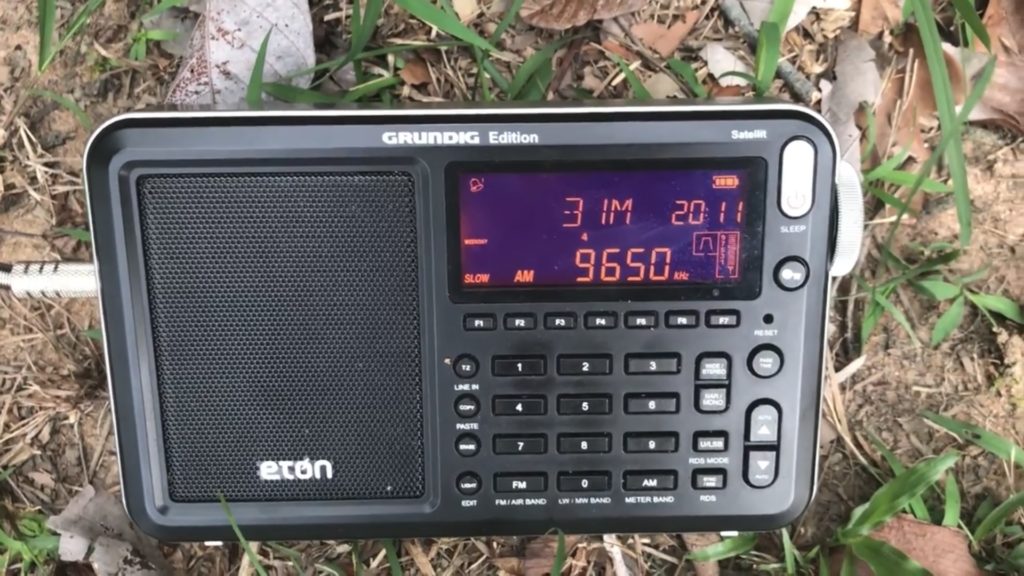
Hi there, I returned from my third trip to the Rio Capim area of Pará, Northern Brazil about 5 weeks ago, having been out there for exactly a month. Now, whilst this was strictly a business trip I always make time to tune around the bands, mostly shortwave, in the hope of copying some interesting DX. My previous two trips were reasonably successful; however, I didn’t really hear anything new – just lots of Tropical Band – and tropical stations with much greater signal strength and clarity. Part of the problem is one of which most of us suffer from – the dreaded local QRM. Even in the depths of the rain forest noise is present from building electrical systems (particularly lighting) and other equipment. In my first attempt to escape the noise on this trip I ventured out of my accommodation building (basically a very large hut) to the wire fence that separates us and the larger fauna (although having said that, the monkeys and everything else that lives in the area appears to have no difficulty scaling a 6 foot fence – funny that! ). Anyway, ultimately, you’ve really got to want to hear something special quite badly to venture out. I suppose it could be the definition of hard-core DX! I tried this only once because as I was copying a very nice signal from Radio Guinea on 9650 kHz, I found myself about 2 feet from a Tarantula Hawk Wasp dispatching a very large spider (check out the very brief video on my YouTube channel). That was me done for alfresco DXing in the jungle.
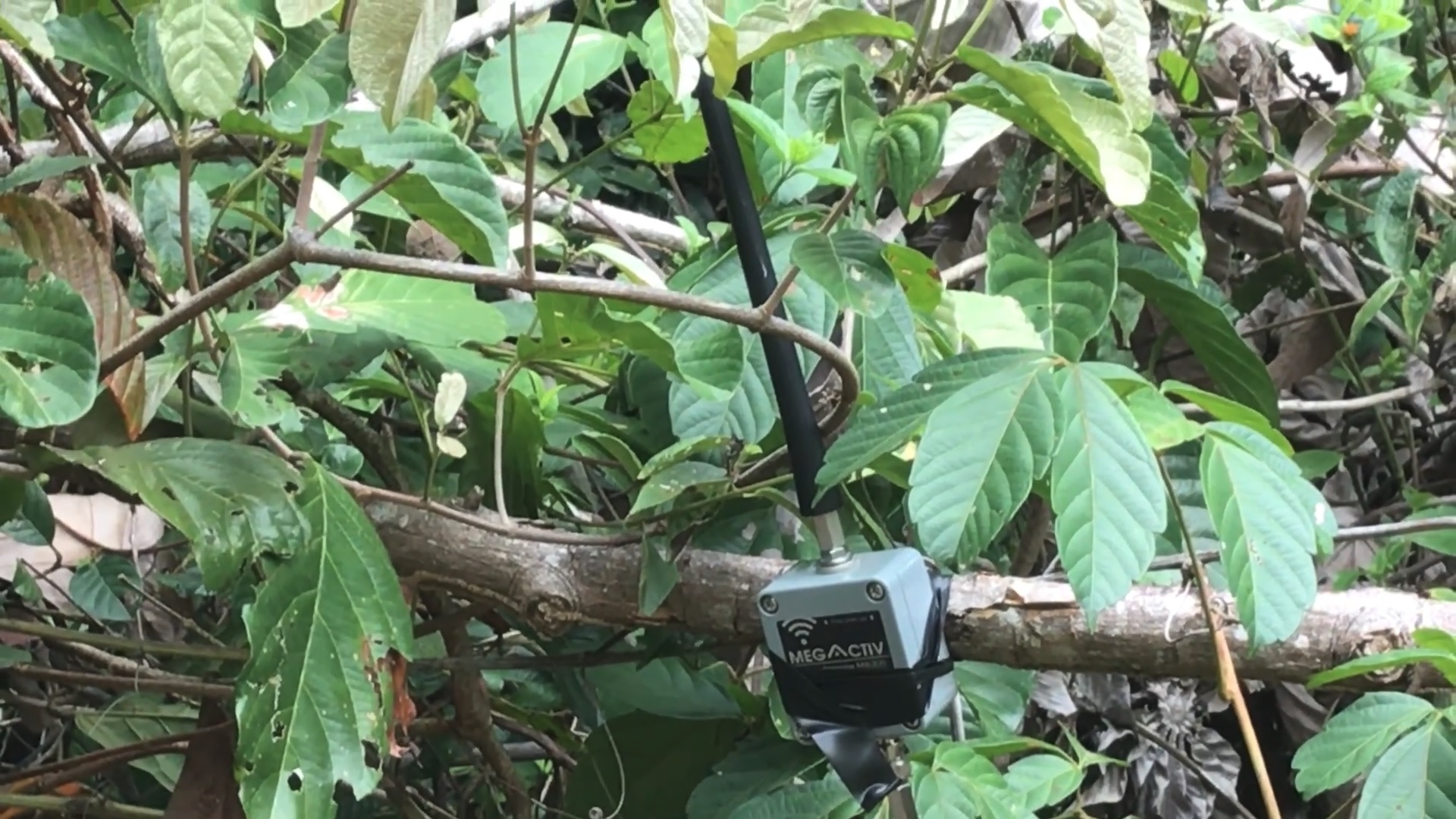
Bonito’s USB-powered MegActive MA305 E-field antenna up a tree…performed superbly in Brazil
Fortunately, I was lent a 4-wheel drive truck for the duration of my visit and so I decided to find a quiet location to park up and listen to the radio – therefore only having to venture outside (at night) to place my antenna. One evening after dinner I got in the truck and drove around the site for a while until I found a location, effectively on the edge of the jungle that was mostly very quiet. Perfect…as long as I didn’t end up as something else’s dinner. I took the super-compact USB-powered Bonito MegActive MA305 antenna with me on this trip because I’d already tested it at home on DXpeditions and in Crete and thus I was confident as to how superbly well it would perform in a quiet location. To supplement my antenna choices, during the first weekend, I made the 90 km drive to the nearest town and bought, amongst other supplies, a 40 metre length of speaker wire and a 3.5 mm jack connector to make a temporary long-wire antenna.
In my experience, there are roughly 3 tiers of Tropical and Tropical Band DX on short wave. There’s the bottom tier of stations which with a decent portable and a few metres of wire can be readily heard in the UK on a Dxpedition – and at home with a magnetic loop antenna, for example and a good quality table-top receiver or SDR. Amongst this group of signals I would include Rádio Clube do Pará, Brazil on 4885 kHz, Radio Difusora Roraima on 4875.3 kHz, Emisoras Pio XII 5952.5 kHz, Radio Santa Cruz, 6134.8 kHz etc. etc. On the next tier are tropical stations that are really difficult to hear in the UK – but can be heard with good propagation and good equipment. This group includes Radio Aparecida on 6135.2 kHz particularly, Rádio Educação Rural on 4925.2 kHz, Radio Tarma Internacional on 4774.9 kHz, Rádio Evangelizar (formerly Radio RB2) on 6040.7 kHz etc. There are many more examples from these two groups I could use, but you get the picture. Lastly, there is a tier of stations that are very rarely or never heard in Europe, irrespective of equipment or propagation. Often these stations operate with low TX power which makes them extremely difficult to copy anyway – and that leads to ambiguity farther as to whether they are even on-air. Furthermore, some of these stations broadcast very irregularly, which makes copying them even more of a lottery.
My mainstay travel receiver, the brilliant Eton Satellit..two-time veteran of South American DXing
In this context, a month in Northern Brazil was a useful timescale for surveying the Tropical Bands and geographically tropical stations for the presence of very rare signals. Fortunately, over many hours of listening in Rio Capim with the Eton Satellit and mostly the Bonito MegActive MA305 antenna, I manged to record six signals that are very rarely heard outside of South America. The list of stations follows below, complete with the antenna arrangement. Further below you will find embedded reception videos and text links to the same videos on the Oxford Shortwave Log YouTube channel. Please take the time to watch the videos and note the comments made by some of my subscribers with local knowledge. In particular, Rádio Gaúcha and Rádio Canção Nova on 4825 kHz are very irregular broadcasters and therefore I was fortunate to be in the right place, at the right time to copy their signal. More luck came my way with the reception of Radio Sora de Congonhas on 4775 kHz – made possible because of a total power cut on site, reducing noise effectively to zero (I was indoors at the time). I, personally, never heard anything else other than Radio Tarma, Peru on or around 4775 kHz – itself something of a rarity, except when conditions are very good.
In conclusion, I have to say, once again, the DXing credentials of the Eton Satellit and the Bonito MegActive MA305 USB-powered antenna are clearly demonstrated here. The perfect travelling companions for the serious DXer and broadcast band listener alike, I had no issues getting through security at any of the airports and their combined weight is unnoticeable in a fully loaded backpack. I definitely recommend both products. It’s also worth noting that if you’re travelling to a relatively remote location, even with modest equipment, you might be able to copy rare signals that will provide good information to the rest of us trying to hear those same signals from 1000’s of km away. I will be returning to Rio Capim early in 2018 and I’m seriously considering taking my Perseus SDR with me. A superbly sensitive and selective receiver with noise reduction that actually works, it opens up the possibility of even more exotic DX on that trip.
As always, thanks for watching/listening/reading and I wish you all excellent DX and Season’s Greetings. 73!
The list of exotic catches and antennas utilised:
Radio Apintie 4990 kHz, Suriname – Bonito MegActive MA305
Radio Cançao Nova 9675 kHz Sao Paulo – 20 metre long-wire
Radio Verdes Florestas 4865 kHz, Cruzeiro do Sul – Bonito MegActive MA305
Rádio Gaúcha 11915 kHz, Porto Alegre – Bonito MegActive MA305
Radio Sora de Congonhas 4775 kHz, Congonhas – Bonito MegActive MA305 antenna
Rádio Canção Nova 4825 kHz, Cachoeira Paulista – Bonito MegActive MA305
Clint Gouveia is the author of this post and a regular contributor to the SWLing Post. Clint actively publishes videos of his shortwave radio excursions on his YouTube channel: Oxford Shortwave Log. Clint is based in Oxfordshire, England.
Many thanks to SWLing Post friend “Karen” who writes:
My husband reads your website every day and is a dedicated radio geek. I’ve decided I’d like to get him an extra last minute stocking stuffer for Christmas. Any suggestions? We buy a lot from Amazon and are Prime members but any retailer that could get something delivered by Friday would work fine. Since this is a stocking stuffer, I don’t really want to pay more than about $70-90.
Thanks for your inquiry! Readers, “Karen” has kindly allowed me to post her message publicly and no that’s not her real name–!
Karen, you didn’t mention what radios he currently has, so you may double check before committing. I’ve listed a few options with links below. This list is by no means comprehensive–I just did a quick scan of a few retailers based on what’s currently a good deal and can be shipped ASAP.
Since you like Amazon and get free two day shipping via Prime, I’ll list several options there. I’d also encourage you to check with radio retailers like Universal Radio, Ham Radio Outlet and C. Crane–they, too, can ship via two or one day service, but it might be at a premium.
Just note to check the delivery date very carefully as we are down to the wire! Note that prices, especially those at Amazon, can change without notice.
Last minute stocking stuffers for the radio enthusiast
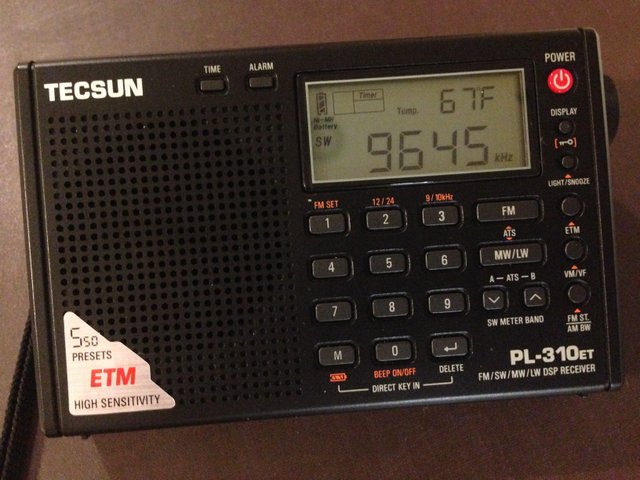
Tecsun PL-310ET ($42.00): The venerable PL-310ET is a classic little ultralight radio and performs quite well for the price. Click here to check out past posts. The PL-310ET is also available on eBay, but I don’t think you’ll get it delivered before Christmas if you purchase from a China retailer. Click here to view on Amazon.com (affiliate link).
Shortwave Receivers Past and Present ($39.95): This book is sure to please any radio geek that is interested in vintage radios. Click here to read my review. It is in stock at Universal Radio but I’m guessing you’ll need to budget for two day shipping since this book is very heavy! Still…I think it’s worth it and will surely surprise the radio enthusiast in your life if they don’t already have a copy. Click here to view at Universal Radio.Note: I would urge you to call Universal Radio to make sure Shortwave Receivers Past and Present can be delivered prior to Christmas.
Thank you for your question, Karen, and for allowing me to post your message, thus my suggestions, publicly. Since you asked specifically about Amazon, and since you get free two day shipping, I focused on Amazon offerings here. Note that my links are affiliate links and if you chose to purchase using one of these links, the SWLing Post will receive a small commission at no cost to you.
With that said, please consider purchasing from one of the radio retailers I mention above. The total price may exceed Amazon’s, but you can actually call these retailers to place orders and ask questions.
Post Readers who live outside of the US will have to check with radio retailers in their country regarding pricing and shipping on the items above. I wish I had time to list links to international options. Perhaps readers can comment with links and other suggestions?
[Note: This procedure was updated and simplified by Guillermo on 22 December 2017]
Many thanks to SWLing Post contributor, Guillermo, who writes:
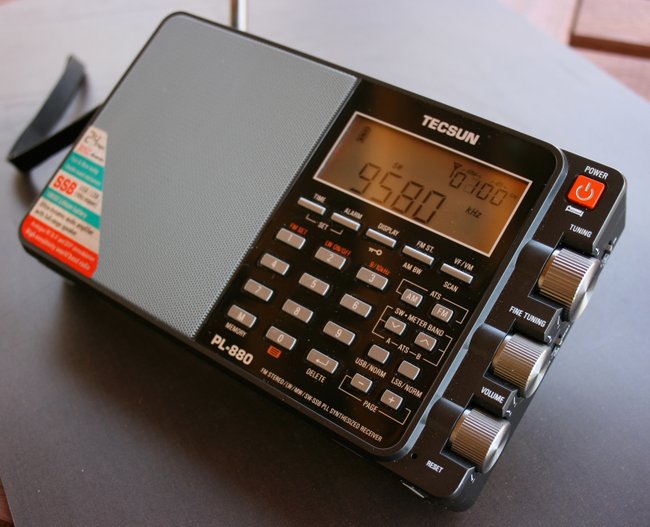
I own the PL-880 and just discovered a new feature : a 1.0 kHz bandwidth mode on shortwave (SW only not in MW).
The procedure to get it is as follows:
Turn on the radio and tune any frecuency on SW . There is no need to connect or disconnect an external antenna and turn on or off the radio during this procedure.
Be sure that on SW the 4 button feature(press 4 for about 2 seconds) is ON and 9 button feature(press 9 for about 2 seconds) indicates a value of 13 or more and not less than 10.
Then turn OFF 4 button feature and then ON again . Press BW button and see the 1.0khz new BW on the screen. Now you can use it permanently on SW and ALSO on MW , UNTIL you press BW button again .
Well, I hope you understand this description–if not please let me know, and tell me if it works on your unit, or it is just works on mine.
Thank you, Guillermo! I see where this is somewhat of a fragile adjustment in that a number of actions could change the bandwidth back to a previous setting, but nonetheless is quite a fascinating hack/hidden feature! Thank you and I’ll add this to our list of PL-880 hidden features.
Post readers: please comment if you can successfully enable the 1.0 kHz bandwidth on your unit. Please comment with your radio’s manufacture or purchase date if possible.
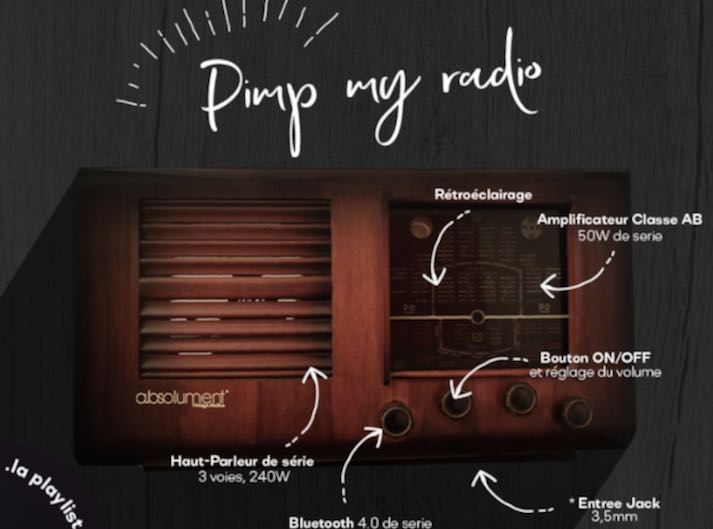
Many thanks to SWLing Post contributor, Kim Elliott, who shares this link to a French company called a.bsolument who specializes in converting vintage valve radios into hi-fidelity Bluetooth-connected audio devices.
According to a.solument’s introduction video, they take vintage radios in disrepair, gut the insides and replace the components with modern hardware which includes Bluetooth 4.0 and aux-in capabilities:
https://vimeo.com/87657532
While I LOVE vintage radios, I have conflicting feelings about this process.
I take pride in keeping my vintage gear in proper working order (through the help of a mentor). Something that simply cannot be replicated with digital hardware is the sound and warm fidelity of AM audio emanating from a valve classic. At home, I have the option of feeding all of my vintage gear Bluetooth and wireless connectivity via an AM transmitter. This allows me to play any digital content while preserving the original audio fidelity (and warming my radio room with those glowing tubes!).
With that said, I’m very much aware that it’s becoming increasingly difficult for the average consumer to find a technician who can repair tube gear affordably. Indeed, some feel it’s impossible thus toss their family radio in the trash.
If a.bsolument is giving vintage beauties–that would otherwise be in a landfill–a new lease on life, then I’m all for it!
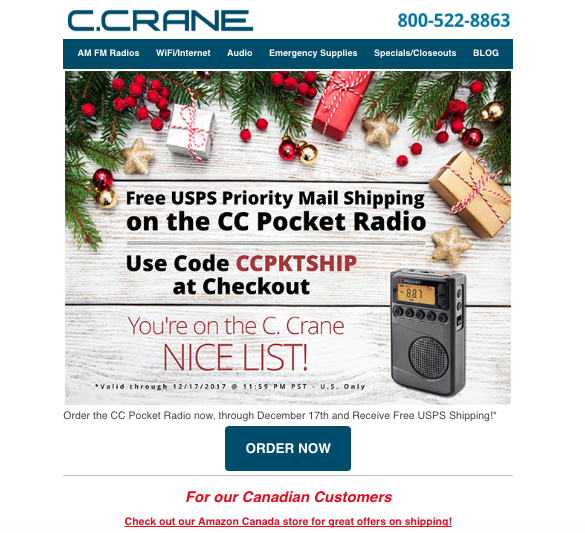
Though not a shortwave radio (the SWLing Post loves ALL radios!), C. Crane’s latest special involves free Priority Mail shipping to U.S. customers for their CC Pocket Radio. Just use the Promo Code: CCPKTSHIP. This special ends at midnight PST on 17 December. The CC Pocket Radio comes standard with the CC Buds earphones – a quality set of earbuds.
Crane’s Amazon Canada store offers free shipping with a number of C. Crane products through Amazon Canada Prime.



 My mainstay travel receiver, the brilliant Eton Satellit..two-time veteran of South American DXing